Thuja is a striking representative of the coniferous family Cypress. It is a widespread, beautiful, evergreen plant. Its excellent ornamental qualities have earned it the nickname "royal tree." Many gardeners decorate their gardens with this plant, and it is also very popular with landscape designers.
This plant is called the "tree of life" due to its medicinal properties. Not only are many medicinal preparations made from it, but the aroma itself is also healing. Therefore, a walk in a garden where thuja grows has a beneficial effect on the body.
Native to North America (and also widespread in East Asia), thuja thrives in temperate climates thanks to its low maintenance; some species even tolerate severe frosts. These plants are ideal for creating hedges and are often used to create beautiful landscape compositions. Providing proper care for thuja outdoors requires little time or effort.
Content
Description of thuja
These evergreen plants are shrubs or trees. Several species are common in the wild. In the wild, specimens reach heights of up to 70 m and crown diameters of up to 6 m. Ornamental varieties found in temperate climates reach a maximum height of 10 m, with some reaching 20 m. Crown diameters reach 2.5 m.
Thuja belongs to the genus of gymnosperms, conifers. Flat, two-winged seeds are found 1-2 per oblong or oval, scaly cone. They ripen in autumn. The seed-bearing cones are found in the center of the crown; those growing closer to the top of the thuja are seedless.
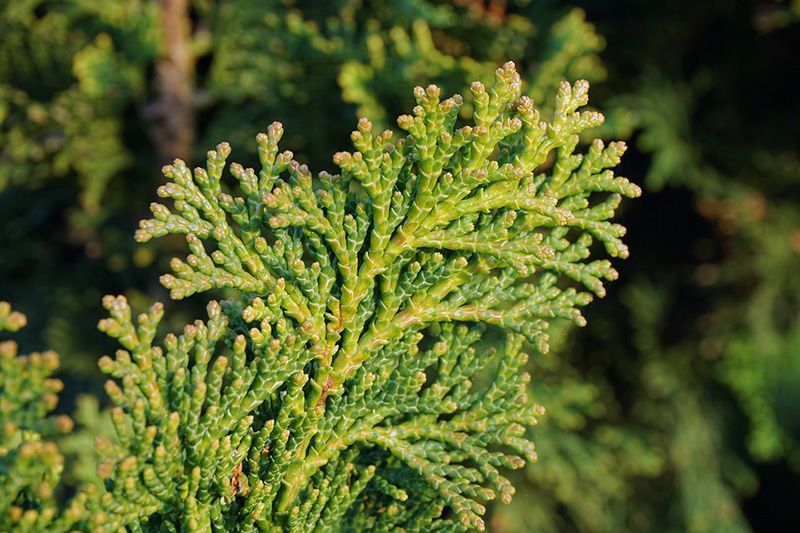
The leaves of young plants are needle-like, soft, and light green, while those of mature plants are dark green and scaly, with the undersides being lighter than the tops. Some varieties develop a brownish tint in winter. They are soft to the touch and almost prickly.
The bark of young trees has a smooth, reddish-brown surface, but with age, it begins to exfoliate, peeling off in strips and acquiring a grayish tint. The root system is developed and superficial.
Undemanding in its special conditions, thuja thrives in cities with polluted air and tolerates frosts well. It is widely used in topiary arrangements. It can be shaped into various forms, and pruning is beneficial for its health.
Varieties of thuja
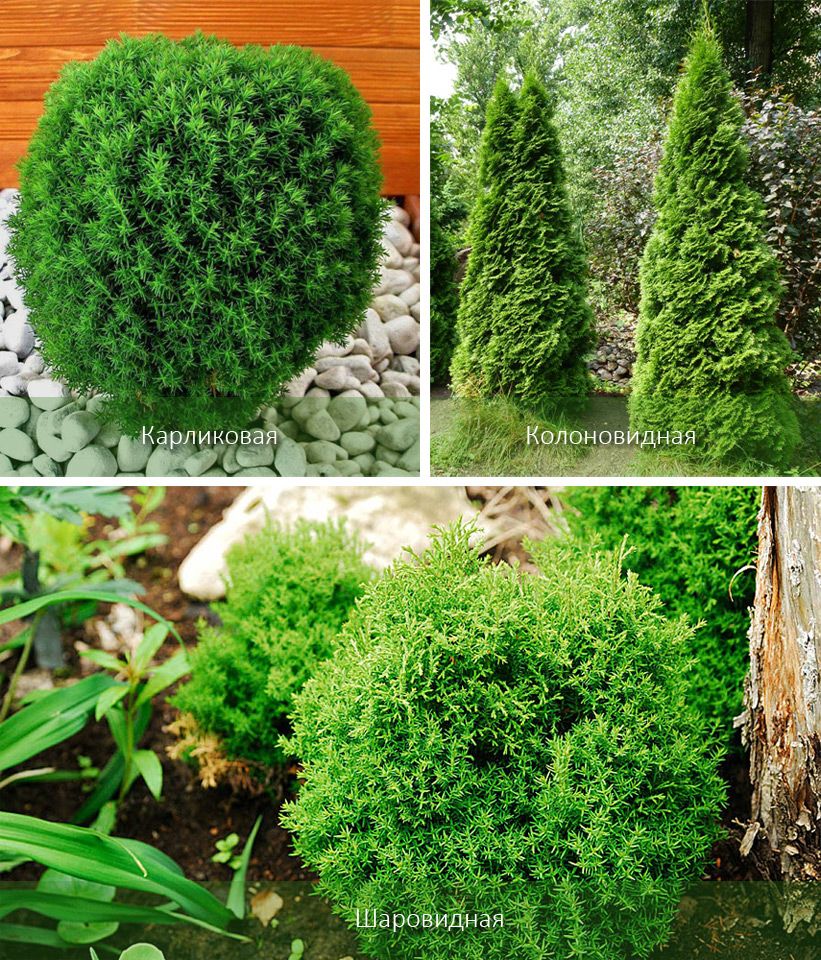
Thuja has different forms:
- columnar (conical or pyramidal);
- spherical;
- dwarf.
There are five types in total:
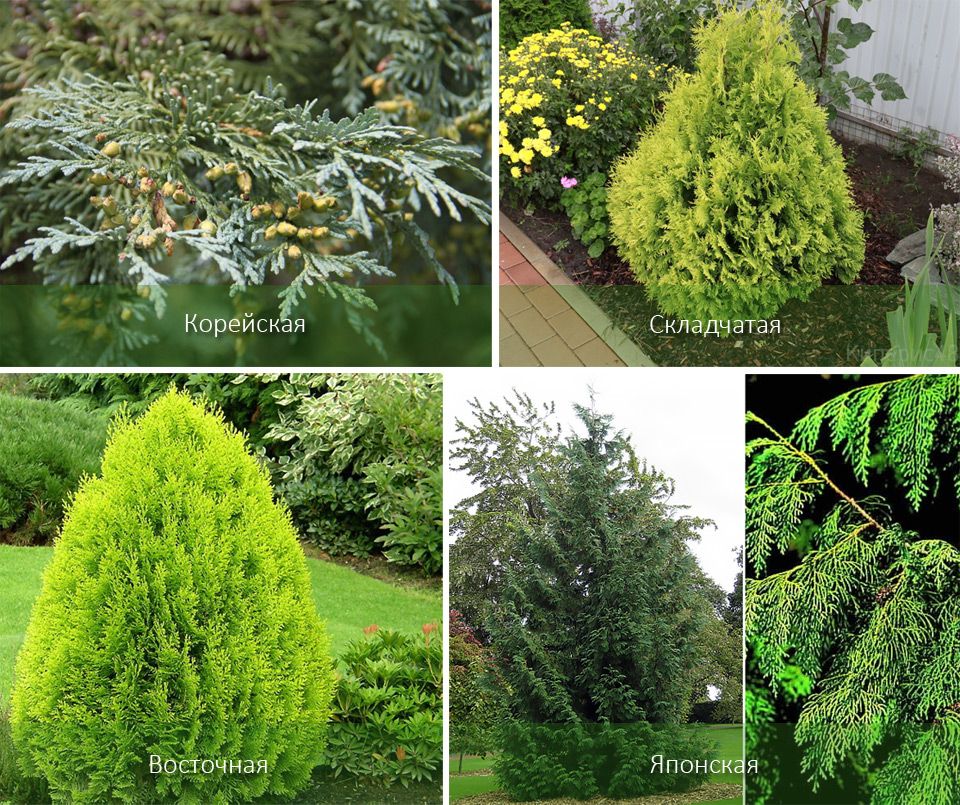
- Western - the most unpretentious and frost-resistant, most often cultivated in the middle zone, a large variety of varieties;
- Korean - frost-resistant, does not tolerate dry seasons, grows well only in ecologically clean areas, the crown is pyramidal, the needles are soft, lush, from green to whitish in color, with a citrus-pine aroma;
- Japanese - slow-growing, maximum bush height up to 5 m, spreading, soft crown, pale green color with silvery shades, frost-resistant species (but does not tolerate winters well), does not like drought;
- folded - a long-liver (500-600 years), belongs to the largest representatives of thuja, in nature some trees grow up to 70 m, with a trunk diameter of about 2 m, decorative species grow up to 15-20 m, the crown is dense, pyramidal;
- Eastern - fastidious in care, popular because of its decorative qualities, very thermophilic, does not tolerate cold weather, prefers rocky soils, crown is light green.
Thuja varieties
More than 120 varieties have been developed from these five.
These are primarily representatives of the western arborvitaes. The most common in gardens and parks in the central zone are:
| Variety | Description |
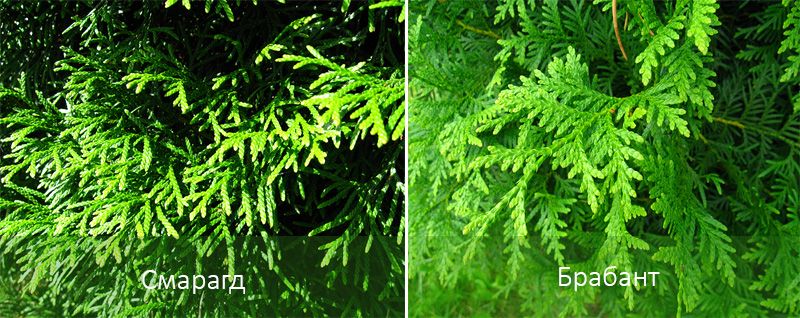
| Smagard | The crown is conical, the plant is squat, reaching 4-6 m in height and up to 2 m in width. The branches are vertical, spaced well, and branching is sparse. The needles range in color from green to golden. It is characterized by rapid growth and undemanding nature, making it easy to grow even for inexperienced gardeners. |
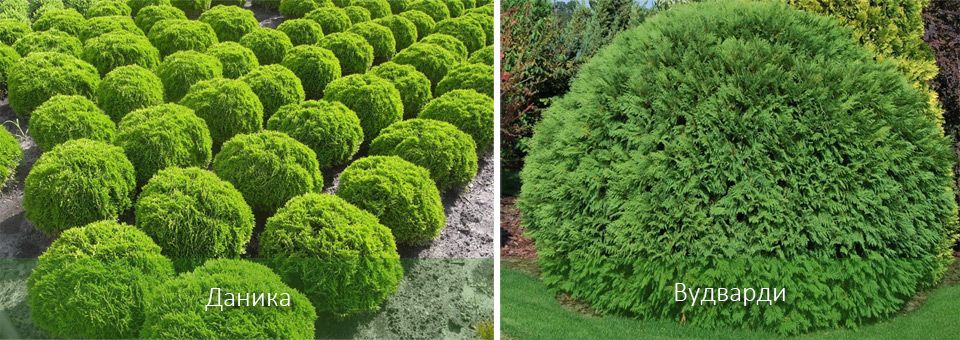
| Danika | A slow-growing variety bred in Denmark. A dwarf, spherical plant. Depending on the variety, the needles can be herbaceous or bright golden, with a brown tint in winter. It grows up to 80 cm tall and 1 m in diameter. |
| Brabant | A fast-growing variety, ideal for hedges. Conical in shape, 15-20 m tall, crown diameter up to 4 m, green needles, reddish bark. A sun-loving plant, it tolerates excess moisture but is not frost-resistant. |
| Woodwardy | A slow-growing dwarf variety, it can reach a maximum height of 2.5 m and a crown width of up to 3 m. It tolerates frost, heat, and adverse urban environmental conditions. It is a beautiful, robust plant with dense, dark green needles. |
Planting thuja in open ground
Growing thuja isn't all that difficult; even a beginner can handle it. To ensure healthy, beautiful plants, consider the following in advance:
- evaluate the general appearance of the site, lighting (presence of tall trees), proximity to other plants, find a suitable place;
- take into account climatic conditions and soil type;
- decide on the season;
- select healthy seedlings;
- perform landing according to the rules;
- provide the necessary care.
Selection of seedlings and planting conditions
Young thujas are usually sold in containers, in burlap with soil. Certain characteristics can be used to determine their viability and how they will thrive in their new location. Incidentally, 3- to 4-year-old plants thrive better and grow faster, often outgrowing 5- to 6-year-olds.
When examining seedlings, you need to pay attention to the following points:
- if the crown is lush and has a uniform color, then the roots are in order, such a specimen will take root faster in a new location;
- the color of the needles can be different shades of green or golden; if they are brown, the plant is not healthy and is not receiving enough nutrients;
- It is better when the crown of the seedling is symmetrical;
- the barrel must be free from damage;
- The needles of a healthy plant do not crumble: you can check whether the plant is alive by squeezing the needles in your palm - if they straighten out immediately when you let go, then everything is fine with the seedling;
- the soil must be moist, because when the roots are in a dry state for a long time, the plant may not take root;
- It is better, if possible, to check the rhizomes, which should have juicy, healthy, white-pink shoots (brown and soft to the touch ones are already rotting due to improper watering).
Timing of planting thuja
There's no exact date; the choice depends on the climate in your region. The appropriate time depends on how early spring arrives or how early autumn frosts arrive. Planting can be done from spring to fall, provided the conditions for the specific season are met.
Spring planting is recommended, as this is when root and shoot growth begins, allowing the plant to establish quickly and gain strength during the warmer months. Spring planting should be done in March-April, when the region experiences consistently warm weather.
If planting is done in summer, then you need to provide the thuja with regular watering, do not allow the soil to dry out; the best time is August.
In autumn, you need to calculate the time so that the plant has time to take root before the onset of persistent frosts.
- Central zone and Moscow region - no later than mid-October;
- Southern - November;
- Urals and Siberia - end of September.
Location
If you find a suitable spot for your thuja in the garden right away, you won't have to spend a lot of time on additional care later, such as watering and preventing yellowing and needle shedding.
What you need to consider when choosing a location:
- The area should be well lit, but protected from direct sunlight; only semi-shaded areas are allowed, as shade has a negative effect on the development of thuja;
- Thuja should not be planted next to large trees with wide-spreading roots, because they will have a suppressive effect, taking nutrients from the soil;
- she doesn’t like the proximity of asters and peonies;
- does not tolerate drafts, you need to choose windless areas;
- These conifers love moisture, but react negatively to stagnant water at the roots, so they choose places where the groundwater level is at least 1 m below the surface.
You can plant thujas next to each other to form a hedge, the distance between them should be 50-60 cm.
Soil
Suitable soil should consist of turf soil, peat (2:1), to which you can add humus (1), and in the case of leaf soil, I add peat, sand, humus (2:1:2:3) to the latter.
Additionally, the mixture is enriched with superphosphate or nitroammophoska - about 3 handfuls, be sure to mix everything well so that the fertilizer does not burn the root system.
Landing rules
- First, prepare the planting hole. A drainage layer (10-15 cm or more) of broken brick, crushed stone, or expanded clay is placed at the bottom. Then, fill it with the prepared fertile soil mixture.
- Half an hour before planting, water the thuja with a rooting stimulant - in addition to benefiting the root system, this will allow the root ball to be carefully removed from the container.
- Remove the plant from its container only when everything is ready for planting. Because its roots dry out quickly, the thuja may not take root.
- A bucket of water is poured into the prepared hole with soil to avoid its significant subsidence in the future.
- The thuja is planted in the soil so that its root collar is 3-4 cm above ground level—this allows for soil settling. Afterward, it will level off.
The root collar should not be positioned too high or too deep.
- Add the remaining nutrient-rich soil around the seedling and water it. After the soil has settled, add more soil to level the surface.
- The planting site is mulched with compost or wood chips. These should not touch the trunk, otherwise the tree will rot.
Caring for thuja in open ground
If planting is done correctly, further care for the thuja will not require much time. While the plant is establishing itself, water it regularly. Young (10 l) and mature (50 l), water it in the morning or evening.
Periodically, the soil around the thuja is loosened and weeds are removed, very carefully, as its roots are shallow.
The next feeding is done six months after planting, and then seasonally in the spring. Use a fertilizer for conifers.
In spring, sanitary pruning of branches is carried out, and in autumn, decorative pruning is carried out.
Thuja wintering
In late autumn, young, still-weak plants are protected from frost with spruce branches and burlap. Mature trees are not covered, but rather their roots are mulched, topped with peat, and pine branches are laid down. The branches are tied to the trunk to prevent them from breaking under the weight of the snow. They are uncovered in the spring.
Pests and diseases
Thuja is sometimes affected by pests and diseases:
| Defeat | Elimination measures |
| Fungal |
For prevention, treat with Istra and Kartocide. In case of infestation, treat with Hom. |
| Aphids, false scale insects | Spray with Decis and Karbofos. |
| Thuja bark beetle, leaf roller | Apply Actellic and repeat the treatment after 2 weeks. |