Each climate zone uses specific plants to create beautiful landscape compositions. In temperate zones, low-maintenance, frost-hardy shrubs are used for this purpose, lending a long-lasting charm to the landscape. Among these is the viburnum-leaved Physocarpus aurea, with its golden crown, which adds expressive and vibrant color to the design of a variety of spaces.
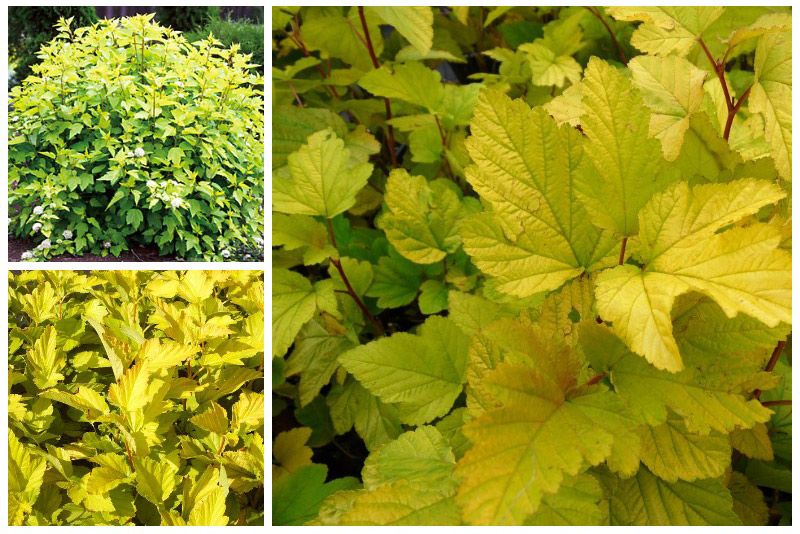
Description of the variety
Aurea belongs to the rose family. Physocarpus senna is a deciduous shrub growing to a relatively tall height (up to 2 m). It is a frost-hardy species with elongated, bright yellow leaves (deep above, pale below) and serrated edges. In summer, it is covered with small white flowers (up to 1 cm) gathered in umbel-shaped inflorescences of 10-15.
During this period, the foliage turns green and then returns to its original yellow color. The small fruit resembles an inflated balloon that bursts when pressed. It grows in the shade, meaning you won't be able to fully appreciate the beauty of this plant.
It's best planted in locations with ample sunlight. It will grow and retain its beauty for 30 years.
Growing Physocarpus Aurea
The Aurea variety is a fairly easy-to-grow plant, but to fully appreciate its unique qualities, it's best to choose loose, well-drained soil. Its pH should be between 5 and 6. The soil should be free of lime and groundwater. Planting and caring for the plant also require certain conditions to ensure a beautiful bladder senna and protect it from disease. An open, well-lit location is best.
The optimal growing conditions for bladderwort are medium loam with sufficient humus. If planting as a standalone plant, prepare a planting hole. For borders, dig a 40x40 cm trench. Prepare the site in advance by filling it with a mixture of soil (leaf or sod), humus (peat), and sand. Ideally, prepare the soil 2-3 weeks before planting.
A bare-root seedling (without a root ball) is planted only in the fall. If it was purchased in a container, you can plant it whenever convenient, except in winter.
For normal development, planting is carried out in compliance with the following instructions:
- There is no need to apply fertilizers immediately, as they will not be fully absorbed;
- the position of the seedling is strictly perpendicular to the surface;
- the soil is added to the hole in parts, which must be compacted;
- watered;
- if the soil has settled, then more is added;
- mulch on top.
Water the plant at the roots and in small amounts to prevent waterlogging. In extreme heat, water frequently—every 3-4 days. Fertilize in the spring (with nitrogen) and in the fall (with nitroammophoska): about 20 g of fertilizer per 10 liters of water.
Physocarpus pruning is essential. This procedure is necessary in the spring to remove damaged and dry branches, to form a beautiful crown, and to give the plant a beautiful shape. Removing side shoots encourages upward growth. Pruning to a height of 40-50 cm will create a strong, voluminous shrub. Special winter protection is not required, as this plant tolerates cold well. Only new shoots should be covered with peat and spruce branches.
Reproduction can be done by almost all known methods:
- By seeds. There's a high risk of not preserving the variety's characteristics, so they're rarely used despite good germination.
- Cuttings. A quick method. This procedure is usually performed before flowering. A shoot is taken and cut into 10-20 cm long shoots with 2-3 growing points, which are then immersed in root growth stimulants for 2-3 hours. The cuttings are inserted into soil mixed with sand, moistened, and covered with plastic wrap. Until shoots and foliage appear, the plants are periodically aired and watered. After they emerge, the plastic wrap is removed. They are replanted in the main location in the spring.
- Division. This requires considerable effort, and there will be few new plants. This is done in early spring or late fall. Typically, the bush is divided into 4-6 separate sections (with good rootstock and strong shoots) and planted immediately to prevent them from drying out. Water and mulch. It's best to keep the plant insulated during the first winter.
- Layering. The best time is early spring, when the first leaves appear. Select a strong shoot growing away from the center of the bush and place it in a trench 12-15 cm deep, secure it, cover it with soil, and water. In the fall, separate the resulting bladder senna from the parent plant. Cover it with spruce branches during the cold season.
Aurea is rarely susceptible to disease or pest attacks. If not properly cared for, it may develop chlorosis (drying of the stem tips).
Top.tomathouse.com recommends: Using Physocarpus Aurea in the landscape
Viburnum-leaved Aurea is widely used in landscape design due to its vibrant foliage color and the ability to create unique shapes with pruning. It looks especially beautiful in the following varieties:
- A free-form flowerbed (mixed border). It's placed at the back for a single-sided arrangement, and in the center of the group for a double-sided arrangement.
- Contrast. Looks good against dark-colored plants (conifers, deciduous trees) or other varieties of Physocarpus with red leaves (Diablo, Red Baron).
- Fencing on property plots. Used to create secluded recreation areas and to enclose playgrounds and sports fields. Bushes are shaped into regular geometric shapes, creating a living hedge.
- A border or ornamental flowerbed (arabesque). It takes some effort, but it will give a formal look and complete the decor of your property.
- A well-maintained lawn. In this case, it's used as a specimen plant. Pinching and trimming create unique shapes.