One of the varieties of Physocarpus viburnifolia, Darts Gold, has found wide application in creating beautiful, varied gardens. This hybrid was developed in Holland by crossing two species, Luteus and Nanus. Its appearance and light, delicate blooms, which can be seen for a month in midsummer, are striking.
Main characteristics of the Darts Gold Physocarpus
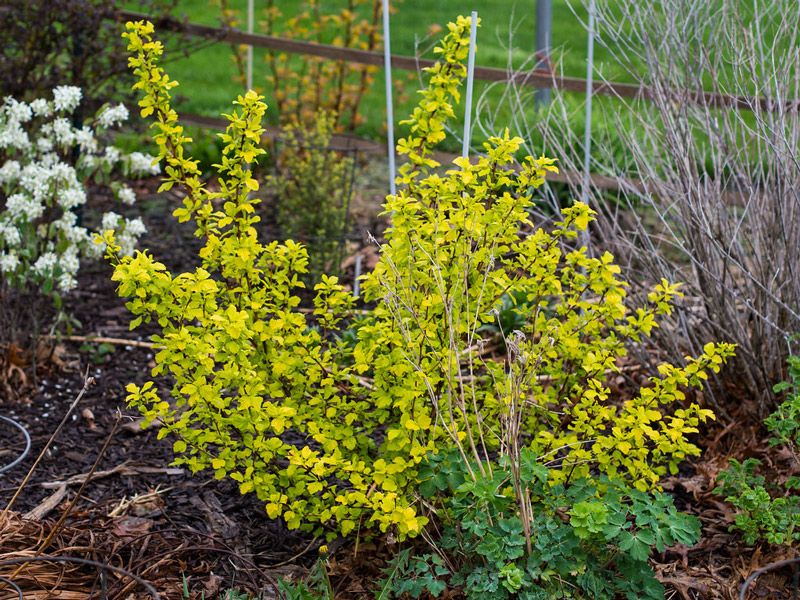
When describing this variety, they talk about a tightly compressed, small bush (up to 1.5 m), forming a hemispherical shape.
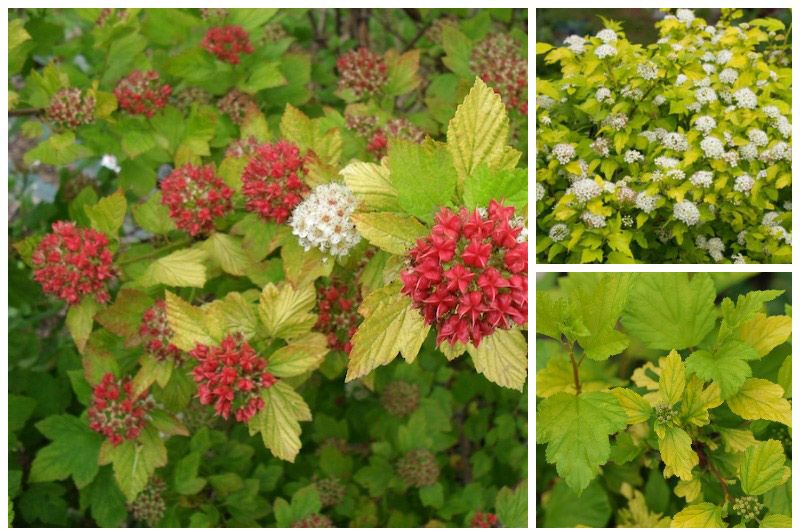
What distinguishes this variety is the leaves that grow quite close together on the branches, forming a dense cap. They change color with the seasons: yellow in summer, turning pale green at the end of the season, and yellow-brown in autumn. The leaf blade is divided into 3 or 5 lobes.
It blooms in midsummer. The corymbose inflorescences are light, ivory-hued. They are followed by crimson fruits, which remain on the bush for quite a long time. They burst when pressed. Darts Gold grows very quickly, making it suitable for decorative purposes: to cover unsightly areas or to enclose certain areas.
Physocarpus senna is an unpretentious plant that doesn't require any special growing conditions. Planting and caring for it is fairly simple. It has no special soil requirements, but prefers acidic loam. The location should be well-lit. If it's exposed to too much shade, it will lose all its charm and become an ordinary, unremarkable shrub. As a member of the Physocarpus genus, it is not susceptible to diseases or pests and requires no special winter protection.
It can be pruned into a wide variety of shapes. It can be shaped into any form your imagination can imagine. It can also be grown as a standard. Its beautiful crown pairs beautifully with many other plants, making it ideal for use in park landscapes.
Planting Features of the Darts Gold Physocarpus
Darts Gold thrives in clayey soil with sand. A pH of 4.5-5 is recommended. If this is not available in your area, it will grow in other soil types.
It's best to locate it on a slightly elevated site to prevent moisture from lingering. Otherwise, ensure good drainage from the area.
If the plant is to be grown as a single plant, a hole (large and up to 50 cm deep) should be prepared in advance, while a trench (50 x 50 cm) should be dug to create a hedge. There are several types of hedges: dense and spreading. In the former, 3-5 bushes should be planted per meter in a staggered pattern; in the latter, 1-2 (rather widely spaced) should be planted. Small earthen mounds are created around them to retain moisture near the roots. The wide planting option involves creating a hedge up to 2 meters wide.
Half to one month before planting, add a special mixture of superphosphate (0.5 kg), manure, and humus (3 buckets of each). Place the seedlings perpendicular to the soil surface, cover, compact, and water thoroughly.
Caring for the Darts Gold Physocarpus
Physocarpus doesn't require any special care. In fact, it can withstand any harsh conditions and still thrive. However, there are a few important points to consider when growing it:
- Watering: do not allow moisture to remain in the soil for a long time.
- Weeding: It is necessary to remove weeds around the trunk and loosen the soil, providing access of oxygen and nutrients to the roots.
- Fertilizing: Apply twice. In the spring, apply a solution of 0.5 liters of mullein, 15-20 g of urea, and 15-20 g of ammonium nitrate per 10 liters. In the fall, apply only urea, as winter approaches.
- Sanitary pruning: performed to remove broken, diseased, and dead branches. Those that disrupt the shape created by the gardener are also removed.
Propagation of the Darts Gold Physocarpus
This variety can be propagated by all possible methods. Gardeners most often use methods that involve creating a new plant from existing parts: layering, cuttings, and division.
Darts Gold can be grown from its seeds, but many of the variety's distinctive features will be lost. The bush's color will not be as vibrant and beautiful, but will instead become ordinary and unremarkable.
Most often, in early spring, large bushes are divided into several new ones (it's important to leave them with a strong root system and healthy shoots) and new locations are immediately determined. There are no special planting requirements. They are not planted too deeply (no more than 5 cm). Then, provide the necessary watering and cover with mulch.
Cuttings root after midsummer. It's best to prepare greenhouse conditions for them in the shade of trees and plant them. During cold weather, they are covered with plastic or burlap. In the spring, when warm weather returns, determine the primary growing location for those seedlings that survived the winter.
During this period, layering is also done. The strongest and most robust shoots are selected, and all leaves except the crowns are removed. They are bent into a pre-prepared trench, secured, and covered with soil. Until the shoots begin to grow, the soil is watered regularly. In late autumn, the shoots are cut from the main plant and transplanted to a new location. During the winter, the young shoots are protected from the cold using a special covering material or mulch.
Top.tomathouse.com recommends: Darts Gold Physocarpus in landscape design
Darts Gold is often used to create a beautiful landscape. Its lush crown looks great planted individually, in groups, or in borders. Any arrangement requires a certain distance between plants (from 45 cm to 1 m).
Growing this bladderwort in your garden creates an unforgettable atmosphere with its appearance. It delights everyone in any weather. It's impossible to remain indifferent to its striking crown, numerous flowers, and unique fruits. That's why it's so widely used in landscaping and landscaping.