The Red Baron Physocarpus is a vigorous shrub reaching a height of up to 2 meters. Its rich red foliage, light white and pink flowers, and decorative fruit make it a striking sight from spring to fall. It is widely used in landscape design as a hedge, a striking single plant, or in compositions.
Description of the Red Baron Physocarpus
The bladder senna is known to many for its appearance, but not everyone knows its exact name. This description, along with the plant's main characteristics, highlights its ornamental value.
Red Baron is native to North America, where it is often found along riverbanks. It belongs to the Viburnum-leaved family and is different in size from its sister plant, Diablo.
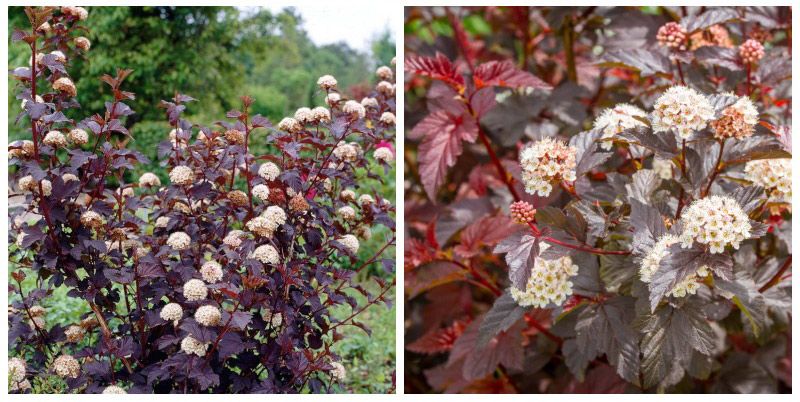
The bush has a hemispherical crown, which can reach 2 meters in height. The shoots are straight or arching, their number depending on the planting location; plants growing in sunny areas are denser. The bark is brown with red hues.
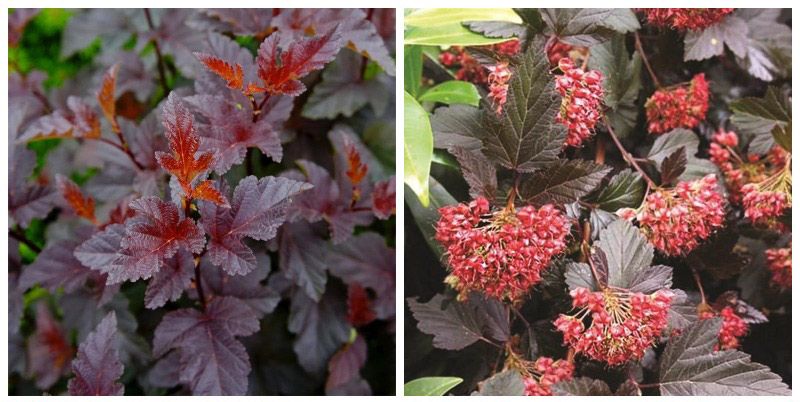
The smooth-surfaced leaves are arranged alternately, composed of 3-5 lobes, and reach up to 7 cm in length. Their shape, similar to that of viburnum, is elongated with slight corrugations and prominent veins. The name "red" (meaning "red") derives from its distinctive feature: the color of the leaf blades. The shades become richer and more vibrant when exposed to sunlight; when planted in shade, they lose their rich purple hue, and the undersides turn green. In autumn, they acquire a bronze hue.
The flowers are small, pale pink or white, with 5 petals, collected in corymbs 5 cm in diameter. The formation and opening of the buds occurs from late May to mid-June.
The fruits are decorative and are complex leaflets consisting of swollen, simple purple and red hues, with a shiny, hard skin that changes color as it ripens and dries, from pink to brown.
Planting the Red Baron Physocarpus viburnum
Planting begins with choosing a site. A sunny, well-lit flowerbed is the best option for developing the full potential of the plant's leaves.
This shrub is very low-maintenance and thrives in all types of soil, from acidic to alkaline. The optimal pH is 5-6.0. The key requirements are good drainage to prevent water stagnation in the soil and loose soil to enrich the root system with oxygen. Soil composition is not critical; rapid growth occurs in a fertile and multi-component substrate, but the shrub can also thrive in fairly poor soil. Gardeners only need to ensure the soil is free of lime and that fertilizers are applied in a timely manner.
Bare-root plants are best planted in the spring before bud break or in early fall, around September. Repotting, complete with root ball, can be done in the summer. Potted or containerized plants remain in the ground throughout the growing season.
This is done in several stages:
- Place the root system in water for 2-5 hours.
- Dig a hole of the required size, at least 50-60 cm deep.
- Place a layer of nutrient substrate on the bottom, which consists of turf, sand, peat and soil, mixed in equal proportions.
- Place the seedling vertically, and for better survival, spread the roots as much as possible and sprinkle with soil.
- After this, the young bush needs to be watered generously.
The plant is planted correctly when its branches are buried 1-2 cm deep and the root collar is at the surface. After 2-4 days, when the soil has settled, you can add the missing substrate to the depressions and loosen the soil.
While the bladderwort is adapting, there's no need to apply fertilizer, as it won't be absorbed. You can spread peat moss near the roots to help retain moisture. Humus or a layer of dry soil will also work.
If Red Baron is purchased for the purpose of creating a hedge, it should be planted in two rows in a checkerboard pattern, with a distance of at least 35-40 cm between the bushes.
Caring for the Red Baron Physocarpus in the Open Ground
This plant attracts many gardeners not only for its decorative qualities and unusual appearance, but also for its low maintenance. The main care steps are watering, timely corrective pruning, and fertilization.
Watering
The frequency of irrigation and the amount of liquid applied depends on the following factors:
- age of the bush;
- soil type;
- climate zone of growth.
On lawns and clay soils, moderate watering is required; on fertile soil or in areas with hot climates, more frequent watering is required throughout the warm season, from spring to autumn.
It's important to monitor the soil and avoid overwatering it; excess moisture can cause powdery mildew or root rot. The recommended watering rate per plant is 30-40 liters, and watering should be done 2-3 times per week.
Fertilizing the bush
Fertilizing is best done in two stages: the first stage consists of nitrogen-containing additives, while later, mineral fertilizers are preferred. The application rates of the main types per 10 liters of water are shown in the table:
|
Name |
Early spring (ml) |
Autumn (ml) |
| Diluted manure | 500 | — |
| Urea | 25 | — |
| Ammonium nitrate | — | |
| Phosphorus nitrate | Not used. | 50 |
The optimal amount of solution for one adult 15-20-year-old plant is 15 liters.
Trimming
Physocarpus is an active grower, capable of growing up to 40 cm in height and width per year. This makes pruning an important part of proper plant care. There are two types of pruning:
- sanitary;
- formative.
The first type is performed in the spring, primarily to remove diseased, broken, or frozen parts of the shrub. The second is necessary to shape and strengthen young shoots. This procedure is best performed before bud break or after the active growth phase in the fall.
Red Baron grows in a fountain-shaped form, and to maintain a beautiful and neat appearance, the crown must be pruned correctly. To achieve a vigorous, spreading bush, the trunks should be shortened at a height of 40-50 cm during the early stages of growth. After the leaves have expanded and become more voluminous, it's important to remove the thin shoots at the base of the bush, leaving 5-6 of the strongest. To achieve the desired shape and stimulate terminal buds, the optimal trunk height is 1.5 m.
The shrub is cold-hardy and overwinters well in many regions, so it doesn't require additional shelter. The exception is the first year, when the plant adapts to its new location and develops its root system and crown.
Propagation of Physocarpus
There are several ways to propagate a plant:
- cuttings;
- layering;
- dividing the bush into parts;
- seeds.
The method using seed material is considered the most unsuccessful and is not used by gardeners, since in this case young seedlings do not adopt the decorative properties of the mother plants.
One of the most successful methods is propagating Physocarpus by layering. Select strong, sturdy shoots growing laterally and remove the entire length of their leaves, preserving only the tips. Next to the plant, make a 15-20 cm deep hole in the soil and place the prepared planting material in it, covering it with soil. To ensure rooting, secure the layering with staples or stakes. In the fall, the plant is ready for transplanting.
Cuttings are often used; for successful rooting, the main condition is the correct selection and preparation of the shoot:
- Young branches should be selected before the shrub blooms. They should be at least 20-25 cm long and have 2-3 internodes.
- On the shoots, the lower leaf blades should be removed and the upper ones should be shortened by half.
- Soak the plant in a solution that helps develop the root system: Kornevin for 2-3 days, or replace it with a solution of honey in water at a rate of 1 tablespoon per bucket.
- When light-colored lumps resembling roots appear, the cutting can be transplanted into open ground or pots. The soil composition should be the same as the soil in the area where the shrub will be planted.
- It is better to cover rooting seedlings with film, which should be removed periodically for watering and ventilation.
The simplest and most effective method is dividing the bush; however, it is often difficult to dig up and separate the roots of an adult plant due to its impressive size.
Top.tomathouse.com advises: how to protect bladderwort from possible diseases
Bladder senna is considered a plant resistant to most pests and diseases. Only improper planting and care can result in an unhealthy appearance.
The main problem for shrubs is chlorosis, the main symptoms of which are yellowing leaves. It is primarily caused by a lack of nutrients in the soil, such as magnesium, nitrogen, and iron. If chlorosis occurs, it is necessary to adjust the fertilizer and add the necessary nutrients to the substrate; complex, balanced fertilizers are excellent for this. To strengthen the immunity of damaged shrubs, you can use Narcissus, Epin-Extra, or Ecogel.
To protect against fungal diseases and corrosion, treat with products such as Gamair, Fitosporin, or Alirin. Dilute the products strictly according to the instructions. Watering should be done in the spring after the soil has warmed; this procedure should be done once a year.
Using Physocarpus Red Baron in landscape design
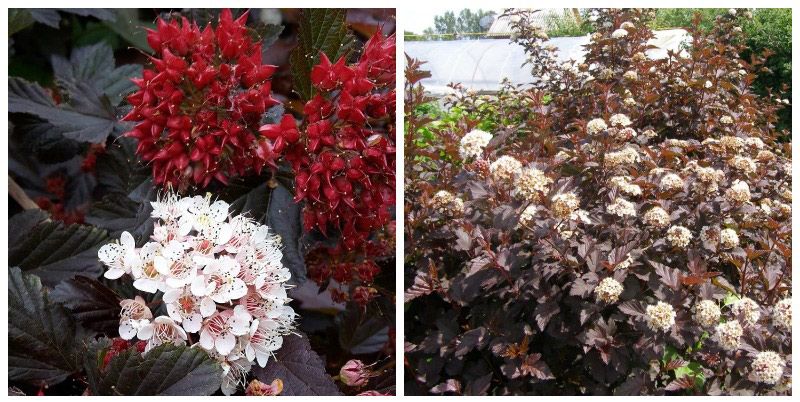
The Red Baron Physocarpus has an ornamental appearance due to the color of its leaves, flowers, and unusual fruits, making it widely used in landscape design. The shrub's overall color scheme changes significantly throughout the season.
The plant often serves as a backdrop in complex, contrasting compositions. With proper pruning, it can also stand out in a flowerbed, becoming a bright and vibrant accent that draws the eye.
It's ideal for creating hedges that will enhance any garden area or make a beautiful frame for gazebos and flower beds. The shrub is easy to care for and doesn't require any special conditions, and thanks to its resistance to air pollution from cars, it can become a spectacular screen that protects against dust and air pollution.
If you follow the basic rules, the plant will attract attention with its bright red leaves and is suitable for framing paths, lawns, gazebos, or hedges that hide the imperfections of the site.