The plant is unpretentious and adaptable, making it ideal for both experienced and novice gardeners, and its variety of sizes allows it to find a place in almost any garden.
Content
Description of broom
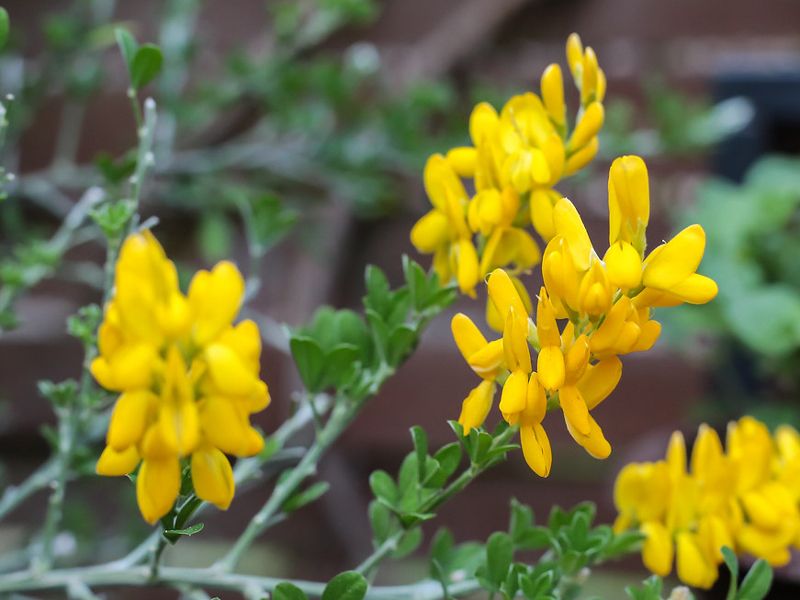
Laburnum (or broom) is a shrub that can grow up to 3 meters in height. Green bark covers its entire stem, which hardens over time. The surface of the branches can be slightly pubescent and faintly silvery.
The young plant's sturdy shoots face the ground because the large mass of foliage bends the fragile stems. Three oval lobes form the leaf blade; at the top of the broom, several lobes may be joined. The leaf reaches 4 cm in length.
Types of broom
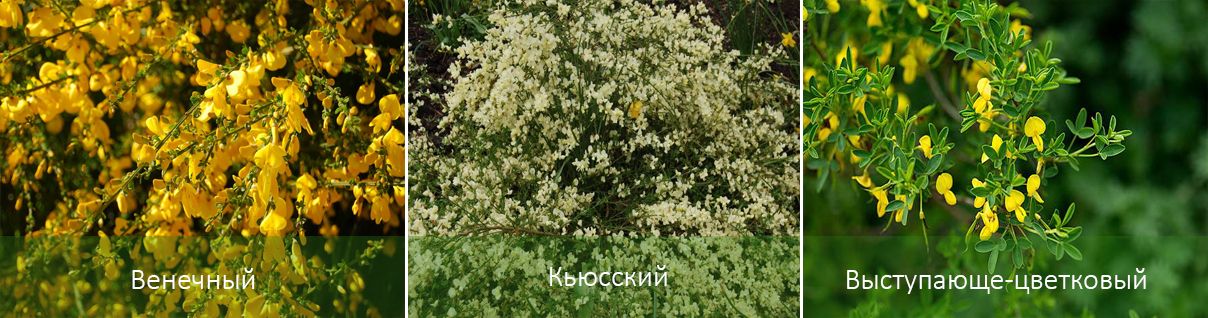
Breeders have developed a variety of species and cultivars of broom, including frost-resistant, strongly fragrant, dwarf, and versatile shrubs valued for their ability to quickly adapt to their environment.
| View | Description | Leaves | Features, application |
| Crown (paniculate fireweed) | In the early stages of growth, the plant exhibits slight pubescence, which later disappears. Green stems can reach 3 m in height. Irregular yellow flowers, covered with down, grow up to 2 cm in diameter. The fruit is a pod with several seeds. This frost-hardy variety can withstand temperatures around -20°C. It is widely grown in the European part of the continent, preferring regions with mild climates. | Alternate, slightly elongated, oval-shaped leaves are prone to early shedding. | The variety of decorative forms allows:
|
| Kyussky | The most common dwarf variety (about 0.3 m), bred in England in the late 19th century. It is extremely spreading, reaching up to 2 m in width. The flowers are large and yellow. | Ternate. | Great to combine with decorative stones. |
| Protruding-flowered | Grows up to 0.6 m in height, adorned with large, rich yellow flowers. Resistant to temperatures down to -20°C. | Small, trifoliate. | The compact size allows the plant to be used universally. |
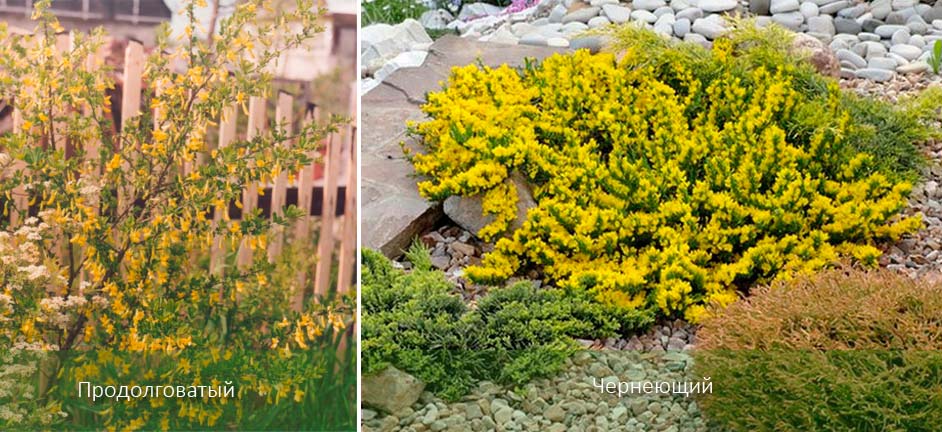
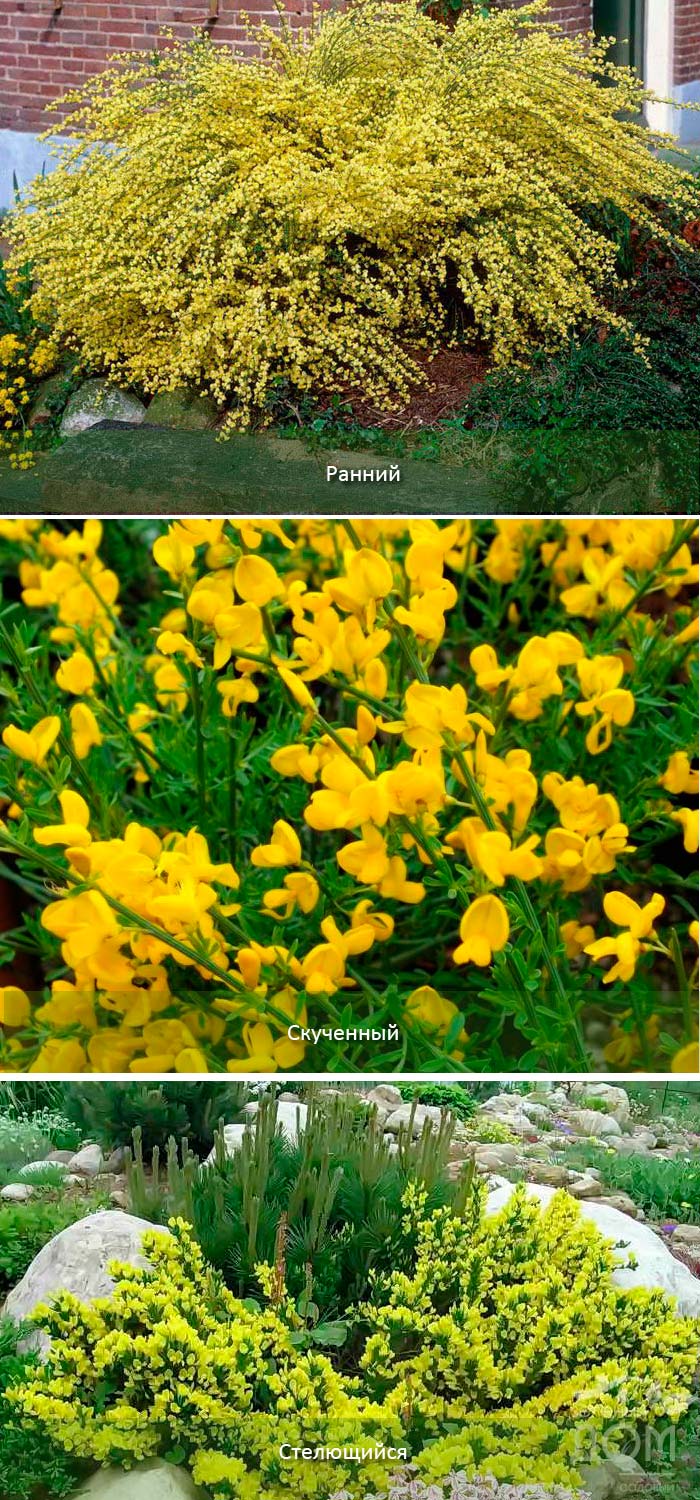
| Early | The bush with a dense crown grows up to 1.5 m. The branches resemble an arch. In May, yellow flowers with a distinctive scent appear. The roots do not penetrate deep into the soil. | Elongated, up to 2 cm in length. | As part of a composition or as a stand-alone plant. Plant to decorate borders and sandy slopes. |
| Bored | The shrub has a compact size: 0.5 m in height and 0.8 m in diameter. Flowering begins in mid-summer and ends in late September. Ripe fruits can be seen in October. | Bright green, oval. | It is notable for its early fruiting and high percentage of seed germination (more than 90%). |
| Creeping | This dwarf shrub grows no taller than 0.2 m, with a diameter of 0.8 m. Flowers come in various shades of yellow. It produces slightly pubescent pods. It has been cultivated since the late 18th century. | The main feature is the splendor of flowering. | |
| Oblong | The most common species among other brooms. It blooms from early to mid-summer. The petals are golden in color. It grows best in loose, nutritious soil in a well-lit area. | The trifoliate leaves are pubescent. | The top is a point. Only mature specimens (over 5 years old) bear fruit, and the beans ripen in early autumn. It is not very cold-tolerant, so it requires insulation in winter. |
| Blackening | The shrub grows no taller than 1 m. Young shoots are covered with hairs. The inflorescences are formed by 15-30 yellow flowers. | Oblong, green in color. | Viable seeds, the plant begins to bear fruit at the age of 2 years. |
| Zinger (Russian) |
Habitat: Mixed forests of northern Russia. The stems of this low-growing species rise to 1 m from the ground. The fruit is a pod (3 cm in cross-section). | Light green, trifoliate, about 2.5 cm long. | Universal in location, prefers sandy soil. |
Popular varieties
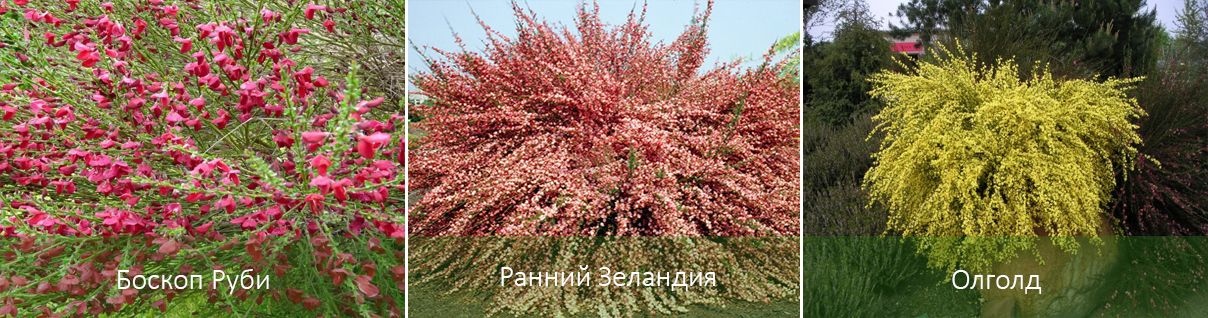
Among such a wide variety of shrubs, almost every gardener will be able to choose the one that is most suitable for growing.
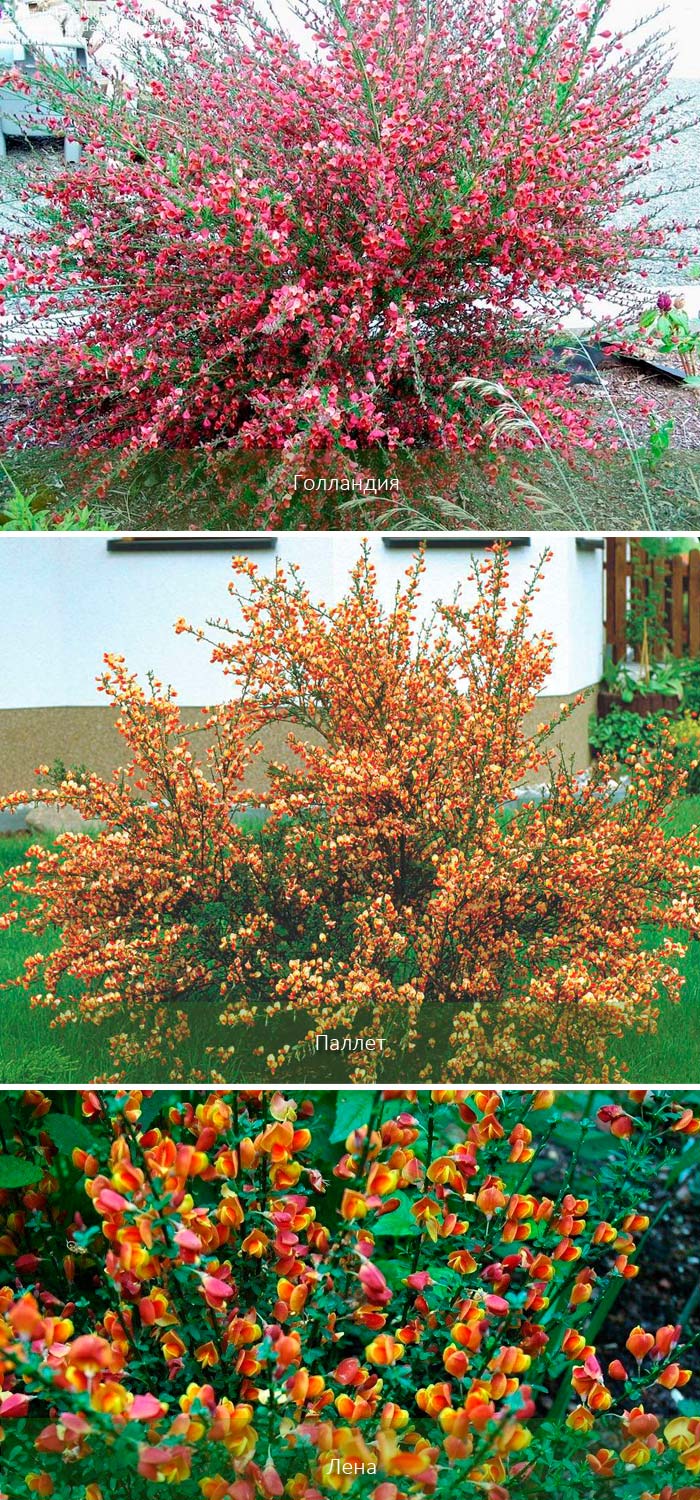
| Variety | Description | Flowers |
| Ruby Boskop | An early variety noted for its decorative qualities. It grows up to 2 m tall, spreading, with long, slender branches. The foliage is rich green. | Red on the outside, purple on the inside. They are densely packed on the bush. |
| Early Zealand | This variety requires insulation during the winter, as it is frost-intolerant and very heat-loving. The leaves are bright green and oblong. | Peach color. |
| Allgold | This early variety is a lush shrub up to 2 m in diameter. It requires full sun and sandy soil. During its abundant blooms, it exudes a strong scent. | Yellow tint. |
| Lena | This heat-loving variety reaches 1.5 m in height and requires insulation in winter. | Red on the outside, golden on the inside. |
| Splenders | Resembling a ball, it grows 0.5 m in height and width. It blooms in late spring. | Rich straw color. |
| Palette | Frost-resistant variety. | A large red flower is framed by a sunny border. |
| Holland | It blooms profusely in mid-spring. This sun-loving variety is noted for its cold tolerance and high adaptability. | Red-purple color and its shades. |
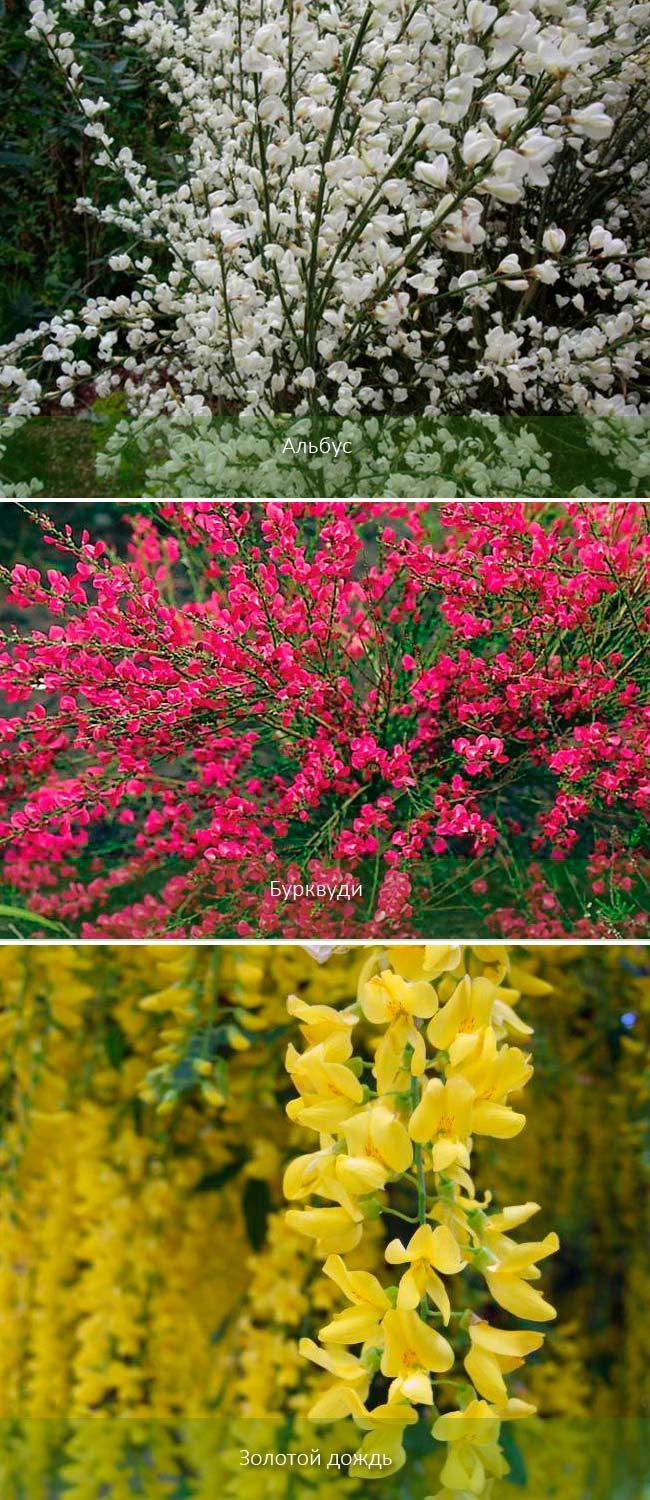
| Albus | This frost-resistant variety is characterized by early flowering, small size and a spherical shape. | White with slight yellowness. |
| Burkwoodie | A tall variety that grows up to 2 m even in poor soil, it is resistant to cold and drought. | Coral flowers are framed with a golden stripe. |
| Golden rain | A compact shrub that contains poison. | Lemon shades. |
Broom planting and care
In order for the plant to delight the gardener with its beautiful appearance, rapid growth rates, and abundant flowering, it is necessary to provide the appropriate conditions for the broom, which is not particularly capricious among other shrubs.
Planting times and rules
Planting seedlings outdoors is done in the spring. The site should be well-lit and protected from strong gusts of wind. Slightly acidic soil with good drainage is preferred. Sandy loam soil is the best option. Planting near water is not recommended, as the toxic elements contained in the plant can harm aquatic life. Prepare a soil mixture beforehand to fill the holes for the shrubs.
It should contain:
- Sand;
- Turf soil;
- Humus.
The recommended ratio of components is 2:1:1.
The mass must be thoroughly mixed the day before sowing, and a little mineral fertilizer can also be added to it.
When planting, it's important to maintain a distance of 30 cm between seedlings. When digging the hole, take into account the soil ball. Providing good drainage (20 cm) will help prevent waterlogging and root rot. For sandy loam soil, a 10 cm layer is sufficient.
Procedure for landing:
- Place the seedling in the hole;
- Fill the free edges with the prepared mixture;
- Compact the soil;
- Moisturize;
- Cover the damp soil with a small amount of organic material to a layer of 5 cm.
Watering
Water generously and thoroughly as the soil dries. During rainy periods, you can limit the frequency of watering, and it should also be reduced at the beginning of autumn. Use settled water, as the lime it contains will harm the broom. Regular weeding and loosening the soil around the tree's trunk to a depth of 10 cm are essential.
Top dressing
The plant should be fertilized:
- Nitrogen, urea in spring;
- A mixture of superphosphate (60 g) with potassium sulphate (30 g), diluted in a bucket of water;
- Wood ash (300 g per 1 bush) when the rate of bush development slows down.
Transplanting and propagating broom
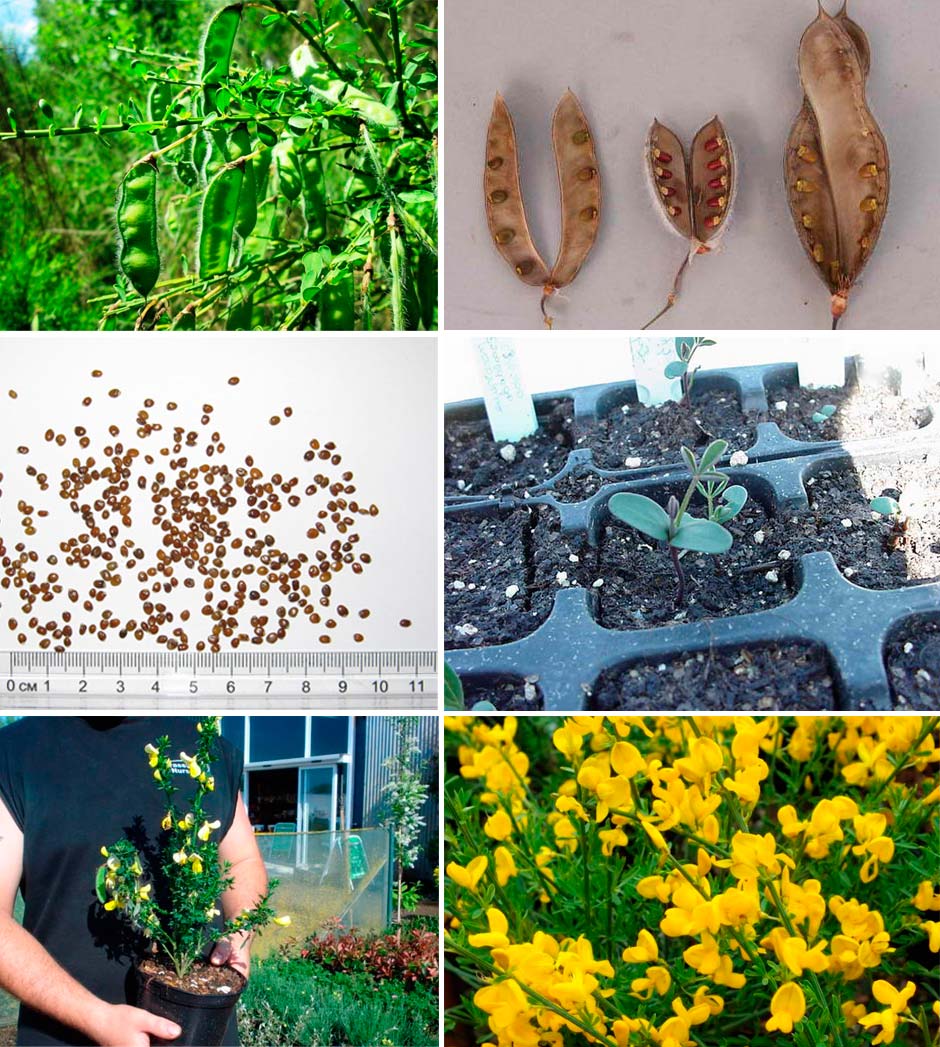
The process of replanting a plant is not significantly different from planting and is carried out as follows:
- A hole is prepared for the bush, which is twice the size of its root;
- The bottom of the hole is filled with crushed stone, broken brick or expanded clay (drainage);
- The day before extracting the bush, the soil is prepared;
- The plant is placed in a prepared hole and covered with soil.
Propagation by seeds
In early fall, you can collect bean seeds and plant them in a special soil mixture made of equal parts sand and peat. The seeds should be buried 0.5 cm into the soil. To create a greenhouse effect, cover the container with plastic and leave it in a warm, dark place. Ventilate and mist the soil regularly.
When the sprouts have developed leaves (at least 2), they should be transplanted into different pots filled with special soil consisting of the following components:
- Sand;
- Turf soil;
- Humus.
In the spring, young plants should be transplanted into larger containers. Afterward, pinch them back to encourage lush foliage in the future.
Planting in open ground is carried out after 2 years, by which time the bush should grow to 0.5 m.
Cuttings
In summer, you can prepare cuttings by taking shoots that have already hardened and developed 2-3 leaves. The seedlings should then be cut back by half and planted in a pre-prepared soil mixture. To ensure successful rooting, the cuttings must be provided with suitable temperature conditions and regularly misted. After 1.5 months, the rooted seedlings should be transplanted into individual containers. After 2 years, the plant can be planted outdoors.
Propagation by layering
In the spring, select branches growing from the bottom and place them in furrows beneath the bush, covering them with a thin layer of soil. Then, feed and water the branches, and with the first frost, insulate them. In the spring, you can plant the cuttings.
Diseases and pests
| Problem | Measure of elimination |
| The moth | Use of chlorophosom. |
| Geometrid moth | Use of insecticides. |
| Powdery mildew | Spraying with foundationol, copper-soap solution. |
| Black spot | Treatment in summer with foundationol, polycarbacin (0.4%), Bordeaux mixture (1%). |
Overwintering broom in open ground
After the plant has finished flowering, trim all thin branches. Bushes under three years old are recommended to be insulated for the winter by hilling them with peat, tying the branches together, and covering them with non-woven fabric.
Application in landscape design
It's used in combination with decorative stone and conifers, but can also be planted as a solitary plant. The shrubs are often used to create a hedge by planting them in a row. Broom pairs well with lilies of the valley, lavender, and heather.
Top.tomathouse.com recommends: the beneficial properties of broom
Zharnovets paniculata is known as a wonderful honey plant and is also valued for its medicinal properties. For example, to prepare a medicinal infusion, pour 1 teaspoon of crushed plant into cooled boiled water, let it steep, and strain.
Indications for use:
- Tuberculosis;
- Jaundice;
- Liver diseases;
- Cough;
- Headache.
It is recommended to take twice daily, but consult a healthcare professional to confirm the dosage before use. Contraindicated during menstruation and in cases of individual intolerance.