
Ratibida is a perennial plant with vibrant, sombrero-like inflorescences. Its native range extends from Mexico to Canada, but it also thrives in Russian latitudes. It requires little care and requires little soil quality, and is tolerant of both dry and hot climates. In Russia, it is better known as the Mexican hat or prairie flower.
The stems reach a height of 120 cm with leaf blades 3-12 cm long. Flowers bloom in early summer and last until autumn. The conical center, protruding 2-3 cm, is edged with petals cascading downward. The color can be burgundy, yellow, or a combination of both.
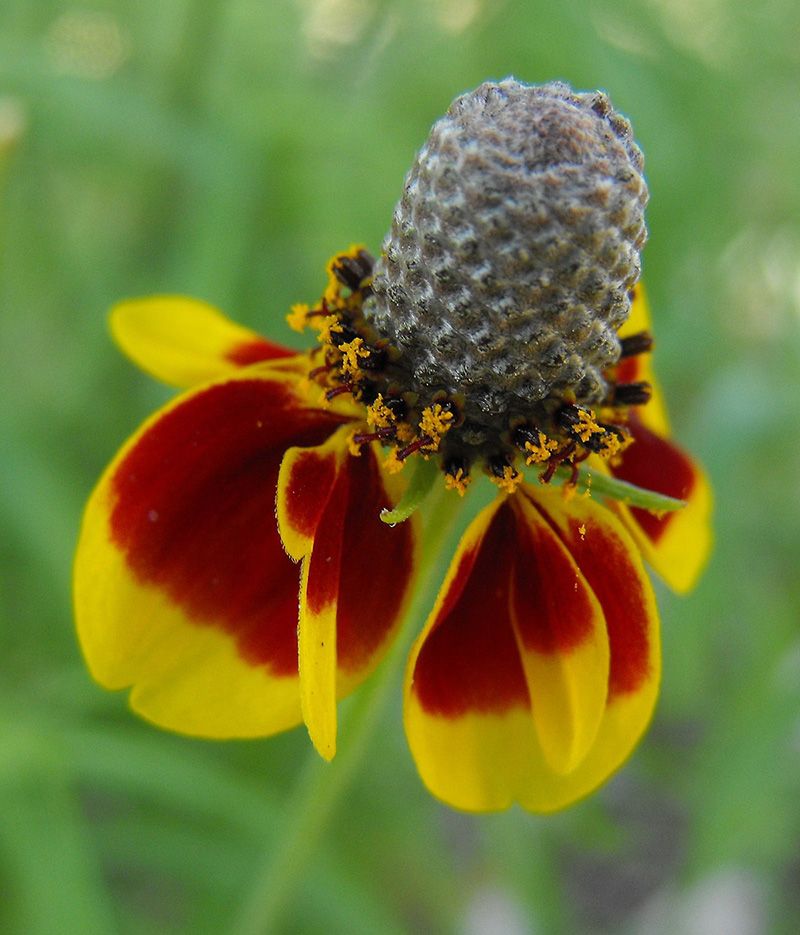
Types of ratibida and their characteristics
There are seven known varieties of this plant, but gardeners grow only two of them:
- Columnar – stem height 1 m. The pinnately dissected, pubescent foliage has a delicate blue-green hue, and the flower is red, burgundy, or yellow. The drooping petals are edged with purple, yellow, or brown. The elongated center, projecting 3-5 cm, gives the appearance very reminiscent of the well-known Mexican hat.
- Pinnate – most often grown as an annual, reaching a height of 1.5 m. The leaves are complex, lanceolate-pinnate. The basket-shaped flower petals are yellow or brown. A small pith protrudes above the inflorescence.
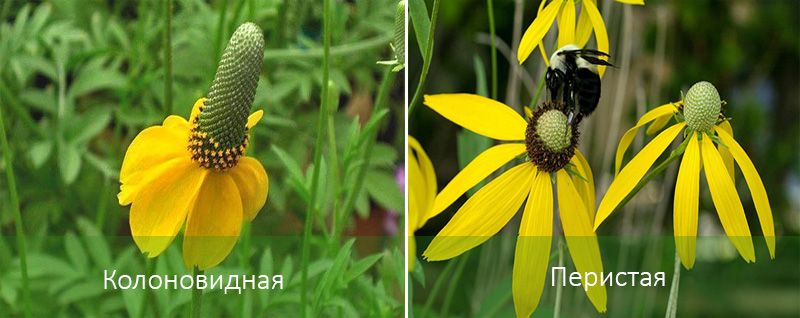
Both varieties have a distinct aroma.
Gardeners prefer to cultivate ratibida because, with proper care, the bush blooms from May to late September and can grow in the same spot for about five years. Even without proper care, it will continue to grow and bloom, as it reproduces by self-seeding.
Growing and Propagating Prairie Flower Ratibida
Ratibida is very easy to propagate. The most common methods are self-seeding, direct seeding, and seedlings. Depending on climate conditions, timing, and planting method, the plant will bloom the following year or later this year.
Seeds
Growing columnar and pinnate ratibida from seeds in open ground begins with sowing in early spring, and in regions with mild and warm climates, even as early as February. Planting material can be purchased or grown locally. Ripe yellowish-brown seeds are harvested from faded, dried inflorescences with a dark brown cone. They ripen in late fall.
The soil should be uniform, well-loosened, and free of clods. For effective cultivation of ratibida from seed, it should be sown in neutral or slightly alkaline soil. However, it grows well in any soil, as long as it is not overly wet. Planting near bodies of water is not recommended. Sow in beds 2 cm deep and spaced 30 cm apart. Watering is recommended only if the winter was not snowy.
Saplings
Planting seedlings is recommended in cooler regions. Sow in late fall or early spring:
- The seeds are distributed on drained moist (but not wet) compost, sprinkled with a layer of substrate and placed in a lighted place.
- It's important to maintain a temperature of +20… +25°C. Under these conditions, the seedlings will sprout in just a few weeks.
- Picking into pots is carried out after the second leaf appears on the sprout.
- The seedlings are then transferred to a greenhouse or hotbed. They are hardened off for two weeks, acclimating them to the open climate and sun. Once they are firm enough to be transplanted into the soil, they are watered two hours before planting.
- Carefully remove the plants from their pots without disturbing the root ball, place them in pre-dug holes of the appropriate size, and cover with soil. The root collar should be no more than 2 cm deep.
Dividing the bush
Dividing a bush is used quite infrequently and only for columnar ratibida, as it has a deep taproot system, while the pinnate variety's is very delicate. It is used to rejuvenate bushes. A 4-5-year-old bush is carefully dug up and divided with pruning shears or a knife, without disturbing the soil from the roots. The divided sections should be planted at the same level as the original. To speed up rooting and establishment, the plant should be watered regularly.
cuttings
Cuttings are also rarely used, as ratibida reproduces well from seeds. This procedure is carried out in May-June before buds form. The cutting is cut at the root and inserted into a damp bud. It is then sprinkled with sand and covered with a jar. After 14-20 days, the cutting will develop its own roots. The seedlings are spaced 30-35 cm apart.
Rules for caring for ratibida in open ground
Care is quite simple, and even an inexperienced gardener can handle it.
Prairie flowers don't require constant watering, only during severe, prolonged droughts, and then only sparingly. They also require light watering during the flowering period.
The quality of the soil does not affect the growth of the flower, however, if the soil is depleted, before the formation of buds, a mineral complex is added, but in no case an organic one.
The plant survives winter well and requires no cover. Preparation for the cold season consists of cutting off the above-ground portion of the stem.
Preventive measures against pests and diseases
The plant is extremely resistant to various diseases and pests. The only threat is improper care. Excessive moisture, for example, leads to attacks by powdery mildew or aphids. Therefore, avoid frequent watering, and keep the area clear of plant debris. Fertilize the soil with a mineral complex containing potassium and phosphorus and mulch with peat.
Landscape designers prefer to plant ratibida next to rudbeckia and echinacea. This allows for a richer plant composition. The flower is also recommended for placement in rock gardens with groundcover plants.
I am very grateful to you for the information. I took advantage of it.