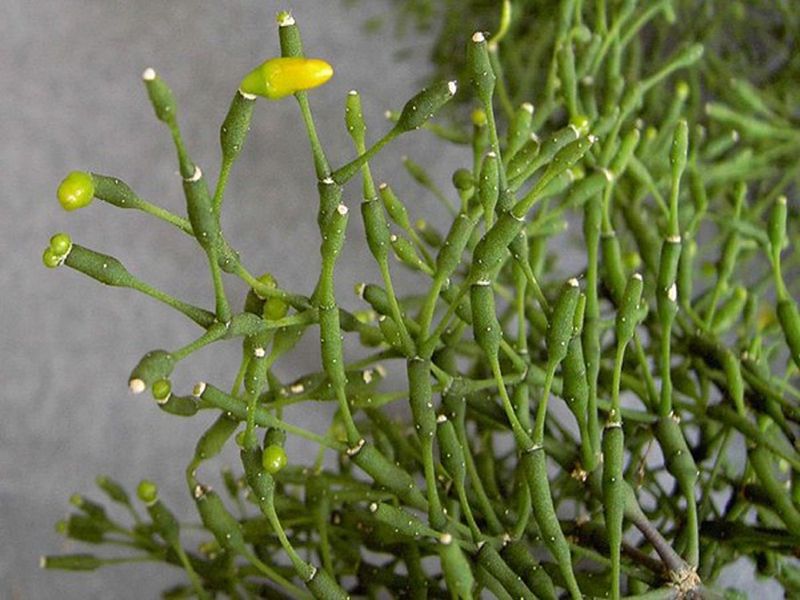
Rhipsalis is a cactus shrub native to Brazil. It features long, branching stems without spines, and its surface is covered with sparse green hairs. During flowering, bell-shaped buds appear. Their colors range from pure white to various shades of red.
In its natural habitat, rhipsalis grows on tree trunks and in rocky cliffs. The plant feeds through its aerial root system.
Types
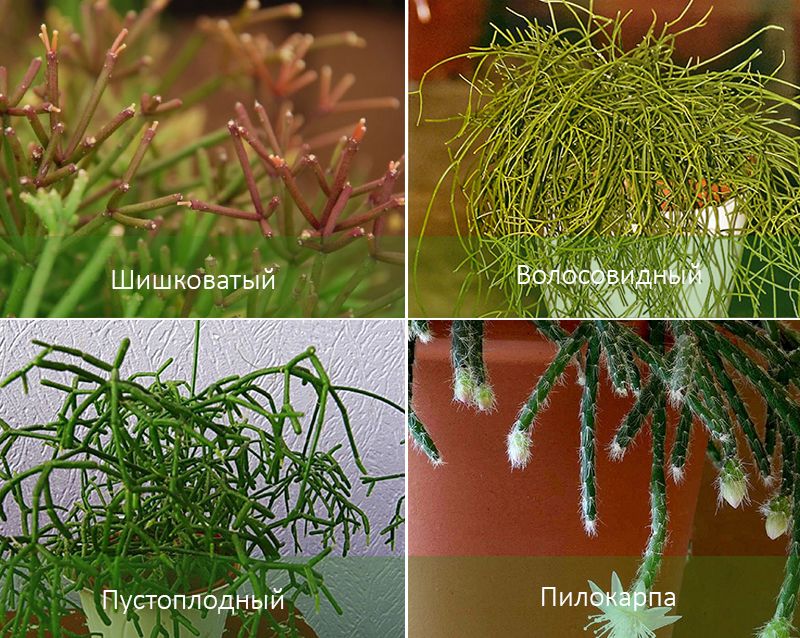
There are over 60 species of Rhipsalis. Some have been successfully adapted for cultivation. The most common are:
| View | Peculiarities |
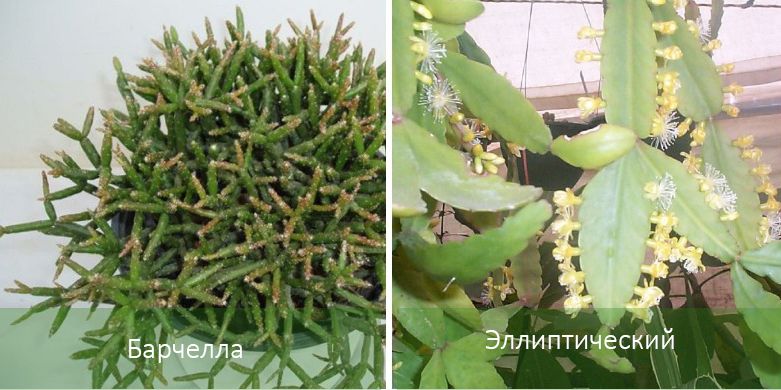
| Barchela | The shoots are cylindrical, 5-6 centimeters long. The stems are smooth, dark green, with light areoles. |
| Hair-like | The stems are thin and branched. From a distance, the plant resembles a tuft of green hair. By late autumn, the shoots bloom and become covered with small white buds. |
| Gnarled | The shoots are long (up to 1 meter), cylindrical. Young stems grow vertically, but as they mature, they gain mass and bend toward the ground. |
| Empty-fruited (cassut) | The elongated shoots consist of cylindrical segments (each 10-50 centimeters long). The stems can reach over 3 meters in length. During flowering, small, light-colored buds appear at their tips. |
| Pilocarpa | The stems are covered with numerous light, yellowish hairs. Flowering occurs several times a year. |
| Elliptical | The shoots consist of flat, wide segments covered with short hairs in the areole area. During flowering, buds form along the edges of the segments. |
| Prismatic | It is distinguished by thin vertical trunks 10-15 centimeters high, along the edges of which prismatic shoots form. |
Home care
Rhipsalis is not particularly demanding in terms of care. Even a novice houseplant enthusiast can handle it. The plant requires proper lighting, humidity, and timely feeding and watering.
| Condition | Peculiarities |
| Location | A south-facing window with shade from direct sunlight. Can be placed outdoors in summer. |
| Lighting | Bright diffused light. |
| Temperature | In summer – up to +23, in winter – up to +10 degrees Celsius. |
| Air humidity | The plant thrives in a dry, indoor environment. In hot weather, it should be misted with water 2-3 times a week. |
| Watering | In spring and summer – when the top layer of soil has dried out. In winter – once a month. |
Selecting soil and pot
The pot shouldn't be too deep, but it should be wide enough. In the wild, rhipsalis grows on tree bark and rocks. Creating a similar base indoors is difficult, so varieties have been bred for light soil. The requirements for this soil are neutral pH and porosity.
Top dressing
The plant requires feeding during the growing season. During this time, it grows most actively, consuming a lot of nutrients. Mineral-enriched mixes, as well as fertilizers for cacti and succulents, are suitable for this purpose.
Transplantation and propagation
Rhipsalis requires repotting once a year until it reaches maturity—5 years. Once mature, the shrub can be repotted every 3 years. Warm spring is the best time for this.
Propagation occurs through cuttings. A segment is broken off from a shoot, slightly dried, and placed in moist soil. After this, the root system begins to form.
Diseases and pests
The plant can become infected with various diseases, the methods for eliminating which are indicated in the table.
| Problem | Description | Solution |
| Chlorosis | The leaves turn yellow and fall off, the flowers change shape. | Select the correct lighting and soil acidity (pH 5.0-5.5). Plant shoots should be treated with a solution high in iron. |
| Scale insects | Brown spots on shoots. | Treat the plant with a soapy solution. If the problem persists, resort to chemical pest control. |
| Red flat tick | Wilted stems, corrosion-like spots. | Increase humidity around the plant. In severe cases, chemical pest control may be necessary. |
Top.tomathouse.com explains: benefits
In addition to its aesthetic beauty, ripsalis has the ability to absorb electromagnetic radiation.
It is useful to place cactus pots near a computer, TV, or in an office space with a lot of equipment.
When flowering, it releases useful elements that filter the air in the room from harmful impurities and dust.
Signs
One variety of Rhipsalis, Hatiora, has a bad reputation among folk. Supposedly, this flower drives husbands out of the house and ruins families. Of course, this superstition is a myth. This houseplant doesn't affect the relationship between spouses in any way, so you can have it without any fear of marital bliss.
Rhipsalis is an easy-to-grow cactus that adapts easily to indoor conditions. With proper lighting, watering, and fertilizing, it will bloom, thrive, and add a unique touch to the space.