The sundew is a carnivorous plant of the Drosera family. Drosera, also known as Drosera, is Latin for "dew." It is found in the wild in marshy areas, sandstones, and mountains, primarily in Australia and New Zealand. There are 200 species, including some that can survive the winter under snow. Others, native to the subtropics, grow year-round.
The plant's lifespan is 2-10 years. It feeds on mosquitoes, flies, midges, butterflies, and beetles. This lifestyle allows the plant to sustain itself. The flycatcher is also grown as a houseplant.
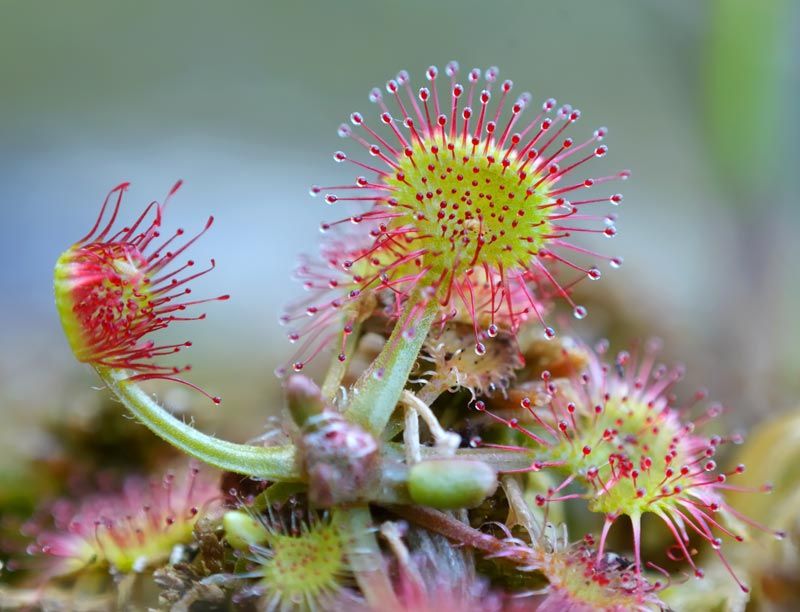
Description of sundew
The sundew plant is a perennial with a thick, tuberous stem up to 20 cm long. Its roots are weak, able to absorb water and hold the plant afloat. It obtains nutrition from its prey—insects.
The leaves resemble small plates. Their length varies depending on the species and habitat: rounded, oblong, petiolate, or sessile. Most species are characterized by a basal rosette. Large, reddish glandular hairs are located along the edges and top of the leaf. They become irritated when touched and secrete a mucus droplet to trap prey. This mucus has paralytic properties, its composition similar to digestive enzymes. It contains organic acids, which allow the flytrap to break down insect proteins. The plant can digest small pieces of cartilage.
Flowering begins in spring and summer. Long stems emerge from the center of the rosette. The inflorescences are pink, white, or cream-colored spikes. The number of stamens and pistils is equal. There are 4-8 petals. Fruits with seeds appear in summer. In nature, the plant reproduces by self-seeding.
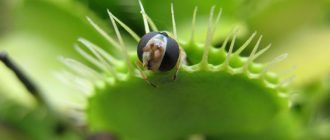
A sticky substance called "dew" forms on the hairs of the trap leaves. Insects landing on the flower quickly become attached. The hairs immediately begin to move, forcing the prey to the center of the leaf. The leaf then curls up into a snail-like coil, immobilizing the insect. Digestion begins, lasting anywhere from a few minutes to seven days, depending on the plant species. After a period of time, the leaves return to their original shape and become covered in mucus.
If a raindrop, sand, or soil falls on the plant, the sundew does not react.
Indoor sundew species
Round-leaved, English, and Intermediate are found in the European part of Russia. The remaining species of carnivorous plant are tropical.
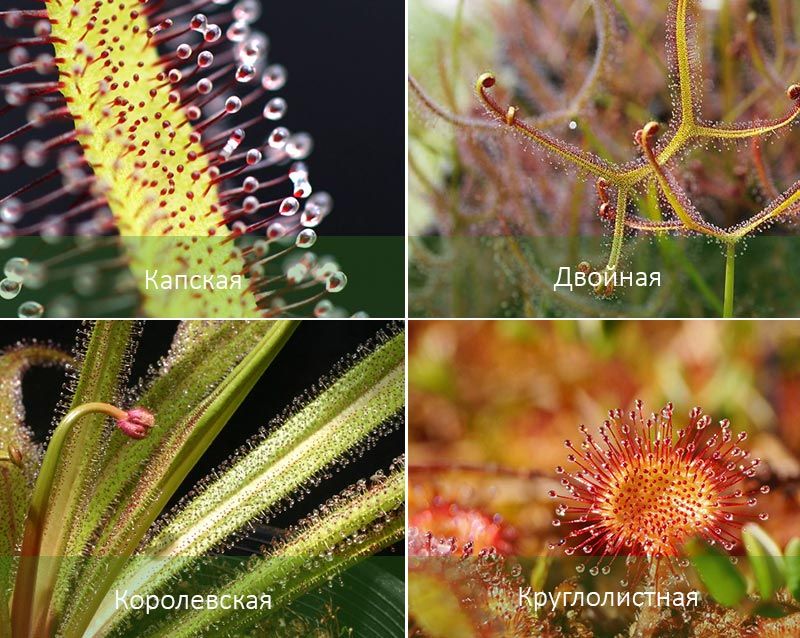
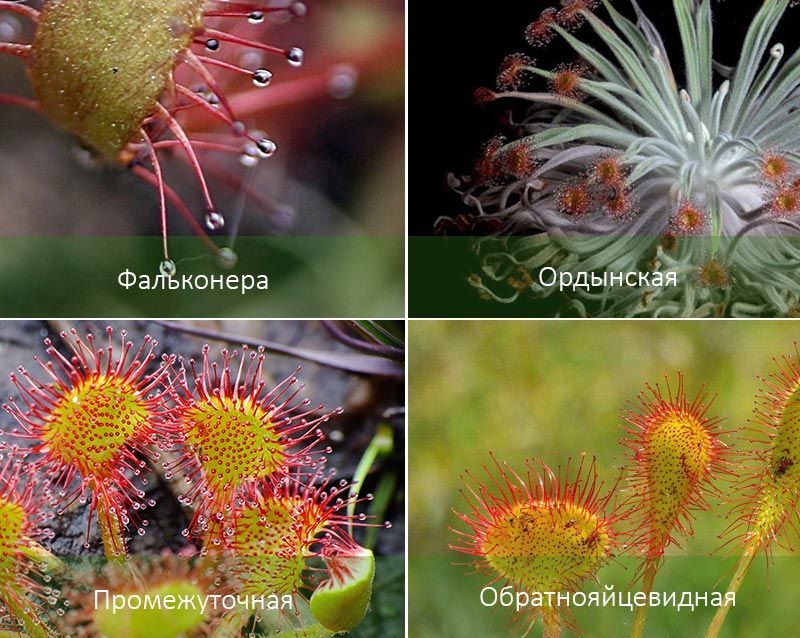
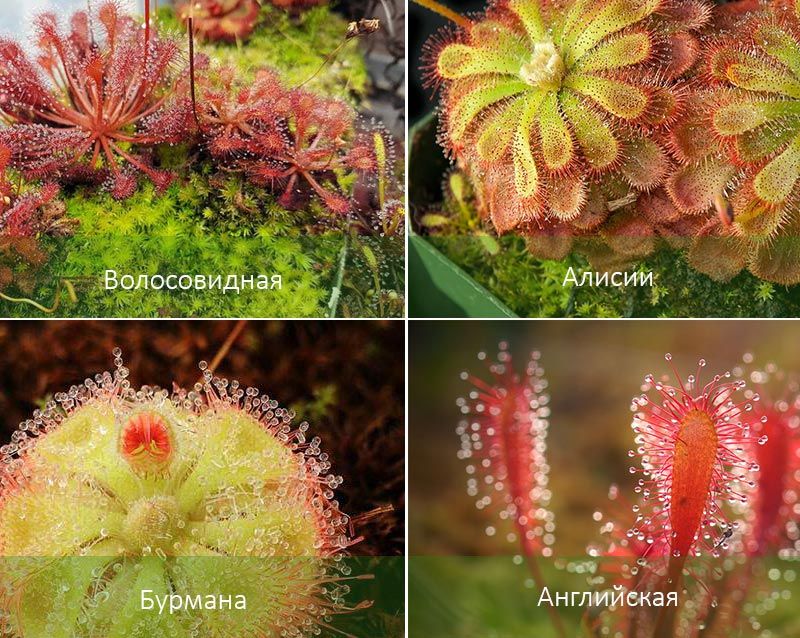
| View | Leaves | Flowers and the period of their formation |
| Cape | Narrow, up to 5-6 cm long, covered with reddish eyelashes for catching. | Small, white. May – June. |
| Round-leaved (Tsar's eyes) | Round, smooth below, green, pubescent above. The eyelashes are red. | July, August. Pink or white. |
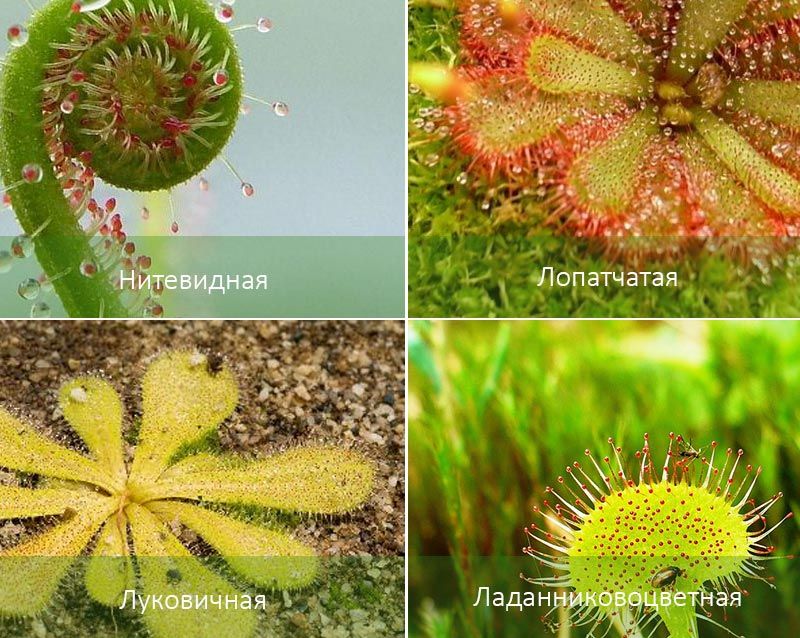
| Spatulate | Wide, spatulate. | Small, red, collected in clusters of 10-15. |
| Double (Disyllabic) | Long, narrow, forked at the end. | White. |
| Alicia | Strap-shaped, green-yellow, with red tentacles. | Pink-purple, bloom in turns. |
| English | Long, narrow, directed upwards. | White, in midsummer. |
| Intermediate | Arched, curved. | White, in July – August. |
| Obovate | Long, directed upwards. | Small, white, in July – August. |
| Bulbous | Wide, pale green, yellow. | White, from April to June. |
| Ordynskaya | Round, long with hairy petioles. | Pink, white, December – April. |
| Filiform | Straight, linear. | White. |
| Hair-like | Spoon-shaped, red in the sun. | Pink, in May. |
| Burman | Wedge-shaped, long, quickly capture prey. | Whites, one by one. |
| Falconer | 2 cm long, 3 cm wide, covered with fluff underneath. | Pink, in November, December. |
| Royal | Large, up to 2 m. | Dark pink. |
| Rockrose | Oblong, up to 5 cm. | Snow-white at the edges, green in the middle. |
Caring for sundew at home
Sundews require specific conditions indoors. Fill a container with a mixture of peat, quartz sand, and perlite (3:2:1).
| Factor | Spring/Summer | Autumn/Winter |
| Location/Lighting | Eastern and western windowsills, in places where there is direct sunlight only in the evening or morning hours. Bright, diffused 14 hours a day. |
Additional artificial lamps. |
| Temperature | +25…+30 °C for tropical species. +20 °C for European species. | +15…+18 °C – for growing in hot climates, +5…+10 °C – in moderate climates. |
| Humidity | High, from 60%. Use humidifiers and mist the air, but do not spray the flower. | |
| Watering | Frequently, abundantly, with distilled water, without getting it on the plant. | Once a week with warm water. |
| Top dressing | Feed it insects once a week. Or take it outside and let the plant forage for food itself. | During the dormant period, no feeding is needed. |
Replanting, soil
After purchase, the sundew needs to acclimate to its new location. This process takes two weeks. Repotting is necessary every two years. This is done in the spring, after the dormant period. Choose a plastic pot no more than 10 cm high, light in color, with drainage holes. After removing it from the old soil, spray the new pot with distilled water and plant the plant in the hole. The sundew needs a week to adapt; during this period, the traps will not appear.
The soil required is acidic pH 4-5 and consists of moss, peat, and sand (2:1:1).
Rest period
In winter, growth slows, leaves fall off, and a dormant period begins. The plant is placed in a cool location. Watering is reduced, but the light remains bright. As daylight increases, the plant awakens. Then, the carnivorous plant is repotted in different soil, and care is resumed.
Reproduction
The plant is propagated by dividing the bush, cuttings and seeds.
The collected seeds are placed in a mixture of sand and peat and sprayed. Cover with plastic or glass and keep at 25°C in bright light. Seedlings appear in up to five weeks. When four leaves appear, transplant.
Vegetative method - the outgoing rosette is separated from the mother one and planted in a separate container.
Leaf cuttings – a cut leaf is kept in damp sphagnum moss. A mini-greenhouse is created, just like for seeds. Wait two months for the sprouts to appear. Then, replant them separately. A simpler method is to root the cutting in a container of water. Plant them after roots appear.
Sundew diseases and pests
The plant is rarely attacked by pests, but is susceptible to diseases due to improper care:
- Root rot – growth slows, stems, and leaves turn black. Causes include overwatering and low temperatures. Trim off the rotten roots and replant in a disinfected pot with new soil.
- Gray rot - remove affected areas and treat with fungicides.
- Dew on the leaves has disappeared—not enough moisture or unsuitable soil. Increase humidity and change the soil.
- Aphids – stems and leaves become deformed, growth stops. Treat with garlic infusion or insecticides (Fitoverm).
- Spider mites - when they appear, use Actellic.
The healing properties and uses of sundew
The insectivorous plant has beneficial properties. It is used to make ointments and remedies for pulmonary diseases. The juice is used to get rid of warts and freckles. A decoction is used to treat whooping cough, cough, pharyngitis, tracheitis, laryngitis, bronchial asthma, and tuberculosis.
Sundew is included in preparations with diuretic, antiseptic, and bactericidal properties. Infusions of it treat atherosclerosis, diarrhea, dropsy, dysentery, and headaches.
The plant is poisonous, so self-medication is dangerous.
Contraindicated in cases of allergies, pregnancy, and breastfeeding. Harvested during flowering, peeled, and dried.