The Venus flytrap is a carnivorous insectivorous plant of the genus Dionaea in the family Droseraceae. It is represented by a single species. It is found in savannas, peatlands, and marshy areas of the United States.
Jefferson's plant, or Dionaea muscipula (the Latin name is mistakenly translated as mousetrap dionaea), is unique in its ability to quickly trap small insects with its leaves. It has no medicinal value and is not poisonous. In its native habitat, it is endangered and listed as endangered.
Content
Description of the Venus flytrap
The Venus flytrap is a perennial carnivorous predator growing up to 15 cm tall. It has a short, bulb-like underground stem from which the leaves grow. They form a rosette of 4-7 leaves, ranging in size from 3 to 7 cm. The broad part of the leaf, or base, is responsible for photosynthesis and nourishment for the root system. The other half, the blade, also known as the trap, is pigmented to attract prey. They are connected by a stem. In summer, small, star-shaped white flowers bloom on a tall peduncle.
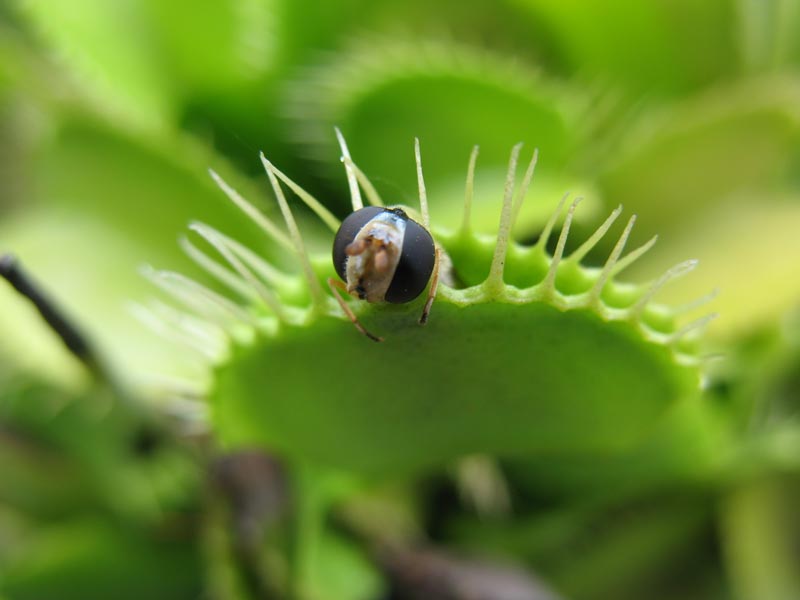
The trap forms after flowering. It consists of two halves, reminiscent of a mollusk shell. Along the edge are two rows of finger-like teeth, along which are special glands with an aroma that attracts insects. Small hairs inside the trap act as sensors: when two different hairs are touched twice, the trap closes. At first, the flytrap does not close completely, but if the trapped prey fails to escape, the trap snaps shut. Digestion of the insect occurs inside. On average, the trap remains closed for two weeks. After three digestive processes, it dies.
Types and varieties of Venus flytrap
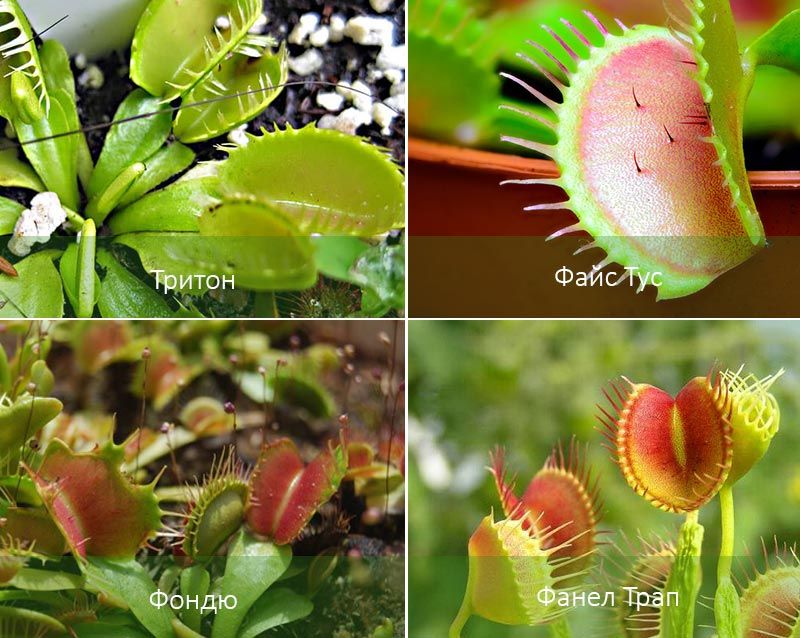
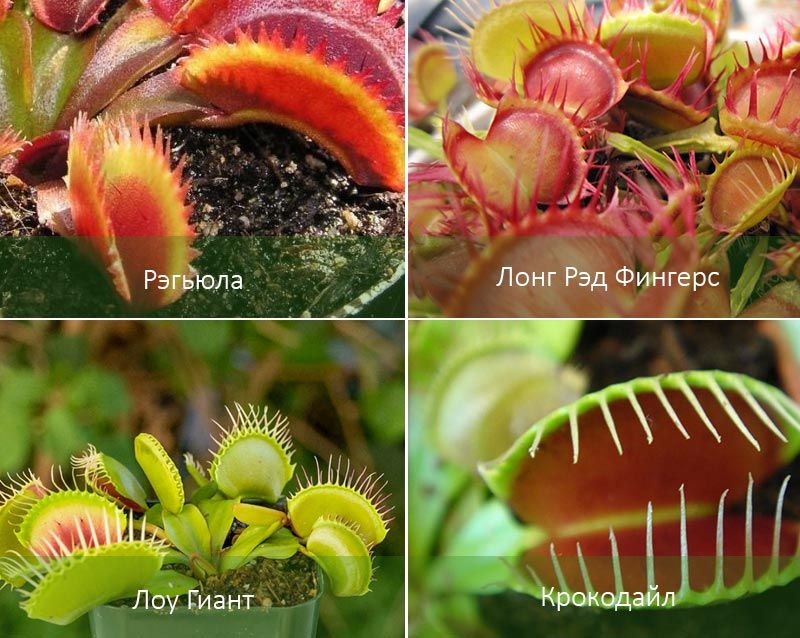
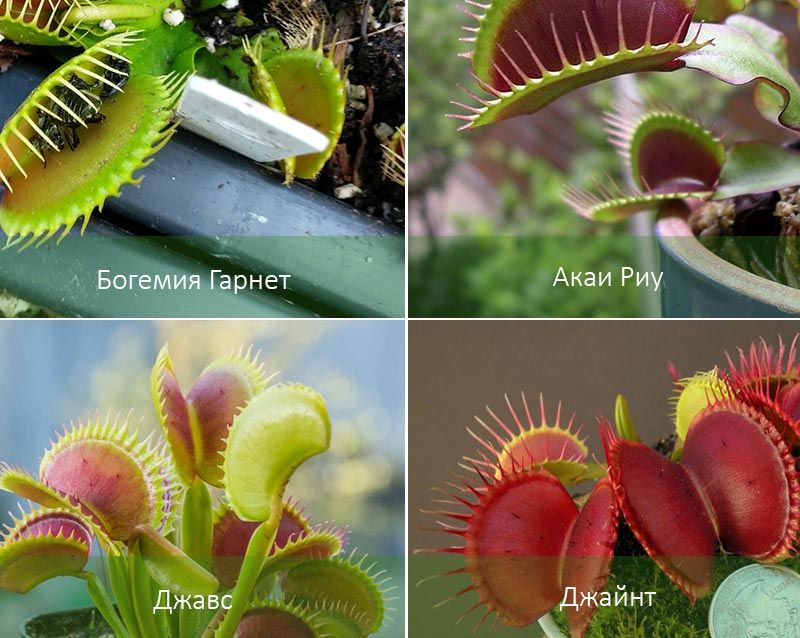
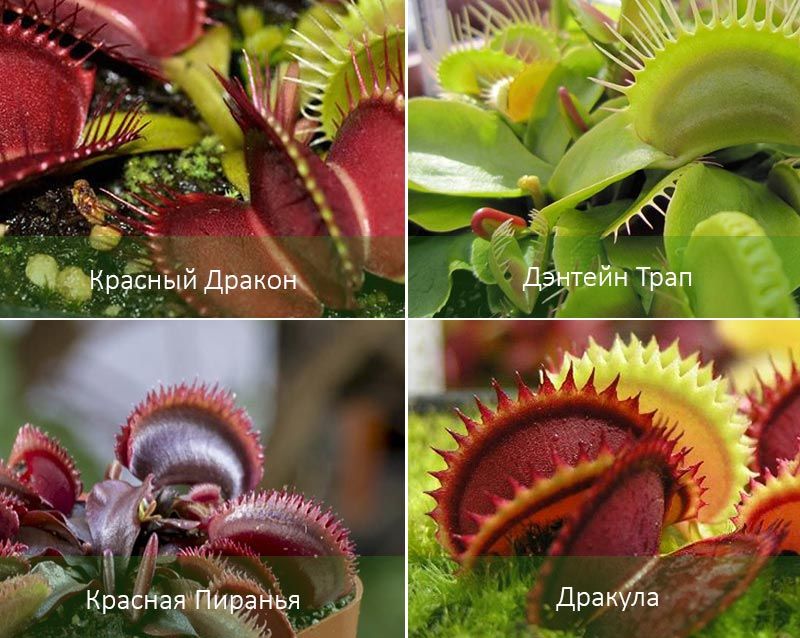
Based on the species, breeders have developed various cultivars. They differ in leaf pattern—leaf color, growth direction, and the number of leaflets.
| Variety | Features of traps |
| Akai Ryu | Dark red with a green stripe. |
| Bohemian Garnet | Wide, bright green, horizontal, up to 12 pieces. |
| Dantain Trap | Green on the outside with a red stripe, red on the inside, 10-12 pieces each, vertical. |
| Giant | Large, dark crimson from the light, they form quickly. |
| Dracula | Green on the outside, red on the inside with short teeth. |
| Crocodile | Green outside, pink inside, horizontal. |
| Triton | Elongated, cut, on one side, the cloves stick together. |
| Fanel Trap | Red, two different types, with green petioles. |
| Fondue | Various shapes, some without teeth. |
| Red Piranha | Red, with short triangular teeth. |
| Red Dragon | In bright light they are red-burgundy. |
| Low Giant | The largest of all. |
| Long Red Fingers | Bowl-shaped, red, long teeth. |
| Javes | Green on the outside, bright red on the inside with short triangular teeth. |
| Face Tus | Rare, thick teeth. |
| Regula | Alternating purple and red. |
Caring for a Venus flytrap at home
This insectivorous predator attracts gardeners. There are many specific considerations when growing and caring for it. The plant is planted in suitable soil, provided with optimal lighting and humidity, and watered correctly during the growing and dormant periods. It is grown in flower pots and glass containers—terrariums, aquariums—to maintain the appropriate humidity.
Location, lighting
Place the plant in a west- or east-facing window, without rotating it. Provide bright, direct sunlight for up to 5 hours, with shade at midday. The total daylight duration should be up to 14 hours. Supplemental lighting is necessary in winter. In summer, the plant can be moved to a balcony or garden.
Temperature, humidity
The Venus flytrap thrives at temperatures between 22 and 27°C, not exceeding 35°C. Humidity should be between 40 and 70%. Ventilate the room, avoiding drafts. Mist regularly. Avoid touching the traps with your hands. In winter, keep the temperature below 7°C.
Watering
Use only clean distilled or rainwater at room temperature for the predator. Fresh water is added to a 0.5 cm layer in the tray, twice daily in the summer.
Do not allow the soil to stagnate or dry out; place sphagnum moss on top of the substrate.
Feeding
Dionea doesn't require regular fertilizer. It's fed with flies, bees, spiders, and slugs. Choose small, non-hard-shelled insects that fit completely, and don't leave any outside the trap. Otherwise, the trap won't close completely and die. A newly transplanted plant shouldn't be fed until it adapts to the new conditions. A young plant should be fed after it has grown 3-4 leaves. During the growing season, three feedings of one insect per plant are sufficient. When the predator is outdoors, it finds its own food.
If a plant is sick, it is treated first and then fed. When it refuses to eat, the food is removed. The flycatcher only responds to insects during times of nitrogen deficiency. No feeding is required in winter.
Soil, capacity of content
Choose a substrate with a pH of 3.5 to 4.5. A mixture of high-moor peat and quartz sand in a 2:2 ratio. A light-colored pot with drainage holes should be no more than 12 cm in diameter and up to 20 cm deep.
Venus flytrap blooming
Small white flowers, reminiscent of stars, appear in late spring and early summer and have a very pleasant scent. Blooming lasts for two months, during which time the plant becomes exhausted and its traps stop developing fully. Therefore, the inflorescences are cut off if the plant is not intended for propagation by seed.
Venus flytrap wintering and dormancy period
At the end of September, the flytrap's new leaves stop forming, and the older ones darken and fall off. The rosette shrinks in size. These are signs of the beginning of the dormant period. No feeding is required. Water sparingly and moderately, ensuring the soil does not dry out. In December, the flytrap's pot is moved to a location where the temperature does not exceed 10°C. Store the plant in the basement or in the lower section of the refrigerator.
The Venus flytrap begins to awaken only in February, and is returned to its original location. Last year's old traps are trimmed, and care begins as usual. Active growth is observed at the end of May.
Transplanting a flycatcher
Venus flytraps are repotted every two or three years. The plant is removed from its old pot, carefully cleared of soil, and placed in a new one. The plant needs five weeks to adapt, so it is placed in partial shade.
The plant does not need pruning; only dried leaves are removed.
After purchase, the carnivorous plant is repotted immediately, with the roots rinsed in boiled or distilled water. Drainage in the form of pebbles or expanded clay is optional. After planting, do not compact the soil.
Reproduction of the Venus flytrap
The Venus flytrap can be propagated by several methods: division of the bush, cuttings, and seeds.
- When dividing, carefully cut the bulb with developed roots from the mother bulb using a disinfected tool. Sprinkle the cut area with crushed charcoal. Plant it in a new container and place it in a greenhouse.
- Cuttings – cut a leaf without a trap, treat the cut with Kornevin. Plant in moist soil consisting of peat and sand, then cover with transparent film or place in a greenhouse. Wait three months for new leaves to appear.
- Seeds form after flowering in special oval capsules. To grow a flytrap from seeds, pollinate its flowers yourself. Plants grown outdoors are pollinated by insects. Seeds are collected and sown within two weeks to maintain viability.
Purchased seeds require stratification. They are wrapped in sphagnum moss and stored in the refrigerator for a month. Then, they are treated with distilled water and 2-3 drops of Topaz.
Scatter the prepared seeds onto a soil mixture of sphagnum moss and sand, mixing 2:1, and spray with soft water. Cover the top, creating a greenhouse. Provide bright light and a temperature of 24 to 29°C. The seeds germinate in two to three weeks. Then plant in a small pot no more than 9 cm in diameter. When two leaves appear, transplant.
Diseases and pests of the Venus flytrap
The plant is resistant to diseases, but if not properly cared for, it is susceptible to fungal diseases and pest attacks.
| Manifestations | Reasons | Elimination measures |
| The leaves are covered with a black coating that forms a crust. | Sooty black mold. | Eliminate high humidity, remove affected parts, remove the top layer of soil, and treat with Fitosporin. |
| The plant is covered with grey fluff. | Gray rot. | Remove affected areas and spray with fungicide. |
| The leaves are covered with small dots, then turn yellow and fall off. White threads are visible. | Spider mite. | Treated with Actellic and Vermitek. Humidify the air by spraying from a spray bottle. |
| Curvature, deformation of traps, sticky spots. | Aphid. | They are treated with Neoron, Intavir, and Akarin. |
| The leaves turned yellow and fell off. | Insufficient watering. | Water more often and more abundantly. |
| The leaves are yellow but do not fall off. | Watering with hard water. | Distilled water is used for irrigation. |
| Brown spots on leaves. | Sunburn or application of mineral fertilizers. | Shade at midday. |
| Bacterial infection. | The plant does not digest the caught prey and rots. | Remove affected parts. |