Ruellia (Dipteracanthus) is a flowering plant in the Acanthaceae family. It is very similar to the streptocarpus family Gesneriaceae, but unlike the latter, which prefer cooler conditions, it is heat-loving. It was named after the French scientist who first discovered it, Jean Ruelle.
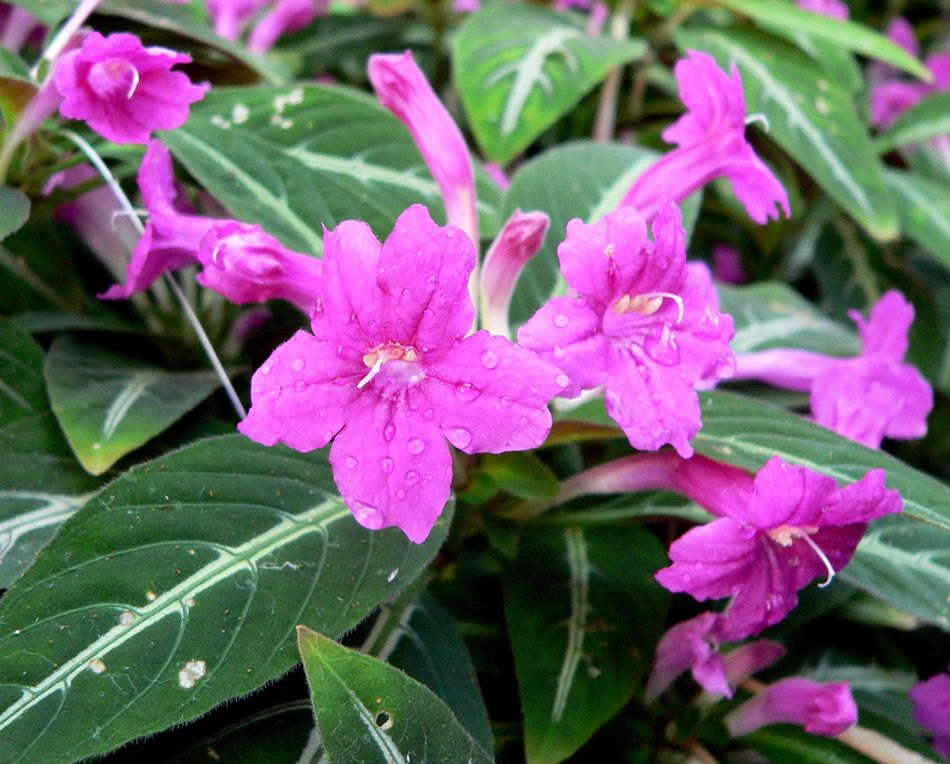
Its native range includes the tropics and subtropics of America, forested areas of Africa, and southern Asia. It is commonly known as Mexican petunia.
Content
Description of Ruellia
The genus Deptheracanthus includes herbaceous species, subshrubs and shrubs.
Distinctive features:
- The stem is branching, and can be straight, creeping, or recumbent.
- The leaves are long, elongated-oval, shiny or matte, the top is emerald with flesh-colored veins, the bottom is lilac-burgundy.
- Flowers (5 cm) are white, beige, purple-pink, appear for no more than 6-7 hours from shoots at the base of the leaves.
- The seed pod that forms in place of the flowers releases seeds. The next morning, the flowers bloom again, and this continues for several months (August to December).
Ruellia varieties for indoor growing
Only a few varieties of dipteracanthus are grown at home.
| View | Escapes | Leaves | Flowers and their blooming period |
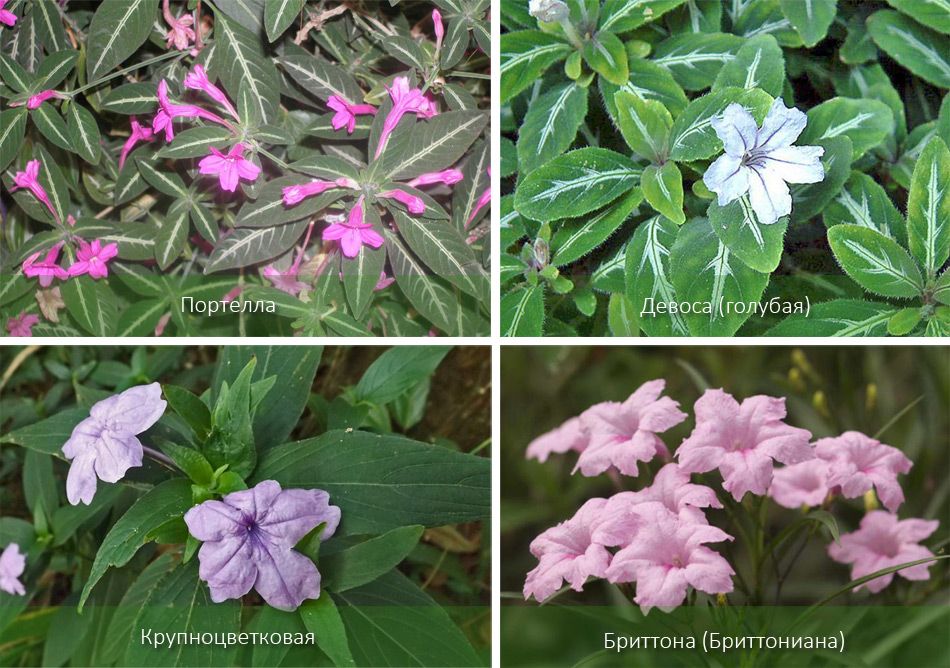
| Portella | Lodging (45 cm). | Oblong, dark green top with white veins and brownish bottom (7 cm). |
Bright pink (diameter 2.5 cm). End of summer. |
| Devosa (blue) | Branched up to 40 cm. | Elliptical, velvety, emerald with light veins, purple at the bottom (7 cm). |
Light lilac with white petioles (2 cm). Autumn - winter. |
| Large-flowered | Erect, branched up to 2 m. | Ovoid (10-15 cm) herbaceous. |
Pinkish-purple, bell-shaped. Length - 10 cm, width - 8 cm). Autumn - early winter (in good light until spring). |
| Britton (Brittoniana) | Straight 1 m, woody at the base. | Long, narrow, greyish with a blue tint (5-12 cm). |
Violet, reminiscent of petunia flowers, there are crimson, pink, purple, white varieties (5 cm). Late spring – early autumn. |
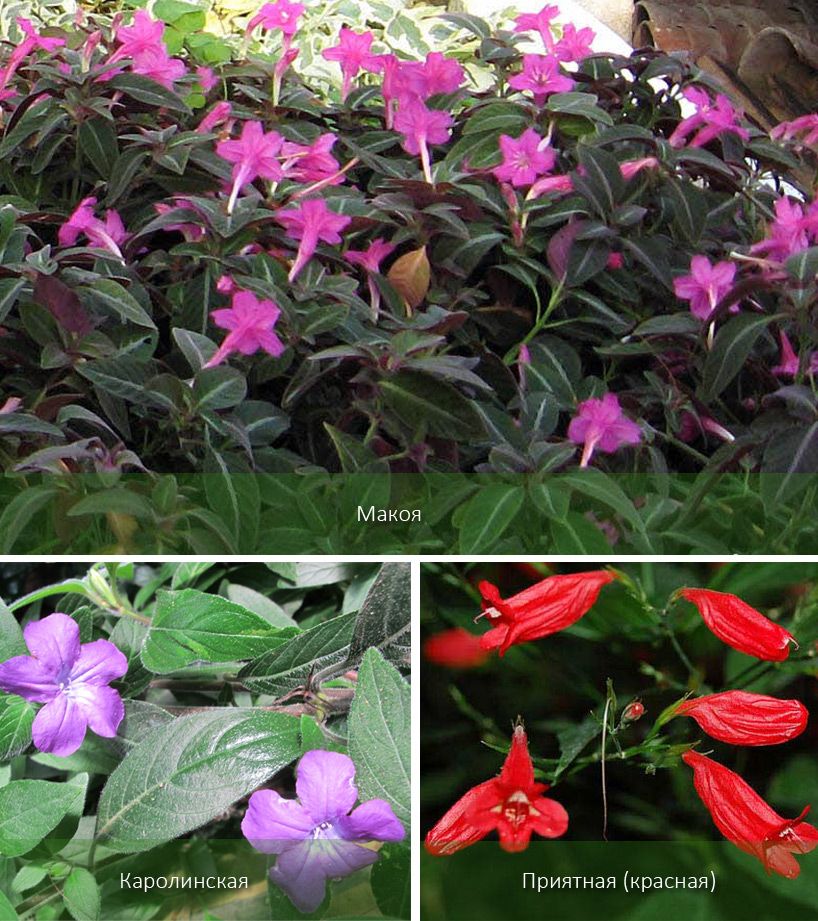
| Nice (red) | Erect up to 1 m. | Oblong-oval, glossy (12 cm) with high petioles. |
Tubular, bright red (3 cm long, 1 cm in diameter). Almost all year round. |
| Makoya | Branched (60 cm). | Dense green with silver stripes (about 7 cm), underside with purple hairs. |
Pink (2 cm). August - January. |
| Caroline (less whimsical). |
Herbaceous, long, bare (50 cm). | Pointed dark. |
Blue-violet (6 cm). End of summer – beginning of winter. |
Caring for Ruellia at Home
In general, indoor species are not particularly demanding; they require good lighting during flowering, and not all of them (Makoya, Carolina).
| Factor | Spring/summer | Autumn/Winter |
| Location/lighting | On the eastern window, if located on the southern one, protect from the sun. | In the south, if there is a shortage, they are illuminated with phytolamps. |
| Doesn't like drafts. | ||
| Temperature | +20…+25 °C. | +16…+18 °C. |
| Watering | 2-3 times a week, generously. | Once every 2 weeks in moderation. |
| Humidity | Increased. Place away from heating appliances. Do not spray, place in a tray with wet gravel, next to an aquarium and a humidifier. |
|
| Top dressing | Once every 2-3 weeks with liquid mineral fertilizers for ornamental plants, half the dose. | Not required. |
Planting, replanting, and shaping indoor Ruellia
Young plants are repotted annually, starting at age 3, as their root system grows. This is done in the spring (March–May).
The soil should be light and breathable. Use a commercial all-purpose potting soil or a mixture of garden soil, leaf mold, coarse sand (perlite), and peat (2:3.5:2:2.5).
The prepared soil mixture is heated in a water bath for 10 minutes for disinfection.
Step by step process:
- Prepare a new pot: the diameter is 3-4 cm larger, it has a drainage hole and a drainage layer (small pebbles, vermiculite, expanded clay).
- Carefully remove the flower from the old container.
- The roots are inspected and any damaged ones are removed (using a sharp knife boiled in water for 10 minutes and then treated with alcohol). The cuts are sprinkled with charcoal. Dry and exposed branches are removed.
- Add 3 cm of soil onto the drainage layer, place the plant and sprinkle with the remaining substrate.
- Water and place in the chosen location.
- For better acclimatization during the growing season, young seedlings are fed with fertilizers (Uniflor-bud, Flower happiness) once every 2 weeks.
To force the ruellia with creeping shoots to grow upward, it is supported.
To form a beautiful bush, the flower is regularly pinched and bare shoots are removed, this stimulates branching and the appearance of new growth.
Propagating Mexican petunia at home
To obtain new plants, four methods are used: cuttings, seeds, layering, and dividing the bush.
cuttings
The easiest way:
- Take the cut branches after the next pruning (10-12 cm).
- Place in a glass with a solution that enhances root formation (kornevin, epin, heteroauxin) for 24 hours.
- If there are large leaves, shorten them by 1/3.
- Plant in a moistened substrate (peat, sand 1:1).
- Cover with a glass container or plastic.
- They air it out every day.
- Maintain at a temperature of +21…+22 °C.
- When roots form (after two weeks), transplant into a pot with normal soil for ruellia.
Layers
This method also does not require much effort:
- Bend the stem towards the ground so that one of its parts touches it, deepen it a little, and sprinkle it with earth.
- When roots appear, separate it from the mother bush and plant it separately.
Seeds
Compared to other indoor plants, this method for ruellia is also not difficult.
After the capsules have ripened, they are picked off, pressed down, and the fallen seeds are planted according to the following scheme:
- They are distributed over the surface of a prepared wide container with soil (peat, sand 1:1), lightly sprinkled with earth.
- Cover with glass or film to ensure a temperature of +21…+22 °C.
- Ventilate periodically.
- After the sprouts appear (after a month), provide good lighting.
- When 4-5 leaves have grown, they are transplanted into pots.
Bush
When repotting a mature, overgrown plant, divide it into sections. This is done carefully to avoid damaging the main, thick root system. Each new plant is planted in its own pot. Care is taken, following all the ruellia care guidelines and rules.
Ruellia care difficulties, diseases and pests
The plant is not particularly susceptible to disease and attacks by harmful insects, but if maintenance rules are not followed, a number of problems arise that require immediate intervention.
|
Symptoms External manifestations on leaves |
Cause | Methods of elimination |
| Yellowing, falling off. | Drafts, insufficient watering or excess moisture. | They adjust watering regimes and move them away from wind currents. |
| Twisting and dry ends. | Dry air. | Provides hydration. |
|
Stretching and exposing stems. Shallowness. |
Insufficient lighting. Old age of the plant. | They are moved to a brighter place or illuminated with phytolamps. They rejuvenate the bush. |
| Spotting. | Strong open sun, high temperature. | Move away from sunlight, shade. |
|
The appearance of a web. Yellow spots, curling, drying out. |
Spider mite. | Spray with Actellic (4 times every 3 days). |
|
Invasion of small white insects. Yellowing, falling off. |
Whitefly. | |
|
Small green, black pests. Stickiness, change of shape. |
Aphid. | Wash with soapy water and treat with Fitoverm. |
|
White coating. Drying. |
Powdery mildew. | Remove damaged parts. Use a fungicide (Bordeaux mixture) three times every 10 days. |
| Fluffy coating and dark spots on flowers. | Gray rot. | The diseased areas are trimmed off and the cuts are sprinkled with charcoal. The entire plant is treated with immunocytophyte. |