Salpiglossis is a genus of plants in the nightshade family. Another name, "trumpet tongue," comes from the shape of the flower corolla, which resembles a folded tongue. It is native to South America, including Peru and Argentina, and grows in large numbers in Chile.
Content
Description of the salpiglossis flower
This annual plant has erect, slender stems. Its height varies from 50 to 100 cm, with little branching. The shoots are uniformly covered with short, bristly hairs and feel sticky to the touch.
The root system is of a mixed type: with a main taproot and developed lateral roots.
The leaves are dark green, petiolate at the base of the shoots, and oblong in shape. In the middle tiers, they have short petioles; in the upper tiers, they are sessile, narrow, and notched-lobed. Leaf blade margins can be smooth or serrated.
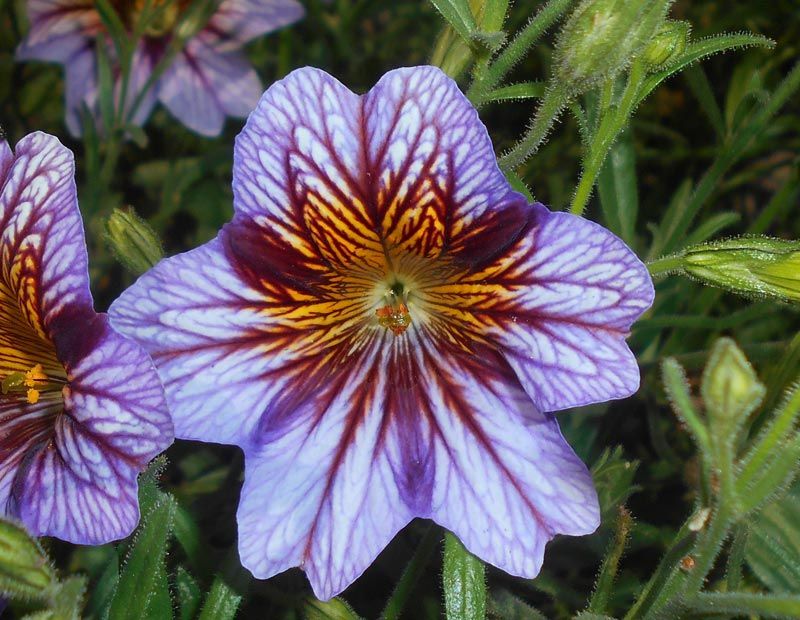
The flower is large, 4-6 cm in diameter, and grows solitarily on the stem. It resembles a perfectly shaped funnel. It has five petals—lobes. The coloring is varied and rich: purple, yellow, shades of red, and blue. A distinctive feature is the distinctive lines on the petals: gold, burgundy, or scarlet. Each marbled stripe pattern is unique and never repeated. The flower's shape resembles a bell, and its coloring resembles an orchid. Blooming continues from midsummer until September, and until November in warm climates.
The seeds are lightweight, formed in oval capsules, and have a long germination period of 4-5 years.
Types and varieties of Salpiglossis
The genus comprises 20 species, but only one—Salpiglossis sinuata—is used for garden cultivation. Several forms have been developed from it through selective breeding:
- Large-flowered. The tallest is 90 cm, densely branching with large buds.
- Superbissima. Distinguishing features include corrugated petal surfaces with prominent veins. Medium-sized bush, up to 60 cm.
- Low. Dwarf: up to 40 cm, lush and profusely flowering. Suitable for growing in containers.
Popular varieties:
| Variety | Peculiarities | Flowers |
Height (cm) |
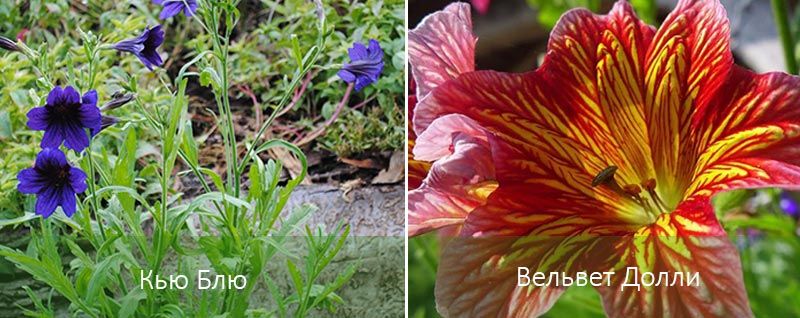
| Q Blue | Grown in greenhouses or used for forcing in spring. | Bright pink and purple shades with golden veins. | Up to 30 |
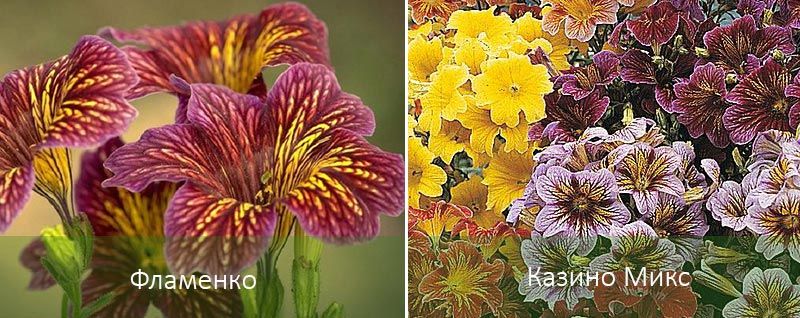
| Casino Mix | It is necessary to tie it to supports. | Multicolored. Red with a yellow throat. | 40-50 |
| Festival and Flamenco | The shortest. | The coloring is varied. | About 30 |
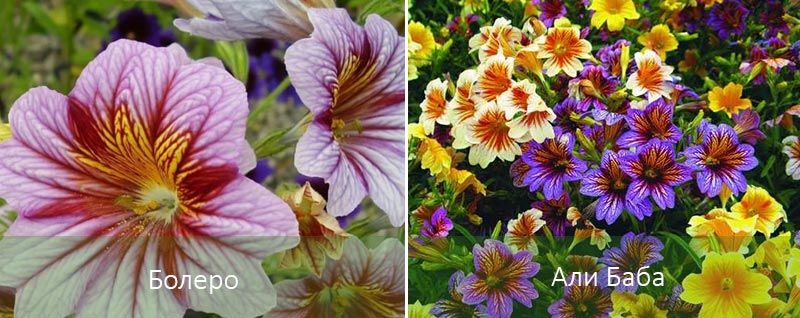
| Bolero | Abundant flowering, strong stems. Tolerates direct sunlight and partial shade. | Pink with raspberry stripes. | Up to 60 |
| Ali Baba | Fragile tall stems need support. Flowers are suitable for cutting. |
Cream, purple, yellow. The colors are rich. | 70-80 |
| Velvet Dolly | Compact, buds with rich color. | The surface of the flower is velvety. | 40 |
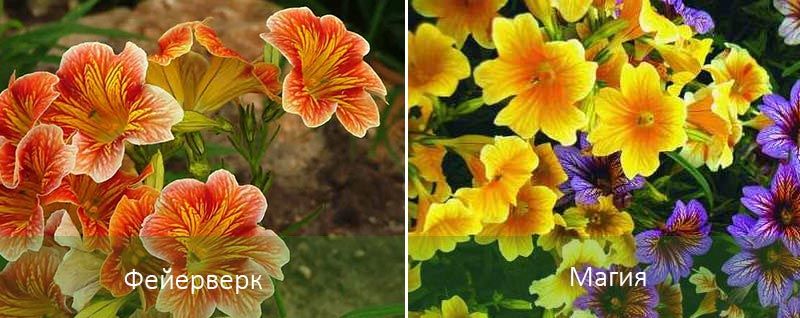
| Fireworks | Good for bouquets or landscape design. | Bright lilac. | 50-65 |
| Magic | Large flowers up to 6 cm. | Many shades of red, white with yellow veins. | 40-60 |
Growing Salpiglossis
Planting and caring for salpiglossis is quite simple; simply follow the suggested guidelines. This ensures that these exotic flowers will delight gardeners with their vibrant, unusual beauty in their flowerbeds for a long time, and some varieties will even delight them on their windowsills.
Reproduction of Salpiglossis
Propagation occurs by seeds, which are sown in March in containers for seedlings, spreading them on the soil surface without covering them with soil. There should be no more than five seeds per pot. For germination, cover with a plastic bag and place in a warm, shaded area. The optimal temperature is +20°C.
To speed up the emergence of seedlings and prevent subsequent sunburn, white paper is placed on top.
Seedlings should be pricked out carefully to avoid damaging the root system. The best time for this procedure is when one or two leaves appear. When transplanting to a flowerbed, it's important to retain some of the root ball on the roots to help them establish in their permanent location.
You can also use the direct-seeding method. Dig 2.5 cm deep holes 25 cm apart, lightly cover the seeds with soil, and moisten them.
Sow outdoors in April to early May, and the plant will bloom in July. In warmer climates, sowing can be done in late fall, which will result in earlier blooms.
Selection and preparation of soil
Before sowing or planting in a flowerbed, prepare the soil. Dig over the selected area 7-10 days beforehand and add ash and sand. Humus in the soil is also beneficial. The plant prefers a neutral or slightly acidic environment: pH 5.4-7.0. Therefore, peat should be added in small quantities.
The soil should be loose and easily drainable. Stagnant water is avoided; the soil should be slightly moist.
If the soil is poor, add another portion of ash immediately before planting and dig the flowerbed again. The plant reacts strongly to the lack of nutrients: flowering and bud formation cease.
Location
The optimal planting location is a sunny spot protected from strong drafts. Growth is possible in shade, but flowering will be weak.
Dangerous diseases and pests
The plant is affected by diseases such as:
- Root or stem rot due to excess water or frequent watering.
- Fungal diseases: powdery mildew and late blight.
Most infected flowers die. To prevent this, regularly inspect the bushes and treat them with fungicides.
Salpiglossis is resistant to many pests, the main enemies are:
| Pest | Signs | Elimination |
| Aphid | The plant looks sick. The foliage turns black and dries up. The buds change shape and fall off. | Lemon or orange peels: 0.5 cups of water, 100 g, leave for 3 days. Soda-soap solution: for 1 liter of hot water, 1 tbsp. soda and ¼ bar of soap. |
| Thrips | Yellow or discolored spots and streaks on leaf blades and petals. Wilting and shedding of foliage, and shoot death. |
Air humidification. Regular inspection of plants. Treatment with medications such as Intavir, Karate, Actellik, and others. Spraying with garlic tincture (2-3 cloves per cup of boiling water). |
| Spider mite |
Treatment with soap solution: 300 g per 10 l; onion peel infusion 100 g per 5 l. Use of acaricides: Neoron, Skelta, Fitoverm. |
Caring for Salpiglossis in the Garden
Salpiglossis is an easy-to-care-for plant. However, care should be based on the following recommendations:
- Tall varieties are secured to supports, which prevents thin stems from breaking and maintains a neat appearance.
- The plant appreciates regular watering. Insufficient watering negatively impacts flowering and growth. To avoid overwatering, wait until the soil dries out. In hot weather, water the flowerbed every day. In autumn, reduce the frequency to 2-3 times a week.
- To form lush, compact bushes, the tops of the plants need to be pinched. This is done 3-4 times during the seedling growth period.
- The number of buds will increase if you remove wilted flowers.
- Salpiglossis loves moisture, and daily spraying in the evening is essential.
- Frequent fertilization with mineral fertilizers is necessary. A complex fertilizer for flowering plants is suitable; it should be applied every two weeks. Ash can also be used.
- Weeding and loosening the soil.
Wintering of Salpiglossis
In cold climates, the plant grows outdoors for one year. Perennials are suitable only for southern regions. You can try repotting salpiglossis in the fall, but not all varieties thrive. Tall containers with a drainage layer at the bottom are suitable for this purpose. Adding pieces of charcoal will further lighten the soil.
The plant requires filtered light; direct sunlight is possible, but brief. Indoors, west- and southwest-facing windowsills are ideal. If the light level is insufficient, it will not bloom and will become tall.
This southern flower doesn't like cold; temperatures should be no lower than 16–18°C. If the room is warmer than 25°C, ventilation is necessary.
Top.tomathouse.com recommends: Salpiglossis in landscape design
Salpiglossis, due to its ornamental qualities, is widely used in landscape design. It can be planted in group formations in flowerbeds or borders, and also alongside:
- petunias, especially white ones, as a bright accent;
- salvia;
- cineraria;
- marigolds (they can be used to effectively decorate a gazebo or flower bed);
- ornamental cabbage;
- matricaria;
- chrysanthemum;
- coniferous plants.
The flowers will look unique in bouquets. They retain their attractive appearance for a long time after cutting. They are best planted along paths or in the foreground of a flowerbed. If planted too far away, the flowers will not be able to appreciate the colors.
Salpiglossis is an exotic southern plant that will brighten up any garden flowerbed. Its wide variety of colors ensures every gardener will find the perfect match.