In this article, we'll cover all the nuances of growing salpiglossis from seed, explaining how to choose the best planting location, how to sow, and when. But first, a few words about the plant itself.
Salpiglossis is a herbaceous plant in the Solanaceae family, native to South Africa. It is an unusual flower with striking, marbled petals (gold, white, purple, and yellow), a velvety fringe, and distinct veins. Its name translates as "curled tongue."
There are annual, biennial, and perennial species. Among them, breeders have developed low, medium, and tall varieties. Annuals are popular here, such as 'Ali Baba,' which reaches a height of 80 cm and is distinguished by its red, variegated color. The flowers have a long-lasting fragrance.
Salpiglossis is grown in flowerbeds, along paths, and near arbors. Different species are combined with each other, as well as with marigolds, lobelia, petunias, and lobularia. Dwarf varieties look beautiful on windowsills, balconies, and verandas, and are used in bouquets.
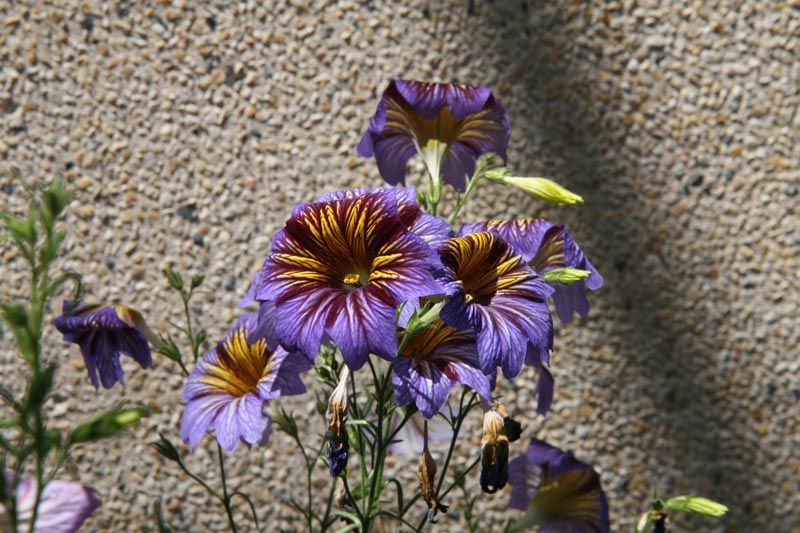
Growing Salpiglossis from Seed
The plant is propagated by seed. There are two ways: sowing directly into the soil or growing seedlings first. You can choose your favorite variety at flower shops or pick them from your garden.
Growing from seed directly in open ground is ideal for warm climates. Flowering will begin in June. In the spring, when the weather warms up, you can begin planting in April or May.
Add humus, sand, and wood ash to the soil in the selected area. Peat increases acidity, and the plant prefers neutral to slightly acidic, well-drained soil. Then, dig the soil, making furrows 25 mm deep. Sow at a distance of 20-25 cm. Cover with soil and water. When the seeds germinate and reach 3-4 cm in height, thin them out, leaving strong shoots.
When planted in the fall, seeds germinate earlier, but this may not happen after harsh winters. To do this, first prepare the soil: apply the necessary fertilizers before frost and dig the soil. Then, wait until the ground freezes to prevent the seeds from germinating prematurely. Plant in the same way as in the spring. For the winter, cover the soil well with lutrasil, dry leaves, and spruce branches.
Sowing seeds
In temperate climates, it's best to grow this flower from seedlings. The seeds are highly resistant to diseases and pests, so they don't require treatment. The plant prefers neutral, slightly acidic soil. It's recommended to sterilize the substrate in a water bath or oven for about 40 minutes. You can also purchase ready-made potting soil for flowering plants at the store.
The time to plant seeds for seedlings is March:
- Prepare wide, shallow containers.
- Add loose soil containing turf, sand, and ash in the proportions of 2:1:0.5.
- To reduce acidity, add a little peat.
- The soil is slightly moistened.
- Distribute the seeds over the entire surface without covering them, just pressing them lightly into the soil. Leave a larger distance between them.
- Moisten again with settled, warm water using a spray bottle.
If you're planting them in individual containers, place 2-3 at a time (remove weak sprouts later). Cover with plastic wrap or glass. At home, choose a bright location with a temperature of 18 to 20°C. Place paper on top, if necessary, to protect the sprouts from direct sunlight. Seed germination is typically 80%.
Growing seedlings
The seed container is aired daily and watered every 2-3 days. Sprouts appear 15-20 days after sowing. The cover is not removed immediately, but left on for 1-2 hours, then 3-4 hours. After the first pair of true leaves has formed, transplant them into separate containers.
This is done carefully so as not to damage the weak root system.
Place the seedlings in a sunny spot, shading them from direct sunlight. During periods of intensive growth, be sure to pinch them before placing them in the garden bed. Water moderately, ensuring the soil does not dry out. At this stage, the plant may require support to prevent the thin and fragile shoots from breaking. In cloudy weather, provide supplemental lighting with phytolamps.
Before placing the seedlings in the ground, they are hardened off by taking them outside or onto a balcony for several hours.
Planting in open ground
In mid-May, choose a site for planting in a flowerbed. The area should be moderately lit, loose, and fertile. Salpiglossis prefers a sunny location protected from the wind; it will bloom less in partial shade.
Step by step actions:
- Two or one and a half weeks before, dig up the soil, add ash and dolomite flour.
- Sand, humus or peat are added to clay soil.
- When the temperature reaches at least +10 °C, dig up the soil before planting.
- The seedlings are planted at a distance of 30 cm.
- First, the seedlings are watered, then, together with the root ball, they are lowered into the planting holes using the transfusion method and covered with soil.
- Water again and install supports if necessary.
- The soil is mulched with compost.
The flower will bloom in June and will delight you with its blossoms until October.
Outdoor care
Further care consists of regularly watering the roots with warm water (fill a large container in advance to warm it in the sun). Avoid allowing the soil to dry out, otherwise the plant will wilt and fail to recover. Overwatering promotes the development of fungal diseases. After watering, loosen the soil around the plants and remove weeds. In the evening, during dry weather, spray the shoots.
Fertilize with mineral and organic mixtures twice a month, especially during flowering. Remove faded and dried inflorescences. Pinch out the central shoots to create a beautiful bush.
Among pests, aphids can attack the flower; they can be controlled with a concentrated garlic infusion, a soap solution, or insecticides. If stem or root rot appears, the bushes should be dug up, destroyed, and the soil treated with fungicides. This can occur with frequent, heavy rains, excessive watering, low temperatures, or if the flower is growing in the shade.
https://www.youtube.com/watch?v=otuGbXBLiKw
Top.tomathouse.com informs: collecting salpiglossis seeds
Salpiglossis can reproduce by self-seeding if the weather is warm and rainy. Gardeners can collect seeds in October. The largest inflorescences are left on the bush. After wilting, an oval capsule-shaped fruit forms. This capsule is cut off, dried in a dark, dry place, and the bushes are removed. The seeds are placed in a cloth bag and resown in the spring. The seeds remain viable for 4-5 years.