Schefflera, or schefflera, is a tree in the Araliaceae family, a distant relative of ivy and ginseng. In its natural habitat, it is considered a weed, suppressing other plants. However, with proper care, it becomes an exceptionally beautiful houseplant.
Content
Description of Schefflera
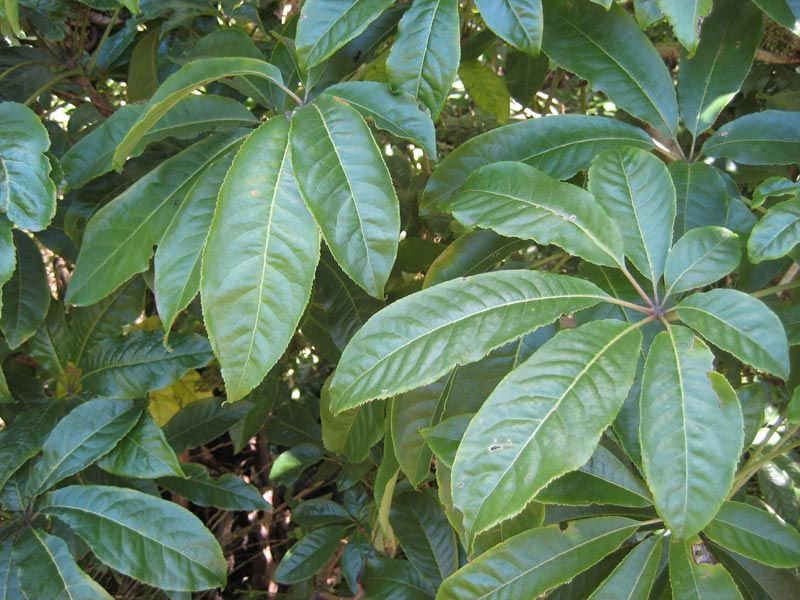
Gardeners appreciate the Schefflera for its lush crown and complex, palmate leaves. These can come in a variety of shapes and colors depending on the species, forming a beautiful, spreading crown. This plant blooms with small, unsightly white or yellowish inflorescences.
The tree's trunk is slender and woody. In its native habitat, Schefflera can grow up to 40 m. When grown indoors, it reaches 1.5-2 m.
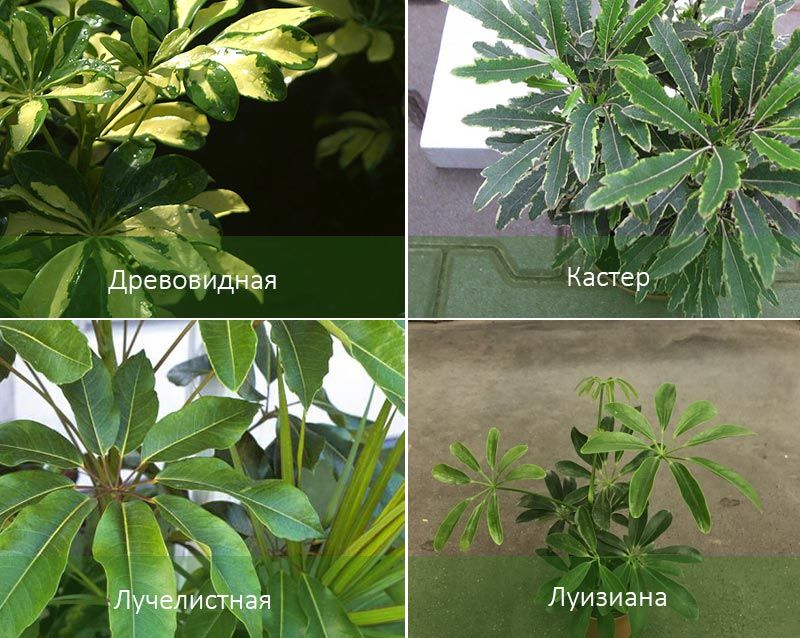
Types and varieties of schefflera
There are over two hundred varieties of schefflera worldwide, but not all of them are grown as houseplants. The most common are low-growing varieties with vibrant, spreading foliage.
| View | Peculiarities |
| Amate | Very large, dark green, spotless leaves with a waxy sheen. Shade-loving. Height up to 2.5 m. |
| Bianca | The leaves are short, dark green, with yellow serrated edges. |
| Eight-leafed | The leaves are green with yellow spots, each consisting of eight oval blades and studded with small, light-colored needles. It reaches 2 m. |
| Gerda | Variegated leaves in dark and light green. Height 0.5-2.5 m. |
| Gold Capella | The trunk is straight and long. The leaves are large, bright green with golden spots. It reaches a height of 120 cm. |
| Arboricola | Compound, light green leaves with rounded tips are densely arranged on a straight trunk and decorated with rare yellow streaks. |
| Caster | Dark green, smooth, spotless foliage. Reaches 120 cm. |
| Louisiana | Beautiful glossy leaves in variegated green shades. |
| Star-leaved (Ray-leaved) | Most commonly found indoors. Large leaves in various shades of green, with serrated tips. Red flowers. Up to 2.5 m. |
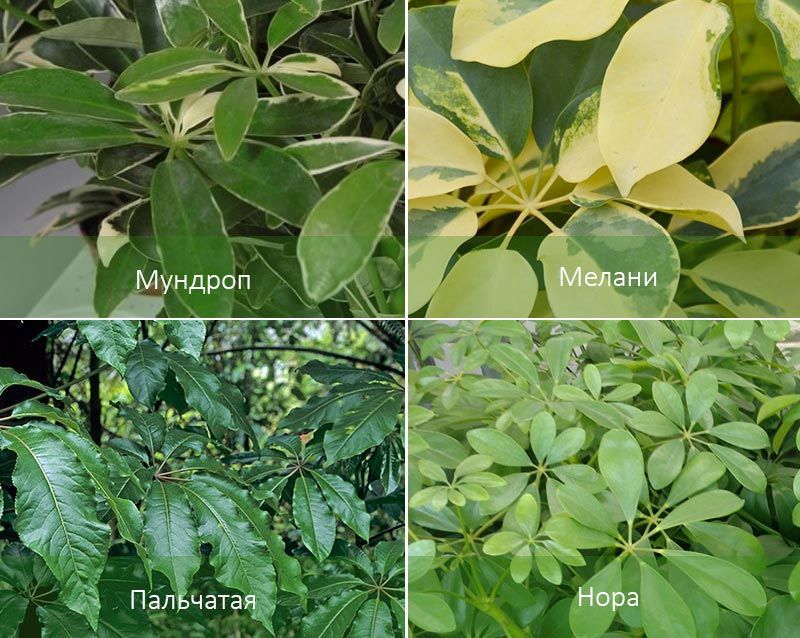
| Melanie | The leaves are large, an unusual greenish-yellow color, often with dark green edges or spots. Unpretentious. Height up to 1.5 m. |
| Moondrop | Multi-stemmed. Small, green leaves with yellow spots. Up to 40 cm. |
| Nora | The leaves are thick, narrow, with yellow specks. |
| Palmate | Dark green leaves with pronounced veins and pointed tips. Large inflorescences. |
| Variegated | The leaves are partly dark green, partly yellow. Unpretentious. D 1.5 m. |
| Spotted | Large leaves with yellow streaks and serrated edges. Unpretentious. |
| Charlotte | The leaves are light yellow on top and dark green underneath, shaped like hearts. Low-maintenance and low-growing. |
Caring for Schefflera at home
Schefflera prefers conditions similar to those found in its native habitat—the tropical and subtropical forests of China, Taiwan, and New Zealand. Creating these conditions indoors is quite easy.
Lighting
This plant loves light, but will burn in direct sunlight. Therefore, placing it on south-facing windowsills in summer is not recommended, but only in winter. North-facing windowsills will be too dark (except for shade-loving varieties such as Amate, Bianca, Arboricola, and Caster).
The ideal location is an eastern or western window, provided that on hot sunny days the plant is removed from the windowsill or shaded until the sun goes down.
Temperature
The optimal temperature is 15 to 22°C. Avoid overcooling: if the temperature drops below 10°C, root rot begins. The room with variegated varieties should not be cooler than 18°C—they prefer warmth more than green varieties.
Watering and humidity
Watering should be moderate—schefflera dislikes excess moisture. Use only settled, room-temperature water. Cold water, like cold air, can promote rot.
Furthermore, the plant prefers humid conditions, so it requires regular misting with warm water. Mature leaves can be gently wiped with a damp cloth.
Soil requirements
Schefflera requires nutritious, slightly acidic soil.
A ready-made palm mixture from the store or one prepared at home from turf and leaf soil, humus and sand in a ratio of 4:3:2:1, respectively, will do.
To prevent water from stagnating in the pot and causing root rot, ensure a drainage layer beneath the soil. Expanded clay or gravel are suitable, for example.
Planting container
It's best to use a pot that widens toward the top. Ideally, its height and diameter should be roughly equal. Drainage holes are essential, even for ceramic containers.
Fertilizer
During the winter, the plant goes into a dormant period, so fertilizing is done from March to September, when it's actively growing. Apply mineral fertilizers 2-3 times per month. Between fertilizing, sprinkle crushed eggshells into the pot.
Features of pruning
To keep the schefflera plant lush and rounded, trim it occasionally. You'll need sharp pruning shears and crushed activated charcoal to disinfect the cuts.
On a young plant, four internodes are pruned from the top branches to prevent it from growing too tall. Once the side branches have reached the desired length, their tops are also pruned to encourage branching.
Most often, gardeners strive to grow Schefflera as a standard (a straight, bare trunk) with a crown shaped like an elegant ball. Sometimes, they also cultivate bonsai.
It is not recommended to prune too often or to prune too many shoots at once – the plant does not tolerate this procedure well.
Transfer rules
When the roots fill the entire pot, it's time to repot. Young plants should be repotted annually, while older plants should be repotted every three to four years.
The optimal time is spring, when the plant comes out of dormancy.
There is no need to take a pot much larger than the previous one; a difference of 5 cm is enough - otherwise, the plant will spend energy not on growing leaves, but on growing roots.
The plant's roots should be transplanted to a new location, along with the root ball. The remaining empty space in the pot is filled with fresh soil, lightly compacted, and watered. Avoid burying the trunk; the soil level should remain the same.
Features of reproduction
The best time to propagate Schefflera is in the spring. Summer is too hot, and winter lacks daylight. Gardeners use three methods:
- growing from seeds;
- cuttings;
- air layering.
Seeds
Seeds should be purchased from a store, as they are difficult to obtain at home, as the plant rarely flowers. You'll need a planting container large enough to easily transplant the young plants.
Planting is carried out in the following order:
- The seeds are soaked for a day in a solution of epin or zircon (one to two drops per 100 ml of water).
- The bottom of the container is lined with a drainage layer, and then filled with at least 20 cm of soil consisting of earth and sand in a 1:1 ratio.
- Each seed is placed in a separate hole measuring 15 cm and covered with soil.
- The container with seedlings is covered with film and placed in a warm place (optimal temperature +25 °C).
- The seedlings are regularly ventilated, watered, and the emerging shoots are sprayed.
- Transplanting into separate pots is required when the seedlings have two fully formed leaves.
Cuttings
This is the simplest and most common method. Cuttings can be obtained during routine pruning. Select branch tips with woody stems and a few leaves.
When propagating variegated varieties of schefflera by cuttings, it is important to remember that they root worse than green-leaved varieties.
Algorithm:
- Before planting, the cutting is cleared of lower leaves, and the cut is treated with a root growth stimulator.
- Drainage holes are cut in a large plastic cup, a small amount of expanded clay or perlite is added to the bottom, and then the cup is filled with soil. A 1:1 mixture of peat and sand is suitable.
- The cutting is lowered into the soil a few centimeters, watered and covered with a transparent bag or half a plastic bottle.
- The seedling is kept at a temperature of +23 °C in the light, but not in direct sunlight, watered, sprayed and ventilated twice a day until fully rooted.
Air layering
To encourage aerial roots, cut one of the lateral stems of a mature plant and wrap the wound with a layer of moss or cotton wool, then cover it with plastic wrap. Periodically remove the wrap and moisten the compress. After roots appear, separate the stem and plant it in a separate pot.
Pests and diseases
Schefflera is susceptible to the same diseases as other houseplants. Its sap is poisonous, but some pests still pose a threat, such as thrips, scale insects, spider mites, and mealybugs. The following table will help you understand how to help a sick plant.
| Symptoms | Cause | Treatment |
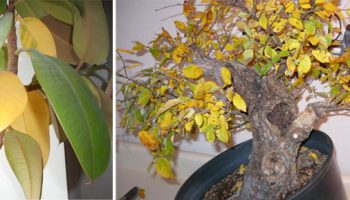
| Withered and falling leaves. |
|
Adjust the conditions of maintenance and care. |
| Drying and curling leaf tips. | Lack of moisture. | Provide sufficient (but not excessive) soil moisture, spray and wipe the leaves more often. |
| Blackened leaves, appearance of a rotten smell. | Root rot. | Remove the plant from the pot, trim off any damaged roots, and let it dry. Make sure the pot has drainage holes. Change the soil, making sure to add a layer of drainage material to the bottom. Avoid overwatering. |
| The leaves turn yellow and fall off, and on their reverse side there are small brownish growths. | Scale insect. | Isolate the plant. Treat the foliage with a soapy solution, after covering the potting soil with plastic wrap. If this doesn't work, use an insecticide (such as thiamethoxam) according to the instructions. |
| Brownish spots on the leaves. | Thrips. | |
| The leaves turn yellow, wither, fall off, and a thin web appears on them. | Spider mite. | Use insecticides. Maintain air humidity. |
| On the leaves and stems there are small white insects, leaving behind a whitish coating. | Mealyworm. | Collect the pests by hand, wash off the plaque, and spray the plant more often. |
Top.tomathouse.com recommends: Schefflera – a flower for harmony
In esotericism, Schefflera is credited with the ability to absorb negative energy. Its presence in the home is believed to bring harmony to the family and prevent discord, as well as improve memory and have a beneficial effect on studies and work.
There are even several folk signs associated with the condition of the plant:
- darkened leaves mean an excess of negativity in the house;
- falling ones are a harbinger of illness or a financial crisis;
- twisted - to a quarrel;
- unexplained growth cessation – to failures;
- sudden rapid growth – to an addition to the family.