Cotinus is a perennial shrub or low-growing tree of the sumac genus. It grows in Eurasia and North America. It is commonly known as the "smoke tree."
It has dark green or purple-burgundy foliage with flowers resembling a fluffy cloud. The tree not only decorates any area with its regal crown, but is also used to make medicinal infusions.
Content
Description
Cotinus is a flowering shrub with spreading branches. It grows to a height of one and a half to three meters. Its lifespan ranges from 45 to 100 years. Shoots emerge from the very base of the trunk. In older specimens, the bark begins to peel off in sheets.
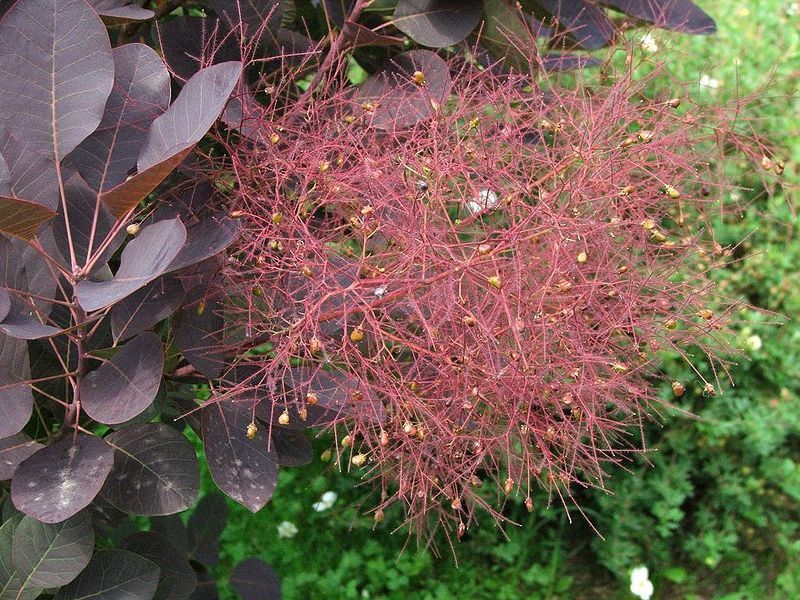
The leaves are round or oval-shaped, dark green, and have elongated petioles. The iridescent blades have entire or serrated edges. They grow to five to eight centimeters. In autumn, they turn red, yellowish, purple, crimson, and golden.
In late spring and early fall, long panicle-like inflorescences up to thirty centimeters long emerge from the foliage. The corolla consists of shortened petals and a cluster of elongated, thin stamens. The greenish-yellow flowers are small. In their place, long, hairy peduncles appear. These peduncles continue to grow even after the tree itself has ceased to flower. As a result, the smoke tree takes on a magical appearance, resembling a fluffy pink cloud.
This shrub is fruitful. It produces drupe-shaped fruits with thin, dark skin, which ripen in July and August.
Types of smoke tree
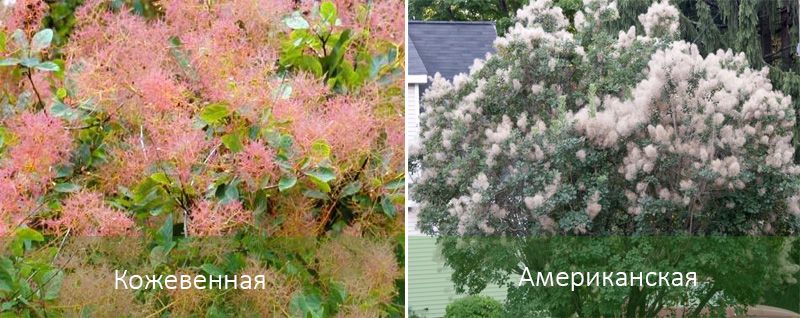
There are seven species of smoke tree, but only two are grown as ornamental plants:
| Name | Description |
| Tannery | Branching begins at the base and reaches a height of one and a half to three meters. The shoots have grayish-brown bark. Stems that reach one year of age become greenish or reddish. The rounded, alternate leaves display patterns of veins. In late May to early June, small yellowish or green flowers appear. After the petals fall, the panicles turn pink and lengthen. Soon, they bear pitted, pulpless fruits. |
| American | A tree with a branched crown, it grows up to five meters. The leaves are rounded and bright green, up to 12 centimeters long. A large number of inflorescences form during the first two months of summer. This species is frost-hardy. |
Varieties for the Moscow region
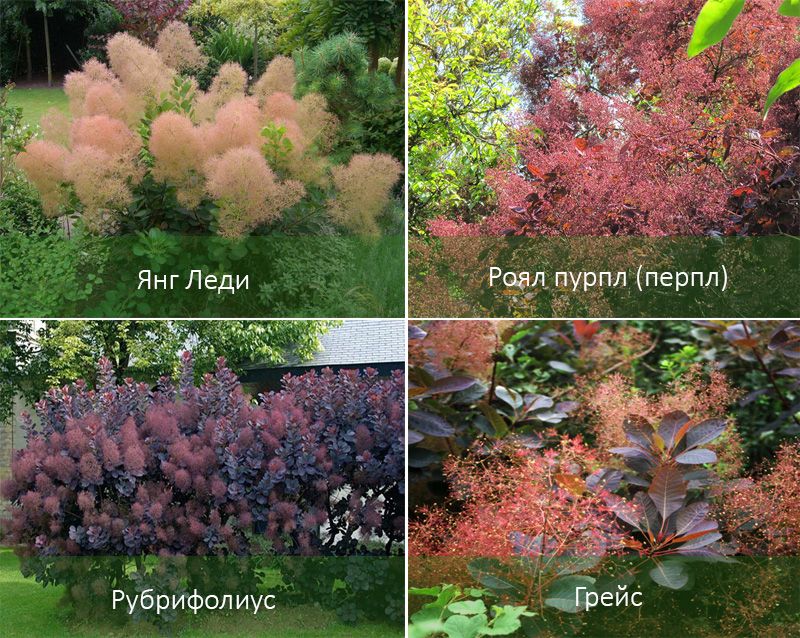
The following varieties of smoke tree thrive in the Moscow region and throughout the central region:
| Name | Description |
| Young Lady | A bush with rich green foliage, reaching four meters in height. Green flowers turn cream or pink over time. |
| Royal purple (purple) | A small, slow-growing shrub with a round, red-leaved crown that turns blue in autumn. Produces voluminous flower buds. |
| Rubrifolius | This is a heat-loving variety of smoke tree, but you can try growing it in the Moscow region, covering it during frosts. It has oval-shaped leaves of a violet-purple color. It reaches a height of three to five meters. |
| Grace | Cotinus Grace thrives in temperate climates. It is a fast-growing shrub with spreading branches, reaching three to five meters in height. The foliage is purple in summer and reddish in autumn. The leaves are oval-shaped. |
Hybrid varieties such as Lilla, Spirit, and Follis Purpureis can also be grown in the Moscow region. They are heat-loving and require protection from frost.
Landing
The most important thing is to choose the right location and soil. Seedlings are grown in containers throughout the summer. Planting takes place in the fall.
Location
For planting, choose the sunniest, open spot. A slope or a slight elevation is ideal. A low-lying area is unsuitable, as groundwater is close to the surface there. The plant dislikes excess moisture.
Keep in mind that smoke trees grow three to five meters laterally. When space is limited, it's best to choose smaller potted plants.
Soil
Cotinus is not picky about soil. Garden soil is fine, but light and airy soil is best.
The depth of the hole depends on the size of the shoot's root system. It is recommended to add lime to it for better growth. Although the plant can thrive in poor soil, it is best to cover the roots with soil mixed with compost and humus.
Care
Cotinus doesn't tolerate frost well. Therefore, before frost sets in, mulch with peat, sawdust, and pine branches. Before overwintering, it's recommended to cover the plant with agrofibre to prevent the rhizome from freezing.
Watering
Cotinus tolerates drought well. Only newly planted trees require watering. During dry weather, watering should be done once a week. Mature trees do not require watering.
Top dressing
Once the snow has completely melted, the smoke tree will need to be fertilized with a nutrient-rich fertilizer. This will help it quickly recover from the cold and begin vigorous growth.
Fertilizing is also done in June. Organic fertilizers such as cow manure or bird droppings are used. The shrub doesn't need fertilizing for the remainder of the season.
Trimming
Young plants need it. It promotes vigorous and abundant crown growth. This results in larger leaves.
Mature plants do not need pruning; if you get carried away with it, they will lose their decorative appearance.
Reproduction
Cotinus is usually propagated vegetatively: by layering and cuttings.
The best way to propagate the plant is by layering, as they root well. To do this, select a lower, healthy branch, make a cut, and bury the branch in the ground with this portion. Water the layering regularly to encourage rooting. Once shoots appear, cut the branch and plant it.
Step-by-step instructions for cuttings:
- cuttings with two or three leaves are cut in May-July;
- soak in Kornevin;
- planted in containers with airy garden soil, covered with a cap;
- the cover is removed every day and condensation is removed from it;
- Before the shoots begin to take root (this will take two to three weeks), they are carefully watered.
The smoke tree is also propagated by seeds, but this is done rarely:
- The seeds are placed in sulphate acid for five to ten minutes.
- Cold stratification is carried out at +3…+5°C for two to three months (the first point can be skipped, but in this case stratification is necessary for six months).
- After preliminary preparation, the seeds are planted in open ground in holes one and a half to two centimeters deep.
- The soil is regularly loosened and watered, but moderately.
When propagated this way, the first shoots appear within a few weeks. About half of the seeds germinate.
Diseases and pests
The tree or shrub is rarely affected by diseases and pests. Sometimes, the smoke tree is susceptible to:
- leaf beetle;
- bark beetle;
- psyllid.
When infected, the foliage dries up, and the smoke tree begins to wilt rapidly. To combat the cause of the tree's decline, insecticides are used, such as Karbosov. It can be purchased at a specialty store.
Top.tomathouse.com recommends: Cotinus – a beautiful healer
This plant not only beautifies any garden plot, but also has medicinal properties. Its healing qualities are studied in pharmacognosy.
Cotinus contains a large amount of the following useful substances:
- tannins;
- tannins;
- essential oils;
- organic acids.
Decoctions are made from the leaves and shoots. They are useful for the prevention and treatment of many pathological conditions. They help with pneumonia, gastrointestinal problems, and intoxication. They can also be used externally, in compresses, baths, and poultices for skin rashes and purulent lesions. Regular rinsing with the remedy is recommended. It relieves inflammation and stops bleeding gums.