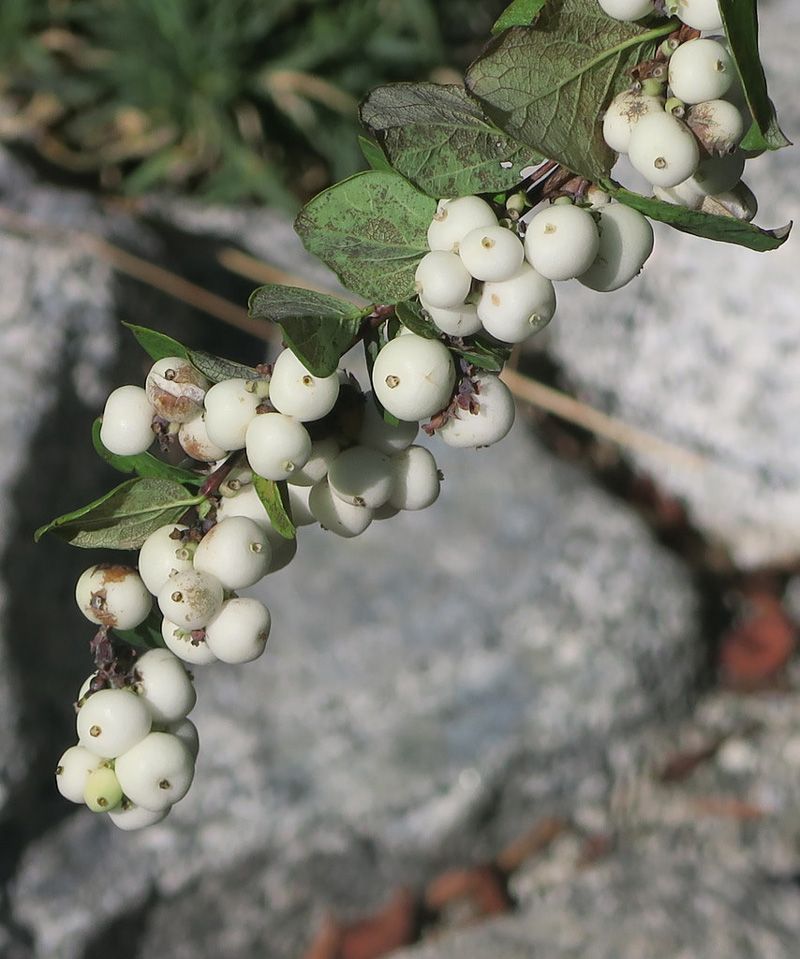
Snowberry (wolfberry) is a shrub belonging to the honeysuckle family. It is widely distributed in North America. The plant is not eaten because it is poisonous and can cause adverse health effects. However, due to its ornamental value, it is often used in landscaping.
Content
Characteristics and description of snowberry
Up to 20-300 cm tall. Entire leaves are set on underdeveloped petioles and arranged oppositely. The branches are flexible and do not break under thick snow cover during the winter.
The buds form racemes located in the leaf axils. The petals come in a variety of shades. Flowering can be observed in the second ten days of summer.
After the inflorescences fade, black-purple, round berries appear. They are 2 cm in circumference and have delicate, pearly flesh. Eating them is prohibited, as they can cause dyspepsia.
Types and varieties of snowberries
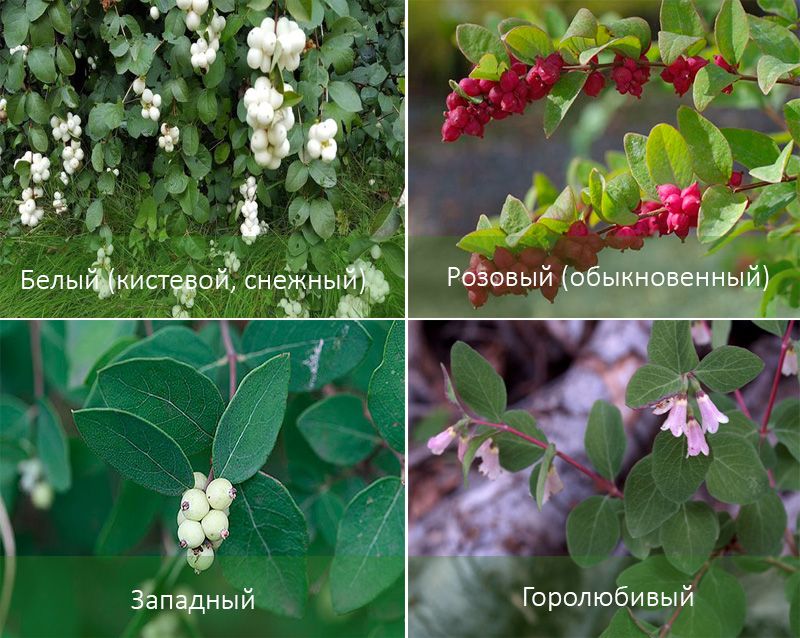
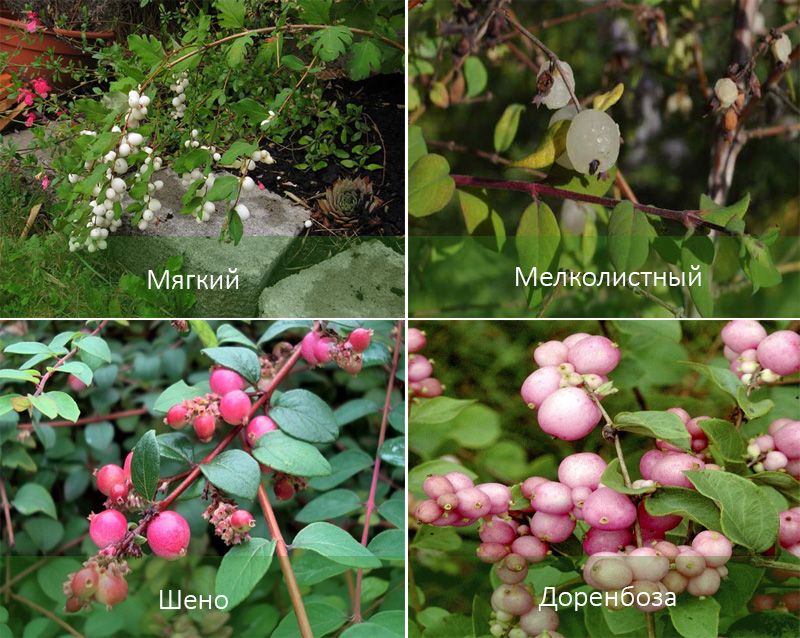
The genus includes 15 species. However, only a few are cultivated:
| View | Description | Berries | Height (m) Varieties |
| White (brush, snow) |
The first species to be included in the genus. It grows in forests, on mountain slopes, and along river banks. The branches are thin and arching, forming a spherical crown. The leaves are oval, malachite on the outer surface and glaucous on the inner surface. The flowers are small and pinkish. They grow along the entire stem. Resistant to severe frosts, it has been cultivated since 1879. |
They ripen at the same time as the buds. You can watch them throughout the winter season until the birds peck them. |
1.5. The most popular is low-gloss. |
| Pink (regular) | It can be found in meadows and floodplains. Its foliage is emerald, with a grayish underside. In autumn, it turns scarlet. Its frost resistance is lower, but it survives winters in our country well. | Red, with an ash-colored dusting. Scattered throughout the bush. |
2-3.
|
| West | It lives near water bodies and mountains. The greenery is light malachite, pubescent underneath. | Crimson or pudding-white, closely adjacent to the neighboring ones. | 1.5. |
| Mountain-loving | It grows in western North America. The leaves are hairy. The flowers are solitary or paired, pinkish or snow-white, bell-shaped. | A whitish two-seeded drupe. | |
| Soft | With creeping shoots. The petals are bright: pudding or amaranth. | Large, pearly. | |
| Small-leaved | Native to Mexico, New Mexico, and Guatemala. Stems are densely hairy. The foliage is dark emerald, lighter in color. Available with or without hair. | White with a crimson tint. | 3. |
| Chenault | A hybrid form. Frost-tolerant. Leaves emerge in early spring and remain until late fall. | From snow to purple. |
1.5. The most popular is Hancock. |
| Dorenboza | Hybrids named after the breeder who developed them, Dorenboz. They are a cross between the white and common snowberries. The flowers are densely packed throughout the bush. | A variety of tones. |
Up to 1.5.
|
Planting snowberries in open ground
The tree grows in full sun or partial shade, on level ground or on a slope. The substrate can be moist or dry.
Planting takes place in May or September-October. For spring planting, the soil is prepared closer to winter, before snow falls. For fall planting, the soil is prepared approximately 30 days before planting in the garden soil mixture.
Step by step actions:
- Dig over the area, adding 1 cup of limestone flour, 3 tbsp. of ashes from burnt wood, and 2 tbsp. of superphosphate. The dosage is indicated for one bush.
- 30 minutes before planting, place the underground part in a mixture of water, clay and mullein so that it is saturated with moisture.
- Dig holes 0.4 m deep, 0.5-0.6 m in circumference, leaving a gap of 1.2-1.5 m.
- Pour sand, peat, humus, compost and additives that were used for digging onto the bottom.
- Place the seedlings in the center so that after the substrate settles, the root collar is above the ground.
- Tamp the soil down to avoid any air pockets, which will cause the roots to dry out.
- Water generously.
When planting a hedge, dig furrows 60 cm deep and 40 cm long. The bushes should be four years old and should be placed in a horizontal line (for example, along a stretched string) at a distance of 20-25 cm.
Caring for snowberries in the garden
Planting and caring for this shrub is fairly simple. The most important thing is to follow these guidelines:
| Factor | Description |
| Watering | Daily for the first few days. After that, natural rainfall is sufficient. In dry weather, water, using 10-15 liters of water per plant. To retain moisture longer, mulch the bushes with peat. |
| Loosening | Apply after precipitation and each time the soil becomes moist. Pull out weeds during the process. |
| Top dressing | In spring, apply mineral or organic fertilizers. In midsummer, water with a solution of Agricola (2 heaped tablespoons per 10 liters of water). |
| Picking | Only perform this in emergency situations, such as when the root system is overgrown or the soil is infected. During the process, be very careful not to damage the rhizome. In mature plants, the rhizome is extensive, so begin digging away from the main trunk to avoid damaging the roots. |
| Haircut | This should be done in the spring before the sap begins to flow through the stems and leaves. Remove dried and broken branches and trim shoots growing in the wrong direction. Treat the cuts with garden pitch to prevent infection. Rejuvenation pruning is done at 50-60 cm from the ground. This will encourage new shoots to grow throughout the summer. Pruning does not affect flowering, as flowering buds are located on the current year's branches. |
| Other care | At the end of the growing season, dig up the area with snowberries. |
Reproduction of snowberry
Can be propagated by seeds and vegetatively.
Seeds
This method of cultivation is rarely used because it is time-consuming and labor-intensive. Preparation:
- Clean the seeds from fibers.
- Place in a nylon cloth and squeeze out.
- Pour into a bowl of water.
- Mix well.
- Wait until the seed material settles and the remaining pulp floats to the surface.
- Remove the seeds and dry.
Sowing occurs in late autumn. This is done not in open ground, but in seedling containers. Step-by-step planting:
- Fill the container with sand, humus, and peat, mixed in equal parts.
- Spread the seeds evenly and sprinkle with a thin layer of sand.
- Cover with plastic wrap. Remove it daily for misting with a fine-nozzle sprayer, ventilation, and collection of condensation from the walls. Bottom watering is also an option.
- The first shoots can be seen in the spring. Transplanting indoor seedlings outdoors occurs at the end of the growing season.
Root shoots
The shrub produces numerous offshoots that form dense clumps. Therefore, the snowberry grows quickly outward and can become displaced.
This method is the simplest. Simply separate a well-formed clump and replant it. This will not only help you get new specimens but also prevent overcrowding.
By division
This method is used in the spring before the sap begins to flow in the shoots or in the fall after the leaves have fallen:
- Dig up and divide the rhizome into several sections. Each section should have a well-developed root system and strong shoots.
- Treat the cut areas with charcoal.
- Plant the cuttings in the garden.
Layering
Step-by-step propagation:
- Select a healthy, well-formed branch growing closer to the base.
- Dig a trench in the ground, place the branch there and secure it with staples.
- Cover with soil, leaving the top on the surface.
- During the summer, care for it as for any other shrub.
- In the fall, when the cuttings have formed roots, separate them from the main bush and transplant them to the planned location.
Cuttings
Hardened or green cuttings are suitable for propagation. In the former case, the cuttings are taken before or after the growing season. The shoots should be 10-20 cm long, with 3-5 shoot primordia. Before planting, young branches are stored in sand in a cool room.
Green cuttings are taken at dawn in early June. The shoots should be long and well-developed. It's easy to tell if a cutting is ready for planting: bend it. When the branch breaks and crackles, the cutting is ready. Place the cuttings in water immediately.
Step-by-step propagation by cuttings:
- Fill the boxes with the same mixture as when sowing the seeds.
- Deepen the branches by 5 mm.
- Place the container in a hothouse or greenhouse (high air temperature and moderate substrate moisture are required for the root system to form).
- In the fall, the roots will be ready for transplanting into the garden.
- For the winter, young bushes should be covered with spruce branches or dried leaves to prevent freezing.
Diseases and pests
Since wolfberry is a poisonous plant, it is not affected by insect pests. It is also resistant to various infections. In rare cases, poor care can lead to infestation with ash leaf mold and gray mold. To save the bush, it is necessary to use chemicals such as Strobi, Falcon, Maxim, Skor, etc. Folk remedies (such as wiping with soap or alcohol) will not help.
To prevent disease, bushes should be treated with 3% Bordeaux mixture in early spring. This will reduce the likelihood of fungal growth.
Top.tomathouse.com recommends: the medicinal properties of snowberry
Wolfberry is poisonous, but only in large quantities. Using small doses helps with:
- wounds, cracks on the hands (fresh berries);
- various skin lesions and ulcers (foliage pulp);
- tuberculosis, venereal diseases (decoction of bark).
The healing properties of snowberry have not been fully studied, so any alternative therapy should be discussed with a doctor. Otherwise, you could seriously harm your health. Furthermore, folk remedies can only alleviate the condition, not cure it completely.
To avoid unwanted consequences, wolfberries should not be planted in preschools, schools, or playgrounds. Children are very curious and may taste the fruit and become poisoned. The main symptoms of poisoning include vomiting, nausea, malaise, indigestion, and diarrhea. In this situation, gastric lavage should be performed immediately and an ambulance should be called.
Wolfberry is a beautiful ornamental shrub that will enhance any landscape design. It's easy to grow, disease- and pest-resistant, and tolerates air pollution well. Therefore, it can be used in urban landscaping, planted near factories and highways.