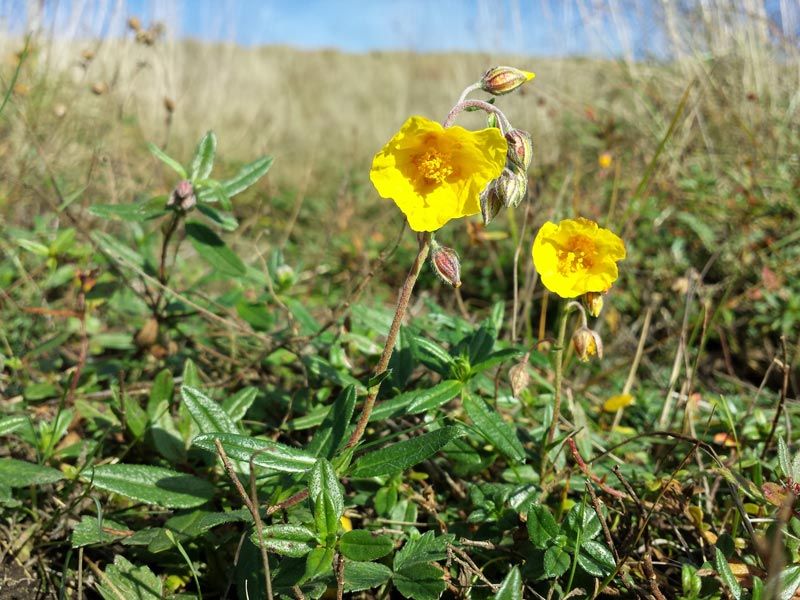
Helianthus spp. belongs to the Cistus family and is also known as labdanum, helianthemum, stone flower, and sun rose. It is found throughout the world, from North Africa to the Arctic regions of Russia. Some subspecies are cultivated by gardeners and are popular for their low maintenance and spectacular blooms.
Content
Description of the sunflower
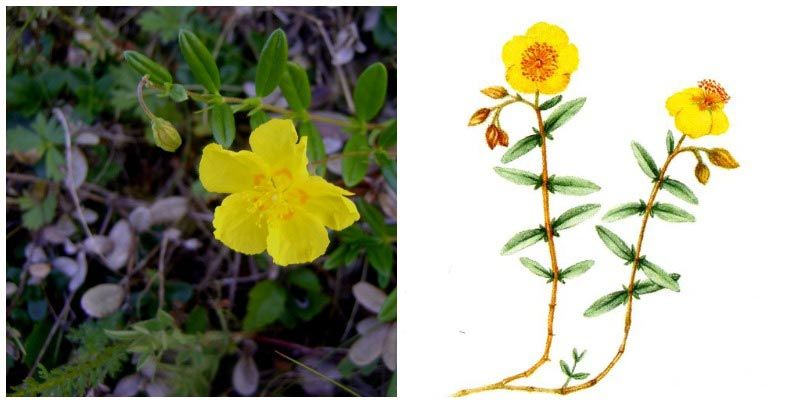
Helianthus derives its Latin name from the fact that its buds open at sunrise, with the petals falling by evening. It is a perennial or annual subshrub with erect or prostrate stems 10-30 cm long. Green, oval-shaped leaves are arranged in opposite pairs.
Flowers may be solitary, although they are most often collected in racemes or panicles. They consist of five petals and have numerous yellow stamens in the center. Their color is most often yellow, but can also be white, pink, or lilac. The fruits are seed capsules consisting of one or three locules.
Types and varieties of sunflower
The genus Helianthemum comprises approximately 70 subspecies, only a few of which are cultivated by gardeners for ornamental purposes. They differ in size, shape, and color of their leaves and flower buds.
| View | Peculiarities | Leaves / Flowers | Height (cm) |
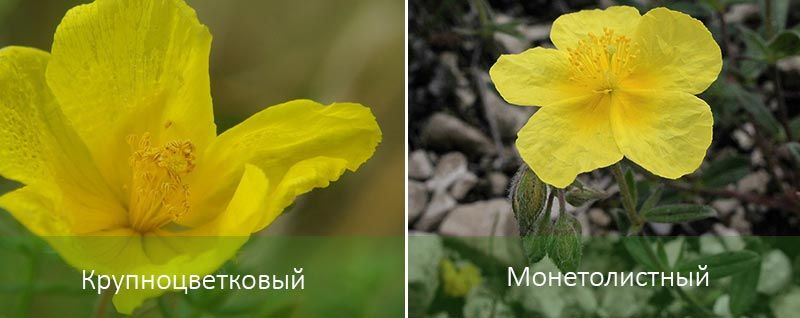
| Nummularium | From the Mediterranean and southern Europe. Creeping, ascending, or prostrate, evergreen. | Elongated oval, green, felt-gray on the reverse side. Cup-shaped, yellow, in hybrids pink shades, form curls up to 25 mm. |
30-40. |
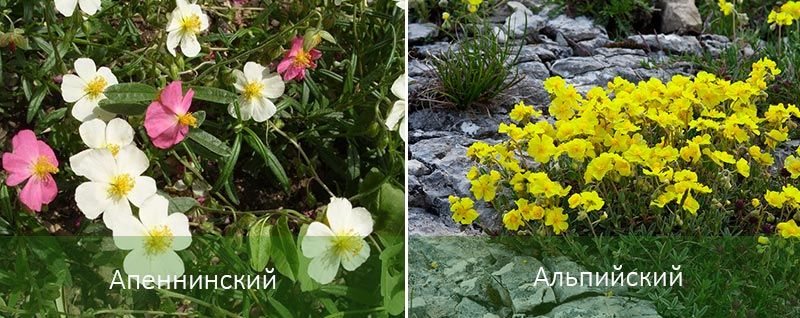
| Alpine (oelandicum) | Grows in the mountains and foothills. Groundcover, winter-hardy. | Thick, elongated, pubescent.
Five-petaled, bright yellow. |
10-15. |
| Large-flowered (grandiflorum) | Found in mountainous areas, including Crimea. It spreads by shoots. | Oval, light green.
Large, up to 40 mm in diameter, deep yellow. |
Up to 30. |
| Apennine (apenninum) | A subshrub native to Asia Minor and the mountains of Europe. Erect stems. | Elongated, with silver trim on the reverse side. White-pink with a yellow center, up to 20-30 mm in diameter, in inflorescences of 3-10 pieces. |
20-25. |
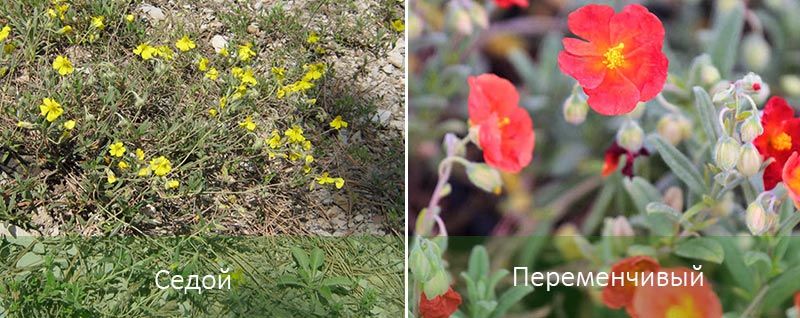
| Gray (canum) | It grows in rocky areas of Europe and North Africa. | Velvety grey-green.
Lemon five-petal. |
10-30. |
| Changeable (mutabile) | Rising above the ground. | Lanceolate, pubescent below.
Pinkish-white, 20 mm, collected in curls. |
Up to 25. |
| Arctic (arcticum) | An endangered species from the Murmansk region of Russia. It grows as a subshrub. | Elongated, green or brownish in color.
Bright yellow, up to 25 mm in diameter, in inflorescences of 3-6 pieces. |
10-40. |
Helianthemums obtained by crossing natural species are called hybrids. They include numerous upright, trailing, and other varieties. Their leaves are roughly the same shape and color, but the flower buds are the main differences.
| Variety | Flowers |
| Pink Lawrence | Light pink with an orange eye. |
| Fire Dragon | Bright red, becoming lighter towards the center. |
| Red Dragon | Uniform red color. |
| The Bride, The Snow Queen | Beige with a yellow center. |
| Anniversary, Golden Queen | Lemon yellow with a double border. |
| Cherry Queen, Ruby | Deep red with full buds. |
| Polar bear | Snow-white with a yellow center. |
| Cornish Cream | Creamy, light orange in the center. |
| Bronze carpet | Orange with pointed petals. |
| Cheviot | Delicate apricot shade. |
The stems and leaves of all these varieties are colored in different shades of green, have a similar shape and a silvery edge at the bottom.
Growing sunflower from seeds
Helianthemum is a herbaceous outdoor plant that can be propagated by seeds, cuttings, and division. To ensure better rooting, mature seeds should be sown for seedlings.
Sowing for seedlings
It's best to sow saffron in the first days of spring in a peat mixture. Replanting, picking, and dividing weaken the root system of young shoots, but peat pots solve this problem. The soil is pre-moistened and 2-3 seeds are placed on top. Then, they are covered with a thin layer of fine sand and wrapped in plastic wrap.
When growing from seed, ensure the seedlings are kept at a temperature of at least 18 to 25°C and receive indirect sunlight. Shoots may not appear for at least a week or even a month. Make sure to remove the plastic wrap promptly and move the containers to a cooler environment at 15 to 16°C.
The growing plants are thinned out, cutting off the weakest ones and leaving one strongest one in each pot. Then they are watered periodically and carefully loosened.
Planting helianthemum in open ground
Seedlings are planted in the soil in mid-May or early June. They must first be hardened off for 1.5 to 2 weeks. This is done by placing them outdoors in a wind-free area. This period of exposure increases daily, starting from a few hours, until the plants can be left outdoors 24/7.
For direct planting, choose sunny sites in neutral or alkaline soil mixed with sand or crushed gravel. Space the holes at least 0.3 m apart to ensure the plants grow freely. Place the peat pots containing the seedlings in the holes, lightly cover them with soil, and water from above.
Caring for a sunflower
Helianthemum is a fairly easy-to-grow evergreen perennial. It requires occasional watering, fertilizing, weeding, pruning of spent shoots, and covering for the winter.
Watering
Under normal conditions, the twig plant doesn't need watering in spring and fall; natural rainfall is sufficient during these periods. Soil moistening may only be necessary in summer, during dry, hot weather.
For this purpose, the water is first settled and heated in the sun.
Fertilizer
The soil around each plant should be weeded, oxygenating it and removing weeds. Helianthemum obtains all its minerals from the soil, but additional liquid organic fertilizer should be added as needed. This should be done before buds appear. It's important to remember that too much fertilizer, especially nitrogen, will result in excessive foliage and sparse flowering.
Trimming
To improve its appearance, perennial lilies need regular pruning. They typically produce their first buds in June or July. These fade after about a month, at which point a third of the shoots containing faded flowers should be trimmed back. This will keep the bushes neat and allow for new blooms to emerge.
In addition, plants older than 5 years are rejuvenated by dividing them into several bushes.
Wintering
In general, helianthus is highly winter-hardy, but some species do not survive winter well. Apennine and coin-leaved varieties, as well as others with yellow or orange flowers, will not require protection. However, alpine and many hybrid varieties, especially those with red flowers and silvery leaves, require winter protection. Dry leaves, spruce branches, hay, or agrofibre can be used for this purpose.
Pests and diseases
The main dangers for the tenderloin are the following problems:
- Rot caused by excess moisture during heavy rains and snowmelt. Affected plants are removed from the area, which is then watered with a fungicide solution such as Fundazol.
- Powdery mildew appears as a white coating on leaves, which eventually wilt. This usually occurs due to excessive moisture, improper pruning, dense plantings, or sudden temperature changes. It can be treated with fungicides.
- Aphids and thrips suck the cellular sap from leaves, weakening them and causing their death. Biological insecticides such as Fitoverm, Trichopolum, and Actofit provide therapeutic effects.
Top.tomathouse.com recommends: using sunflowers in the landscape
Stone flower is a groundcover plant that covers a plot of land with a flowering blanket. In landscape design, it is used to create complex, combined, and multi-tiered flowerbeds, as well as artificial rock gardens. It can grow even in poorly fertile and rocky soil, anchoring and decorating walls, slopes, garden paths, and borders.
It is best to plant the helianthus near soapwort, veronica, chickweed, iberis, armeria and other creeping perennials.
It also makes a beautiful contrasting composition with bellflowers, sedum, and many upright garden plants. Moreover, they can be arranged so that they bloom at the same time or at different times, creating floral patterns.