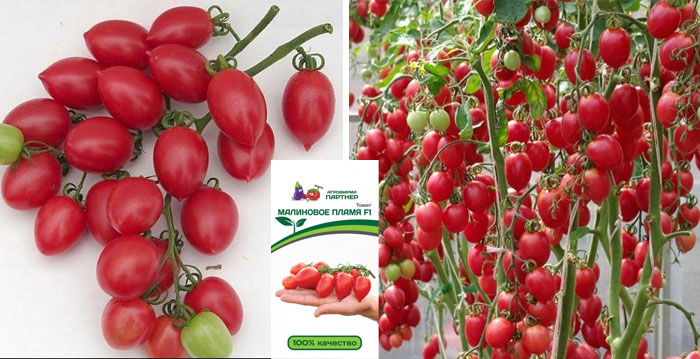
The Malinovoye Plamya F1 tomato is a very young variety, zoned for various regions of the country. It is ideal for tomato preserves, as the fruits are lightweight and neatly shaped.
Content
- 1 Table of characteristics of the tomato variety Raspberry Flame F1
- 2 Photo gallery of the tomato variety Raspberry Flame:
- 3 The origin of the Raspberry Flame tomato variety
- 4 A detailed description of the Raspberry Flame tomato variety
- 5 Advantages and disadvantages of the tomato variety Raspberry Flame F1
- 6 Planting Features of the Raspberry Flame F1 Tomato Variety
- 7 Caring for the tomato variety Raspberry Flame F1, watering and fertilizing
- 8 Resistance of the tomato variety Raspberry Flame F1 to diseases and pests
- 9 Harvesting and storing the tomato variety Raspberry Flame F1
- 10 Using Raspberry Flame F1 tomatoes
- 11 Comparison of the tomato variety Raspberry Flame F1 with other varieties in the table
- 12 Real reviews from gardeners about the Raspberry Flame F1 tomato variety
Table of characteristics of the tomato variety Raspberry Flame F1
| Characteristic | Description |
| Description | This hybrid, determinate variety has an early ripening period. It was developed as a greenhouse tomato, but in regions with favorable climates, it can also be grown outdoors. |
| Ripening period | 90-95 days |
| Fruit weight | 45-50 g |
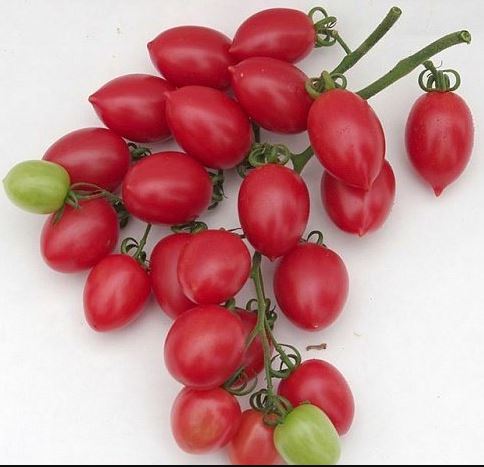
| Description of the fruit | The tomatoes are small (cherry), slightly elongated, with 4-5 seed chambers inside. The color is bright crimson. |
| Productivity | 240-250 c/ha |
| Usage | Tomato is most often used for various types of preparations (canned food, tomato products), and can also be eaten fresh, for example, in salads. |
| Preferred growing regions | The variety is zoned for cultivation in different regions of the country. |
| Disease resistance | High resistance to fusarium, brown spot, and mosaic. Early ripening virtually eliminates late blight. |
| Agricultural technology | Listed as a determinate variety, it can grow as a semi-determinate or indeterminate plant. The bush forms three shoots and requires staking. |
| 2021 | |
| Originator | Blokin-Mechtalin V.I., head of the agricultural firm "Partner" (Russia) |
Photo gallery of the tomato variety Raspberry Flame:
The origin of the Raspberry Flame tomato variety
The Partner agricultural firm has been renowned for its seeds for many years. Its specialists regularly develop new plant varieties that are gaining popularity among consumers.
In 2019, a small-fruited tomato variety developed for canning. It was named "Flame" for its vibrant skin and flesh color. The pure red-orange tomato retained this name, while a brighter, almost crimson, color derived from it became known as "Raspberry Flame."
Initially, this variety was intended to be grown exclusively in greenhouses. However, in warmer climates, Raspberry Flame also showed good results when planted outdoors.
In 2021, the variety was added to the register.
A detailed description of the Raspberry Flame tomato variety
The Malinovoye Plamya variety is listed by the manufacturer as determinate. However, those who have grown tomatoes in their own plots have noted that the shoots can often be described as semi-determinate or indeterminate.
Bushes
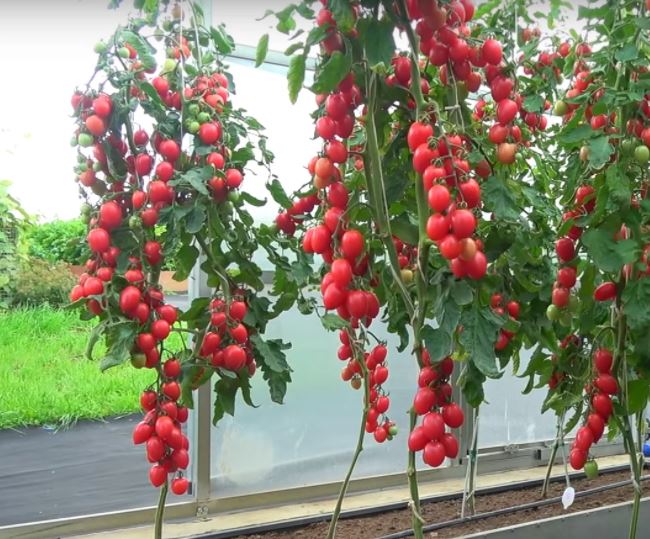
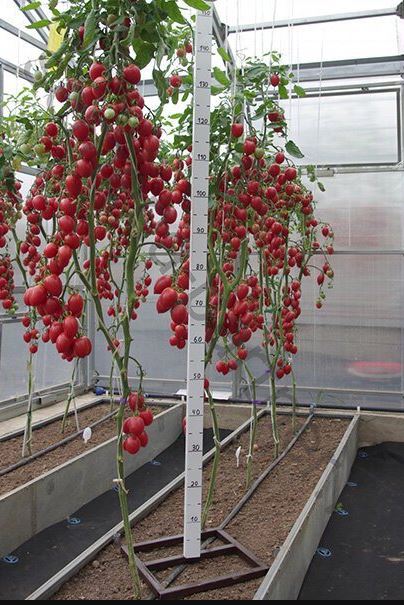
The bushes can reach a height of 140-160 cm. They definitely require tying and support to prevent them from breaking under the weight of the harvest.
The plant is formed into a maximum of 3 stems.
The first inflorescences begin to form above the 6th or 7th leaf. Subsequently, they form at intervals of 1-2 leaves.
It is recommended to plant no more than 3 plants per square meter.
Fruit
The fruits of the Raspberry Flame variety ripen quite early; the harvest can be collected after 85 days.
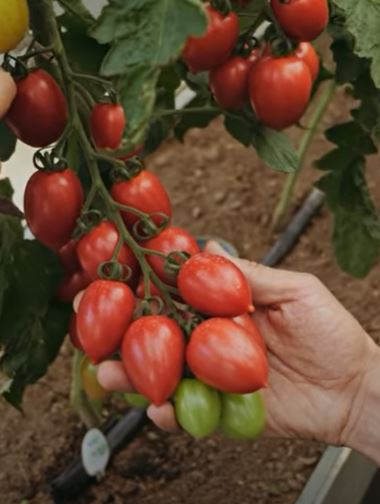
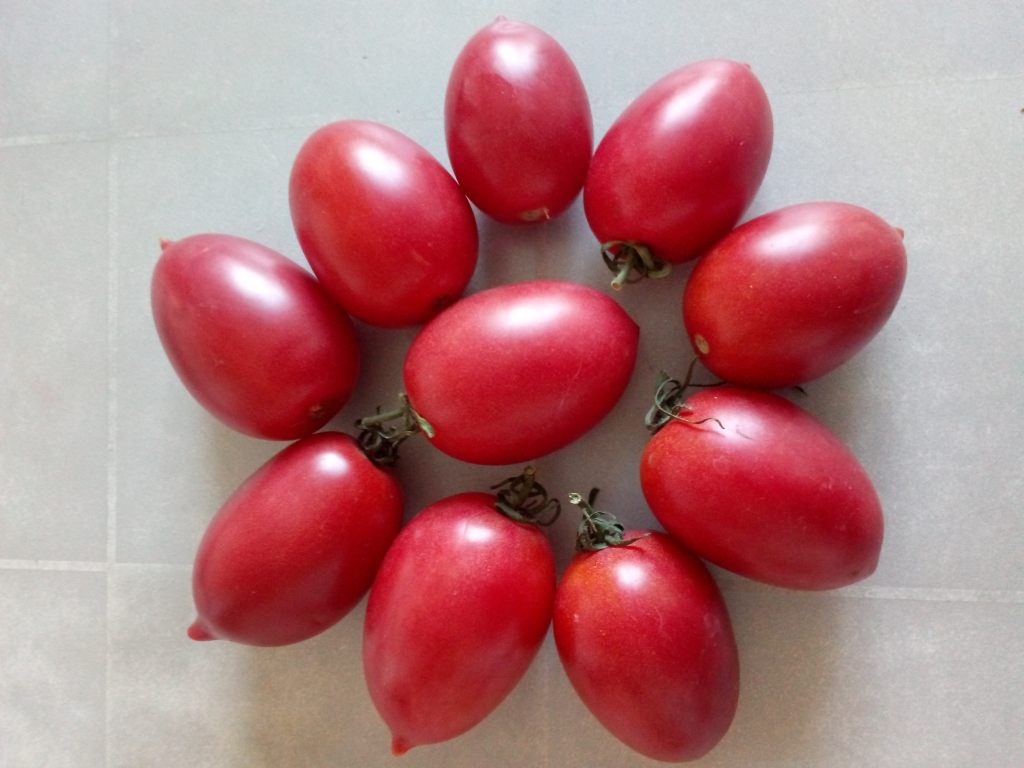
The shape is slightly elongated, with a pointed tip. The originator describes it as "inversely ovate." The skin and flesh are bright crimson.
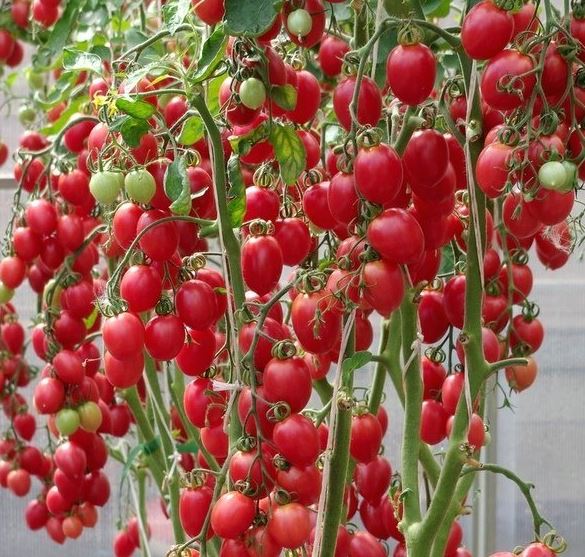
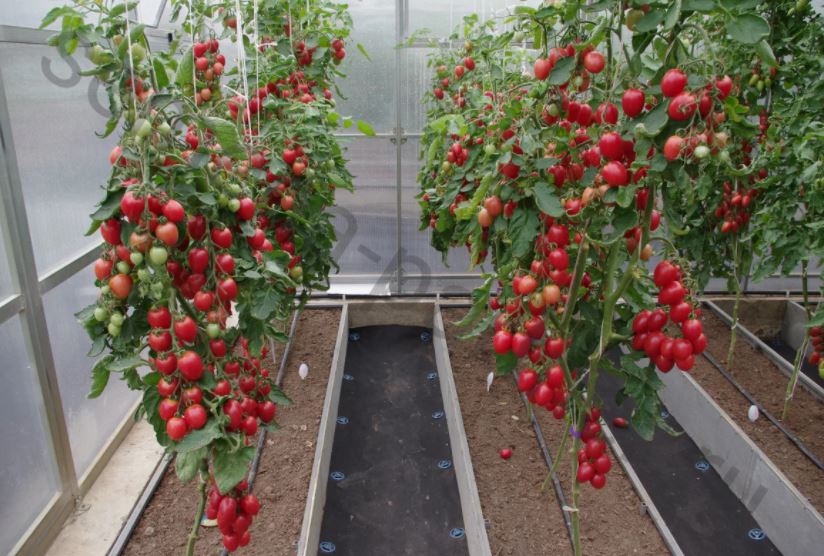
The tomatoes, weighing approximately 50 grams, are harvested in clusters of 12-13 tomatoes each. They ripen evenly, so the harvest can be completed in one go. The fruits do not crack, transport well, and are ideal for canning.
Productivity
Tomato yield depends on how the bush is trained. On average, each square meter yields approximately 25 kg of firm tomatoes weighing 45 to 50 g.
Ripening time
From the first shoots to harvest, it takes no more than 90 days. The fruits ripen evenly, allowing for harvesting by the bunch rather than individual tomatoes.
Advantages and disadvantages of the tomato variety Raspberry Flame F1
The Raspberry Flame variety has significant advantages and only one drawback:
| Advantages | Flaws |
|
|
Planting Features of the Raspberry Flame F1 Tomato Variety
It's recommended to grow the Raspberry Flame tomato using seedlings. This allows for harvesting even earlier than the manufacturer's stated harvest dates.
Sowing seeds and growing seedlings of the tomato variety Raspberry Flame F1
Seed cultivation begins approximately two months before planting tomatoes in the ground. Each region has its own sowing time, which depends on climatic conditions.
Seeds of the Raspberry Flame tomato variety cannot be collected independently, as it is a hybrid. They are sold by the agricultural firm "Partner," which pre-treats all planting material. This information is provided on the packaging. Therefore, there is no need to additionally treat the seeds at home—the manufacturer has taken care of this.
If the purchased seeds are coated with a colored shell, they don't need to be soaked before planting. If they don't have a shell, place the seeds in a damp cloth and leave them on a plate in a warm place to germinate before planting. This procedure speeds up germination after planting.
Before adding soil, containers or pots should be disinfected by rinsing them with a weak solution of potassium permanganate. This is especially important if the same containers are used annually.
It's best to buy ready-mixed soil; it has the right consistency and balanced composition. However, if this isn't possible, or if you need a lot of soil, you can make your own by mixing equal parts garden soil, sand, and humus. Some gardeners add 1 tablespoon of wood ash for every 3 cups of substrate.
The resulting soil needs to be disinfected. To do this, you can either soak it in a potassium permanganate solution or bake it in the oven at a temperature of at least 180 degrees Celsius.
Fill the prepared container 2/3 full with soil, then water and plant the tomatoes. Make furrows in the soil surface, spaced 3 cm apart. Place the seeds in these furrows, 1.5 cm deep. Cover the container with plastic or glass and store it in a room with a temperature of 24-25 degrees Celsius.
As soon as the first shoots appear, remove the cover and move the containers to a bright location with a temperature of 16 to 17 degrees Celsius for about a week. This will help harden off the seedlings and prevent them from stretching.
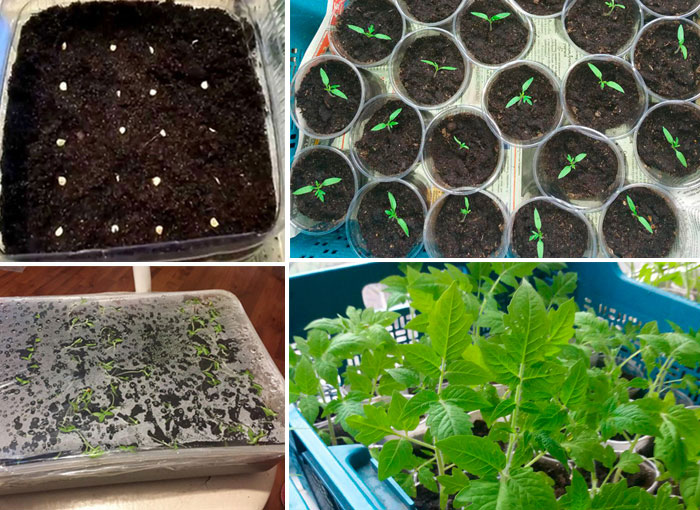
If all the seeds have sprouted and the plantings have become too dense, the tomatoes are pricked out and transplanted into individual containers. Two weeks later, the first fertilizer can be applied. The second fertilizer application should be no later than two weeks before planting in the permanent garden bed.
About 10 days from this point, the hardening off process begins: all the seedlings are taken outside for a couple of hours, and then they can stay there all day.
Planting the tomato variety Raspberry Flame F1 in the ground
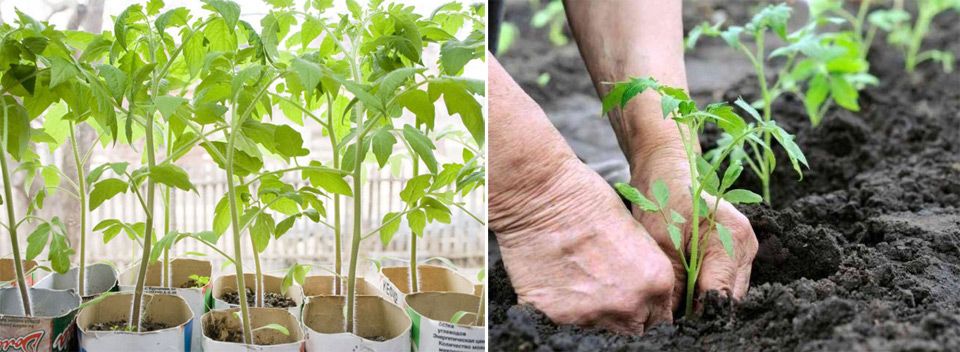
Experienced gardeners recommend planting tomatoes in a permanent bed when they're two months old. If the bed is older, the adaptation process will be more difficult, the risk of disease will increase, and yields will decrease. The soil for planting should be prepared in the fall. When digging at the end of the season, add 5 kg of humus or compost per square meter.
In the spring, prepare holes for each plant; there can be 3 to 4 holes per square meter. Add 30 grams of potassium salt or superphosphate to each hole.
After planting, water the plants. Experienced gardeners recommend mulching the beds to retain moisture and reduce weeds.
Caring for the tomato variety Raspberry Flame F1, watering and fertilizing
The Raspberry Flame variety doesn't require any specific care. The most important factors are proper bush formation and support. Proper watering and fertilizing are also crucial.
The variety does not tolerate excess moisture well, so watering is only done when the bed has dried out to a depth of 5-8 cm. Water should be applied until the soil is moistened to a depth of 15 cm.
After each watering, it's necessary to loosen the bed to prevent a crust from forming, which will prevent oxygen and moisture from penetrating. At this time, it's also recommended to remove weeds, which compete with the tomatoes for nutrients and can attract pests.
After two weeks have passed since planting tomatoes in the ground, the first feeding should be applied. At this stage of growth, seedlings require nitrogen supplements to stimulate vegetative and root growth.
After two weeks, you can feed the tomatoes with phosphorus and potassium. Experienced gardeners recommend alternating organic and mineral fertilizers, so you can use a solution of rotted cow manure or a green infusion of weeds as one of the fertilizers.
The bushes absolutely require support and tying—without this, they become more difficult to care for, and the branches can break under the weight of the tomatoes. The Raspberry Flame variety grows with no more than 2-3 shoots.
Preventative disease and pest control are crucial. This variety has a relatively strong immune system and is rarely affected by late blight, as it ripens before this pest becomes active. However, preventative spraying is still necessary, two to three times per season. All treatments should be stopped two weeks before harvest.
Resistance of the tomato variety Raspberry Flame F1 to diseases and pests
The Raspberry Flame variety ripens early, allowing it to avoid the most common disease, late blight. The cultivar's originator notes its resistance to viral mosaic, fusarium wilt, and brown spot.
However, if care instructions are not followed, signs of rot or other diseases may appear. Therefore, preventative treatment of plantings by periodically spraying them with specialized products is recommended.
To reduce the risk of slugs, it's recommended to sprinkle sand, ash, and crushed eggshells under each bush. Insects don't like crawling on such surfaces, as they can injure their bodies. If pests appear on the bushes, they will have to be removed manually, after which the tomatoes should be treated.
Harvesting and storing the tomato variety Raspberry Flame F1
Tomatoes on the brushes ripen evenly, so the harvest is usually not spread out over time.
Tomatoes can be stored for some time without losing quality, depending on the conditions. However, this variety is considered an early ripening one, so it's best to process the harvest immediately.
Using Raspberry Flame F1 tomatoes
Their compact size and light weight make tomatoes ideal for canning. Their thick skin allows them to be grown on an industrial scale and transported over long distances.
Consumers note the pleasant taste of tomatoes, which they add to salads and other dishes.
Comparison of the tomato variety Raspberry Flame F1 with other varieties in the table
Please note! How can you easily convert centners/ha to kg/sq.m? Simply divide by 100! For example, the Abakansky Pink tomato yields 400 centners of marketable fruit per hectare. This equals 4 kg per square meter. It's that simple! Also, keep in mind that typically no more than 3-4 plants are planted per square meter. This way, you can calculate the yield per bush. In the case of the Abakansky Pink, it's about 1 kg.
| Variety | Ripening period (number of days from full germination to ripening)
Yield of commercial fruits |
Brief description | Fetus |
| Crimson Flame | 90-95 days
620 c/ha |
An early-ripening determinate variety for greenhouses. Requires training into three stems. Suitable for salads. | Obovate, smooth, pink, 50 g. Taste is good to excellent. |
| Flame | 90-95 days 1410 c/ha |
An early-ripening determinate variety for greenhouses. Requires training into three stems. Suitable for salads. | Elliptical, dense, orange, 50 g. Good taste. |
| Raspberry Liana | 85-90 days
700 c/ha |
An early (ultra-early) determinate standard variety for open ground and greenhouses. Suitable for salads, canning, and processing into tomato products. | Round, smooth, raspberry-pink, 65-90 g. Good taste. |
| Raspberry Farmer | 85-90 days
1000 c/ha |
An early-ripening determinate variety for greenhouses. Suitable for salads. | Round, dense, slightly ribbed, cocktail, raspberry, 50-60 g. Good taste. |
| Raspberry Fountain | 100-105 days
520-610 c/ha (greenhouse and under film) |
An early-ripening determinate variety for greenhouses. Suitable for salads. | Elliptical, medium density, slightly ribbed, raspberry, 20-27 g. Good taste. |
| Marusya | 105-110 days
690 c/ha |
An early-ripening determinate variety for open ground and greenhouses. Suitable for salads and whole-fruit canning. Heat-resistant. | Ovoid, smooth, dense, red, 80-95 g. Excellent taste. |
| Mahitos | 90-100 days
340 c/ha |
A mid-season indeterminate variety for greenhouses. Requires staking and shaping. Suitable for salads. | Round, smooth, dense, red, 72 g. Excellent taste. |
| A gardener's dream | 95-100 days
630 c/ha |
An ultra-early determinate variety for open ground and greenhouses. Requires staking and shaping. Suitable for salads. | Flat-round, smooth, medium density, red, 80 g. Good taste. |
| Midas | 105-115 days
700-1000 c/ha |
A mid-season indeterminate variety for open ground and greenhouses. Suitable for salads, canning, and drying. | Pear-shaped, smooth, orange, 60-80 g. Good taste. |
| Pink miracle | 70-90 days (in a greenhouse and in open ground)
230 c/ha |
An ultra-early determinate variety for open ground and greenhouses. Requires staking and shaping. Suitable for salads. | Round, smooth, medium density, raspberry, 100 g. Excellent taste. |
| The Lazy Man's Miracle | 800-900 c/ha
85-95 days |
An early-ripening, determinate variety for open ground and greenhouses. Suitable for salads, processing into tomato products, and canning. | Oval, elongated, smooth, red, dense, 60-65 g. Excellent taste. |
| Apple tree of Russia | 118-135 days
530-560 c/ha |
An early-ripening, determinate, standard variety for open ground. Requires staking and shaping. Suitable for salads. | Round, smooth, red, 70-80 g. Good taste. |
| Verlioka | 95 days
900-950 c/ha |
An early-ripening determinate variety for greenhouses. Suitable for salads, canning, and processing into tomato products. | Round, smooth, shiny, red, 80-100 g. |
| Kemerovo resident | 100-105 days
214-428 c/ha |
An early-ripening, determinate, standard variety for open ground. Suitable for salads. Marketability: 93-100%. | Heart-shaped, slightly ribbed, raspberry, 60-104 g. Good taste. |
Real reviews from gardeners about the Raspberry Flame F1 tomato variety
Gardeners note the ease of care for the Raspberry Flame tomato. It produces a good harvest even in cool summers. However, since it's a hybrid variety, seeds must be purchased annually.
I'd like to leave a review of SEMKO and PARTNER products. Regarding the tomatoes: I really liked the PARTNER "Vashe Rossii" cherry tomatoes. I wasn't so keen on them at first, as the skin was a bit thick for small tomatoes, and they weren't very sweet. However, it turned out we didn't wait until they were fully ripe. They turned out VERY sweet, with firm, delicious flesh. They're great for eating. I also dried them, and they turned out great.
The PARTNER cherry tomato "Raspberry Flame," 1.60 m tall, is the earliest to fruit. It began bearing fruit in late June and is still producing fruit (September). We're harvesting juicy, raspberry-colored tomatoes with a beautiful nose, which are used for eating and drying. The PARTNER F1 tomato "Kakhuri" is a very productive tomato, with beautiful cones hanging in clusters. It looks and tastes similar to the "100 Poods" variety, but being a hybrid means it's less susceptible to disease. The SEMKO cucumber "Gunnar" is the earliest to fruit and is still bearing fruit. The fruits are beautiful, evenly shaped, and they're suitable for eating and look great in jars, without any bitterness. I see no one is ordering it in this batch, but it's a very good, vigorous plant.
The Iskander zucchini has been my long-time favorite. Every year I swear off buying new varieties. I buy it, grow it, and once again my family and I come to the conclusion that there is nothing better than the Iskander. The fruit is even, crispy, doesn't become cottony, has a very marketable appearance, the bush is strong, but compact for eating, and it freezes great.
The PARTNER tomato "Zlatoyar" is a yellow cherry tomato, not small, but round. It's a real surprise when frozen. When you add it to a dish in winter, it doesn't get soggy when cooked, the walls of the tomato retain their shape, and it feels fresh. It freezes perfectly. I recommend everything I've written about. Good luck to everyone!
I agree with the previous review. This year I planted cherry tomatoes "Your Honor" and "Raspberry Flame" from PARTNER. They are very productive and delicious. I recommend them. Pictured is "Raspberry Flame."
CRIMSON FLAME F1
This is a tomato that has no flaws.????????
But all the advantages are there.????
✅ It is very early - from germination to the beginning of ripening 85-90 days.
✅ Plant height 140-160 cm - suitable for standard greenhouses with a low height, as well as for open ground.
The first inflorescence forms very low—above the 6th or 7th leaf—with subsequent inflorescences occurring 1 or 2 leaves apart. Fruit set is excellent in all weather conditions, even in low light. It's best to watch this tomato during the ripening period in the video. Words fail to describe such abundant splendor. In a word—delight!
✅ Small, beautiful, bright crimson fruits of a slightly elongated shape with a pointed nose, collected in equally beautiful clusters of 12-13 pieces each.
✅ The fruits are firmly attached to the cluster, but at the same time, they separate easily from the stalk without damage. This hybrid is suitable for both cluster and individual tomato picking.
✅ It's very tasty!???? The walls of the tomatoes are medium thick, the flesh is tender, sweet, very juicy.????
✅ The fruits on the bunch do not crack, are easy to transport, and are suitable for fresh consumption and canning.
✅ The hybrid is resistant to fusarium, brown spot and tomato mosaic virus.
✅ Yield 25.0 kg/m2. ????????
✍ We recommend a planting density of 3-4 plants/m2 and formation into 2-3 stems.