Spathiphyllum is a perennial plant belonging to the Araceae family. It is native to Polynesia, southern America, and eastern Asia.
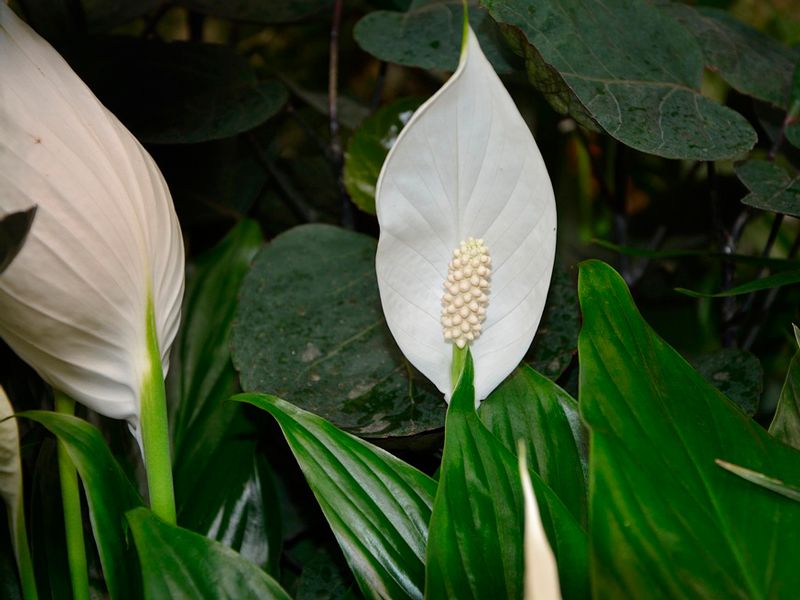
Description of Spathiphyllum
The plant has no trunk; the foliage located at the root forms a tuft directly from the soil.
The rhizome is shortened. The leaves are oval and have a prominent central vein. The inflorescences have an elongated stalk and a white spathe at the base.
Types of Spathiphyllum
Several varieties of spathiphyllum are suitable for home cultivation:
| View | Description |
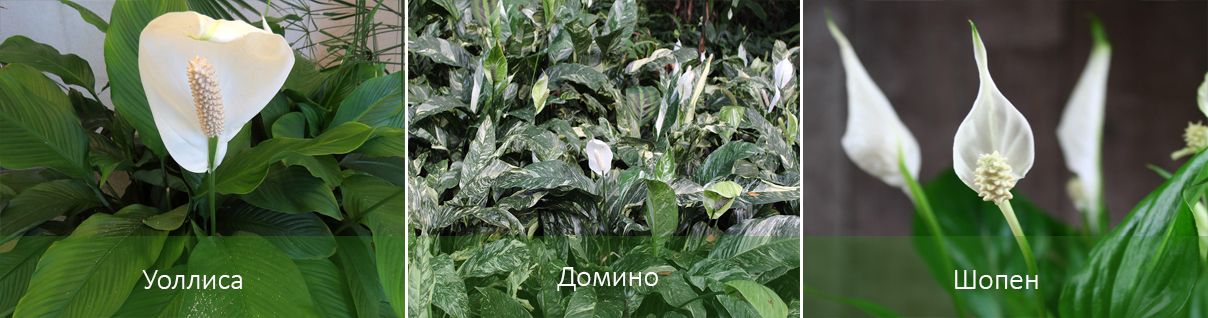
| Wallis | A shrub up to 45 cm tall, with inflorescences about 10 cm long. It is considered the least demanding variety. |
| Dominoes | Neat, oblong foliage with pointed tips. The color is rich green with randomly placed white stripes. They are noted for their high ornamental value and long flowering period. |
| Chopin | A shrub growing up to 40 cm. Elongated leaves with bright veins. Pleasant scent. |
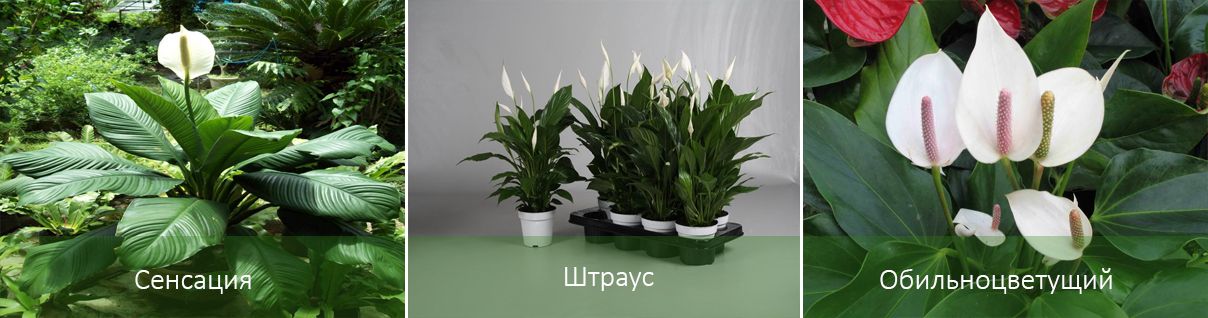
| Sensation | A hybrid plant. With proper care, it grows up to 1.5 m. Large, vibrant inflorescences. |
| Strauss | A shrub up to 30 cm in height. Dark green elongated foliage. |
| Abundantly flowering | Medium-sized inflorescences. Oval leaves darken as the spathiphyllum matures. It has an elongated peduncle. |
| Nice | The plant grows up to 60 cm tall, with long leaves and strong petioles. The cob is surrounded by a white and green blanket, resembling a flag. |
| Cannolistny | A hybrid shrub often used for interior decoration. Large oval foliage. |
| Spoon-shaped | Grows up to 1 m. Leaves are elliptical, 40 cm long, about 20 cm wide. The blades are glossy and have wavy edges. |
| Heliconia-leaved | It has a white spathe that darkens as it grows. The elliptical leaves are up to 0.5 cm long. |
Spathiphyllum is very popular among gardeners, so breeders are constantly developing new varieties. Most of these are descended from species such as Wallis and profusely flowering.
Some varieties are 2-5 cm long, while others are around 45 cm. The most common of these are:
- Mauna Loa – grows up to 60 cm, has dense foliage.
- Petite is a miniature variety, reaching only 18 cm in height, with leaf blades 5 cm long.
- Clevlandii – narrow, drooping foliage with wavy edges.
- Picasso is a variegated variety with white and green segments on the leaves.
Spathiphyllum maintenance conditions by season
When caring for a flower at home, you need to focus on the season of the year:
| Factor | March-September | October-February |
| Location/lighting | The optimal location is an east or west-facing window. The light is good, but diffused. | Provide additional illumination with a fluorescent lamp. |
| Temperature | +22…+23 °С. Protect from drafts. | Not less than +18 °C. |
| Humidity | Level: 65-70%. Spray regularly with warm boiled water. Place the pot in a tray with moistened pebbles. | Spray with warm water once a week. |
| Watering | After the top layer of soil has dried out, two to three times a week. | Once a week. |
| Top dressing | Every 10-14 days. Use liquid mineral fertilizers high in potassium and phosphorus. Vermicompost and bird droppings are also used. | Once every 3-4 weeks. Mineral complexes with nitrogen. |
Adapting Spathiphyllum to indoor conditions
It's recommended to leave the plant alone for the first few days after purchase, as it experiences significant stress due to the change in its environment. Repotting should not be done until the plant has adapted.
To speed up this process, the pot is moved to a dark room away from direct sunlight. The spathiphyllum is kept in this environment for 3-4 weeks, then repotted. If the plant is purchased during the growing season, it should not be moved until the end of this period.
Choose a container made of plastic or clay for the shrub, as these retain moisture longer. The bottom of the container should have drainage holes to prevent water accumulation and rhizome rot.
The container should be 2-3 cm larger in diameter than the previous one. Young shrubs should never be planted directly into large pots, as the root system will not be able to absorb all the soil and it will begin to sour.
Soil can be purchased from a store or prepared at home. The soil should be fertile, rich in nutrients, and nutritious. In the wild, the plant thrives in areas containing compost, branches, fallen leaves, and charcoal. For indoor cultivation, a similar mixture can be prepared.
The substrate for growing shrubs can consist of the following components, taken in the proportion 2:4:1:1:1:
- garden soil;
- peat;
- sand;
- humus;
- coniferous soil.
Once the soil and pot are prepared, you can move on to replanting. Due to the fragility of the rhizome, only the transshipment method is used, and the following plan is followed:
- A drainage layer containing expanded clay and pebbles is placed at the bottom of the new vessel.
- Sprinkle a little soil on top.
- The bush in the pot is watered generously; this is necessary to simplify the process of removing the plant.
- All lateral shoots are cut off.
- The root ball is removed from the old container and placed in the center of the new one. The side voids are filled with the prepared potting mix, preventing the formation of air pockets.
- The flower is watered; if the soil has settled, a little new soil is added.
- Move to a dark place.
After repotting, mist the spathiphyllum for two to three days, but do not water it. Full rooting will occur within two to three weeks. Only then should watering be resumed.
Reproduction of Spathiphyllum
When grown indoors, the flower is propagated using several methods:
- cuttings;
- dividing the bush;
- planting seeds.
When choosing the first method of reproduction, follow this algorithm:
- From an adult spathiphyllum, cuttings 10 cm long are cut.
- A substrate consisting of wet sand and perlite in a 1:1 ratio is prepared. The rooting container is a small plastic cup.
- The cuttings are placed in soil and covered with plastic film to create greenhouse conditions. The rooting process will be visible through the glass.
- When the bush gets stronger, the film is removed and the flower is transplanted into a separate pot.
If dividing the bush is chosen, "babies" will form at its base. In March, these are carefully separated and planted in pre-prepared soil (using the same method as for cuttings). All steps are performed with extreme caution to avoid damaging the spathiphyllum.
You can also divide the rhizome. To do this, when replanting a shrub, separate its root system into two parts (using a sharp, sterile knife), then move them into separate containers.
Seed propagation is rarely practiced because it's time-consuming and doesn't produce 100% results. If you do use seed, follow this plan:
- The seeds are planted in a substrate of sand and peat (1:1).
- The pot is covered with film to create greenhouse conditions.
- Ventilate regularly until rooting occurs.
The strengthened seedlings are moved into separate containers.
Diseases, pests and difficulties in growing spathiphyllum
Growing spathiphyllum at home is accompanied by attacks from pests and diseases, which are exacerbated by poor care:
| Symptoms
Manifestations on leaves |
Cause | Elimination |
| The edges and stems turn black. | Over-hydration. | Excess water is removed, sphagnum is spread over the surface, and dead above-ground and root parts are removed. |
| They dry out. | Low air humidity. | Adjust the humidity level, misting the foliage twice a day with a spray bottle. Transfer the plant container to a tray with moistened expanded clay. In winter, move the plant away from heating appliances. |
| Yellowing. | Exhaustion due to nutritional deficiency. | Transfer to a new container, removing as much of the old soil as possible. Leave for several weeks without fertilizer to allow the root system to establish. |
| No flowering. | Incorrect maintenance: poor lighting, insufficient air humidity, poor watering, deficiency or excess of nutrients. | Adjust each care point according to requirements. |
| Burn. | Influence of direct sunlight. | Place in a darker place. |
| Withering. | Moisture deficiency or excess. Poor soil quality. | Watering is regulated: dry soil is watered, while overly wet soil is allowed to dry out. If the soil is heavy, the plant is repotted in a lighter medium. |
| Stretching. | Poor lighting. | Move to a brighter room. |
| Slow growth. | Capacity too large. | Transplant into a pot with a smaller diameter. |
| Numerous greenish insects. | Scale insect. | Adult insects are removed by hand, the foliage is washed with green soap, and sprayed with any insecticide. This process is repeated after 2-3 weeks. |
| Powdery deposit. | Sooty mold. | Treat with soapy water. |
| Thin white web. | Spider mite. | Wash with soapy water and treat with any insecticide. |
| White waxy coating. | Mealybug. | The leaves are sprayed with an infusion of citrus peel. |
| Wilting, appearance of yellow-white spotting. | Thrips. | The plant is treated with Molniya, Actellik or Fitoverm. |
If these problems are identified and addressed promptly, the plant will delight you with a healthy appearance and blooms. However, if treatment is delayed, the spathiphyllum will begin to turn yellow, wilt, and eventually die.
Top.tomathouse.com recommends: Spathiphyllum – the flower of female happiness
Spathiphyllum has several names—peace lily, white sail, and woman's happiness—but the last is considered the most common. This plant is believed to possess great magical powers.
With proper care, a peace lily will reward its owner with joy, happiness, and peace of mind. These flowers boost self-esteem, promote health, and help you find harmony with yourself and the world around you.
There are even several signs associated with this plant:
- If a single woman is given this flower, she will soon meet her true love;
- in the absence of children, it allows you to experience the happiness of motherhood;
- improves harmony in relationships.
The effects of spathiphyllum are enhanced by the addition of anthurium, a symbol of male happiness. The combination of these flowers will ensure true harmony, romance, and mutual understanding in the family.