Spiraea is a deciduous ornamental shrub in the Rosaceae family. It grows in steppes, forest-steppes, semi-deserts, mountain slopes, and valleys. Landscape designers select varieties to delight with blooms from early spring to late fall. Shrubs are planted singly and in groups, along garden paths, fences, and walls, and used to create borders, flowerbeds, rockeries, and rock gardens.
Content
Description of spirea
Spiraea (meadowsweet) – meaning "bend" in ancient Greek – has dwarf varieties up to 15 cm tall and tall varieties up to 2.5 m. Its branches are erect, creeping, and sometimes spreading and recumbent. Its color ranges from light to dark chestnut. The bark peels longitudinally.
The leaf blades are alternately located on petioles, 3-5 lobed, oblong or rounded.
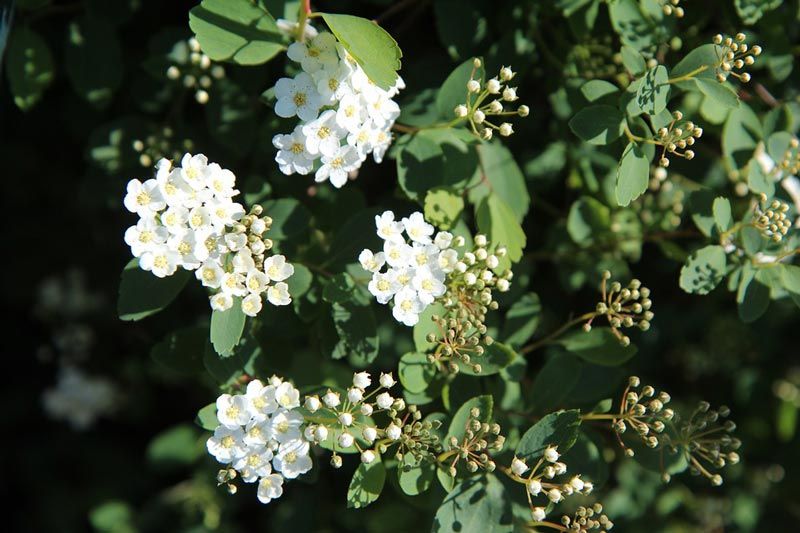
The inflorescences are paniculate, spike-shaped, pyramidal, and corymbose. They are located along the entire stem, and at the ends of the branches in the upper part. The flower palette includes snow-white, cream, crimson, and pink.
The root system is represented by adventitious roots and is shallow.
Spiraea: Japanese, gray, Vanhoutte and other species and varieties
There are about a hundred species of spirea, divided into spring-flowering varieties—those that bloom early in the spring on shoots from the previous season, in the second year after planting, and are predominantly white. They also feature numerous above-ground branches.
Summer-flowering ones form inflorescences at the ends of young shoots, while last year’s ones gradually dry up.
Spring-flowering
When spring spireas bloom, they cover their leaves and branches with flowers.
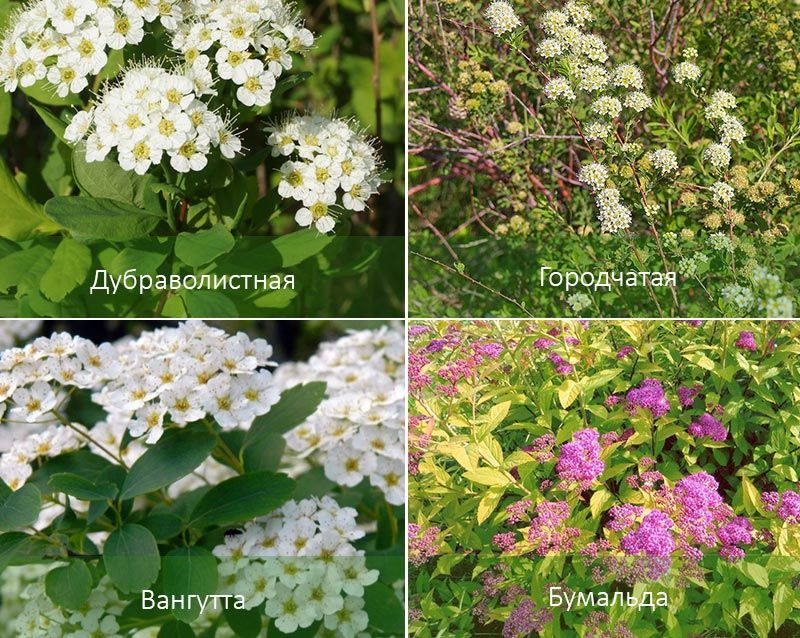
| View | Description | Leaves | Flowers |
| Vanhoutte | Bushy, spreading, spherical up to 2 m, with drooping shoots. | Smooth, small, serrated, dark green, grey below, turning yellow in autumn. | White, honey-bearing, they bloom from umbrella-shaped inflorescences. |
| Varieties | Bloom | ||
| Pink Ice. | May, August. | ||
| Oak-leaved | A frost-hardy shrub up to 1.5 m tall with pubescent branches. The crown is lush and rounded, and spreads by roots. | Oblong, serrated, dark green. Gray underneath, turning yellow in autumn, up to 4.5 cm long. | Small, white, 20 pieces per inflorescence. |
| Nippon | A low, spherical bush up to 1 m tall with brown, horizontal branches. | Round, bright green up to 4.5 cm, do not change color until mid-autumn. | The buds are purple and bloom white with a yellow-green tint. |
| Varieties | Bloom | ||
|
May, June. | ||
| Crested | Up to a meter tall, the crown is loose. Tolerates low temperatures, drought, and partial shade. | Grey-green, obovate with veins. | White and cream-colored flowers are collected in corymbose inflorescences. |
| Gray | Fast-growing, up to 2 m, with branched, curved branches. Shoots are felted and pubescent. | Gray-green, pointed. | White, terry. |
| Varieties | Bloom | ||
| Grefshteym. | May. | ||
| Arguta | Spreading up to 2 m, branches thin, curved. | Dark green, narrow, serrated, up to 4 cm long. | Snow-white, fragrant. |
| Thunberg | Reaches 1.5 m, branches are dense, crown is openwork. | Thin, narrow. Green in summer, yellow in spring, and orange in autumn. | Lush, white. |
| Varieties | Bloom | ||
| Fujino Pink. | Mid-May. | ||
Summer-flowering
Summer flowers form paniculate or cone-shaped inflorescences.
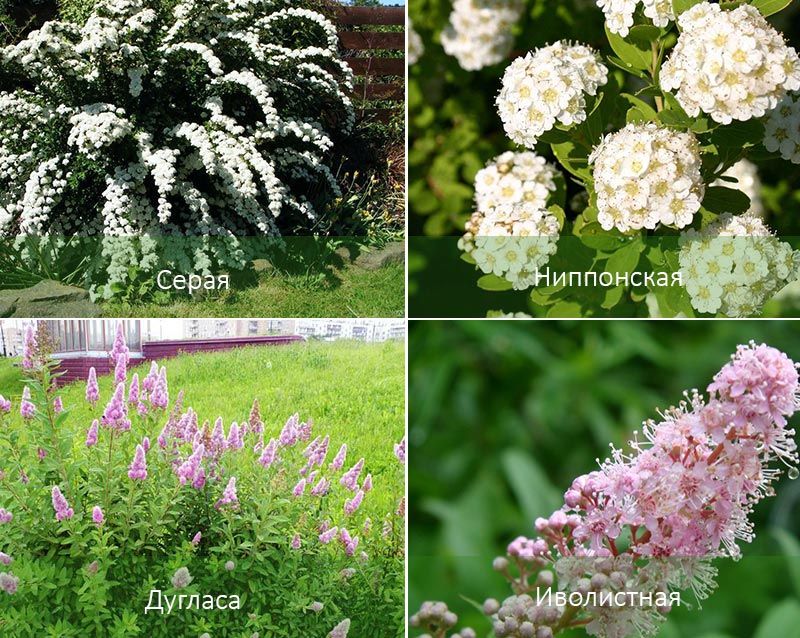
| View | Description | Leaves | Flowers |
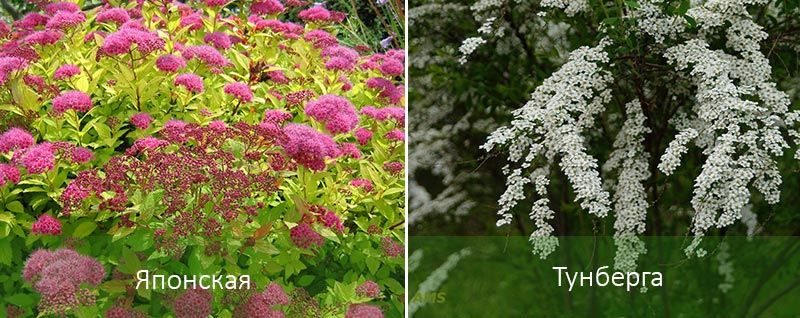
| Japanese | Slow-growing, up to 50 cm, with erect, free stems, young shoots are pubescent. | Elongated, ovoid, veined, serrated. Green, gray below. | White, pink, red, formed at the tops of shoots. |
| Varieties | Bloom | ||
|
June-July or July-August. | ||
| Willow-leaved | Up to 1.5-2 m tall, with upright, smooth branches. Young shoots are yellow and light green, turning reddish-brown with age. | Pointed up to 10 cm, serrated at the edges. | White, pink. |
| Douglas | Grows up to 2 m. Red-brown, erect, pubescent shoots. | Silvery-green, lanceolate with dark veins. | Dark pink. |
| Bumalda | Up to 75 cm, erect branches, spherical crown. | Obovate, green in shade, golden, copper, orange in sun. | Pink, crimson. |
| Varieties | Bloom | ||
|
June-August. | ||
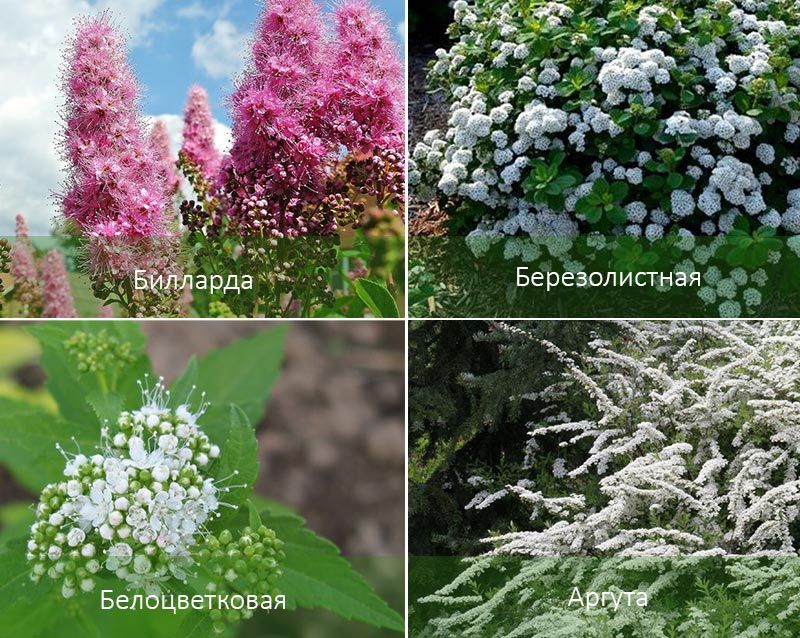
| Billard | Height up to 2 m, frost-resistant. | Broad, lanceolate. | Hot pink. |
| Varieties | Bloom | ||
| Triumphans. | July-October. | ||
| White-flowered | Dwarf, 60 cm – 1.5 m. | Large, green with a red tint, yellow in autumn. | Fluffy, white. |
| Varieties | Bloom | ||
| Macrophile. | July-August. | ||
| Birch-leaved | The bush is up to a meter high, the crown is spherical. | Elliptical, light green, up to 5 cm, turn yellow in autumn. | They bloom from 3-4 years of age, white with pink shades. |
Features of planting spirea
Rainy and cloudy September weather is the optimal time to plant spirea. Choose a site with breathable, loose, humus-rich soil.
A sunny location is recommended. Soil composition: leaf mold or turf, sand, and peat (2:1:1). Dig a hole 2/3 larger than the seedling root ball and leave it for two days. Place drainage, such as broken brick, at the bottom. Treat the roots with heteroauxin. Plant at a depth of 0.5 m. Leave the root collar at ground level.
Planting in spring
In spring, only summer-blooming plants can be planted before the leaves emerge. Select flexible plants with good buds. Roots with dry roots are soaked in water, and overgrown roots are pruned. Place the seedling, straighten the roots, cover with soil, and compact. Water with 10-20 liters of water. Place a 7 cm layer of peat around the seedling.
Planting in autumn
In the fall, summer and spring spirea varieties are planted before the leaves fall. Add soil to the center of the planting hole, forming a mound. Place the seedling, smooth out the roots, cover with soil, and water.
Caring for spirea
Caring for the shrubs is easy: water them regularly, using 1.5 buckets per shrub twice a month. Loosen the soil and remove weeds.
They are fed in the spring with nitrogen and mineral mixtures, in June with minerals, and in mid-August with phosphorus-potassium mixtures.
Spirea is disease-resistant. Spider mites may appear in dry weather. The leaves develop white spots on the top, turn yellow, and dry out. Treat with acaricides (Acrex, Dinobuton).
Bitten off inflorescences indicate an aphid infestation; garlic infusion or Pirimor helps.
Insects: The versicolor leaf miner and rose leaf roller cause leaf curling and drying. Use Etafos and Actellic.
To prevent the appearance of snails, treat spirea with Fitosporin and Fitoverm before the leaves appear.
Top.tomathouse.com recommends: pruning spirea
Without timely pruning, spirea looks unkempt; dry and weak branches prevent new shoots from forming. To give the bush a decorative appearance, regular pruning is recommended. This encourages the plant to form strong shoots and numerous inflorescences, allows more light and air to pass through, and reduces the risk of pests and diseases.
In early spring, before the buds open, perform sanitary pruning. Remove frozen, diseased, thin, broken, and dried branches from spirea. After flowering, spring varieties are immediately pruned and dried inflorescences removed. Remove new shoots with bright green leaves from Japanese spirea.
Early bloomers older than 3-4 years should undergo stimulating pruning and be trimmed back to a quarter of their length in the fall. The plant can be shaped as desired (ball, square, or triangle).
It is recommended to feed with mineral mixtures after the procedure.
Summer-blooming trees require stimulating pruning starting in their 3rd or 4th year. In the fall, remove weak, diseased, and old branches with sharp pruning shears, down to the crown, leaving 2-3 buds.
For spirea plants older than 7 years, rejuvenation pruning is also performed 2-3 weeks before frost. All branches are cut back to ground level, leaving 30 cm. In the spring, the bush will produce new shoots.
Reproduction of spirea
To propagate by seeds, sow them in prepared containers with damp sand and peat and cover with soil. They germinate after 1.5 weeks. Treat them with Fundazol, and after 2-3 months, transplant them to a specially designated bed in partial shade, trimming the roots. Water generously. Flowering is expected only in the 3rd or 4th year.
Layering is a more common method of propagation. In the spring, before the leaves appear, the lower shoots are bent to the ground, secured with a rod or wire, and covered with soil. Water regularly.
They are replanted the following year after the root system is fully formed.
In the fall, 15-20 cm cuttings, cut at an angle, are soaked in Epin for 12 hours, then treated with Kornevin and rooted in damp sand. After three months, more than half of the cuttings will have formed roots. The cuttings are covered with plastic wrap, sprayed, ventilated, and provided with diffused light. In spring, they are transplanted into open ground.
A 3-4-year-old bush dug up in September is placed in a container of water, then divided into sections with 2-3 shoots and roots, trimmed, treated with a fungicide, and planted as usual.
Spiraea wintering
In cold regions, the plant is insulated for the winter. The soil around the bush is mulched with peat or sand. The branches are bent low to the ground, secured, and covered with leaves or vegetable tops. When snow appears, the plant is covered with snow.