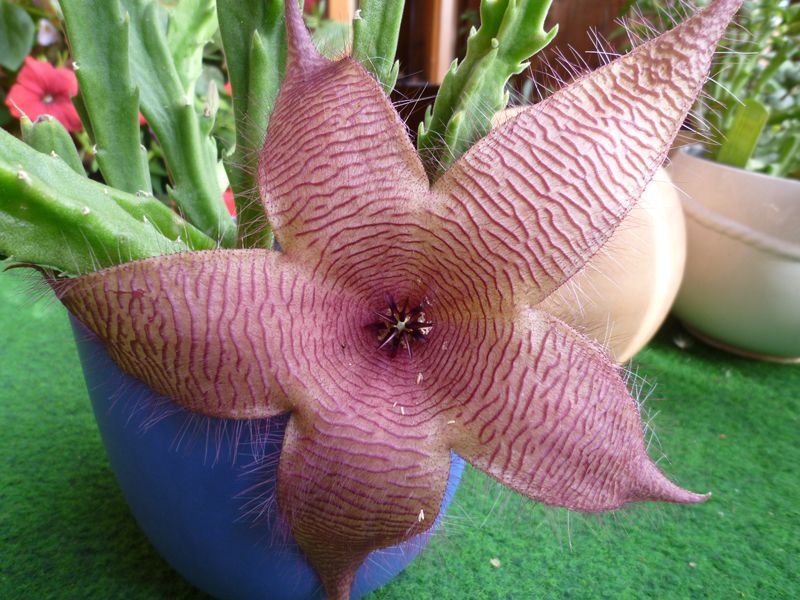
A unique houseplant, stapelia attracts attention when it blooms. Its large, single flowers have a beautiful, regular shape, unique hues, and a distinctive aroma that attracts flies.
It needs insects not for food, but for pollination and seed production. In the regions of South Africa where the plant is native, there are no bees or butterflies.
Content
Description
The plant belongs to the Apocynaceae (Lastovneve) family, a genus of succulents. Flowers vary widely, from small (up to 5 mm) to enormous (30 cm). Indoor stapelias are 5-6 cm. The shape is a perfect five-pointed star, reminiscent of a fully opened bell.
The colors are rich burgundy, brown, and beige with black stripes or speckles. Some varieties have heavily pubescent flowers.
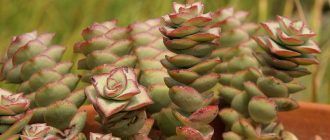
Description of general appearance: stems are muted shades of green, grayish-green, and glaucous, and can turn purple-brown in the sun. They are numerous, succulent, with serrated edges, and can reach 60 cm in length. There are no leaves.
Difference from cactus
The plant is often confused with a cactus. Indeed, its ribbed stems resemble those of the Epiphyllum genus, a cactus often grown indoors. However, stapelia is not related to this group of plants. It is a succulent plant in the Asclepiadaceae family (order Gentianales). Cacti, on the other hand, belong to the Cactaceae family (order Caryophyllales).
Types
Various species (sometimes mistakenly called varieties) of stapelias are grown indoors.
| Name | Description |
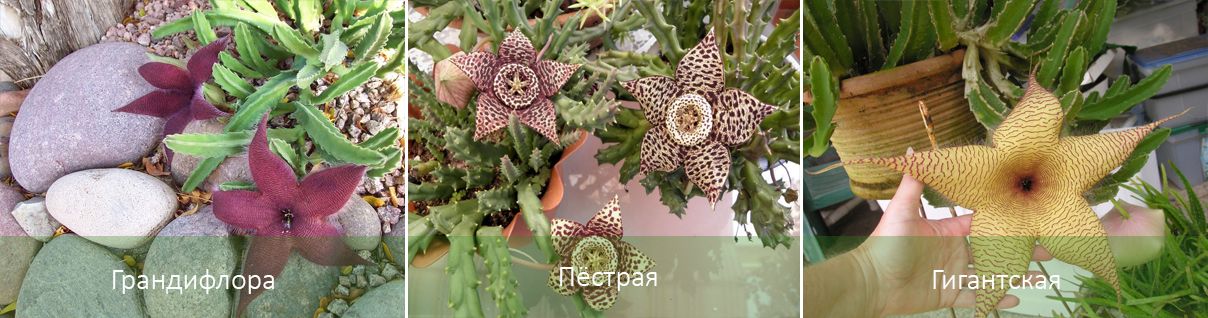
| Stapelia grandiflora | The flowers are dark burgundy, star-shaped, and very large—15-20 cm. The large-flowered variety is unscented. There is also a species called Stapelia tavaresia grandiflora. Despite the similar name, it has a completely different type of flower. They resemble enormous, long bells. |
| Stapelia variegata | Flowers are 5-8 cm, exotic, light yellow, variegated, and speckled with black. The scent is quite strong. |
| Stapelia gigantea | It has enormous flowers, up to 35 cm in diameter. They are light yellow and heavily streaked with dark spots. The scent is very strong, reminiscent of rotten meat. |
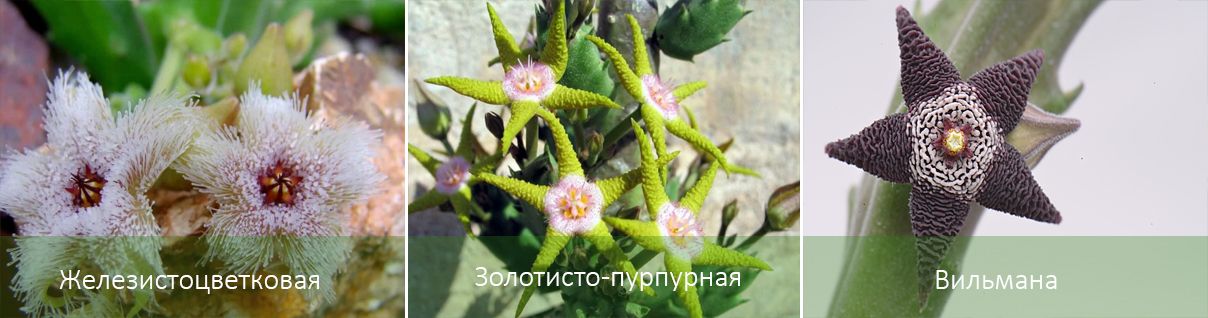
| Stapelia glanduliflora | The flowers are small, up to 5 cm, yellow-green, but distinctive – heavily hairy. The hairs are shaped like small pins, thickened at the tip, and white. This makes the flowers appear to be covered in a generous amount of dew. |
| Stapelia flavopurpurea | The flowers are small, up to 4 cm, and shaped like a deeply dissected star, with very narrow, elongated petals of a light green color. The petals are wrinkled, giving their surface a karakul-like appearance. The fragrance is pleasant. |
| Stapelia wilmaniae (or leendertziae) | Spherical, bright red flowers, reminiscent of bells in shape, 12.5 cm long. |
| Stapelia hirsuta, or hairy stapelia (Stapelia hirsuta) | Dark red stars, densely covered with hairs, 5-15 cm, resemble rotting meat in both appearance and aroma. |
| Stapelia divaricata | The flowers are very smooth, waxy stars of a light cream shade, slightly pinking towards the tips of the petals, up to 4 cm. |
Stapelia cristata (f. Cristata) is a form of some species (gigantea, grandiflora, herrei), with characteristic fused stems reminiscent of sea combs.
Very close to stapelias is the genus Huernia (Hyernia) - more compact plants with thorny shoots and a variety of flowers of amazing shapes and colors.
Home care for stapelia
Stapelias are easy to grow, requiring minimal conditions. They're an excellent plant for busy people with limited time or experience. Caring for this flower at home comes down to simple guidelines.
Location, lighting
The plant requires bright light, but direct sunlight can damage the stems, even causing burns. Therefore, a south-facing window or balcony will require some shade during hot weather.
It's easy to spot insufficient light: frail, elongated, thinned stems. Too much light results in a purple tint to the skin and brown, dry, burnt spots.
Temperature
In summer, stapelias are happy with standard room temperatures. In winter, as with any desert plant, a temperature of 10 to 14°C is preferable. Flower buds form during the dormant period. However, if cool temperatures are unavailable, the plant can be kept at 20 to 25°C. The flower will survive until spring. However, in this case, you can't expect abundant summer blooms.
Watering, humidity
The plant doesn't require abundant watering. In summer, water moderately, once a week. In winter, it's best to avoid watering. However, if the temperature in the apartment is high and the plant hasn't gone dormant, watering is necessary.
This should be done less frequently than in summer, once every two weeks. It's advisable to provide the plant with additional lighting, otherwise the stems will stretch too much. The soil should dry out well between waterings.
There is no need to spray; in extreme cases, the plant can be washed, but only if it is heavily soiled.
Top dressing
The plant does not require abundant nutrition, but for better growth and flowering in the summer, you can add any complex mineral fertilizer for indoor flowers or a special one for cacti.
Fertilizing is carried out several weeks before the expected flowering and during the period of bud appearance.
The fertilizer is diluted with water at a rate 2-3 times the recommended dosage to avoid burning the roots. The resulting solution should only be applied to already moist soil.
Rules for boarding and replanting
The plant isn't picky about soil composition, but rich mixtures with a high humus content should be avoided. Stapelias will thrive in regular cactus soil.
The optimal planting option is sandy loam with a pH of 5.5-7. Good drainage is essential. The homemade mixture consists of: turf soil (2 parts), quartz or river sand (1 part).
The pot should not be too tall, but wide; the root system of stapelias, unlike many plants that store moisture in their stems, does not go deep and is not very active.
Fill the pot 1/3 full with drainage. When repotting, remove the old shoots in the center, as they won't form flower buds.
After repotting, stapelia should not be watered for 5-7 days to avoid damaging the damaged roots. Once this period has passed, water for the first time.
Mature, healthy plants don't need to be repotted annually. Simply refresh the soil by removing a couple of centimeters of the top layer and replacing it with fresh soil. Old shoots are removed.
Reproduction
Stapelia is easily propagated by both seeds and stems. Cuttings are separated from the main stem and placed in water or directly planted in a mixture of sand and peat (prepared potting soil). The latter method is preferable. Before rooting, the cuttings are dried at room temperature for several hours (called wilting). This is necessary to allow the cut to heal.
The plant's milky sap is poisonous and dangerous to many insects. This property requires careful handling of cuttings. It won't cause significant harm, but it can irritate mucous membranes.
Propagation by seed is rare, but also not difficult. Seeds are quite easy to obtain at home. They are collected from the elongated pods that appear on the plant from time to time. The flower's seeds resemble dandelion seeds in appearance. They are sown in the spring in a mixture of sand and leaf mold, kept in a bright place at 24°C. After 3-4 weeks, seedlings will appear, and they are transplanted into small succulent pots (6-8 cm). After a year, the plants will be large enough for their first transplant into a new container.
Pests, diseases
Stapelia can be affected by aphids, mealybugs, and spider mites, but this is exceptional and occurs only if improper care is provided. Generally, the plant is extremely resistant to pests and diseases when grown indoors.
The only serious mistakes are overwatering, overfertilizing, or soil that's too heavy and retains moisture. Excessive moisture can cause bacterial rot.
Errors and troubleshooting methods
The main mistakes are obvious to the eye: the plant does not bloom or has elongated, unsightly stems.
There are several reasons for the lack of flowers:
- Too warm wintering, no dormant period.
- Stress: excessive watering, lack of light, excess fertilizer.
- Lack of potassium fertilizers, excess of nitrogen fertilizers.
- Overwatering, soil too compact, poor drainage.
If the stems are stretched, the stapelia isn't getting enough sun. You need to move it to a brighter windowsill, add some lighting, or create cooler conditions.
Errors in stapelia care are rare, so growing this exotic plant is safe for beginners. Even experienced gardeners won't pass it by. The plant is very unique and eye-catching. Its benefits extend beyond its decorative appeal and uniqueness. Astrologers believe stapelia removes negative energy from an apartment.