Statice, also known as limonium, or kermek, is a biennial (perennial) plant. Linonium grows to varying heights, reaching a maximum of around 80 centimeters. It belongs to the plumbago family. Its stems are ribbed, and its flowers are small. The leaves that surround it form a rosette.
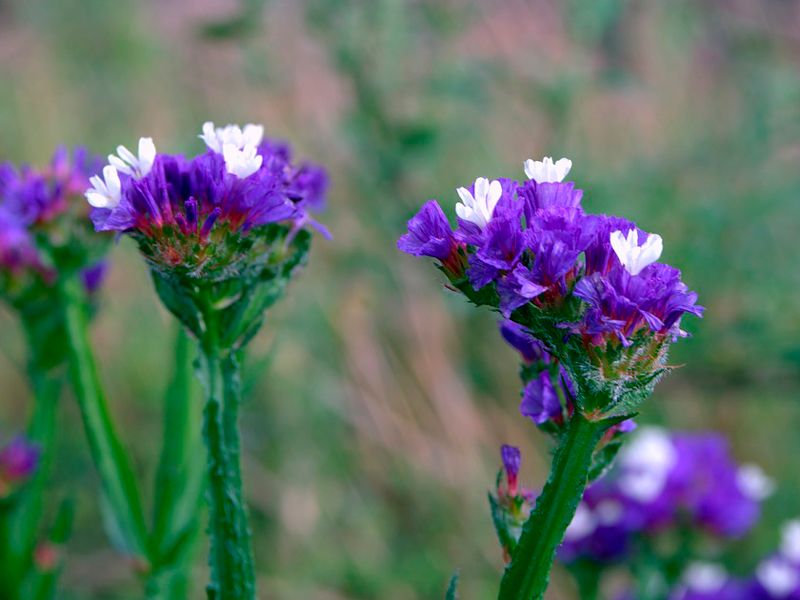
Each flower is no more than 1 cm in diameter, folded into corymbose compounds consisting of 3-4 spikes. The corollas of the plant are white, and the sepals are multicolored, ranging from yellow to purple.
Description and characteristics of statice
Many people know statice as a very popular immortelle. It's also known as "limonium" or "kermek." It's typically a perennial shrub, growing about five feet tall.
Statice's leaf blades are straight, fairly elongated, and large, usually basal and gathered into a single rosette. The stems are straight, often leafless on top, and densely pubescent.
This plant blooms in spikes, and its flowers typically come in a variety of shades. These include the usual white and red, as well as more interesting colors that combine several shades, such as purple or lavender. The immortelle, like many others, reaches its peak bloom only in midsummer.
Many assume that this plant is best grown as an annual, as it doesn't tolerate cold very well. However, gardeners' opinions differ, and some believe it's entirely possible to take the risk and grow statice as a perennial. However, since this is a rather complex process, it requires some training.
Popular types and varieties of statice
There are many varieties of this plant, most of which were adopted from uncultivated environments. They are still found today in the vastness of the Caucasian and European steppes, in their original form. Although not specifically bred by gardeners and landscape designers, they are nevertheless quite popular. This is due to their winter hardiness and decorative qualities. Here are some well-known varieties:
| View | Description | Varieties | Flowers | Height (cm) |
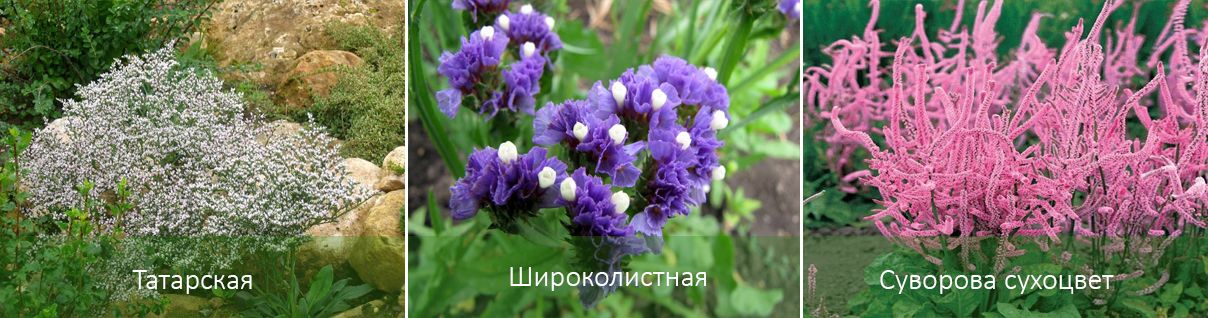
| Tatar | It is very widespread in the southern European part of Russia, the Caucasus, Bulgaria, and Ukraine. In the steppes, it becomes a tumbleweed after flowering. It has a long taproot and large, leathery leaves. It can grow in any soil. | None. | It blooms in June, the bud consists of five white petals. | 30-40. |
| Broadleaf | The leaves are wide and clustered in a rosette near the base. It prefers dry soil and open, sunny areas. | Blue Cloud, Violetta | It blooms for about a month and a half, starting in July. The buds are small and purple. | 50. |
| Suvorov dried flowers | In gardens, it is grown as an annual. Seedlings are planted in April, and they are planted outdoors in May or June, when there are no night frosts. | None. | They are arranged in spikelets and are lilac or pink in color. | 20–80. |
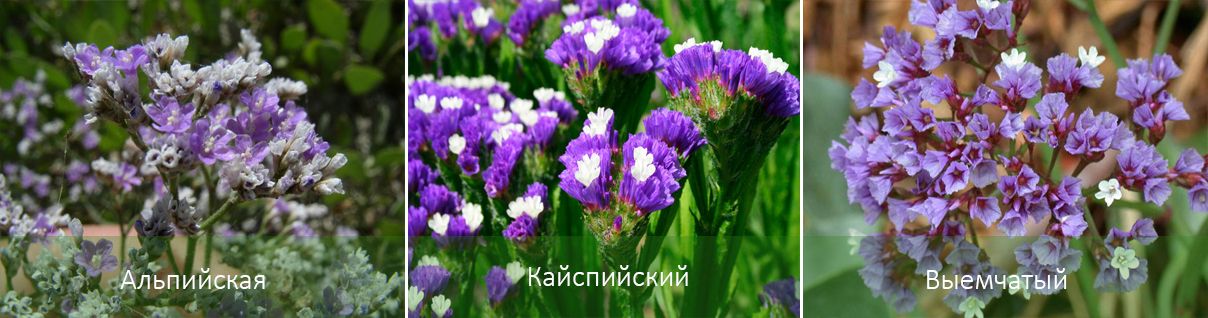
| Caspian | It loves warmth, so it's grown in warm locations. It's not suitable for central Russia, as it will freeze there. It retains its shape and color well after drying, making it ideal for bouquets. | Small, pale purple in color, they grow in leaf-like, branched stems. | 70. | |
| Notched (Notched-leaved) | Native to Asia Minor, the Mediterranean, and North Africa, the leaves are faintly defined, feather-shaped, and arranged in a rosette at the base. In temperate Russia, it is grown as an annual. It thrives in full sun. It holds up well when dried, making it popular in floristry. | Crimean mix, Supreme, Shamo, Iceberg, Roseum, Talisman, Apricot, Turbo, Blue River, Petit Bouquet and others. | They are arranged in spikes and are usually blue, purple, pink, white, or yellow. Later, an ovoid capsule appears in place of the bud. | 80. |
| Gmelina | It prefers salty soils. It is often found in the steppes of European Russia and Siberia, Central Asia, Northern China, Central Europe, and Mongolia. The leaves are gray-green, gathered in a rosette near the base. When grown in central Russia, it should be covered for the winter and protected from direct sunlight in the spring. | None. | Not spreading, but gathered in fairly dense clusters. The petals can be lilac, or less commonly white. | 50 |
| Bonduelli | It is widespread in North Africa, where it gets its name. It is usually grown as an ornamental annual. | Fluffy, yellow or white in color | 90 | |
| Chinese | In the wild, it grows as a perennial, but in temperate climates, it is grown as an annual. The leaves are glossy and form a basal rosette. | Confetti, Elegant. | Yellow in color, have white perianths. | The bush is seventy centimeters high. |
| Ordinary | The trunk is straight and hollow, with a taproot system one meter long. The leaf blades are green, oval, and arranged in a rosette at the base. | None. | Flowering lasts for over a month. The buds themselves are purple, forming a panicle about 50 cm in diameter. | 50. |
| Perez | The Canary Islands are considered the homeland of this flower. | Large, colored in a bright purple hue. | 60 |
Propagation of statice
Propagating healthy, vigorous statice, both indoors and outdoors, is only possible through seed sowing. Vegetative propagation is not recommended, as the root system is very sensitive to transplantation and may die as a result.
You can buy statice seeds at a store that specializes in this type of seed. However, not only do you buy them, you also need to germinate them, which is quite challenging. For a positive result, several conditions must be met.
- The seeds should be thoroughly prepared for planting. Don't remove the ribbed shell completely; lightly sand it to promote germination.
- Soak the seeds in a prepared wet mixture of sawdust and epin.
- Prepare a soil mixture of sand and potting soil. Sift thoroughly, removing all debris.
- Place the resulting soil in a microwave oven and heat to a temperature of 100 °C for two hours.
- After this, pour it with a weak solution obtained from potassium permanganate.
- Lightly rinse with warm water.
- Plant each seed in a separate peat pot so that you don’t have to transplant them later, otherwise you risk damaging the root system.
- Place plastic film on top or put glass on top.
- Place in a cool, but fairly sunny location for two weeks. Maintain the temperature at 20°C.
When time passes, the first shoots will emerge. To ensure this happens, you need to:
- ventilate slightly;
- examine the soil for its degree of dryness.
The finished seedlings are planted in prepared soil directly in the container in which they grew.
Rules for transplanting into open ground
The planting site for immortelle should be well-lit and warmed. It can be placed in a windy area—it tolerates drafts and winds. Any soil can be chosen for immortelle, but light sandstone or slightly alkaline loam are best.
The root system is quite delicate and must be handled with care, especially when repotting. The holes where the flowers will be planted must be large enough to accommodate the peat pots. Once the flowers and statice are planted and covered with soil, water them with salt water. To do this, add 1 tablespoon of salt for every 10 liters of water and mix well.
Specifics of caring for statice
How you care for your kermek determines how it will grow and whether it will be decorative. It's important to remove faded flowers and prepare dried flowers.
While they are growing, they need to be looked after and appropriate procedures carried out:
- Watering. Statice is a drought-tolerant plant, so it needs to be watered during prolonged dry periods. To do this, pour one and a half cups of water under each flower.
- Fertilizing. This should be done before planting seedlings in prepared soil. For this, apply a complete fertilizer mix, applying approximately 4 kg per 100 m². If the soil is poor, apply organic fertilizer every two weeks.
- Preparing for winter. To ensure the plant survives the winter without dying, it needs to be carefully cared for and covered. It's crucial to remove the cover promptly, otherwise the statice roots will become overwatered and may die.
It can be considered that the growing process is finished, since most of them are annuals.
Wintering
This plant species is frost-resistant. Some species and varieties can tolerate quite low temperatures, for example: Sea lavender – down to -30°C. However, all plants require care to ensure they don't die and bloom again in the spring. Remove yellowed autumn leaves, trim the roots, cover with fallen leaves or spruce branches, and drape a special covering over them. This "blanket" will provide excellent protection, preventing the immortelle from dying, protecting it from the cold and spring meltwater.
Flowers that have faded should not be thrown away, it is better to:
- gather into bunches;
- hang to dry in a ventilated area.
They can then be used to create floral arrangements. If prepared correctly, they will retain their color and beauty all year long.
Diseases and pests
Statice is not susceptible to the various diseases that affect most plants. The only one it can't resist is aphids, which pose a threat to the immortelle flowers. This can be cured by spraying with a liquid solution consisting of alcohol and diluted soap. Another problem is root rot. To prevent this, water the statice as little as possible, and it's even better if you provide adequate drainage in the soil.
Top.tomathouse.com recommends: using kermek
Because of its uniqueness and good shelf life, the plant is dried and used later in ikebana arrangements. A unique, beautiful winter arrangement can be created by cutting the limonium after it blooms. Hang the limonium flowers upside down and dry in a dark, ventilated area.
To decorate gardens in country houses, it is planted in sunny spots along fences or hedges. Smaller varieties make a beautiful addition to flower beds or along garden paths.
By combining a variety of plants, you can achieve the perfect decor. For example, purple statice will complement a bed of yellowish-orange marigolds or calendula. White varieties pair beautifully with asters or salvia.
Because statice comes in a huge variety of colors, it always looks beautiful when combined with other plants in any corner of the garden. It will delight you with its blooms all summer long, yet requires little or no maintenance.