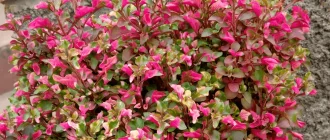
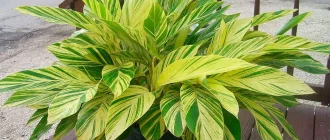
Stromanthe is a beautiful perennial plant native to the swampy regions of South America. It grows in the lower forest canopies where temperatures are high, light is abundant, and moisture is abundant. It reaches a height of 150 centimeters, with leaves about 50 centimeters long. This flower belongs to the Marantaceae family, and its closest relatives include the following plants: Maranta, Calathea, and Ctenantha. Due to its similarity in appearance, Stromanthe is often confused with calatheaSometimes even experienced specialists cannot distinguish them.
Content
Botanical description
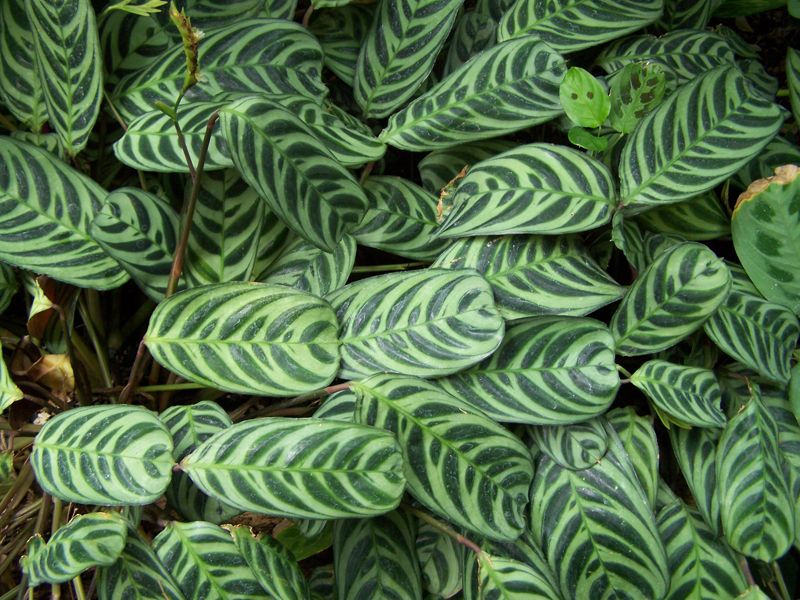
The plant has a very bright, festive appearance, thanks to its colorful, variegated, and unusual leaves on elongated petioles. The top is dark green with stripes of cream, pink, and white. The underside and petioles are purple, violet, burgundy, and crimson. These incredibly colorful leaves always reach toward the light source.
Because its leaves rise and brush against each other at night, "preparing for sleep," it makes a soft noise. This property has earned the stromanthe another name, "Praying Mantis" or "Praying Flower."
In the wild, the plant produces a long stem of white and yellow flowers in summer, with red bracts attached to them. Indoors, the plant blooms extremely rarely.
Types of stromanthe for the home
There are approximately 10-13 species of this plant. The most commonly grown are Stromanthe palatine and Stromanthe sanguineum.
| Types | Description |
| Nice | The height is approximately 30-35 centimeters, the leaves are 15-20 centimeters long and about 4-6 centimeters wide. The leaf blade is oval-shaped. The leaves are light green on top with darker herringbone stripes and oblong in shape, while the underside is olive-green with hints of purple. The reverse side of the leaf is silvery-green. The flowers are inconspicuous. It blooms in spring. |
| Blood red | It grows approximately 40-50 centimeters tall, with leaf lengths varying depending on room conditions, ranging from 20-40 centimeters to 10 centimeters wide. Unlike the previous species, it has a pointed shape. The herringbone pattern is somewhat darker than the leaf's base color. A V-shaped pattern is visible on the upper surface. The underside is pinkish-purple. The inflorescence is a spike. The flowers are inconspicuous. |
| Yellow | It grows up to 2 meters tall. However, the leaves are only 35 cm long, revealing numerous stems branching upward. The flowers are bright yellow and appear in winter. |
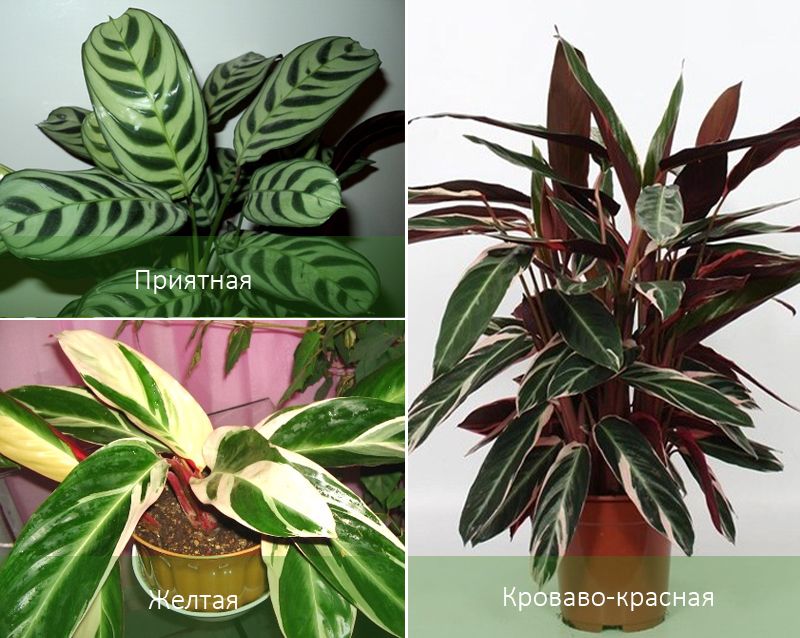
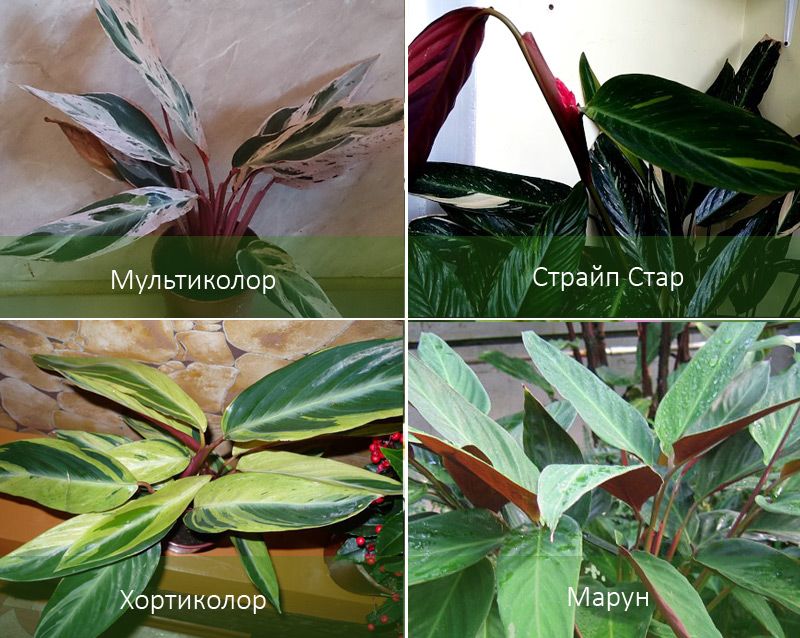
Breeders have developed many decorative hybrids from the blood-red species, some of the most striking among them:
| Varieties | Description |
| Tricolor | It has a very bright, festive coloring. The dark green leaf is striped and spotted with olive, beige, light green, white, and pink. The underside is dark burgundy. |
| Multicolor | The dark green leaf surface is marked by irregular spots and stripes of delicate pastel shades ranging from cream to white. The underside is burgundy-red. |
| Horticolor | Light yellow, emerald, and light green stripes are located on the upper side of the leaf. The underside is dark red. |
| Maroon | The central vein is light green, clearly visible against the rich green leaf blade. Its underside is burgundy. |
| Stripe Star | Chaotic white veins on a dark green leaf. |
Home care
Stromanthe is a very demanding plant, and sometimes providing it with optimal conditions at home is difficult. However, if you know certain rules for each season, it's entirely possible. Below is a chart of care instructions for each season.
| Parameter | Spring-summer | Autumn-Winter |
| Watering | Water abundantly to maintain moisture. | Moderate watering. |
| Temperature | +22-+27 degrees Celsius. | +18-+20 degrees Celsius. |
| Top dressing | Twice a month. | Not required |
| Trimming | Removing dead leaves. | Not required. |
Landing and transplanting
- It's best to repot a very young plant up to four years old every year, removing a thin layer of soil (2 centimeters) and adding new soil. Choose a bucket-shaped container, as the plant's root system is very extensive. When repotting, spread the roots. Place the plant in steamed soil and press lightly.
- Mature plants are repotted after three years if roots have emerged from the drainage and the pot has become too cramped. As before, the top layer of soil is removed and replaced with new soil.
Step-by-step instructions for transplantation
- The bottom of the pot should be filled with expanded clay, filling about 1/4 of the way. This is done to allow excess water to drain away.
- Then add a layer of coarse sand. This will prevent soil from washing away and fill the empty space in the container.
- Next, you need to pour the substrate onto the drainage layer so that there is 2-3 centimeters between the drainage and the roots of the plant, and then lightly moisten it.
- Carefully remove the plant from the old pot, tapping the sides, after thoroughly moistening the soil. Trim off any dead roots and thoroughly wash the remaining ones.
- Then, place the flower, with its roots spread out, onto new, moistened soil and carefully fill it in without compacting it. Water the soil. If the soil has settled, add another layer.
Choosing a pot
The main rule when choosing a pot is its diameter. You should buy a pot 2-3 centimeters larger, as stromanthe roots grow very quickly, filling the entire space.
You also need to consider the depth and width of the container. It shouldn't be too deep, but wide enough to allow the plant to thrive.
Location, lighting
The plant should be placed on an east- or west-facing window. A south-facing window is also possible, but it should be shaded from direct sunlight, or a north-facing window should be provided with backlighting.
Watering and fertilizing
The plant requires ample watering, especially in spring and summer, when the foliage is growing. During cold weather, reduce watering by half, as low temperatures and excessive moisture can cause root rot. Water the plant with settled, room-temperature water.
An important component is spraying flowers during the hot season; this should be done in the evening or early in the morning.
From approximately April to November, it's crucial to feed Stromanthe with complex mineral fertilizers for ornamental plants, every 12-14 days, reducing the dose by half. Examples of such fertilizers include Etiss and BonaForte. Stromanthe can also be fed with organic matter, such as humate. It's logical to purchase fertilizers specifically for this family, but they're not always available in stores.
Reproduction
Stromanthe is fairly easy to grow indoors. It can be propagated by rhizomes or cuttings.
Propagation by rhizome
- Carefully remove the flower from the pot and remove excess soil, rinse the roots well.
- Divide the flower into two or three pieces and sprinkle the cut areas with charcoal. Plant the pieces in small containers with slightly damp soil.
- Allow the plant to acclimate to the new conditions. Eventually, cover the bushes with a plastic cap and remove it after 7 days to create greenhouse conditions.
Propagation by cuttings
- The selected cuttings are carefully cut further than the attachment of the leaves, leaving three or two leaves on each.
- Place them in water and cover with a regular plastic bag.
- After 30 days, when roots appear, plant them in soil made of coarse-grained sand with low acidity.
- After 50-60 days, plant in regular plant pots.
Care errors and how to fix them
| External signs | Possible causes | Treatment and prevention |
| The leaves have dried out and lost color. | Excess of sunlight. | Move the plant to a brighter location, away from direct sunlight. Or shade the room. |
| The tips of the leaves are drying out. | Dry air. |
|
| Spider mite. | ||
| The leaves are curled and falling. | Incorrect watering of the flower. | The soil must be moist. |
| Stem rot and leaf fall. | Cold room temperature. | The air should warm up to +25 degrees. |
| Yellowish-brown foliage at the edges. | Incorrect feeding. | Pay attention to the feeding rules. |
Pests and diseases
| Pest | Distinguishing features | Solution to the problem |
| Spider mite | The tips of the leaves dry out and curl. The flower's color fades. The petioles and the junctions with the leaflets become covered with a transparent thread. | Exposure the plant to ultraviolet light every 12-15 days for 2-3 minutes. After this, treat the leaves with a soap-alcohol solution for 30 minutes and rinse thoroughly. After 3 hours, spray the plant with an acaricide (Vermitek, Nisoran, Oberon) and cover with a plastic bag. |
| Scale insect | Bumps with a characteristic gray-brown color appear on the underside of the leaf. The surrounding areas turn yellow and later white. | First, treat the leaves with a cotton pad or cloth soaked in alcohol, or even take a shower at 45-50 degrees Celsius. Spray the plant and the soil with an insecticide (Mospilan, Metaphos) and cover with a regular plastic bag for 2 days. After treatment, do not expose the plant to direct sunlight, as it may be damaged. |
| Whitefly | The larvae suck the sap from the leaves. Afterward, the leaves lose their shape and fall off. The plant stops growing. | Solutions of strong-smelling herbs, garlic, and onions can be used. Fly tape can also be used. Control methods include Komandor, Tanrek, and Admiral. Spray the solution on the soil itself every 3-4 weeks or on the plant every 7 days for about a month. |
| Thrips | The insects settle on the underside of the leaf, secreting a sticky liquid and sucking out the sap. The upper side becomes covered in a beige and silvery hue. | Folk remedies include infusions of potato tops and tobacco shavings. You can also use insecticides (Dantol, BI-58, Mospilan), shower the plant, treat it, and cover it with a plastic bag. |
Top.tomathouse.com informs: Stromanthe - harmony in the family, confidence in work
This flower possesses incredible properties. Its presence in the home establishes a close connection between a person's physical and spiritual worlds.
This plant will help those who suffer from insomnia and sleepwalking. As is well known, such people often find themselves restless and try to occupy themselves while awake.
There's also a solution for those who are restless and depressed. Stromanthe will bring peace and tranquility to the home, and a person will be able to discover a new side of themselves.