Plumbago is a small, evergreen flowering shrub native to the tropics (family Plumbago). The scientific name, plumbago, is Latin for lead. Therefore, it was once believed that it could be used to prepare an antidote to this substance.
It has the appearance of long, slender shoots, densely covered with leaves and inflorescences. This explains its popularity as an ornamental plant for both gardens and indoors.
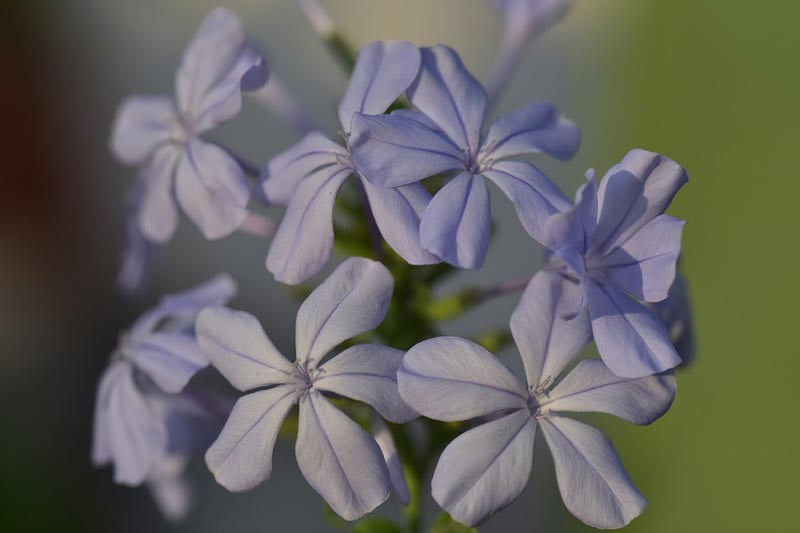
Description of lead
Plumbago produces numerous shoots, grows densely, and reaches 2-3 meters in height. This allows it to be grown in any shape:
- standard with trunks tied at the bottom and a spherical cap on top;
- ampelous, with branches hanging freely below the level of the pot;
- Liana-like with upward-climbing shoots, suitable for cultivation in warm climates.
Small leaflets with two stipules are arranged alternately on the slender stems. Each leaflet is elongated and conical, tapering toward the base with an entire margin, and reaches 5-12 mm in length. Occasionally, their surface may be covered with fine hairs. After maturing, the rich green color of the underside of some varieties fades to a whitish hue.
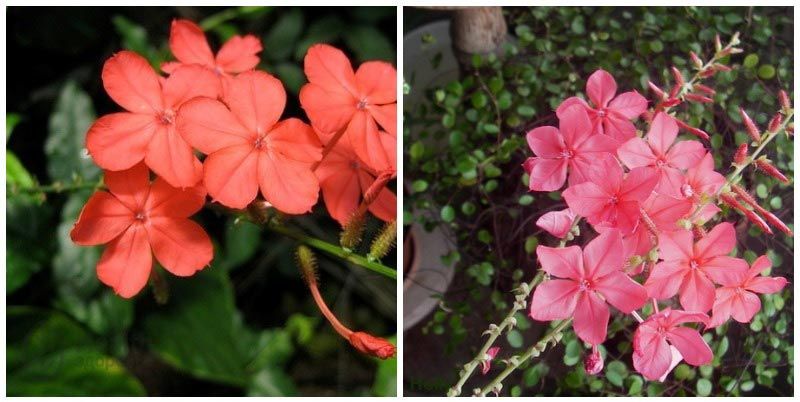
The stems are crowned with flowers, large compared to the leaves, reaching 30 mm in diameter. The five-petaled corollas are borne on a thin tubular calyx, which contains an elongated ovary. Near the stem, they gather into a racemose or spike-shaped inflorescence, covering the entire bush.
Each bud contains glands that secrete a sticky fluid. The seeds also contain a similar mucilage, which facilitates their dispersal by birds and insects.
The flowering process extends from early spring until September, after which the elongated ovules form. As they ripen, the ovoid fruits burst open from the base to the tip, releasing the seed.
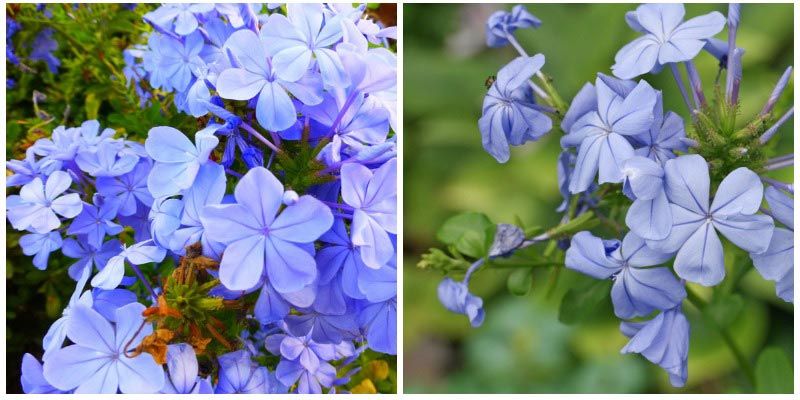
Popular types of lead
The genus Plumbago contains up to 10 species, most of which are suitable only for subtropical climates. Two main cultivars are grown in cultivation:
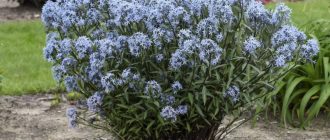
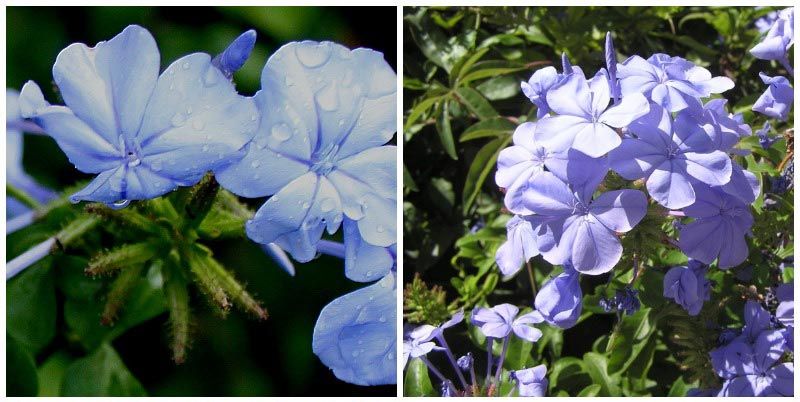
- Plumbago auriculata (or capensis), native to South Africa, is the most common of the three. It has large blue flowers gathered in umbels. The soft, light green leaves are up to 7 cm long and 3 cm wide. They are borne on long, grayish-green stems that are almost rigid and reach 3-6 m. It can grow as a shrub, a trailing form, or a rambling climber. There are also varieties, including 'Alba' with snow-white corollas and 'Cape Royal' with cobalt-blue ones.
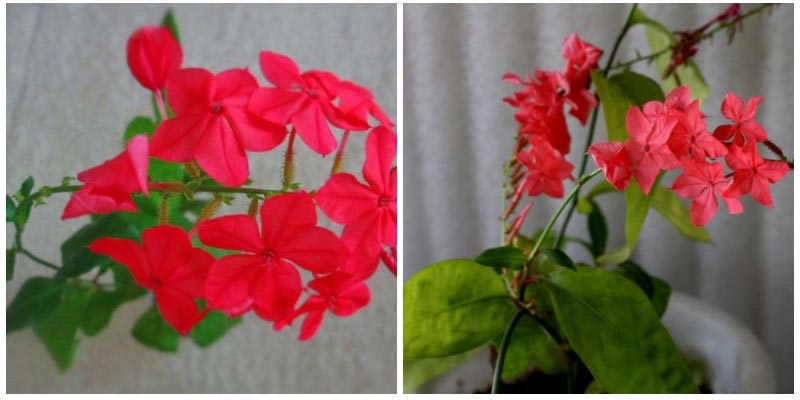
- Indian rose (Plumbago indica) is native to Southeast Asia. It is widely cultivated in gardens in India, but is much less common in other countries. It is distinguished by its elongated, bright red flower spikes with corollas up to 3 cm in diameter. The creeping stems grow up to 1.5-2 m in height, and the slightly wavy, glossy leaves on them reach 8-13 cm. It blooms in winter and requires warm conditions during this period.
Tips for caring for plumbago at home and in the garden
Caring for lead at home includes the following aspects:
- Lighting should be bright, with direct sunlight from fall to spring and light protection in hot rooms. In summer, it's best to move the plant to a balcony or garden for fresh air, and in winter, move it to a south-facing windowsill.
- Temperatures should be moderate, ranging from 18 to 24°C. Leaves begin to fall when temperatures drop to 12°C, and when temperatures rise, ventilation or spraying is necessary. In winter, temperatures can be reduced to 10 to 15°C for the Cape variety, which blooms from April to September.
- Starting in June, water generously, up to three times a week, and humidifiers can be used. After flowering, water weekly as the soil dries out.
Following these guidelines, plumbago can be grown both on a windowsill and in the garden, in tubs or hanging pots. Fresh air is essential for it, which should be taken into account during the growing season.
The rest of the time, cool temperatures and regular, albeit infrequent, watering are acceptable, but it is best to transition to them gradually.
Replanting, soil, fertilizing, pruning
Plumbago is considered a perennial and remains green year-round. To promote growth, it should be repotted annually in early spring, at least when young. As the plant matures, this frequency can be reduced to every 2-3 years, repotting as needed. Avoid contact with the rhizome and only change the top layer of soil.
The soil should be well-drained, slightly acidic, and highly nutritious. A universal substrate for flowering plants containing turf, peat, and sand in a 2:1:1 ratio, possibly with humus, can be used.
Planting a plumbago is only half the battle, but to ensure vibrant colors and beautiful blooms, it needs regular feeding. This should be done throughout the growing season, mixing fertilizer into the water several times a month, according to the instructions.
Both universal fertilizers and types for beautifully flowering plants are suitable.
To ensure a decorative, compact appearance, and abundant flowering, pruning is necessary in late fall or early spring, preferably in February or March, before fresh buds appear, depending on the growing style.
- in the ampelous form, the vines are only slightly shortened, not allowing them to stretch out too much;
- when using supports, only the very tops of the stems can be pinched, which are then tied up;
- To shape the bush, all excess length that extends beyond the shape is trimmed off.
At the same time, the weakest and thickest branches are removed, as they will hinder the growth of strong ones. Three to four strong shoots growing from the center are left as the base, and the remaining shoots are cut to two-thirds of the height, leaving two to three pairs of leaves. To renew or restore the bush, more radical pruning is done, cutting all branches back to a length of 30 cm.
Another mandatory procedure is pinching off flower buds as they dry out and removing flower stalks in early spring.
Reproduction
This ornamental plant from the Plumbago family is long-lived, and under favorable conditions will live for about 7 years. It can be propagated using one of the following methods:
- Cuttings at least 8 cm long, taken during routine pruning, are planted in a covered container. The container is moved to a cool place, kept at a temperature of 15°C and ventilated periodically. A mixture of peat and sand is used as a substrate, which should be watered regularly. Rooting takes 2-3 weeks, during which time the shoots will begin to grow.
- In early spring, use a seed and plant it in a container with a moist mixture of soil and sand. Cover with plastic wrap or a glass jar and place in a warm place with a temperature of at least 20°C for 1.5–2 weeks. Plant the seedlings when a couple of leaves emerge from the soil.
The bushes will not immediately become decorative, although the first buds may appear this year after planting the flower.
Diseases, pests of plumbago, growing problems
Plumbago is fairly resistant to diseases, but there are still some problems to be wary of:
- Over-watering of the soil in winter can lead to root rot;
- in deep shade, the shoots will begin to stretch out and the leaves will decrease in size;
- drying out of the soil leads to a cessation of flowering and wilting;
- Irregular watering causes the leaf blade to turn brown.
She rarely suffers from insects, but in dry air some of them become active:
- Spider mites, which appear as translucent webs and cause leaves to fall, live in the soil. Control requires repotting and treating the roots with insecticides (Fitoverm, Antikleshch), and the stems with an infusion of yarrow, garlic, or onion.
- Scale insects form reddish-brown spots along the veins on the underside of the leaf. The affected areas are wiped clean of the plaque and then treated with Malathion.
- Aphids and mealybugs, which feed on the sap from the branches, appear with a lower probability.
It's worth noting that these insects most often attack unhealthy plants, such as those dehydrated by thirst or wilting in a stuffy room. They won't cause much harm to a perfectly healthy plant if it's treated with specialized chemicals in a timely manner.