The Andreevsky Surprise tomato variety is a relatively new development. However, it has already gained popularity among gardeners thanks to its unique flavor and its ability to be grown in regions with challenging farming practices.
Content
- 1 Characteristics of the Andreevsky Surprise tomato variety in a table
- 2 History of the variety's creation
- 3 A detailed description of the Andreevsky Surprise tomato variety
- 4 Advantages and disadvantages of the Andreevsky Surprise tomato variety
- 5 Features of sowing and planting the tomato variety Andreevsky Surprise
- 6 Care tips for the Andreevsky Surprise tomato variety
- 7 Resistance of the tomato variety Andreevsky Surprise, disease prevention
- 8 Using the Andreevsky Surprise tomato variety
- 9 Comparison of the Andreevsky Surprise tomato variety with other varieties
- 10 Gardeners' reviews of the Andreevsky Surprise tomato variety
Characteristics of the Andreevsky Surprise tomato variety in a table
| Characteristic | Description |
| Description | A late-ripening indeterminate variety for greenhouses. Can be grown outdoors in the south. |
| Ripening period | About 120 days. |
| The fruit is mass | 120-230 g |
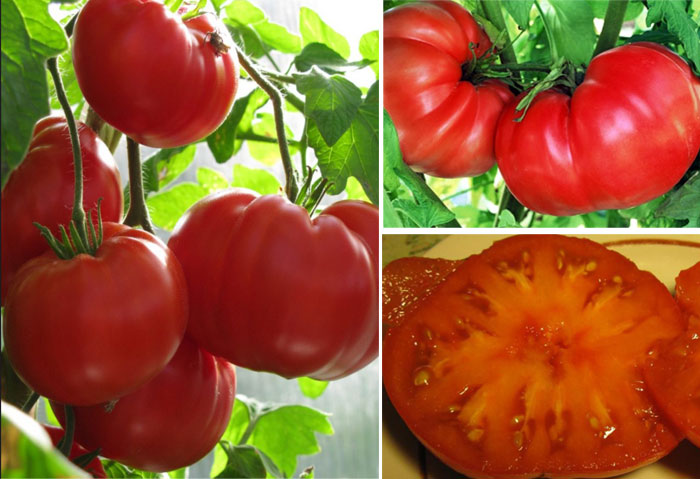
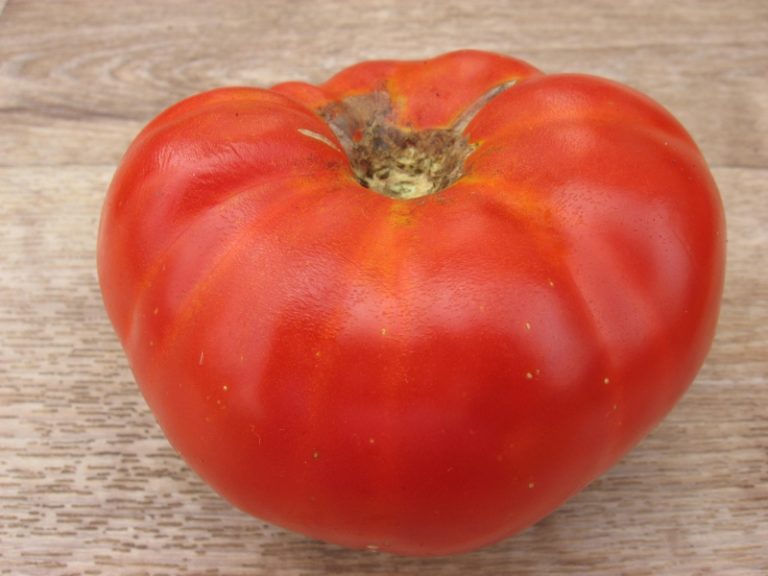
| Description of the fruit | Flat-round, smooth, medium-dense, pink. Excellent flavor. |
| Productivity | 800 c/ha. |
| Usage | Salad. |
| Marketability, shelf life | Low. Not intended for long-term storage. |
| Preferred growing regions | Northern, Northwestern, Central, Volga-Vyatka, Central Black Earth District, North Caucasian, Middle and Lower Volga, Ural, Western and Eastern Siberia, Far East. |
| Disease resistance | To many diseases of nightshades. |
| Agricultural technology | Requires garter and shaping. |
| 2007. | |
| Originator | LLC AGROTECHNOLOGICAL FIRM "AGROS". |
Photo gallery of the tomato variety Andreevsky Surprise
History of the variety's creation
The variety was developed by breeders A. A. Kamanin and V. N. Gubko (Siberian Research Institute of Crop Breeding). In 2007, it was added to the Register of Breeding Achievements, after which it was immediately launched for sale. Developed by Siberian breeders, the variety is suitable for cultivation in cold regions.
A detailed description of the Andreevsky Surprise tomato variety
Let's take a closer look at the variety.
Bush characteristics
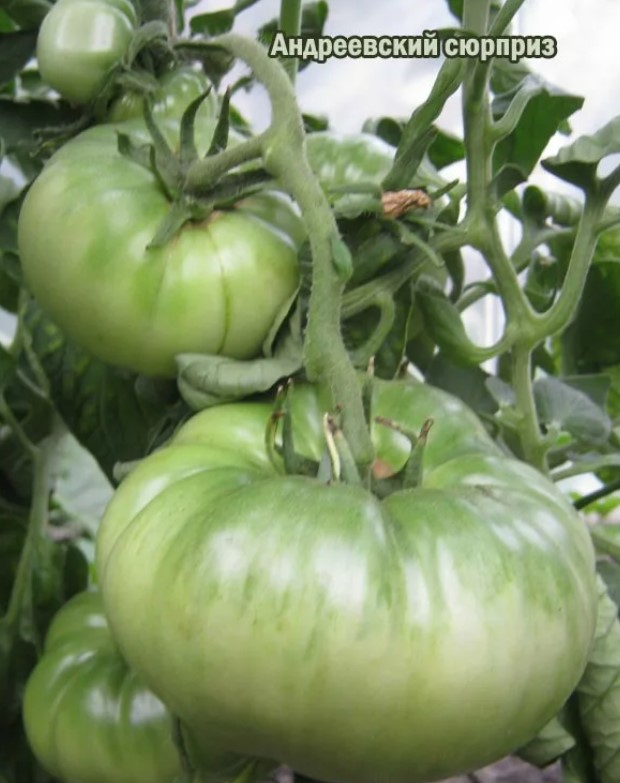
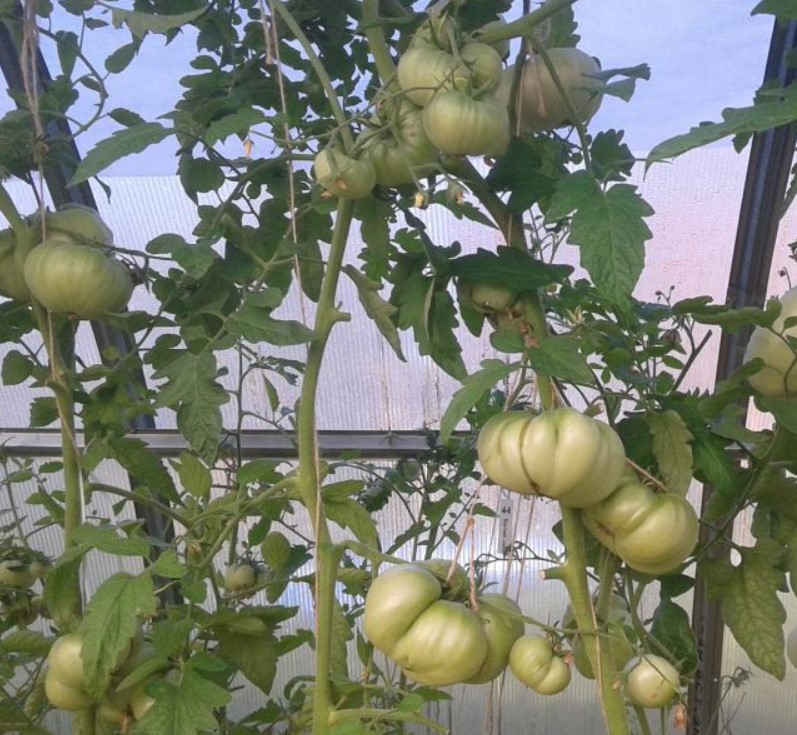
The bushes are indeterminate and can reach 2 m. The leaves are dark emerald in color and medium in size. Intermediate inflorescences form every three leaves.
The flowers are bisexual and self-pollinating. Pollination by wind and insects is also possible. The first raceme appears after the 8th or 9th leaf. The peduncles are articulated.
Fruit characteristics
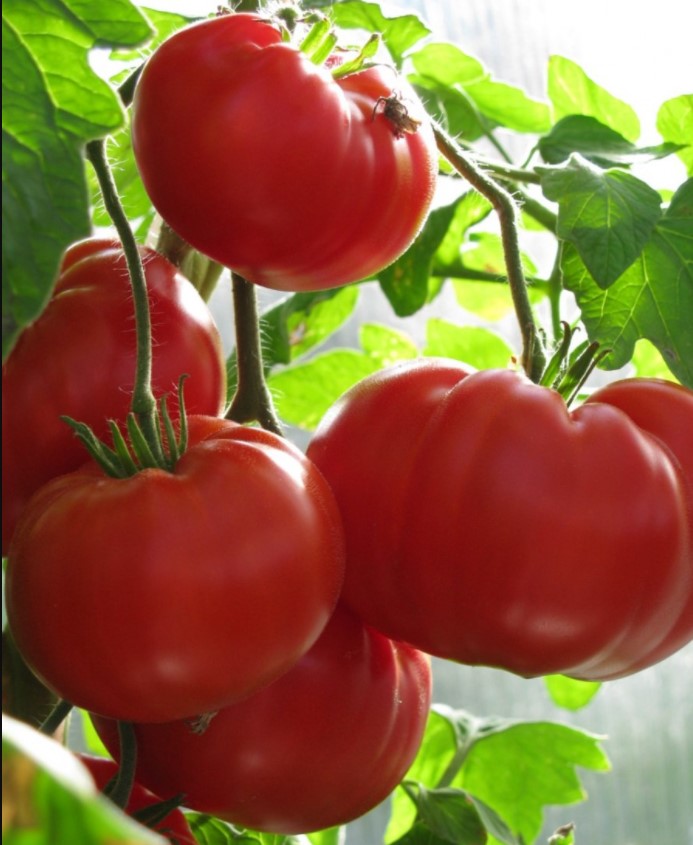
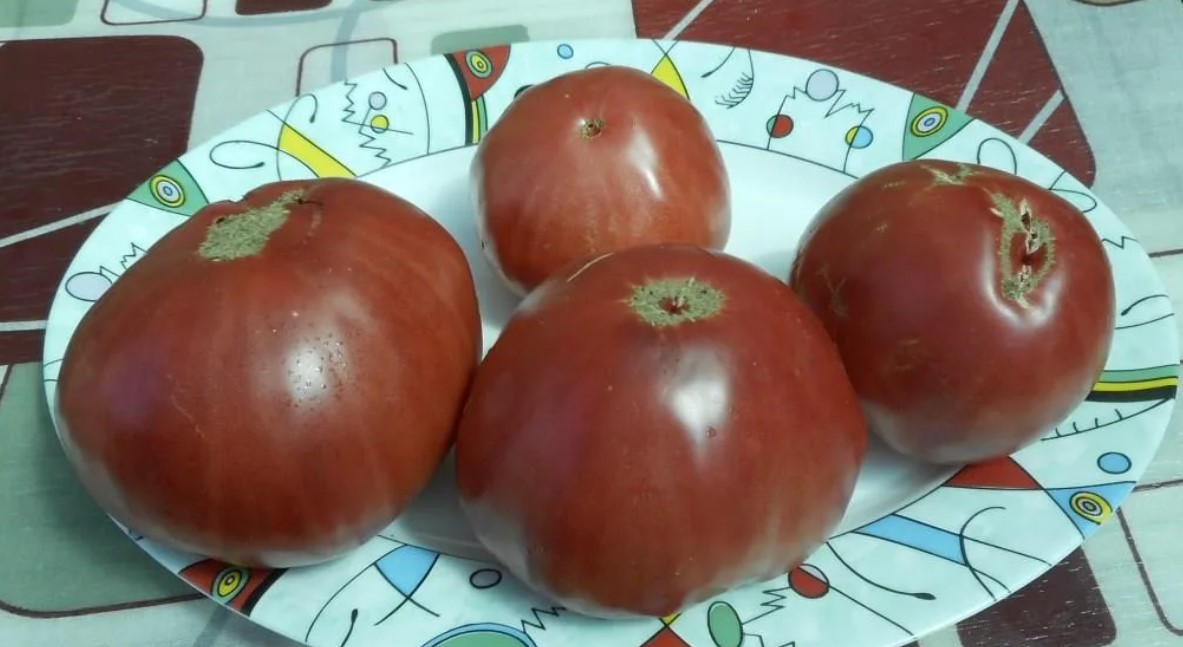
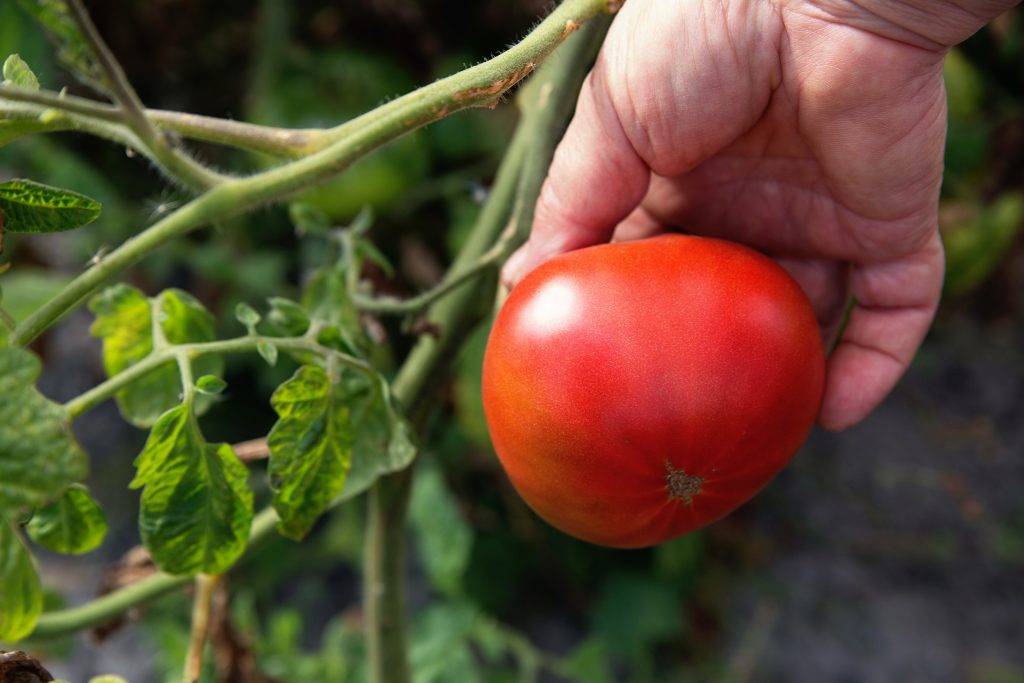
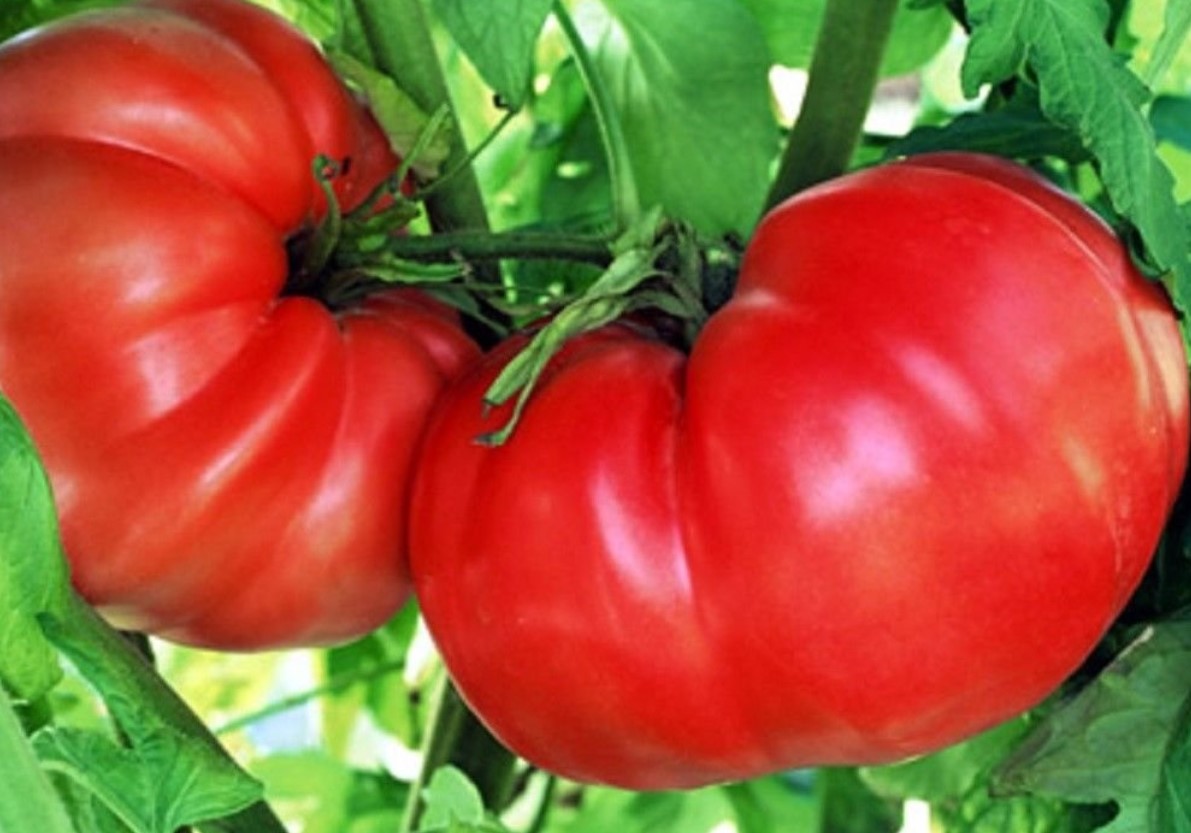
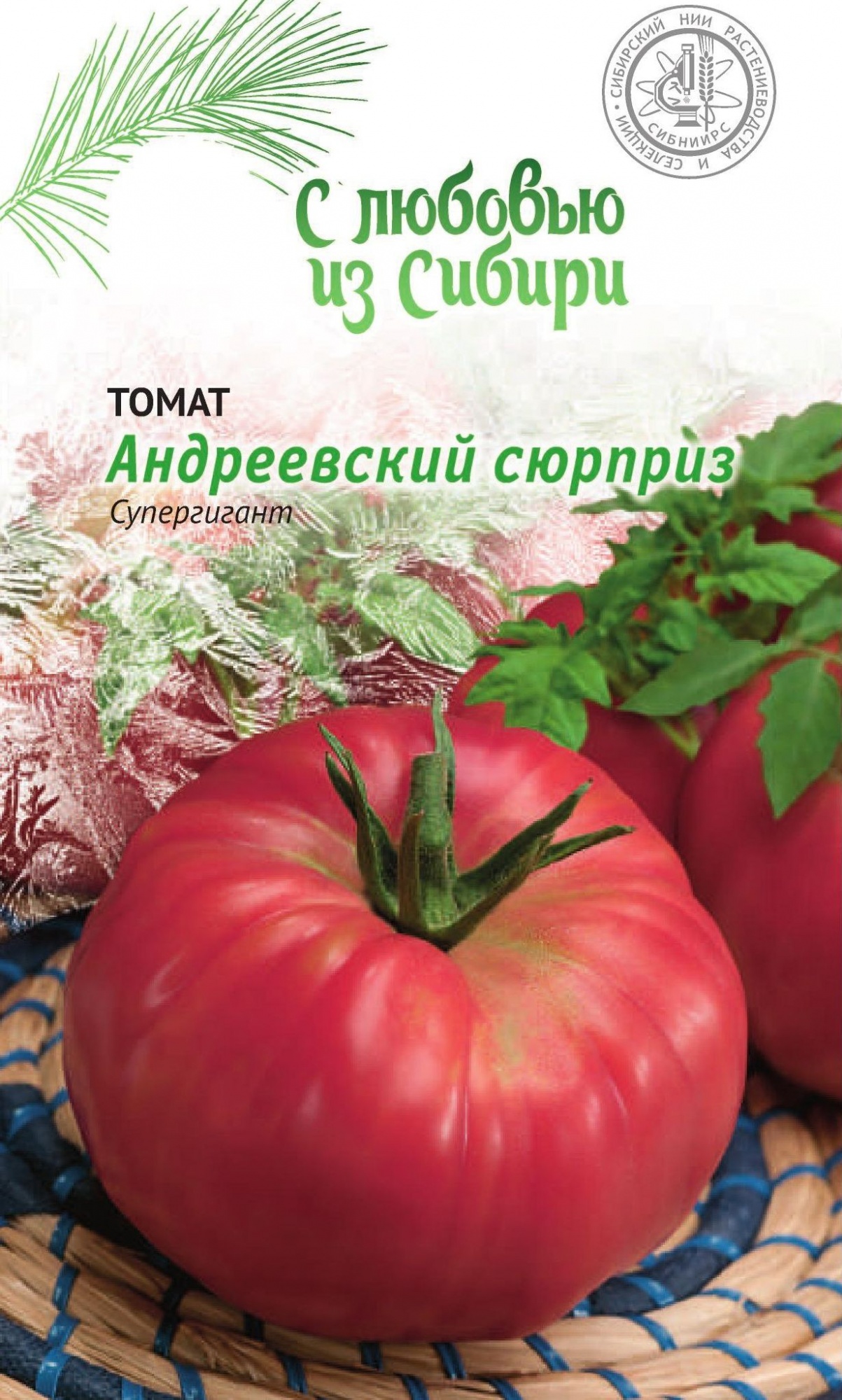
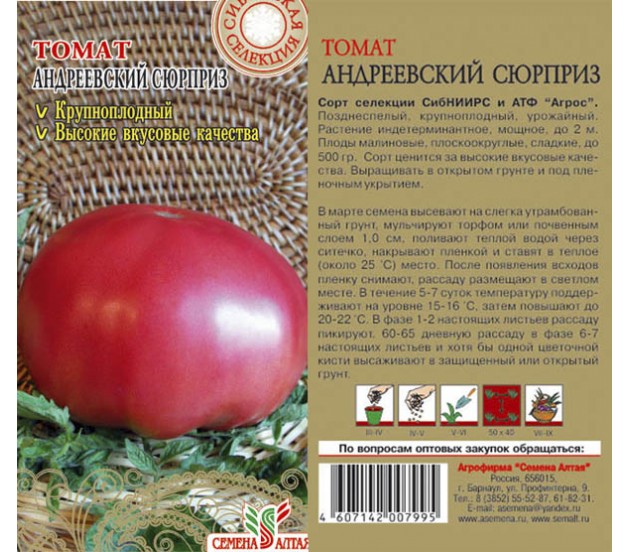
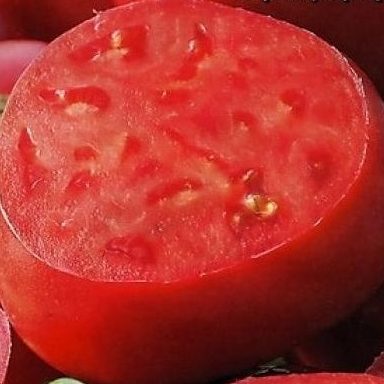
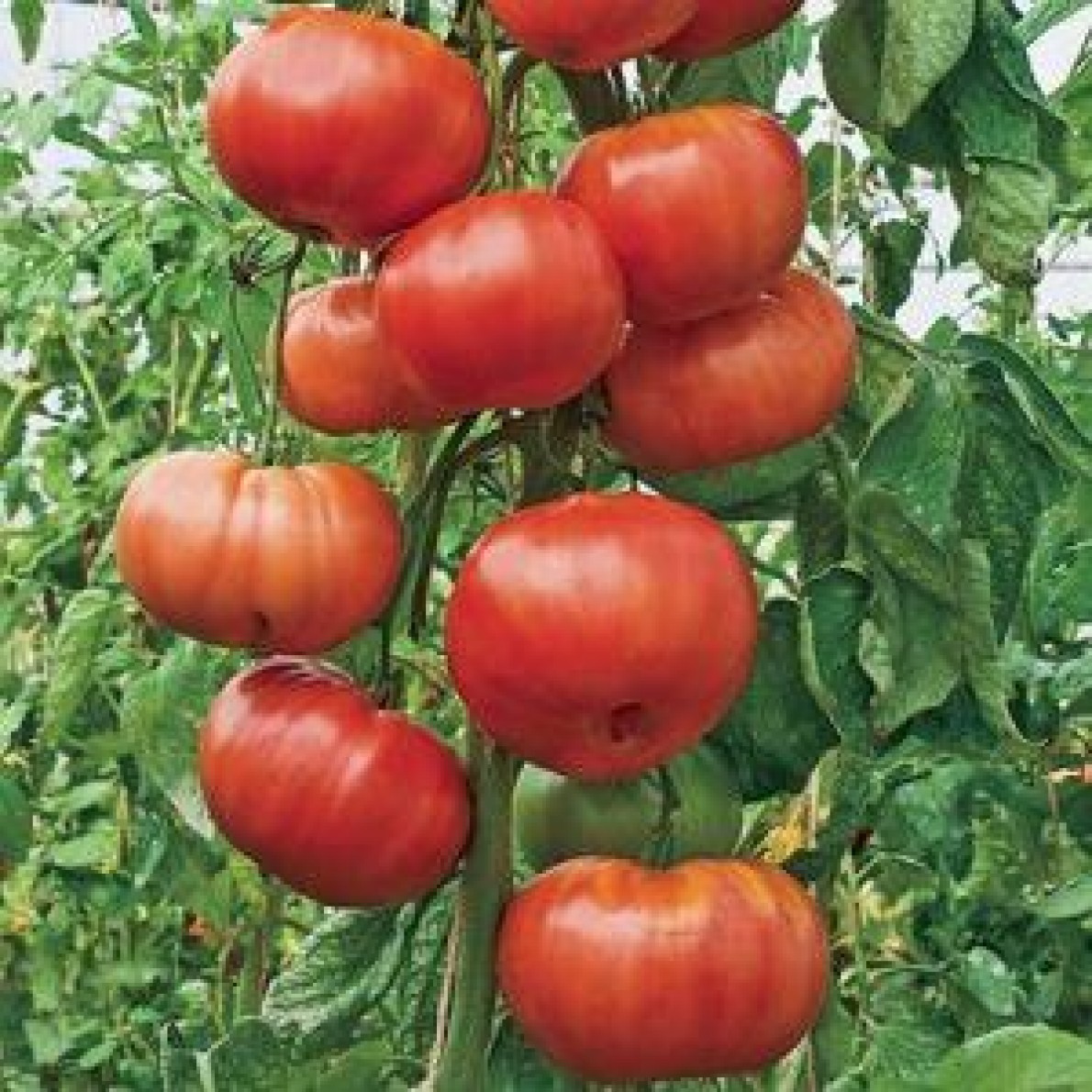
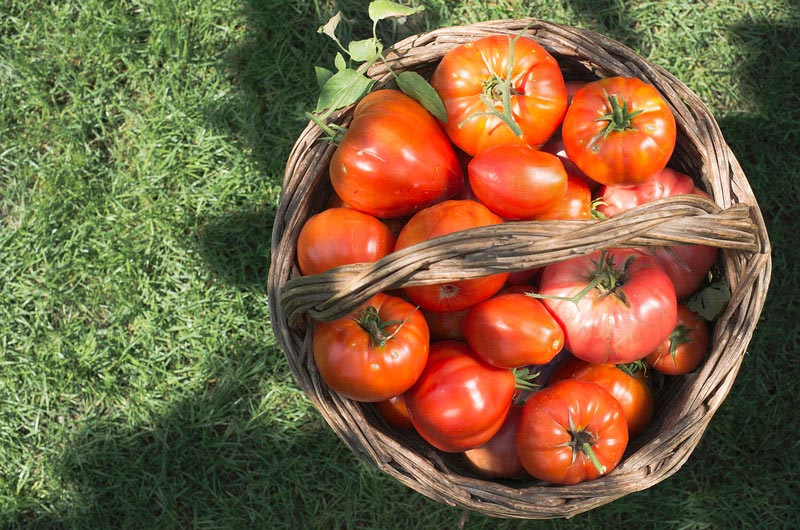
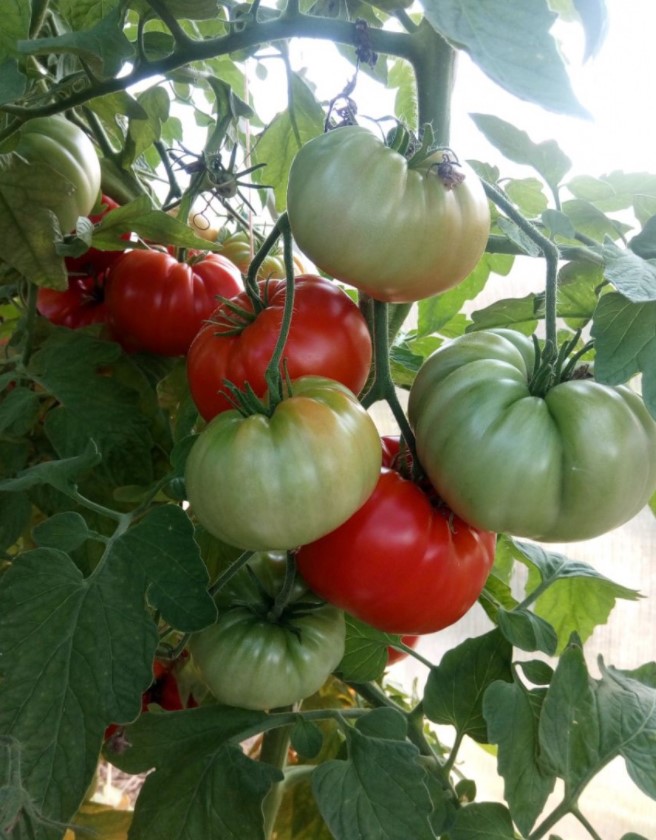
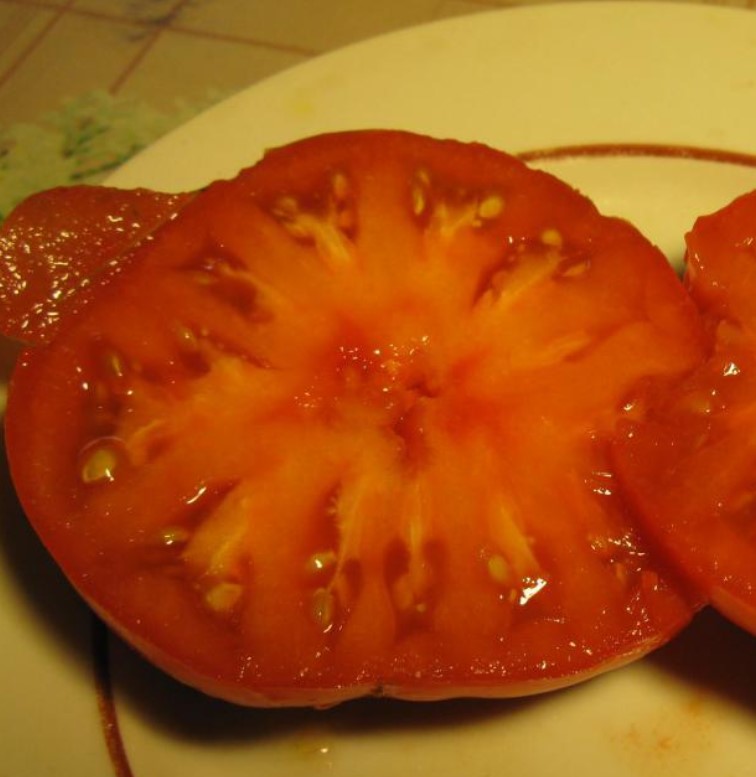
The pinkish fruits are flattened and round, without ribbing, as you can see in the photo. The multi-chambered flesh is dense and very juicy. The fruits average 120-230 g in weight, but some can reach up to 600 g. They have excellent flavor. Moreover, this is closely related to environmental conditions. The more sunny, warm days there are, the better the flavor.
Ripening time and yield
The harvest can be completed approximately four months after the first seedlings emerge. 350-800 centners of tomatoes can be harvested per hectare. This variety produces maximum yields when all agricultural requirements are met.
Advantages and disadvantages of the Andreevsky Surprise tomato variety
The Andreevsky Surprise variety has a number of advantages and disadvantages:
| Advantages | Flaws |
|
|
Features of sowing and planting the tomato variety Andreevsky Surprise
To obtain a rich harvest, it is necessary to follow certain rules when growing.
Sowing seeds and growing seedlings
Seeds are sown from March 1st to 15th for open ground and plastic greenhouses. They can also be planted in late February for growing in a glass or polycarbonate greenhouse.
The seedlings of this variety are quite shade-tolerant and do not require additional lighting.
A 6-8 cm layer of nutrient-rich soil is poured into pre-prepared seedling boxes. A 2 cm distance is left between plants in a row. A 4 cm distance is left between rows.
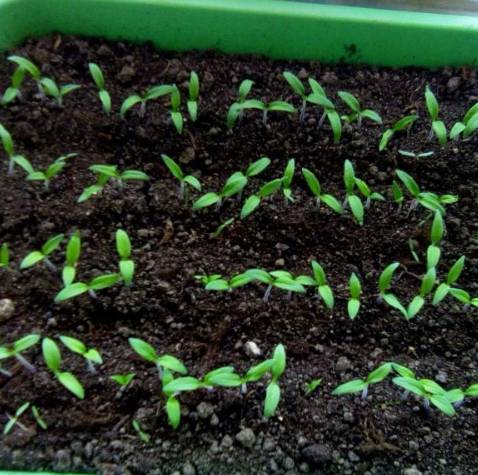
After sowing, cover the box with plastic film to create greenhouse conditions. Place the seedlings at a temperature of 25 to 28°C. Lower temperatures will slow growth. The temperature should be lowered only if the seedlings are developing too quickly. Remove the film daily for ventilation and misting with a spray bottle. Avoid overwatering. Once the seedlings emerge (after about a week), remove the cover completely.
Pricking out is done at the two true leaf stage. The sooner this is done, the faster the seedlings will establish themselves and adapt to the open ground. Pricking out is done three times before planting in their permanent location. This will strengthen the root system. It also slows down the growth of the seedlings, as the variety is indeterminate and the bushes develop very quickly. The seedlings are planted deep down to the cotyledon leaves to encourage the formation of additional roots. Fertilizer is applied no earlier than a week after pricking out. Fertilizing is required no more than twice.
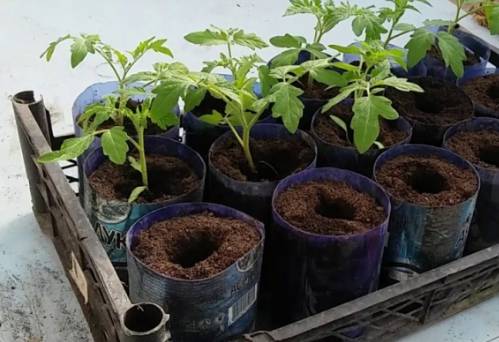
A month before planting, the seedlings need to be hardened off. To do this, take them outside daily, gradually increasing the time spent outdoors.
Preparing the soil and planting in the ground
Seedlings can be planted in a greenhouse in early May, and in open ground when daily temperatures no longer drop below 15°C. The exact date will depend on the climate of the growing region. The optimal age for planting is 60-65 days.
If you've grown your own seedlings, you can plant them at any time of day and in any weather. If you've purchased them, you should begin planting them in the evening after sunset or on a cloudy day.
For transplanting, it's recommended to use seedlings with thick stems, large leaves, and a well-developed root system. Gardeners advise that when planting in their permanent location, each bush should have one unblown cluster. If the buds have already opened, it's best to remove them, but it's best not to do so beforehand, as the largest fruit will be lost.
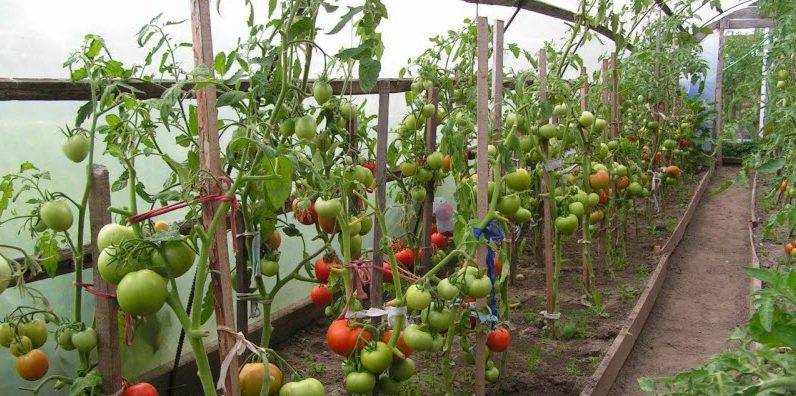
Planting is done in a 50 x 50 pattern. It is recommended to place no more than two plants per square meter. Seedlings are planted 2-3 cm below the first true leaves.
When planting, it is necessary to immediately install support and tie up the tomato stems.
Overgrown seedlings should be placed in furrows, leaving the above-ground portion at normal height above the surface. Immediately after planting, the bushes are tied to a trellis or supports.
Care tips for the Andreevsky Surprise tomato variety
To obtain a good harvest, it is important not only to follow the rules when planting, but also to ensure high-quality care in the future.
Growing temperature
When growing the variety in a greenhouse, it is necessary to constantly ventilate it and maintain a temperature of no more than +30 °C.
In open ground: cover plantings during sudden changes in weather conditions.
Watering
Water the bushes twice a week, morning or evening, with warm, settled, or rainwater. Water generously.
In case of rain, it is necessary to reduce watering when the bushes are in open ground.
Top dressing
Fertilizers are applied according to the following scheme:
- organic and nitrogen fertilizers about a week after planting;
- potassium mixtures during the formation of ovaries;
- phosphorus-potassium fertilizers during fruit formation.
Fertilizers should be applied at least 3 times during the growing season.
Formation of bushes
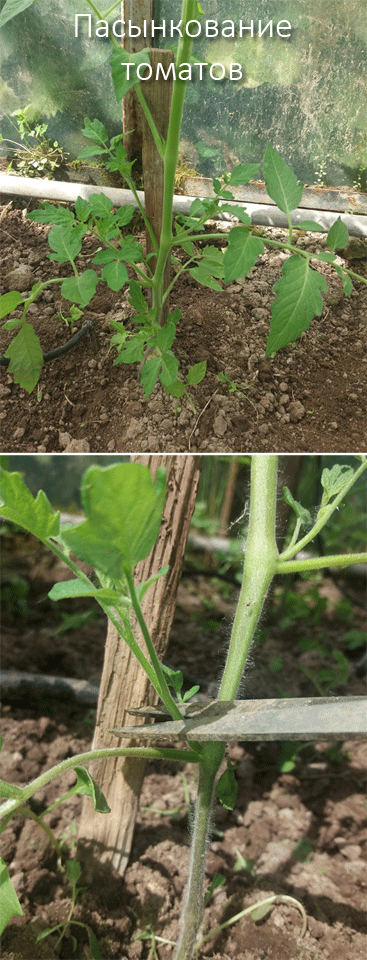
Removing side shoots ensures better nutrient supply to the bushes. This will speed up fruit ripening. Side shoots are removed when they reach 5 cm in length. They can be pinched or broken off by hand. Shoot tips are pinched in early August in northern regions and in late summer in the south.
Resistance of the tomato variety Andreevsky Surprise, disease prevention
Although this variety is disease-resistant, preventative treatment is still required. Mosaic disease is particularly dangerous and can occur both in open and closed soil. When infected, leaves change shape and color. Yellow and green spots alternate on the leaf blades. Yield declines. Over time, the plants turn completely yellow and die. Affected plants must be burned to prevent the spread of the infection.
Some recommendations to reduce the risk of infections:
- use 2-3 year old seeds;
- Before sowing, soak the seeds for half an hour in a 1% solution of potassium permanganate;
- Every 1.5 weeks, treat the seedlings with skim milk (1 liter of milk, 1 teaspoon of urea, pour 10 liters of water).
Late blight also poses a danger. This disease is characterized by the appearance of brown spots on all parts of the plant and a snow-white coating on the underside of the leaves. To prevent the disease, it is recommended to spray the bushes with calcium nitrate (1 tablespoon per 10 liters of water), iodine solution (1 teaspoon per bucket of liquid), or the store-bought product Profit Gold.
Using the Andreevsky Surprise tomato variety
The greenhouse harvest begins in July at full or near-full ripeness, when the tomatoes turn pink or reddish. This variety ripens evenly. All the fruits can be harvested in three or four stages. The last green tomatoes remaining on the vines should be picked before the first frost. Store them in a dark, warm place. They will ripen within a couple of weeks.
All the tops should be removed, dried, and burned. The beds should be dug over and fertilized to prepare them for next year's planting. This will eliminate the need for soil preparation in the spring.
Comparison of the Andreevsky Surprise tomato variety with other varieties
Please note! How can you easily convert centners/ha to kg/sq.m? Simply divide by 100! For example, the Abakansky Pink tomato yields 400 centners of marketable fruit per hectare. This equals 4 kg per square meter. It's that simple! Also, keep in mind that typically no more than 3-4 plants are planted per square meter. This way, you can calculate the yield per bush. In the case of the Abakansky Pink, it's about 1 kg.
| Variety | Ripening period (number of days from full germination to ripening)
Yield of commercial fruits |
Brief description | Fetus |
| St. Andrew's surprise | about 120 days
800 c/ha |
A late-ripening indeterminate variety for greenhouses (can be grown outdoors in the south). Suitable for salads, juices, and tomato paste. Seedlings tolerate low light conditions well. | Flat-round, smooth, medium density, pink, 150-230 g. Excellent taste. |
| Mushroom basket | 115-120 days 630 c/ha |
A late-ripening, indeterminate, standard variety for open ground and greenhouses. Requires staking and shaping. Suitable for salads. | Flat-round, very strongly ribbed, medium density, pink, 250 g. Good taste. |
| Altai masterpiece | 110-150 days
up to 1000 c/ha (under film) |
A mid-season indeterminate variety for open ground and greenhouses. Requires staking and shaping. Suitable for salads. | Flat-round, medium-ribbed, medium density, red, 300-400 g. Good taste. |
| Scarlet Mustang | 115-120 days
391 c/ha |
A mid-early, indeterminate variety for open ground and greenhouses. Suitable for canning. It has a very high marketability (97.3%). | Medium, cylindrical, hard, slightly ribbed, red, 95 g. |
| Volgograd (5/95) | 116-130 days
374-1035 c/ha (20-25% of the total yield ripens within 15 days of fruiting) |
A late-ripening, indeterminate, standard, compact variety for open ground. Suitable for salads and processing into tomato products. | Flat-round, smooth and slightly ribbed, medium-sized and large, red, 90-150 g. Good to excellent taste. |
| Pride of Siberia | 85-100 days up to 2000 c/ha |
A mid-late, indeterminate, standard variety for open ground and greenhouses. Suitable for salads and processing into tomato products. | Flat-round, large, red, 320 g. The taste is good and excellent. |
| Malinka Star | 85-95 days
12,600 c/ha |
An early-ripening indeterminate variety for open ground and greenhouses. Suitable for salads. | Flat-round, medium ribbed, pink, 97-120 g, reaches 300 g. Good taste. |
| Abakan pink | 120 days or more
400 c/ha |
A late-ripening determinate variety for open ground and greenhouses. Requires staking and training. Suitable for salads and processing into tomato products. | Flat-round, slightly ribbed, medium density and pink in color, 200-500 g. Good taste. |
| Russian size | 125-127 days
700-800 c/ha |
A late-ripening indeterminate variety for greenhouses. Suitable for salads. | Flat-round, slightly ribbed, red, 630 g. Excellent taste. |
| Wonder of the World | 120 days 550-620 c/ha |
A late-ripening indeterminate variety for open ground. Requires staking and shaping. Suitable for salads and pickling. | Obovate, slightly ribbed, yellow, 80 g. Good taste. |
Gardeners' reviews of the Andreevsky Surprise tomato variety
Reviews from gardeners who have tried growing the Andreevsky Surprise variety are positive. They note the excellent sweet flavor and juicy, fleshy flesh. Disadvantages include the need to strictly adhere to agricultural guidelines. Otherwise, yield will drop significantly or the tomato will even die.
Good day to the readers of my review!
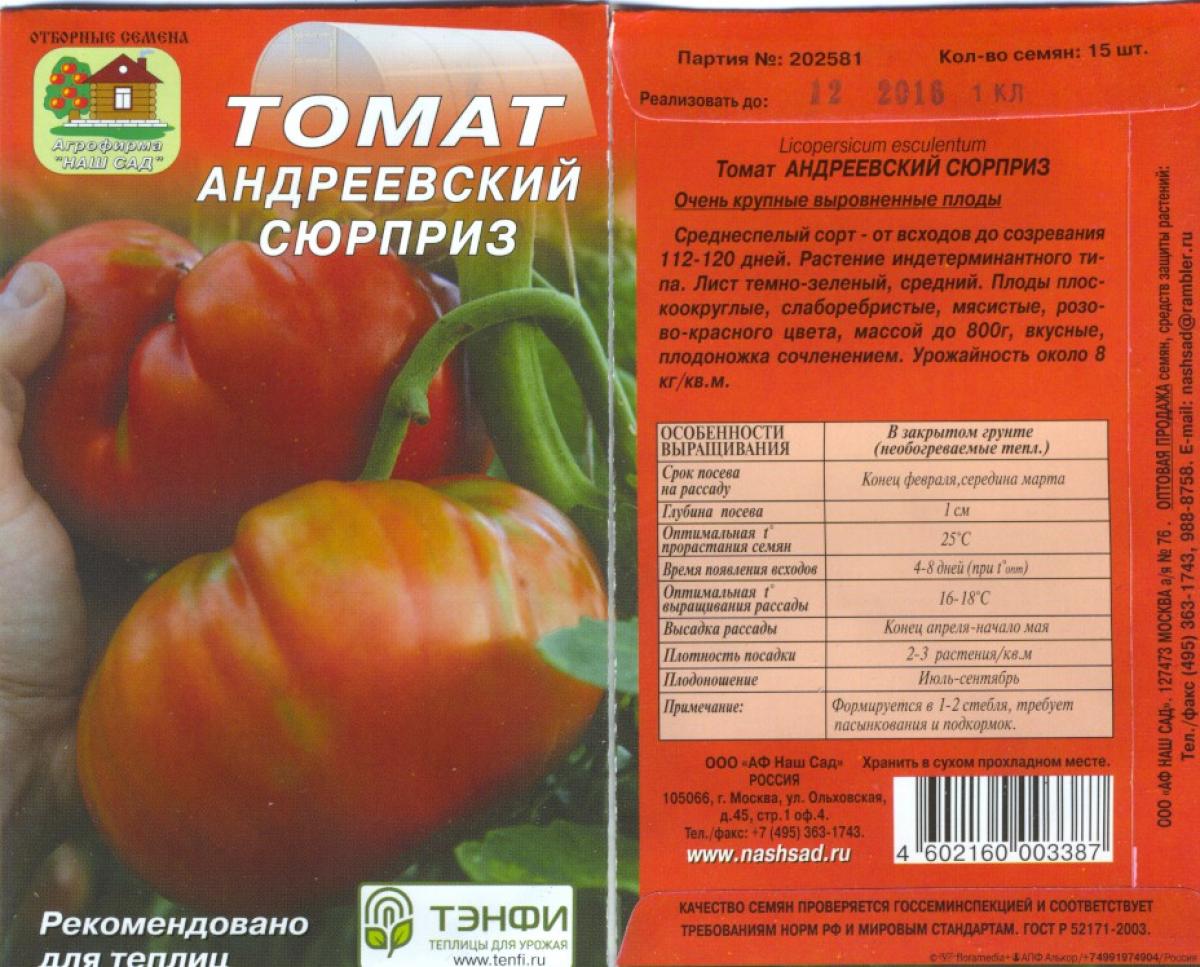
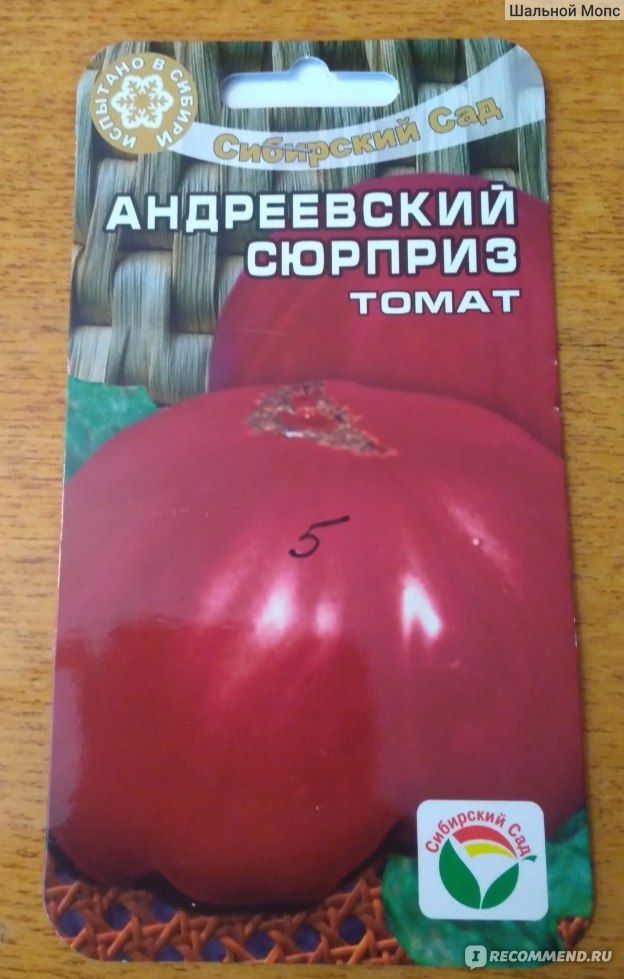
I'm sorting through my tomato seeds and making a rough list of what to plant next year. Of course, I want to plant some worthy ones that have already shown excellent results. The Andreevsky Surprise tomato variety, produced by Agros, is one such example. The packet is a bit worn, but I usually write notes on them based on the growing results.
There's some great growing advice on the back, with an expiration date that's already passed, but the seeds germinated 100% this year.
It is enough to sow high-quality calibrated seeds twice.
I sowed the seedlings in mid-March, and germination was excellent. The seedlings developed well and were transplanted to the greenhouse in mid-May. Although the height is stated as 1.5 meters, the bush grew to almost 2 meters. The yield is average. It produces numerous large, beautifully shaped fruits. The fruits ripened without cracking. The photo doesn't fully capture the color; in reality, it's a rich, vibrant tomato.
The fruit tastes wonderful, sweet and juicy. We mostly ate it in salads. Some was used for juice.
A decent variety, with an A+ for taste and appearance. Yield is a solid B; larger plants are desirable. Seeds cost 16 rubles this year.
I recommend it.
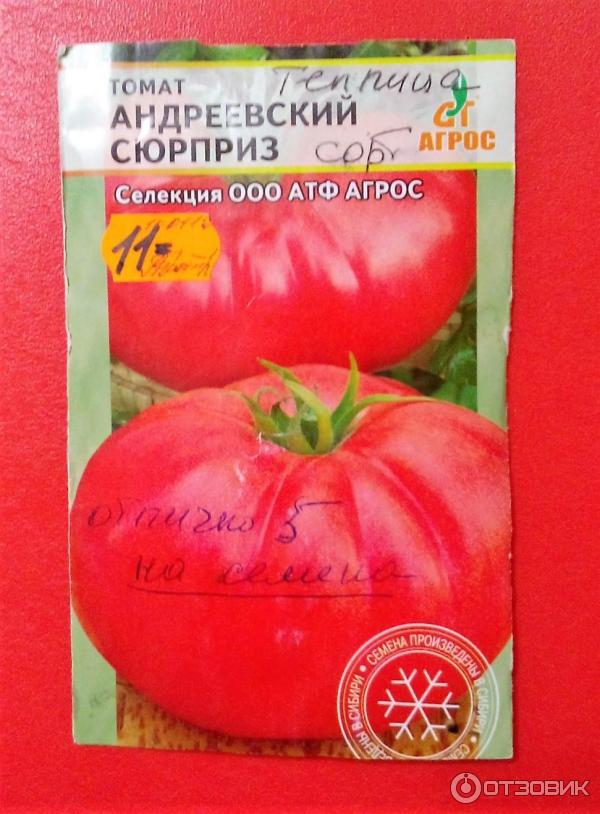
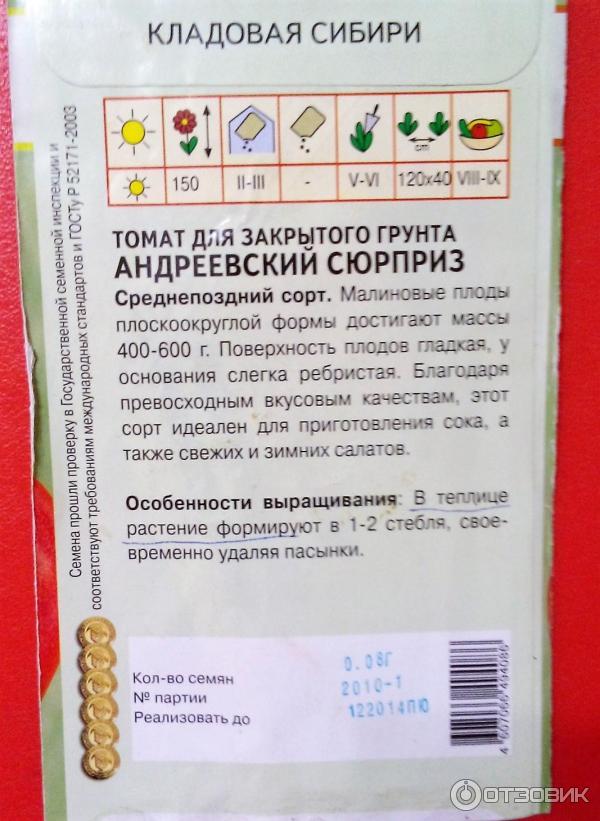
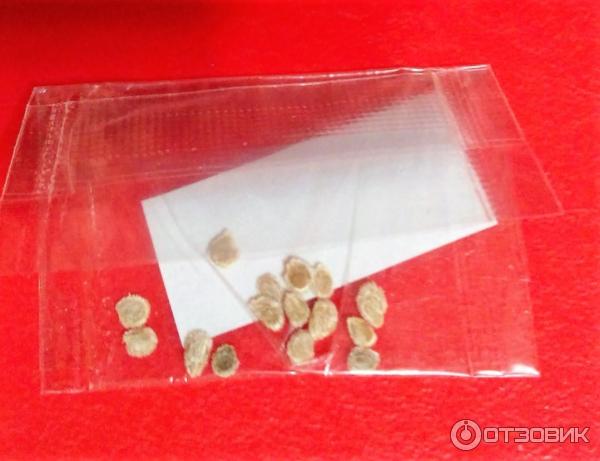
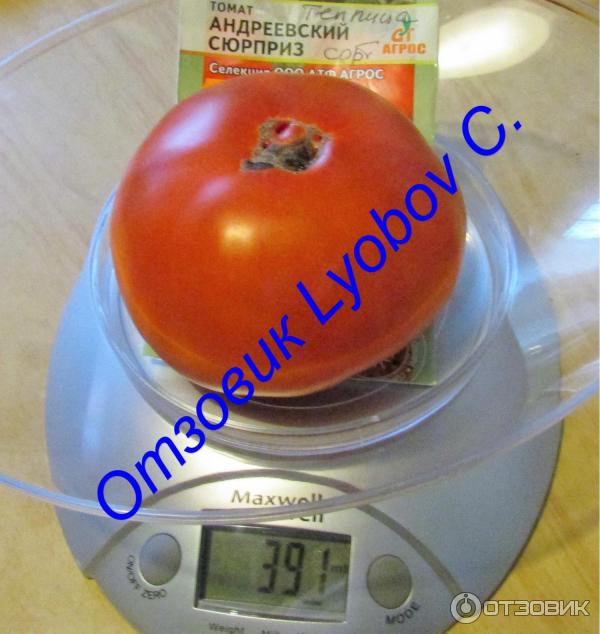
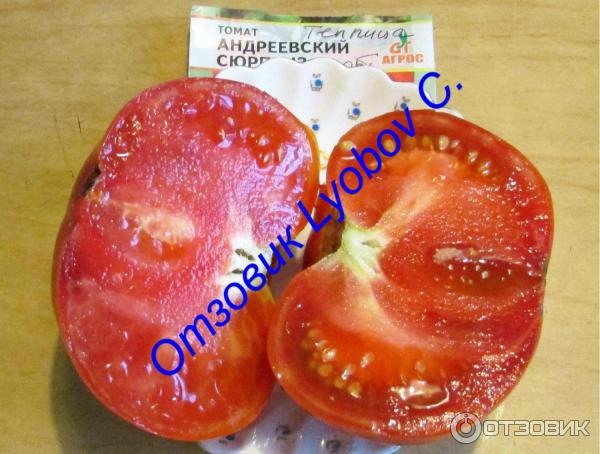
We've loved this tomato variety, "Andreevsky Surprise," for a long time, and I plant at least 10-15 bushes of it every year.
What is he like?
The first thing that comes to mind is that it is big and red, although most tomato varieties probably have these qualities.In fact, this isn't the only quality I choose this variety for. I believe it's suitable for both greenhouses and open ground. Personally, I plant "Andreevsky Surprise" tomato seedlings in February (and always in accordance with the lunar calendar) and then directly under plastic. The first ovaries appear at the end of May, and a month later we're already sampling a new crop. And this is in the Southern Urals, where the weather isn't particularly warm and early in the spring. This means this variety is suitable for the somewhat chilly Ural climate.
Another important advantage: the bushes grow strong and tall, and it's a productive variety. Ten bushes are enough for us, but I plant some in reserve to feed the neighbors and a little for sale. The yield can reach up to ten kilograms per bush.
The next quality that makes me prefer these tomatoes is that the tomato bushes are almost never affected by late blight.
And the most important thing is the taste, we all like it juicy, slightly sour taste.
Seeds of this variety are sold at any kiosk and are inexpensive. I recommend them.
The tomato "Andreevsky Surprise" was a real discovery for me.
Reviews of the Andreevsky Surprise tomato
Firstly, it's important that it was created by Siberian breeders. I've bought Siberian seeds many times and have never regretted it.Secondly, Andreevsky Surprise is suitable for cultivation in areas with risky farming, which includes central Russia.
This variety ripens late. Another important factor is that, with proper care, this variety is not susceptible to one of the most common diseases—late blight—as it has good immunity to it.
Indeterminate tomato
This means it has no growth restrictions. In a greenhouse, it can grow up to 2 meters in height.
I grow tomatoes from seedlings; the seeds have a good germination rate. I transplant them to the greenhouse after 1.5-2 months. I train them to a maximum of three trunks. This variety requires partial removal of side shoots and staking.
Tomatoes resistant to late blight
The yield is quite abundant.With proper care, you can get 3.5 to 8 kg per square meter. It's realistic!!! The Andreevsky Surprise really did produce a lot of fruit per bush.
How to Grow Delicious Tomatoes
The tomatoes are superb in taste: sweet, multi-chambered, juicy, with a distinct tomato flavor. The average fruit weight is 150-300 grams, but there have been specimens as heavy as 700 grams, especially the first fruits.If the fruits are not large, you can try salting them, but they are mainly used in salads and as a base for ketchups and various sauces.
Advice:
Tomatoes on the vine begin to ripen gradually at night, starting with the lower bunch. A tomato's flavor is determined by its sugar and acid content; the more sun it gets, the more of these substances it will contain, so don't rush to pick them green. Let the tomatoes ripen in the garden, and they'll delight you with a rich, full-bodied flavor, firm pink flesh, and juiciness.
A universal variety of tomatoes
Advantages of the tomato "Andreevsky Surprise":Very tasty, large-fruited, disease-resistant, unpretentious, universal use.
Disadvantages of tomato:
Average yield, fruit prone to cracking.
Legend Multiflora is an excellent tomato for canning + LOTS OF TIPS for growing tomatoes.
If you're looking for a large-fruited tomato with a high yield, I recommend checking out the Tomato Queen.
If you want to surprise your family and friends, I recommend paying attention to the tomato varieties "Malachite Box" and "Tlacolula".
See you again on my page.

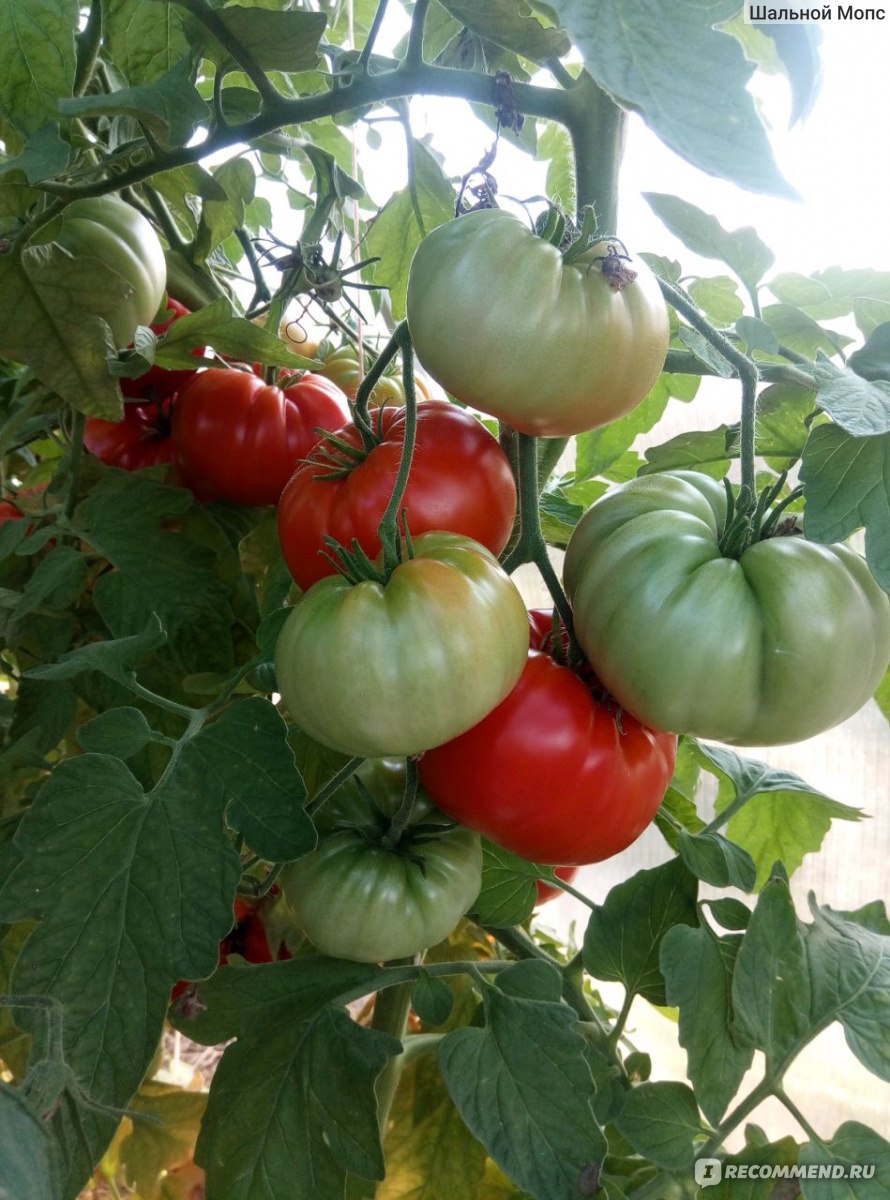
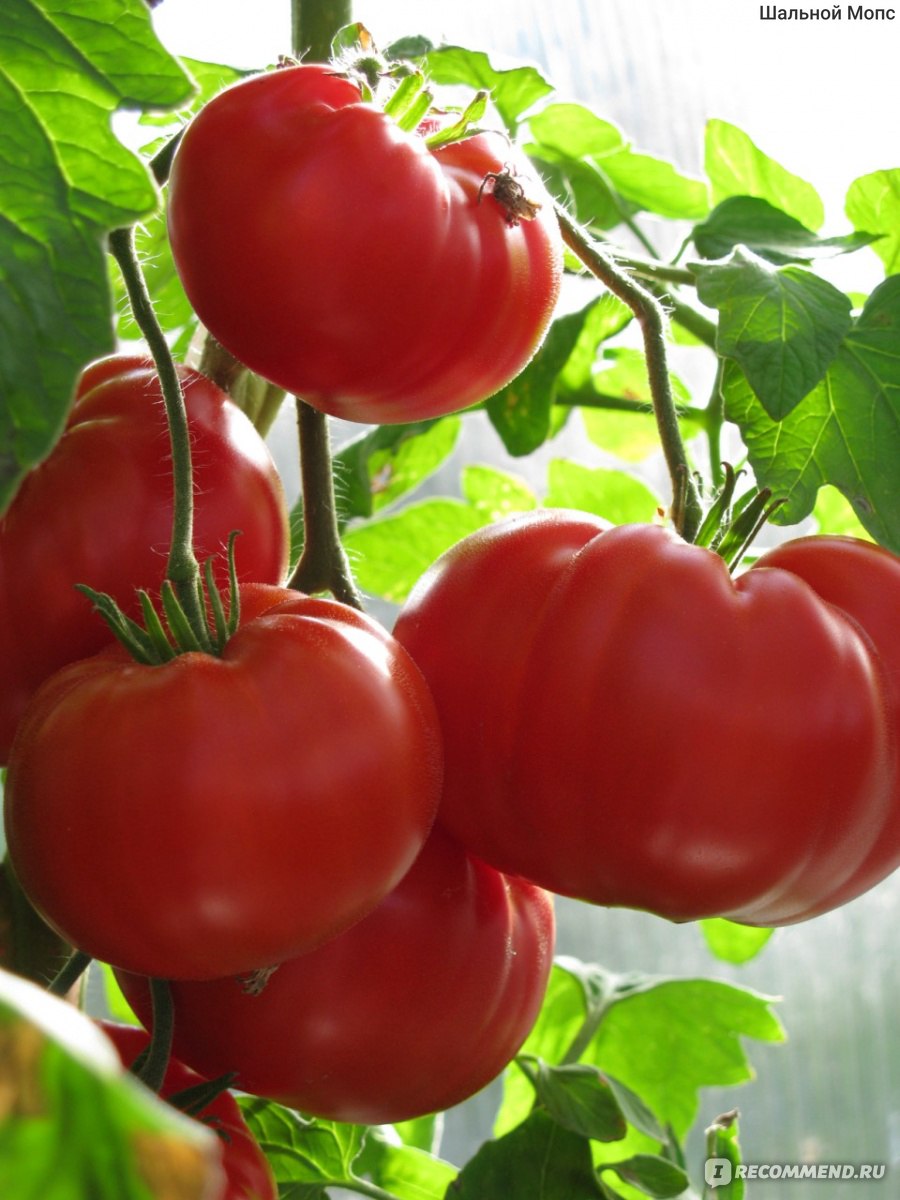
A Siberian-bred beef tomato for greenhouses. Produces a consistently high yield (at least 8 kg/m²) in all regions. Fruiting begins 115-120 days after germination. Plants are indeterminate, vigorous, and reach a height of 160-180 cm. The fruits are flat-round, large, multi-chambered, and fleshy, with a small number of seeds. Ripe tomatoes are pinkish-crimson in color. The average tomato weight is 200-250 g, with early fruits easily reaching 500-600 g. Thanks to their excellent taste, the tomatoes are ideal for fresh consumption and juice processing.
Photo by: cat2008
Photo by: Angelina
Photo by: Yanina
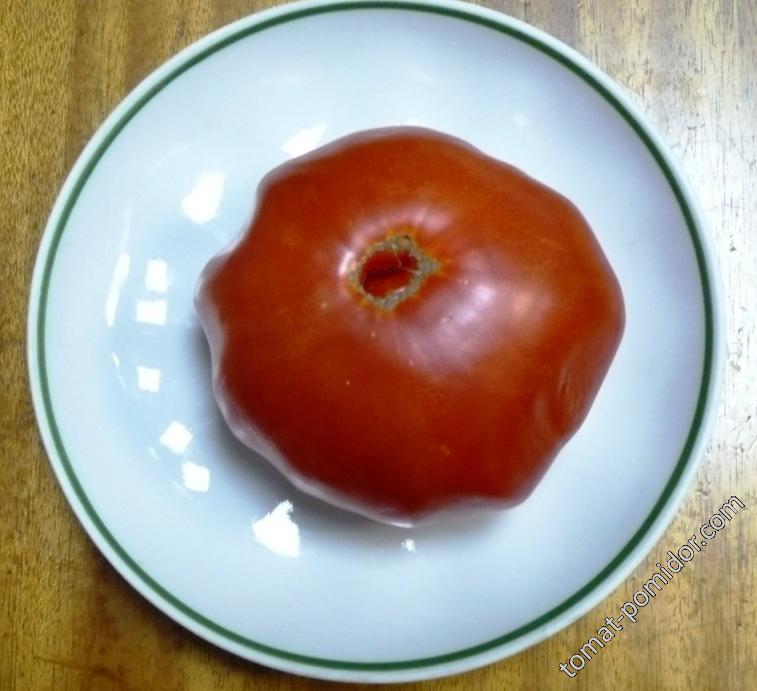
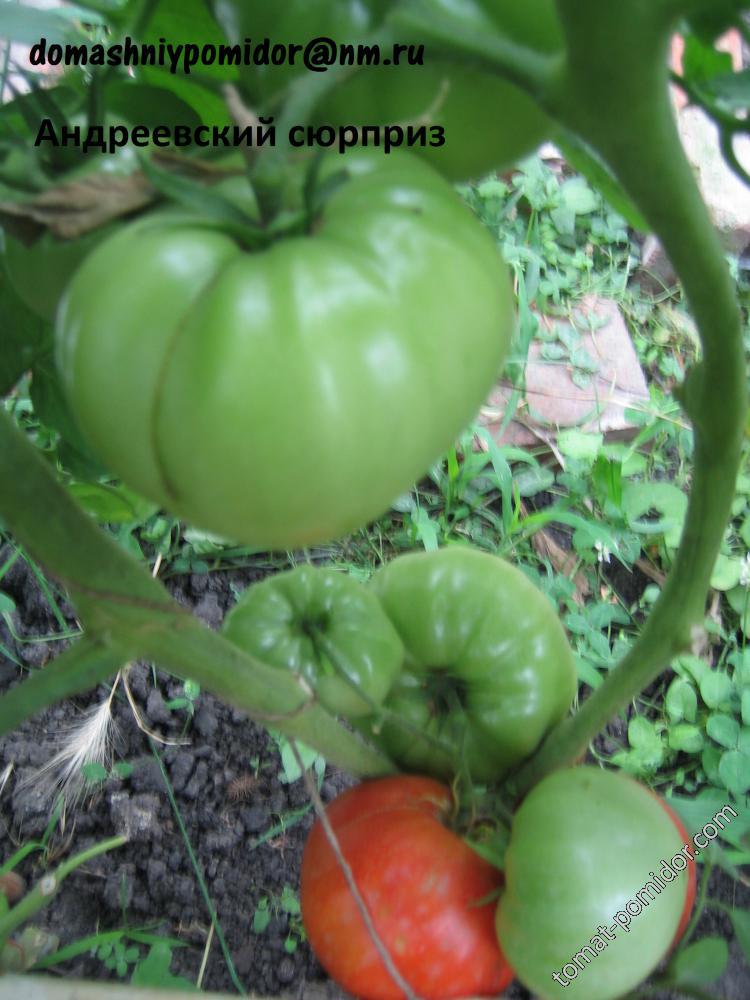
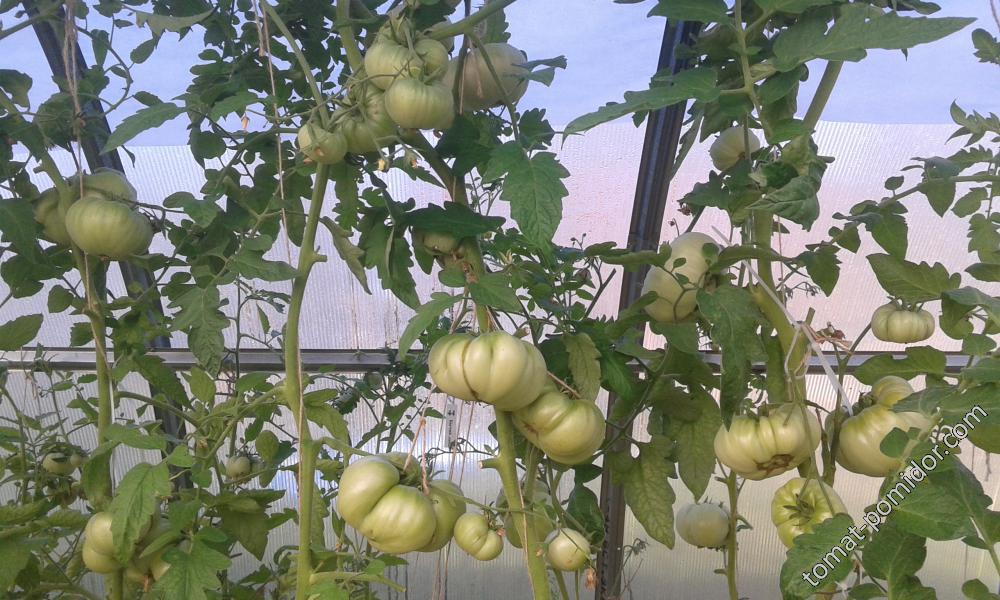
Very tasty, sweet, and fleshy. My yield was average. Such a stupid year.
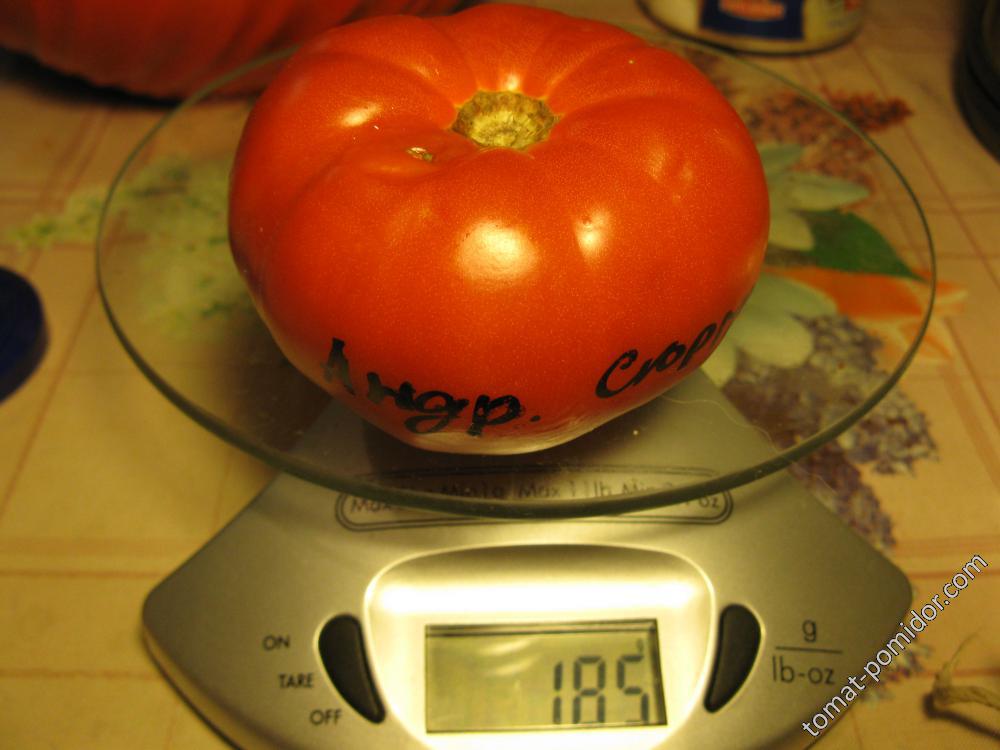
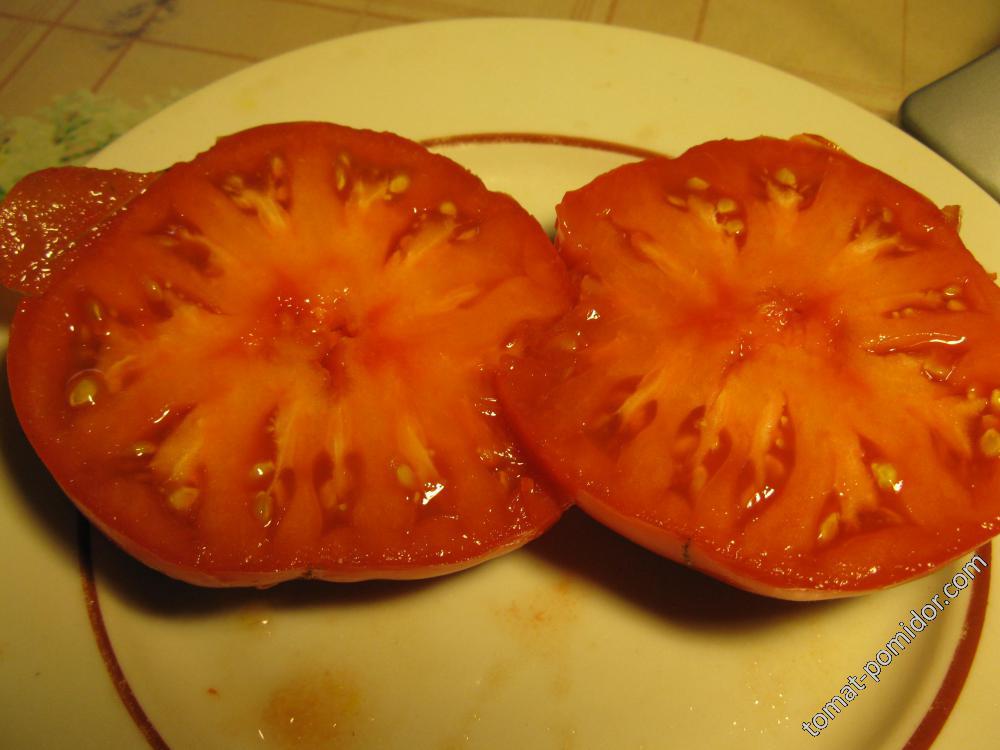
And my Andreevsky surprise was simply magnificent!
It was a bit slow at first, but then it worked hard. It bore fruit longer than anyone else. Frosts had already set in, but it still kept producing fruit. The last of the Andreevsky Surprise tomatoes was chopped into a New Year's salad.
But I'd like to point out that there were some bushes that weren't exactly a mixed variety, but they weren't very productive either. The first fruits were large, but then some were small. Three out of ten weren't very good. And yet, they were the most beautiful ones as seedlings.
I left some seeds from the most productive and typical plant.
Moreover, all plants of this variety grew well both in the greenhouse and in the open air, although the description only lists it for greenhouses.
I will definitely plant it again.