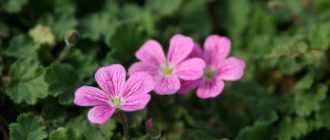
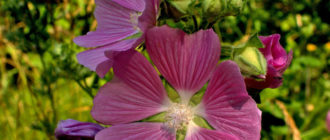
Alchemilla alchemilla is a member of the Rosaceae family, subfamily Rosaceae. According to various sources, the genus contains 300-600 species. In the wild, the plant can be found in North America, Greenland, eastern Africa, and almost all of Eurasia, with the exception of the Far North and arid, tropical regions. Common names for the herb include alchemilla, love plant, dew plant, wild horseradish, and ram's mantle. It is used in gardening, cooking, and traditional medicine.
Description of the cuff
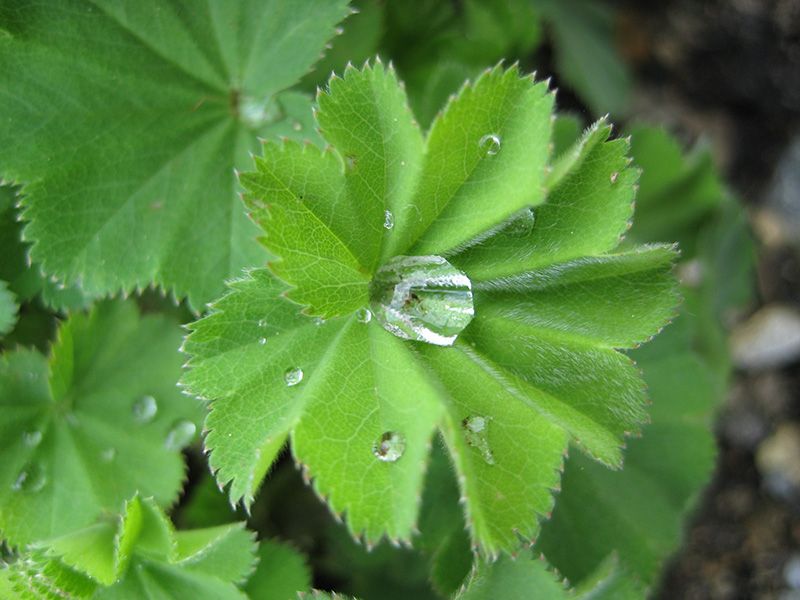
A herbaceous perennial with erect stems forming a bush. It reaches 16-50 cm. The rhizome is horizontal and underdeveloped. The leaves are palmately dissected or palmately lobed, rounded, pubescent, and toothed along the perimeter. They are decorative. Each leaf blade has 5 to 11 concave lobes. The foliage is gathered at the base into a rosette, forming a spherical bush.
The flowers are whitish or canary-green, inconspicuous. Blooming is profuse and long-lasting, from May to August. The fruits resemble nuts with numerous seeds inside. Alchemilia prefers to grow along roadsides, at forest edges, in open forests, and in marshy areas. It is long-lived under favorable conditions. Its life cycle is approximately six decades.
Alchemilla soft, common and other species
Approximately 170 species can be found in our country. Wild forms and hybrids are cultivated:
| View | Description | Height (cm) |
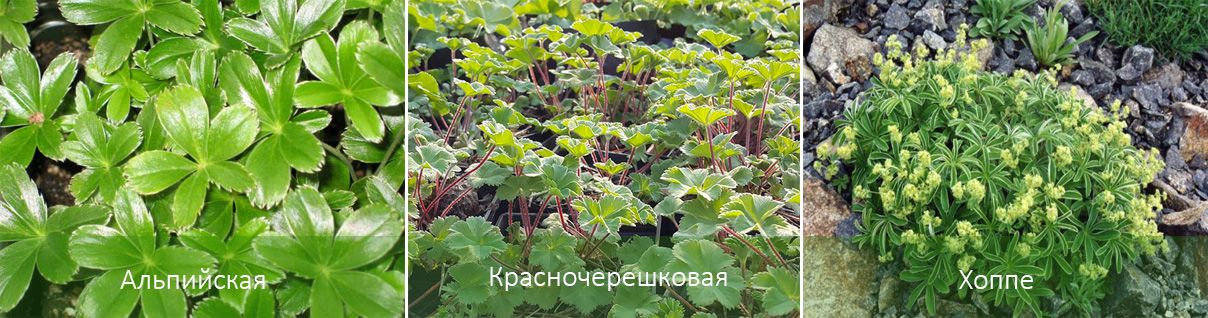
| Alpine | In midsummer, small yellowish flowers appear on elongated, splayed peduncles. The upper surface of the leaves is emerald, the lower surface is a silvery, hairy color. | 15 |
| Red-petioled | The inflorescences are light green and canary yellow. The leaf blades are serrated, dissected into 7 lobes. | 20 |
| Hoppe | A close relative of the Alpine variety. It has seven-lobed leaves and grows among limestone shards. | 15 |
| Siberian | Found only in Siberia, hence the name, it has a thick rhizome and kidney-shaped, pubescent leaves that are decorative and gathered in a rosette. Small green buds form paniculate inflorescences. It blooms in July. Propagation occurs by division of the rhizome. | 25-31 |
| Soft | It grows in western Asia and eastern Europe. The leaves are rounded and hairy. The inflorescences are loose, consisting of malachite-lemon flowers, reaching 3 mm in circumference. Flowering occurs from mid- to late summer. In landscape design, it is often used as a herbaceous border. The foliage dies back when frost sets in. | 45-51 |
| Ordinary | The foliage is folded, especially noticeable in young specimens. It blooms with prostrate inflorescences from May to June. It is used to treat many ailments. | 50 |
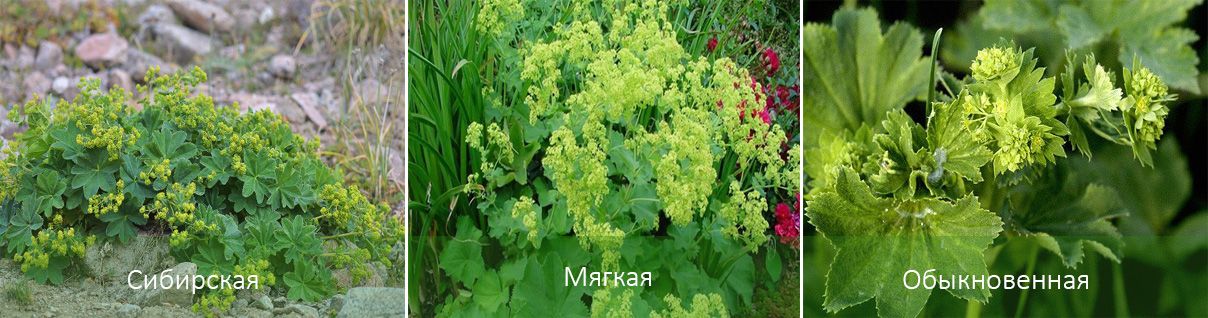
Care and cultivation of alchemilla
Alchemilia is easy to care for. When grown in an artificial environment, it quickly adapts to any environmental and climatic conditions. It can be used to decorate both sunny and shady areas. Its distinctive feature is its winter hardiness.
| Criterion | Recommendations |
| Location/lighting | It tolerates direct sunlight well, but grows better in diffused light or light shade. |
| Priming | Fresh, with humus added. A small amount of clay is acceptable. The optimal pH is 6. Alchemilla does not grow in poor soil. |
| Watering | In partial shade, rainfall is sufficient. During droughts and when planting in full sun, abundant rainfall is necessary. However, avoid stagnant water. |
| Other care |
|
| Wintering | It tolerates cold well in central Russia. However, to prevent freezing during the winter, mulching with peat is recommended. |
Reproduction
It happens in several ways:
Seeds
You can sow directly into the garden or grow seedlings. In the first case, sow in March. In the second, sow in early November.
- Distribute the seed material over a box with moistened soil mixture.
- Cover with plastic to create a greenhouse effect.
- After a couple of weeks, take the plants outside and bring them back in only in early spring. This is necessary for stratification, which strengthens the young plants' immunity. They become resistant to various diseases.
- After wintering outdoors, the seeds germinate quickly. They should be transplanted into spacious pots after 21 days.
- After the roots are fully formed, plant them in a permanent location.
Cuttings
- After flowering, separate the shoots from the main stem along with the rosette.
- Root in moist soil and place in a room with diffused light.
- After 2 weeks, plant in an open area if the root system is sufficiently formed.
By division
It can be produced at any time of year. Its disadvantage is the risk of damage to the rhizome. Because of this, rooting takes a long time and is painful.
Diseases and pests
Alchemilla spp. is susceptible to various diseases and pests. Typically, the bush becomes ill due to poor maintenance. Common problems include:
| Problem | Pathogenesis/symptoms | Control measures |
| Mold |
Grayish spots with dark edging. |
|
| Rust |
Yellow or reddish-brown circles on greenery, which become darker over time. |
Spray with Oxyhom or colloidal sulfur 2 times a month. |
| Septoria | The causes of damage are the same as for rust. Soft, protruding, round plaques of a dirty emerald hue. The undersides of the plates are slightly indented and colored brownish-green. |
|
| Ring mosaic |
Pale green stripes appear on the foliage. As the lesion spreads, they turn yellow, forming large spots. The bush degenerates and dies. |
There's no cure. The flower must be dug up and burned. |
| Aphid | The insect is widespread throughout Russia. Avoiding its presence is impossible. The most important thing is to detect the pest promptly and begin combating it.
|
Treatment with purchased poisons:
|
| Spider mite |
|
Spraying with Agrovertin, colloidal sulfur and other preparations. |
Top.tomathouse.com recommends: Alchemilla – medicinal properties and its uses
The plant is widely used in medicine. It is used to make infusions, decoctions, and poultices. Its medicinal properties include:
- antitumor;
- antimicrobial;
- vascular strengthening;
- anti-inflammatory;
- wound healing;
- lactogenic;
- hemostatic.
Alchemilla is used to treat various diseases:
| pathological condition | Description | Recipe |
| Gynecological diseases. | Restores ovarian function and prevents large amounts of blood loss. Used for:
Healers recommend taking alchemilla before conception and just before labor. This helps avoid problems during childbirth. |
|
| Ulcers, abrasions, open wounds. |
|
|
| Venous insufficiency and other cardiovascular pathologies. |
|
|
| Problems with the respiratory system. | Used for:
|
|
| Gastrointestinal diseases. | Helps with:
|
|
| Diabetes mellitus. |
|
|
| General strengthening of the body. | Alchemilla tea is recommended for people of all ages. It strengthens the immune system, restores vitality, and nourishes all organs and systems with vitamins and other nutrients. It is especially beneficial for women during breastfeeding, as drinking alchemilla tea improves lactation. |
|
Despite its enormous benefits, not everyone can take this herb; it has the following contraindications:
- individual intolerance;
- rapid blood clotting;
- tendency to form blood clots;
- children under 2 years of age.
It is not recommended to consume infusions, decoctions, and teas made from lady's mantle for long periods of time. Diarrhea may occur with prolonged use or overdose.
Before using any prescription, consult a physician. Only they can determine whether its use will cause harm.
Alchemilla is added to various dishes, including salads and soups. The leaves and stems can be used for preserving vegetables.
Shchi recipe:
- Place 250 g of fresh, young herbs in a saucepan.
- Add 1 liter of meat broth.
- Wait until the leaves are cooked.
- Add seasoning or sour cream to taste to the finished dish.
Thanks to its decorative, spreading foliage, alchemilla is used in landscape design. It is typically planted to create a backdrop for more colorful plants. It also looks harmonious in alpine gardens.
Grass looks attractive when the edge of a flowerbed extends into a pond. Planting it along the perimeter of a lawn is not recommended. Alchemilla grows quickly and can take over space not intended for it.
With proper care, Alchemilla will decorate your garden for decades to come. It will always be a remedy for various ailments and a delicious addition to dishes. Despite the many positive aspects of growing Alchemilla, caring for it is quite simple and doesn't require any special skills.