Tricyrtis is a flowering herbaceous perennial plant from the extensive Liliaceae family, of which there are approximately 20 species. Most of them grow wild, while some are cultivated as garden plants. These exquisite flowers resemble orchids, but are much more low-maintenance.
In Greek, the word tricyrtis means "three tubercles"—its name comes from the flower's three nectaries. The plant is native to Eastern countries, most commonly found in the Himalayas and Japan. Tricyrtis have been cultivated as garden flowers since the 9th century, but it wasn't until the 20th century that they gained widespread popularity.
Tricyrtis names
Tricyrtis has three more names:
- In the Philippines, this beautiful flower is called the "toad lily" because its juice is used by locals as bait when hunting toads for food.
- In Japan it is called "cuckoo" because of its variegated coloring, reminiscent of the plumage of this bird.
- In Europe, it is called the "garden orchid" because of the interesting, original shape of this graceful flower, which, although it does not look like an orchid, is very reminiscent of it in beauty and characteristics.
Description of Tricyrtis
Tricyrtis is an easy-to-grow ornamental flowering plant. It grows in semi-shaded wooded areas and prefers moist, peaty soil. It tolerates dry periods well, but frosty winters are too harsh for it.
The root system is shallow, well-developed, and regenerative. The stem is straight (sometimes branched), cylindrical, and slender, reaching a height of 60 to 100 cm, sometimes more.
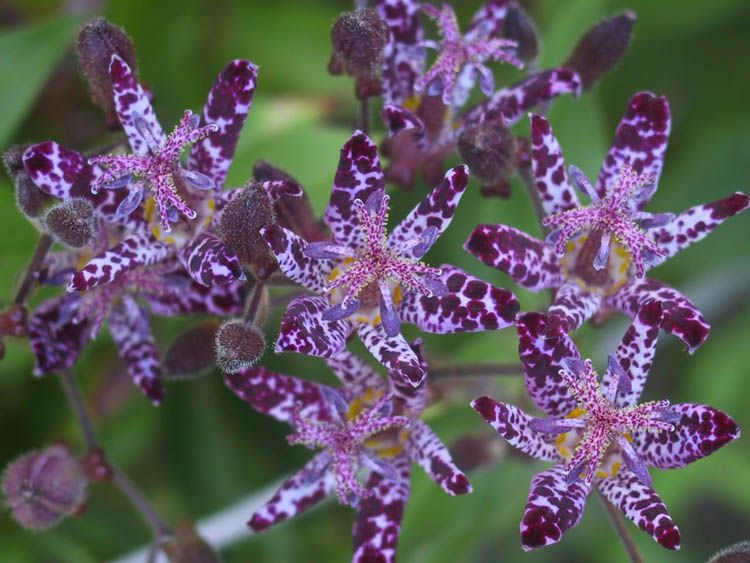
The leaves are petiole-less and twine around the stems along their entire length. Their shape is oval or elongated (belt-like). They can reach up to 15 cm in length and up to 5 cm in width. The large, funnel-shaped flowers can be borne singly or in clusters. Their color is vibrant, and can be solid (white, pink, beige, purple, blue) or with dark speckles, most often purple.
In autumn, fruits with black or brown seeds appear, which are located in oblong capsules.
Many wild species of this flower are found in remote subtropical forests. Therefore, botanists are still discovering new, previously unknown specimens.
The most common and winter-hardy species of Tricyrtis
In appearance, different varieties of tricyrtis differ little.
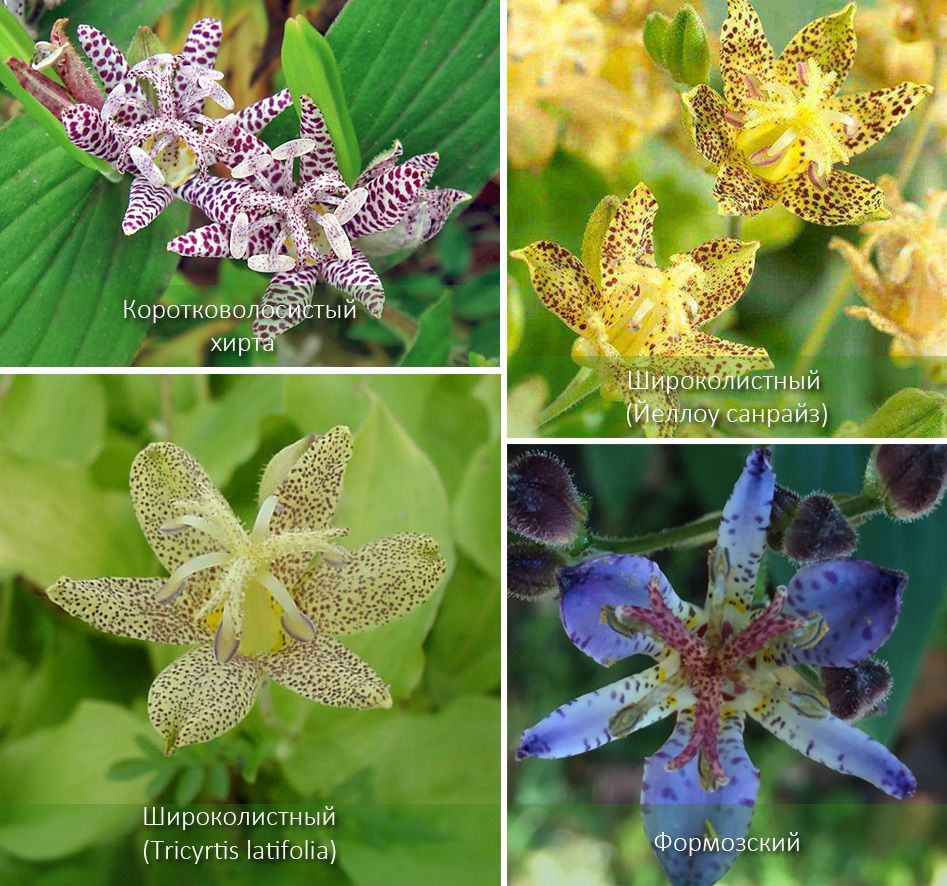
They are divided into several groups that share common characteristics. Most are heat-loving, and winter-hardy varieties are also available.
| View | Description |
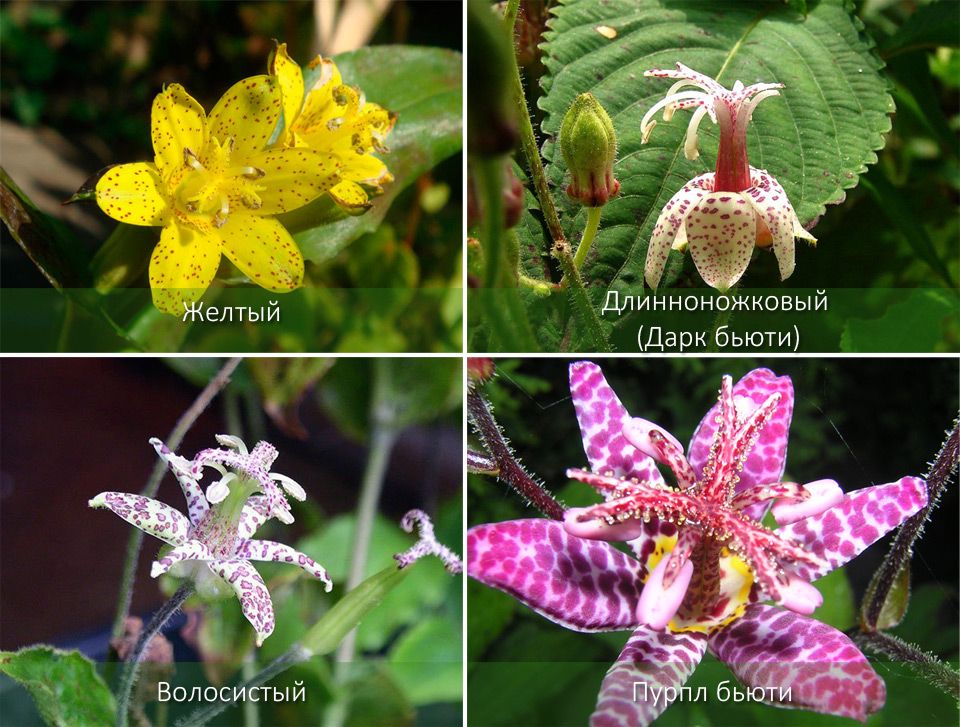
| Yellow (Tricyrtis flava) (frost-resistant) |
The stems are straight, sometimes also branched, 25-50 cm high. The flowers are yellow, single-colored or speckled, located at the top of the stems, collected in inflorescences of several pieces. |
| Hairy (Tricyrtis pilosa) | Reaches 60-70 cm. Flowers are snow-white with purple spots. Rarely grown as a cultivated plant. |
| Short-haired hirta (Tricyrtis hirta) (winter-hardy) | Native to the Japanese subtropics, it is most often grown by gardeners because it is hardy even in challenging weather conditions. The stems are branched, covered in short, light pubescence, and reach a height of 40-80 cm. The leaves are oval and drooping. The flowers of the hirta are relatively small, with white petals speckled with purple. The buds are arranged in clusters, with buds appearing singly at the top of the stem. The roots quickly spread via underground, horizontal shoots. |
| Long-legged Dark Beauty | The flowers are miniature, mostly rich dark in color (crimson, purple), with light spots. |
| Formosan (beautiful, Taiwanese) (Tricyrtis formosana) | Flowers vary widely—white, lilac, pink with burgundy or brown speckles. Stems up to 80 cm tall are hairy, with oval leaves. One of the most easy-to-grow varieties. |
| Purple Beauty | This variety grows low, with leathery leaves. The flowers are white with purple spots, and the petals are half-fused. |
| Broadleaf (Tricyrtis latifolia) (winter-hardy) | The most frost-hardy variety. Stems up to 60 cm. Flowers are white and green, collected in inflorescences. |
| Broadleaf (Yellow Sunrise) (winter-hardy) | Flowers are yellow with brown spots. Stems up to 80 cm. Leaves are ovate, leathery. |
Planting Tricyrtis
Although these plants are quite hardy, in regions where early autumn frosts are common, the flowering period will be short. This occurs in the second half of summer, with the main part occurring in autumn, and continues as long as the weather remains warm. Flowering can only be extended by planting them in containers.
They are planted in open ground where it is warm enough in September.
Choosing a location for planting in open ground
It is better to plant these plants in places where there is partial shade for most of the day, next to trees.
A garden with tall trees is a wonderful place for them. They prefer loose forest soil with leaf mold, peat bogs, and black soil.
They don't tolerate standing water at the roots or drafts. Therefore, they should be planted in a location protected from the wind and with adequate midday light.
Methods of reproduction
Tricyrtis can be propagated:
- Sow seeds directly into the ground. Sowing should be done in the fall; only freshly harvested seeds are suitable (last year's seeds have a low germination rate). You can also plant in the spring, but before sowing, you should pre-heat the seeds by keeping them on the bottom shelf of the refrigerator for three weeks. Sowing by seed is not very effective.
- Seedlings. Seeds treated with a growth stimulant are planted in pots with peat in February. They are transplanted into the ground when the weather becomes consistently warm in the spring. Flowering occurs in 1-2 years.
- By dividing the rhizomes. In the fall or spring, use a shovel to separate a portion of the root and plant it in a different location. This method yields the best results. The plants take root well and flower faster.
- Cuttings. Root cuttings are suitable in early spring, and stem cuttings can be taken in summer. The cut sites are treated with growth stimulants (Kornevin) and the cuttings are planted in the ground. The roots will grow and strengthen within a month.
Growing and caring for Tricyrtis
If you choose the right location, all other concerns about this plant come down to:
- regular watering - growing is possible even in arid areas, but on condition that the soil around the plant is always moist;
- weeding, loosening the soil (which is recommended to be done after each watering);
- top dressing (humus, peat, mineral fertilizers are suitable, but fresh manure cannot be used);
- removal of dried, damaged flowers.
How does Tricyrtis survive the winter?
In temperate climates, where severe frosts are common, these plants must be covered for the winter. Otherwise, the rhizomes will freeze.
For cover, use agrofibre or a thick layer of peat. Species such as yellow do not require frost protection.
Young shoots are sensitive to high temperatures and should be prevented from overheating. Therefore, in early spring, when the weather warms up, be sure to remove the insulation.
You can protect the soil from overheating by mulching with pine bark.
Pests and diseases of Tricyrtis
Tricyrtis are quite resistant to pests. They most often die due to overwatering in hard soil, where water stagnates and the roots rot. To prevent this, create good drainage under the flowerbed using gravel, branches, and sand.
Snails and slugs, which eat holes through leaves, pose a danger. Mulch made from crushed eggshells and tree bark can help prevent these pests from moving.
Tricyrtis require little care when planting and caring for them outdoors. These plants can enhance any garden landscape. Tricyrtis look best in group plantings. They are ideal for planting near ponds, ornamental shrubs, and trees. For those with little time for the constant chores of maintaining flowerbeds, these perennials are a real find.