The genus Cornflower (from the Latin Centaurea) consists of over 730 species of herbaceous plants in the Asteraceae family. It was named by Carl Linnaeus, referring to the centaur. In ancient Greek mythology, it was this flower that Chiron used as an antidote to the venom of the Lernaean Hydra. According to another hypothesis, the name cornflower dates back to the time of the famous physician Hippocrates and means "bull-piercing."
Description of cornflower
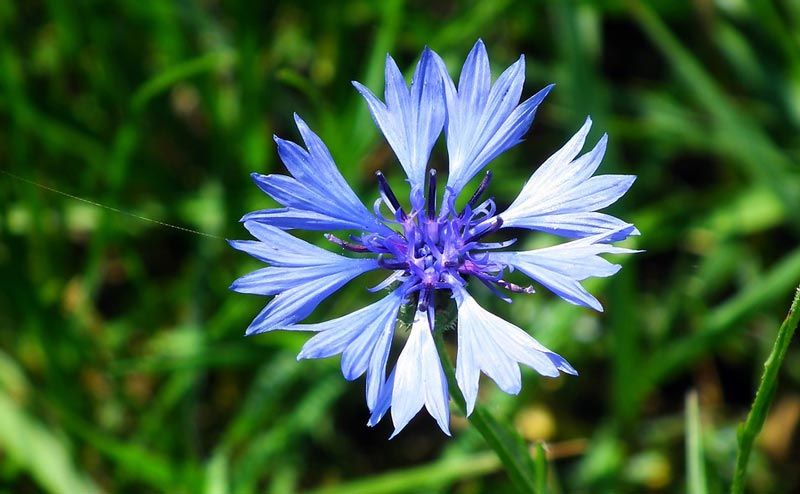
This flowering plant has a fibrous root system, an erect or prostrate and branching stem covered with stiff hairs, and grows up to 120 cm in height. The leaves can vary in appearance within a single stem: at the top of the shoot, they are entire, narrow, and long, while at the bottom, they are lobed and slightly larger.
The stems are crowned with flowers gathered in inflorescences that appear in June, and the plant blooms until October. The inflorescence consists of true tubular flowers containing pistils and stamens, and false, ligulate flowers along the edge of the inflorescence. They can be single or double. Colors include purple, burgundy, blue, light blue, yellow, pink, and white. Cornflowers are highly attractive to pollinating insects.
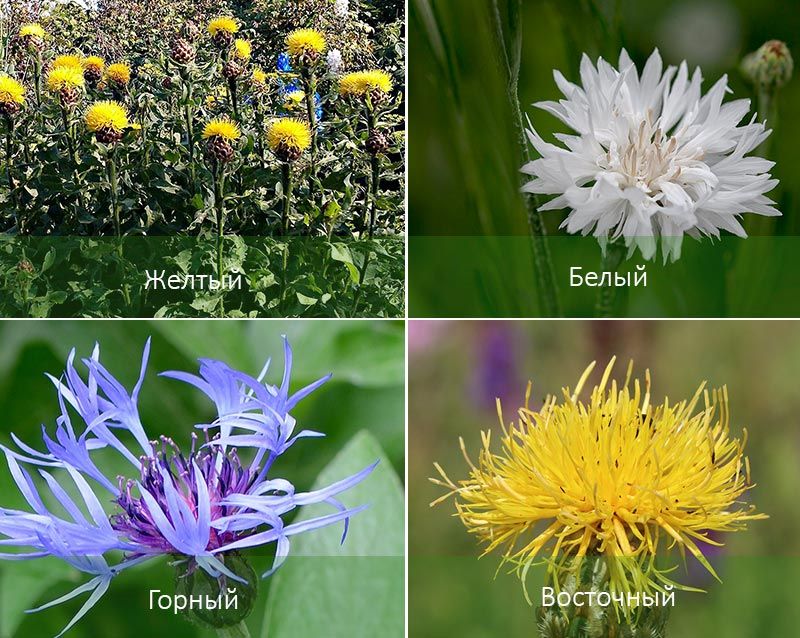
Types of cornflower
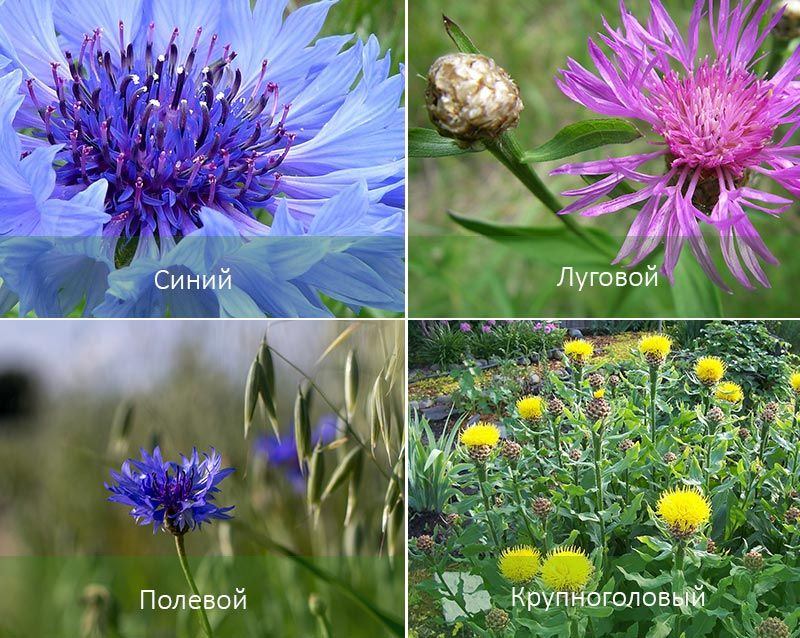
| View | Description / Height (cm) | Leaves | Flowers |
| Blue | The stem is erect and branched. An annual or biennial herb. 20-80. |
Different: lower ones with petiole, upper ones without petiole, entire. | They are collected in inflorescences called baskets. They are blue and light blue in color. |
| White | Perennial. Protected species.
Up to 30. |
Thin, elongated, lanceolate. | Terry. Baskets are 4 cm in size. |
| Mountain | An erect plant.
70. |
Entire, lanceolate, smoky green. | The central tubular flowers are 7-8 cm in size and are lilac or bright pink. False blue or light blue flowers are located along the periphery. |
| Yellow | Perennial. Branched thick cylindrical stem.
Up to 100. |
Lanceolate. | Yellow color, 5 cm in diameter. |
| Big-headed | A perennial with a branched stem. Up to 120. |
Rough, lanceolate, dissected. | Golden, 7 cm in diameter. The receptacle is covered with small scales. |
| Oriental | Wild perennial.
80 – 120. |
With petiole, pinnately divided. | With a strongly enlarged receptacle, covered with large scales. Yellow. |
| Meadow | A perennial with a ribbed, stiff stem. The entire plant is covered with small, silvery hairs.
80. |
The lower ones have a petiole. The upper ones are lanceolate and lack one. Arranged alternately on the stem. | False flowers are large. Purple-pink. |
| Field | Annual.
50. |
Narrow and long, lanceolate, gray-green. The plant has a solid margin at the top and lobed at the bottom. | Shades of blue and light blue. |
| Whitewashed | A perennial with branching stems.
Up to 60. |
The lower ones are petiolate, dissected, with whitish pubescence, the upper ones are green, sessile with a lobed or dissected edge | False purple, tubular - white or pale pink |
| Spreading | A spreading biennial plant. The hairs impart a grayish tint.
20-50. |
The upper ones have a whole leaf blade, the middle ones are dissected, the lower ones are twice dissected. | Small, up to 5 mm in diameter. Pink, light purple, white. |
| Pink | Perennial, erect stem, strongly overgrown receptacle.
Up to 100. |
Lanceolate, dull green in color. | Pink, 5 cm. |
Cornflower in the garden
Prefers a loose planting, at least 25 cm apart, and a sunny location. Fertile, neutral soil is essential. The flower's coloring is more vibrant in lime-rich soil. Water moderately; it does not tolerate overwatering.
When combined with other flowers, cornflower is planted in front so that the sun's rays evenly illuminate the leaves.
Planting and propagation methods
Cornflowers are best planted directly from seeds in prepared soil at a depth of 2-3 cm. Seeds remain viable for three years. Sprouts appear on the 15th day. If sown in the fall, they will bloom early the following year.
Some prefer to grow from seedlings. In this case, it's best to sow them in peat containers so you can plant them in soil without removing them, as young roots are weak and easily damaged.
Perennials are also propagated by rhizomes. After flowering, the plant's roots are divided into sections, each containing at least three buds. The bushes are planted immediately after division.
Care and cultivation
The plant is undemanding. Loose soil, moderate watering, and a weed-free environment are all it needs. For longer blooms, remove spent flower heads. Cornflowers rarely get sick and are pest-resistant.
Top.tomathouse.com recommends: the benefits and uses of cornflower
The flower has medicinal properties used in medicine.
In folk medicine, it's good as a diuretic and choleretic agent for urinary tract inflammation, helps with coughs and gastrointestinal ailments, alleviates whooping cough, and has a beneficial effect on the nervous system. It treats salt-related and skin conditions, rheumatism, and gout.
In gynecology it is used to normalize the menstrual cycle and increase lactation.
In cosmetology practice, it is suitable for dry skin, narrows enlarged pores, and an infusion of flowers can be used for puffy eyelids.