Gardeners are familiar with several varieties of loosestrife, which number over 200 species. These are primarily wild plants belonging to the Primulaceae family, but there are also many ornamental varieties.
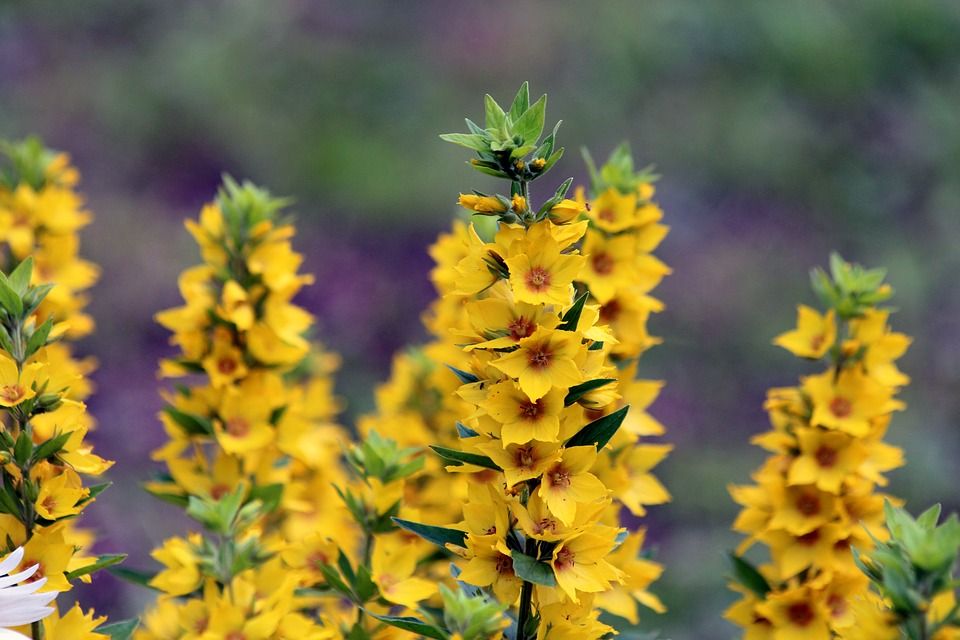
They are happily chosen to decorate their garden plots for their unpretentiousness and lush flowering.
Description of loosestrife
These plants are related to primrose, cyclamen, and milkweed. Most are perennials, while some species are annual or biennial. The Latin name for these flowers is Lysimachia. Lysimachia is so named because of the resemblance of its leaves to willow.
Its stems are mostly erect, although some species have creeping (groundcover) stems. The leaves are oval with pointed corners or elongated, arranged in whorls or opposite rows on the stem.
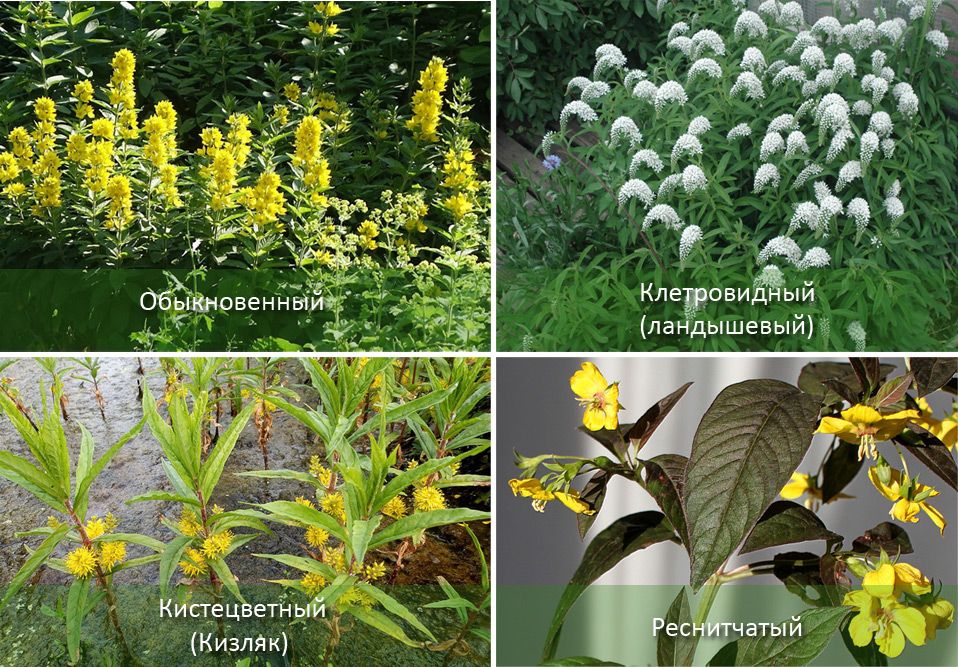
Many species have bright yellow flowers, gathered in inflorescences (spicate or corymbose panicles) or solitary (axillary). Varieties with white, pink, burgundy, and wine-colored petals are also found. Ripe fruits are round or oval capsules containing seeds.
In the wild, these plants are most common in East Asia. However, they are also found in Central Asia, European Russia, North America, and South Africa.
Popular species and varieties of loosestrife
The most famous of the garden ornamental loosestrife are:
| View | Description | Leaves |
Flowers Flowering period |
| Ordinary (Vulgaris) |
The stems are straight and grow up to 1 m. | Oval, arranged oppositely in several pairs, they form a lush bush. | Bright yellow, with five-partite sepals, they are located on elongated peduncles. |
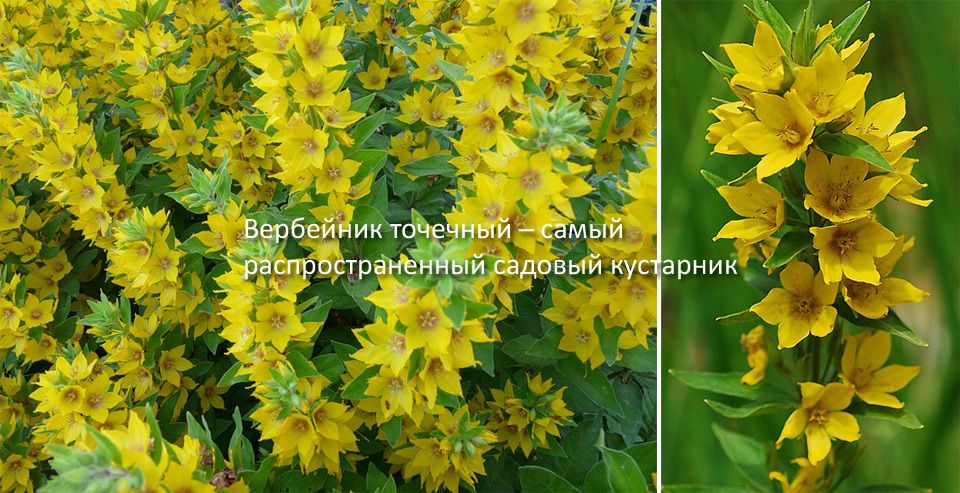
| Point
(Puncktata) |
Forms lush bushes, up to 80 cm. | Elongated, rounded, densely spaced. |
Sunny, five-petaled, bell-shaped flowers arranged in clusters along the stems. More than a month, starts at the end of June. |
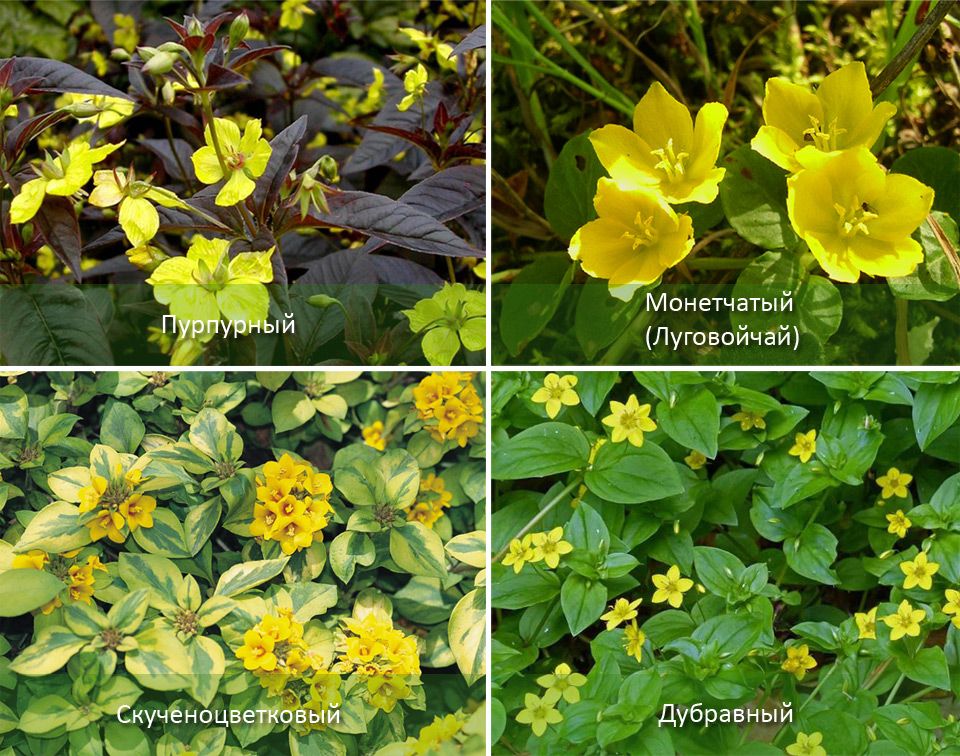
| Dubravny (Nemorum) |
Height up to 30 cm. | Large, wide. |
Chicken-colored, single on high peduncles. From May for 2 months. |
| Purple (Purpurea) |
Straight stems 45-90 cm. | Small, lanceolate. |
Dark wine-red shades, collected in spike-shaped inflorescences. From July to August |
| Ciliated (Ciliata) |
They grow up to 70 cm. | Large lanceolate, up to 12 cm long, beautiful chocolate-purple color. | Small, inconspicuous yellow. |
| Clethroid (lily of the valley)
(Clethroides) |
The stems are straight and strong, the rhizomes are pinkish-white (like lilies of the valley). | Rounded with pointed tips. |
Small, snow-white, forming drooping spikelets 20-30 cm high. At the end of July for 20 days. |
| Racemose (Kizlyak) (Thyrsiflora) |
Height up to 60 cm. | Narrow lanceolate, arranged oppositely. | The small yellow flowers form an inflorescence similar to cereals, and due to the strongly protruding stamens they look like fluffy balls.
At the end of May and beginning of June. |
| Meadow tea
(Nummularia) |
The shoots are creeping, up to 30 cm long, rising up to 5 cm above the soil surface. Groundcover plants, creeping along the ground, take root and quickly spread around. The most popular varieties are: Area, Goldilocks. |
Emerald-colored (there is a variety with golden-yellow ones), small, round (resembling coins), oppositely arranged. |
Bright yellow. They bloom in mid-summer and continue flowering for 20 days. |
| Crowded-flowered (Congestiflora) |
Low-growing. Several varieties have been developed: Persian Carpet (with red veins on the leaves), Persian Chocolate (with purple leaves), and others. | Large, bright green. | Sunny, like wax, which are distinguished by their abundance. |
Caring for loosestrife
Growing loosestrife is fairly easy, even for inexperienced gardeners. These plants are extremely undemanding, growing in even the most infertile soils and tolerating both drought and excess moisture.
They prefer moist soil; some varieties can even grow in water. Most species prefer partial shade.
Only the coin loosestrife loves the sun (but it grows more luxuriantly in the shade) and the ciliate loosestrife, which simply requires sunlight (its leaves in this case acquire a more intense chocolate hue).
Care instructions:
- The planting site should be chosen with close groundwater, then the plants will grow well even without watering;
- They can survive a dry period, but their development will become worse;
- Despite its unpretentiousness, it is better to prepare loose soil rich in organic matter for loosestrife;
- There is no need to apply fertilizers during the growing period; it is enough to prune the above-ground part in the fall and fertilize with manure,
- there is no need to cover them for the winter - they have good winter hardiness;
- Most loosestrife grows very quickly, and to prevent it from choking out other plants, it is necessary to fence off the planting site (with slate, bricks, etc.) with a depth of 20 cm to prevent the roots from growing further, and also to remove excess shoots in a timely manner.
Propagation of loosestrife
There are several ways to plant loosestrife:
- By seeds. Rarely used because other methods are more effective. It's best to plant seeds in the ground in the fall to allow them to undergo natural stratification. For spring sowing, seedlings need to be grown. After four weeks in the refrigerator for stratification, seeds are planted in February-March in boxes with prepared soil made from sand, peat, or garden soil. After germination, transplant them into pots. Plant outdoors in early June. They bloom in the second or third year.
- Cuttings. When bushes are pruned for thinning in the fall or spring, many cuttings are left over. Simply cut 20 cm long shoots and soak them in water for a few days to root. Then you can plant them in open ground.
- Vegetatively. Loosestrife grows very vigorously, sending out new shoots. Therefore, it's easy to separate the resulting shoots, which already have sprouted roots, and plant them in the ground in a new location.
- Dividing the rhizomes. The bush can be dug up and divided into several parts using a shovel. The key is that each separated part has a sufficiently developed and strong root system. Plants transplanted this way establish better and faster in new locations, and flowering occurs earlier than with other planting methods.
Unpretentious perennial loosestrife can grow in one place without replanting for up to 10 years (if they are not thinned out) and up to 15 years (if you remove excess shoots and loosen the soil in time).
Diseases and pests
Loosestrife has a high resistance to diseases that affect most plants. The only pest that can damage these plants is aphids. However, even these can be prevented by using a specialized treatment, such as Aktara, in a timely manner.
Application in landscape
Loosestrife is a beautiful, tall perennial plant that pairs well with astilbe, monarda, and irises. Loosestrife is used as a trailing plant and groundcover.
They look great in flowerbeds, rock gardens, and other design compositions.
The benefits and harms of loosestrife
Loosestrife has medicinal properties:
- antiseptic;
- hemostatic;
- painkillers;
- strengthening.
This plant is widely used in folk remedies and homeopathic preparations. However, conventional medicine has yet to produce medicinal products based on it.
Traditional uses of loosestrife help treat wounds, stomatitis, ulcers, and thrush, and help restore strength after illness, as well as stomach upset and diarrhea. Decoctions, infusions of flowers and leaves, and freshly squeezed juices are used.
Loosestrife has vasoconstrictive properties and increases blood clotting, so it should not be used in cases of a number of illnesses.
Contraindications:
- varicose veins;
- thrombosis;
- hypertension;
- atherosclerosis;
- increased blood clotting;
- dry cough.
Planted in a garden plot, loosestrife will not only be an excellent decoration in landscape design, but also a good natural remedy.