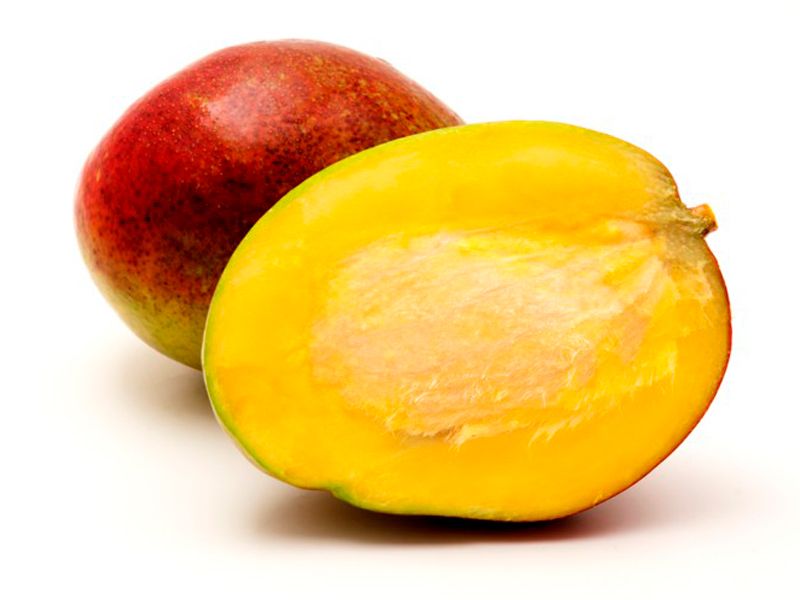
The mango is an exotic plant in the sumac family, native to the tropical forests of India. It is an easy-to-grow, low-growing tree that reaches up to 1.5 meters in height indoors. In the open ground, under suitable climate conditions, it can grow up to 50 meters.
The foliage is a pleasant, rich green on the upper side and paler on the underside. Young leaves have a pinkish tint, making the tree even more attractive. Mangoes weigh between 250 g and 1 kg. The fruit is rich in vitamins and microelements, boasting a high content of folate, magnesium, potassium, iron, phosphorus, and vitamins A, C, and E.
If you want to grow a mango from a seed, it is important to create optimal conditions, which we will describe below.
Content
How to grow mango at home?
The desire to grow mangoes limits gardeners to planting material. Only the pit is available. But even this is enough to add a unique, exotic tree to your home collection.
Fruit selection
The key is choosing the right fruit with a seed from which to grow a high-quality plant. It must meet the following criteria:
- be bright, tight, not damaged;
- do not have slippery or loose skin;
- smell of resin, especially the tail;
- the core should easily come away from the pit.
Preparation of material and planting
The pit must be cleaned very carefully to prevent any remaining pulp from causing it to rot. Overripe fruits may have a cracked pit. In this case, special care must be taken to avoid damaging the emerging shoot. The best time to plant a mango, by any method, is early summer. Methods:
- Take a whole seed and plant it, pointed end down, about three-quarters of the way into soil (for flowering houseplants or succulents, mix it with small stones or expanded clay). Create a mini-greenhouse over it, for example, using a cut-down plastic bottle. Place the container in a room with high humidity. Water regularly with room-temperature water. This method has a drawback: due to the hard shell, the sprout may take a month or more to emerge.
- You can speed up the process by slightly opening the seed at the sharp end with a knife and soaking it in warm water for 24 hours. Then, seal it tightly in a plastic bag with a little water. Place it on a plate (or any flat surface) that will provide warmth but will not burn you, and place it on a radiator. When the seedling's core has completely split open, revealing the sprout's bud and root, open the bag and add water constantly, maintaining moisture. Avoid overwatering, otherwise the sprout will rot. When green growth appears, transplant it into the ground.
- If the seed's shell is too hard and cracking it could damage the sprout, place it in lukewarm water and then place it in a sunny window. Change the water every two days. Once the seed softens, try cracking it open.
- Once the seed has opened slightly, you can carefully remove the kernel, wrap it in a napkin soaked in warm water, and plant it in the soil. Just like when planting a regular seed, leave the blunt end at the top.
- You can remove the core, wrap it in a damp cloth, and place it in a warm place on a saucer of water, monitoring the water level constantly. Once the sprout emerges, plant it in light soil at a depth of 2-3 centimeters. Maintain soil moisture by watering the planted sprout regularly.
Home care
Caring for a mango tree is quite simple.
Location
The plant loves light, so it should be placed in a well-lit area. If it doesn't receive enough light, the mango will be more susceptible to disease and pest attacks.
Choosing a pot and soil
The plant has a powerful root system, so the container should be large, deep, and have a sufficiently sturdy bottom. This will prevent the roots from penetrating the bottom. The pot should be made of natural material to allow the soil and roots to breathe, and the mango itself to evaporate excess moisture.
The drainage layer (expanded clay) should occupy at least a third of the container to prevent soil rotting during intensive watering.
Better rooting and optimal plant growth are possible in warm and humid microclimate conditions.
When planting a seed, sprout, or young plant, it should be in light soil with a moderately acidic pH. You can use a ready-made cactus mix with a little sand. Or, prepare your own: mix equal parts leaf mold or turf soil with sand (river or lake sand only). Sand can be substituted with coconut shavings, sphagnum moss, or vimiculite.
Watering and humidity
Watering should be regular, and the soil should be kept sufficiently moist. Avoid overwatering, as this can lead to rot. Spraying should be done with extreme caution, as excess moisture on the leaves can promote fungal diseases and mold.
To maintain a soil acidity that is comfortable for the tree, add a few drops of lemon juice or vinegar to the water when watering.
To ensure the necessary humidity, you can add coconut fiber or expanded clay to the pot's tray. Companion plants will also help maintain humidity—they will create higher humidity when placed nearby.
When watering, you need to add Epin, Ammonium Nitrate, Ammonium Sulfate, Potassium Humate to the water, approximately 1-2 times a month.
Top dressing
They need to be applied regularly, but without excess, as this can cause soil salinization, which will negatively affect the growth rate.
Top dressings can be as follows:
- In the spring, before the tree blooms, add vermicompost (it can be replaced with fertilizer for any citrus or palm trees) – the nitrogen content stimulates the growth of green biomass;
- After flowering, it's best to use organic fertilizer—an infusion of manure, nettle leaves, or dandelion. If this isn't possible, use any fertilizer suitable for citrus trees.
Transfer
If the seedling was initially planted in a small pot, it's best to wait at least a year before repotting it for the first time. The plant doesn't tolerate repotting very well and may respond by dropping its leaves or even dying.
The best option is to immediately select a pot of the optimal size in which the mango can grow for several years.
Formation of the mango crown
As the tree grows, it is worth regularly pinching the top to form lateral shoots and a bushy tree shape.
Pruning a mango tree is essential – it will help limit the growth of its crown and form the correct shape.
Deformed branches that point downward and deviate from the tree's overall size should be pruned. Prune almost from the growing point, leaving stubs 2-3 mm long extending from the main trunk. The tree tolerates shaping well, but it's best to do this in the fall after harvest (if the tree is fruiting).
Safety
Growing mango in an apartment is quite harmless; the tree is not an allergen.
Top.tomathouse.com: Is it possible to grow mangoes at home?
A plant planted from a seed will never bloom or bear fruit, especially if the seed is from a store-bought cultivar rather than a wild-growing one. A fruiting plant can be obtained by grafting. If possible, this can be done at specialized nurseries:
- Budding grafting. To graft, cut a bud with a piece of bark from a fruit-bearing tree. The knife should be sterile and sharp to avoid unnecessary damage to the plant. Make a T-shaped cut on the tree, carefully bend back the edges of the bark, and insert the cut bud. Gently tie it in place and wait for it to take root.
- Grafting using a scion. This method allows grafting the tip of a shoot up to 15 cm long. The tip of the scion and the tip are cut at an angle, aligned, and securely fastened together to ensure a union. It's best to wrap the scion with grafting tape, but electrical tape, adhesive bandages, or a piece of duct tape can also be used.
From the moment of grafting until the first flowering, about 2 years pass.
If this happens, after 100 days, juicy, ripe fruits will appear, ready for harvest. However, it's important to remember that a tree ready to bloom and bear fruit requires regular feeding and fertilizing.