Morning glory belongs to the Convolvulaceae family. It's also known as "birch," or "birch plant." Scientists call it Convolvulus, which means "to curl up" in Latin. This stems from the fact that many varieties require support and twine around neighboring plants. The flower is native to subtropical and temperate climates.
Content
Description and characteristics of bindweed
It is a perennial or annual herbaceous plant or subshrub. It reaches 4 m in height, with prostrate or erect stems and a creeping root system with thread-like rootlets.
The entire, alternate leaves are located on petioles. They can be arrow-shaped or heart-shaped, toothed or lobed.
Flowers are borne singly or in clusters in the axils of foliage. They are funnel- or bell-shaped, with weakly defined lobes. The petals open early in the morning, only in clear weather.
After flowering, fruits begin to form. These are capsules containing seeds. They remain viable for 2-3 years after harvest.
Types and varieties of bindweed
The genus comprises 75 species, with another 836 species still undetermined. Only a few species are found in Russia.
Field
A perennial or annual plant reaching 1-1.5 m in length. The flowers are small and grow along the entire smooth or hairy stem. They come in a variety of colors: most often pure white or pinkish, less commonly blue, light blue, or violet. Flowering period: from the second ten days of spring until frost. Propagation occurs by seeds or root suckers.
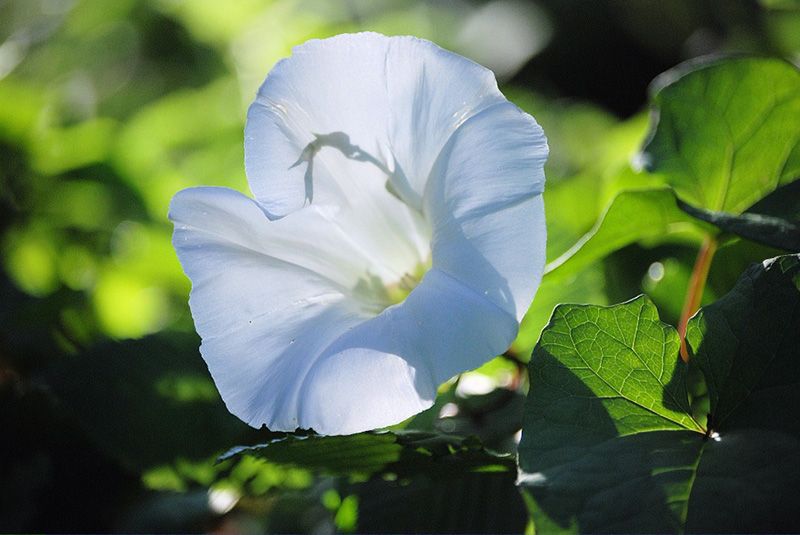
Common bindweed (common morning glory) is often eliminated from gardens and summer cottages because it grows very quickly and entangles other crops, draining their vitality. However, it has benefits that not everyone knows about. Plants planted nearby are less susceptible to mold and mildew. Field bindweed also makes a good mulch.
The plant also has medicinal properties. It is excellent for kidney and liver conditions, treats respiratory diseases, and cleanses the circulatory system.
Garden
A distinctive feature is the variety of contrasting and vibrant colors. A flowering carpet can decorate an unsightly slope, an empty space, or an alley. Garden bindweed is also used to decorate borders and create partitions. It can be used to separate one part of a plot from another or to shade other plants. Popular varieties include:
| Name | Description | Flowers |
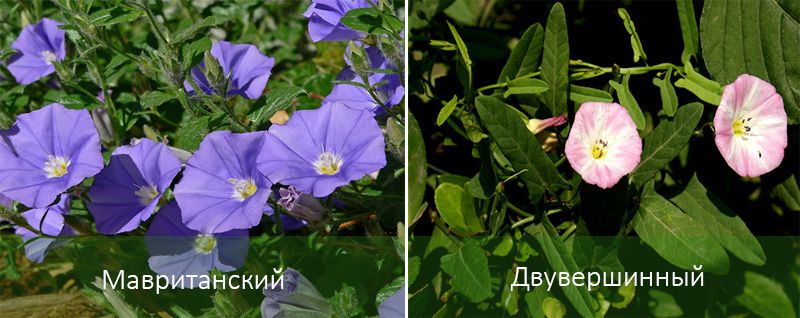
| Mauritanian | Up to 0.5 m. Usually grown in containers or hanging planters. Foliage is grayish-malachite in color. | Light lilac. |
| Double-peaked | Up to 0.4 m. In the wild, it can be found on mountain slopes, sandy shores of reservoirs, and in steppes. The stems are prostrate or slightly ascending. The blades are arrow-shaped, glabrous or pubescent. | Single, pudding. |
Tricolor
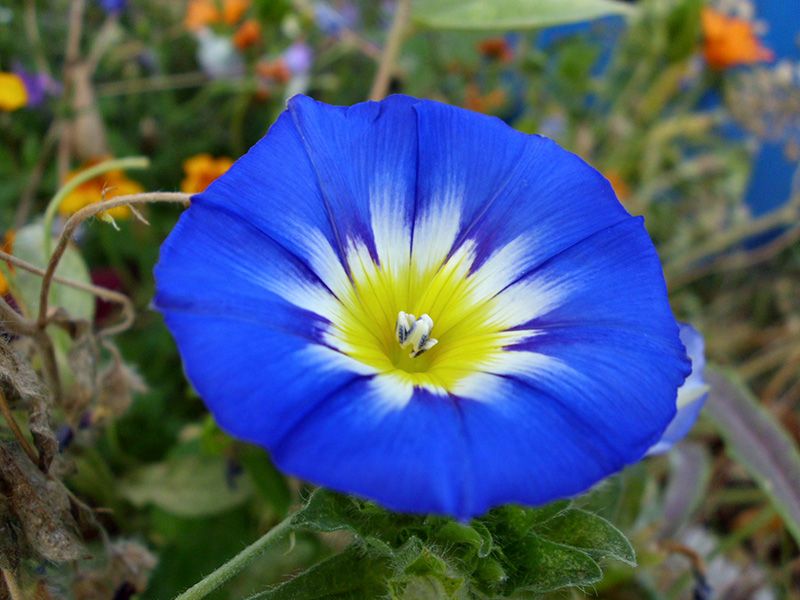
An exotic ornamental vine up to 0.5 m long. The glaucous emerald foliage is densely packed along the entire stem. Large flowers with wavy edges reach 5 cm in circumference.
The most beautiful varieties:
- Blue and Rainbow Flash with whitish-ultramarine flowers, lemon core;
- Royal Ensign with velvety purple petals with a black tint;
- Crimson Monarch with bright crimson buds.
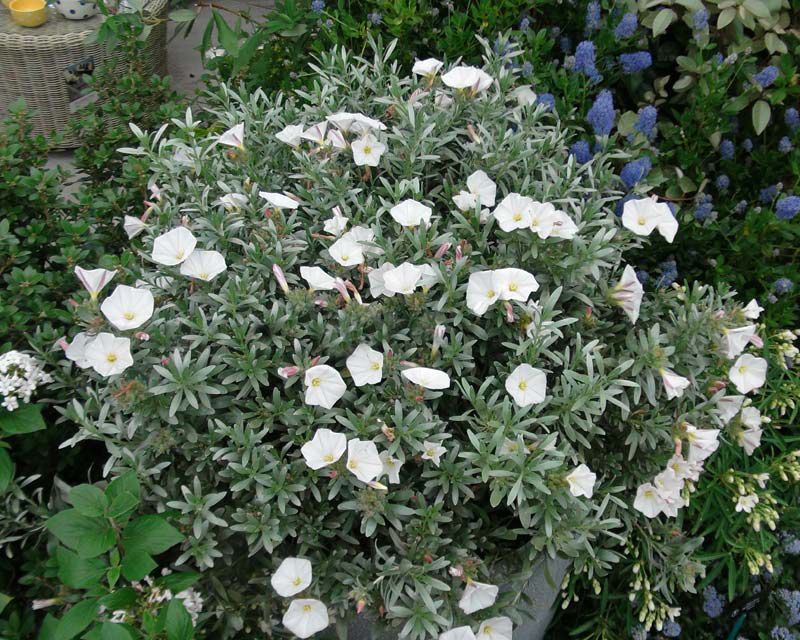
Morning glory is a low-growing plant with numerous side shoots, giving the bush a spherical shape. This variety looks spectacular in containers on terraces, loggias, windowsills, and balconies.
Growing morning glory from seeds
The flower is propagated only by seeds. They can be sown directly outdoors or planted as seedlings. Growing the plant from seeds indoors is preferable, as it will promote faster growth and more abundant blooms.
Sowing for seedlings is done in March:
- Leave the seeds in water for 24 hours.
- Place in separate containers with potting mix for flowering plants. It is not recommended to plant them in shared containers, as morning glory does not transplant well.
- Deepen the seed and cover with a thin layer of soil.
- Keep pots at +18…+20° C.
- Apply mineral fertilizer. Water regularly, preventing the soil from drying out.
- The first shoots will appear in a couple of weeks.
Planting bindweed in the garden
Before planting, seedlings need to be hardened off. To do this, take them outside daily, starting with 10 minutes and gradually increasing the time. This will strengthen the morning glory's immune system and help it resist various diseases.
Planting dates
Planting takes place after the snow melts and the risk of frost has passed. This usually occurs in mid-May to the first half of June.
Planting technology
It's essential to choose a sunny location. Only then will it bloom profusely and for a long time. The flower isn't picky about soil, but grows best in a permeable, loamy soil. Planting is as follows:
- Dig up an area with peat (2-3 kg per 1 sq.m).
- Level the surface of the ground.
- Transfer the plants to holes spaced 20-25 cm apart using the transshipment method. Water the seedlings before transplanting (this will make removing the plants from their pots easier).
- Moisten generously.
Caring for bindweed
Planting and subsequent care are simple. Just follow a few guidelines:
| Criterion | Recommendations |
| Watering | Regular and generous watering. If the plant lacks moisture, it will drop its petals. When watering, be careful not to allow water to stagnate. This can lead to fungal infections. |
| Top dressing | If growth is slow, add wood ash or fertilizer for flowering plants, such as Nitrophoska or Agricola. |
| Weeding | During the first 2-3 weeks after planting. Once the bushes become established, they will be able to suppress weeds. |
| Formation | It is necessary to create a support so that the bindweed can twine around it during active growth:
When a flower grows in the wrong direction, prune it. |
After flowering
In Russia, it's grown as an annual plant. Therefore, in mid-autumn, it should be dug up, including the rhizome, and the area should be dug over. Since the flower self-sows, new plants will begin to form in the same location the following season.
Diseases and pests
Bindweed is a robust plant that is rarely affected by diseases or insects. Sometimes, if not properly cared for, the plant can become infected with powdery mildew. This can be identified by the following signs:
- White powdery spots containing fungal spores. Over time, they begin to secrete liquid droplets resembling dew.
- Early petal fall.
- Curling and wilting of leaves.
- Arrest in development.
The disease most often occurs due to errors in care:
- high humidity;
- aphid infestation;
- excess nitrogen in the soil;
- excessive planting density.
Fungal spores can also be transmitted through water during irrigation, from other plants by the wind, through people, or through undisinfected tools.
If the damage is severe, the flower dies; in the early stages of the disease, it can still be saved:
- Remove affected areas.
- Spray with soda ash (2-3 g per 1 liter of water) or a soap-copper solution (25 g of green soap and 2.5 g of copper sulfate per 1 liter of liquid).
- Treat the bush itself, containers, and soil with Vitaros, Fundazol, Topaz, Hom, or other fungicides.
Occasionally, aphids will infest bindweed. These pests can be identified by the following signs:
- wilting of young leaves and buds;
- dark spots (punctures from proboscises);
- syrupy liquid on the above-ground part;
- the appearance of ants near the plant (they are attracted by sticky mucus).
You can destroy the insect in the following ways:
- wipe the above-ground part with a cloth soaked in a soapy solution;
- buy red ant or ladybug larvae (these are natural enemies of the pest) at a gardening store;
- use purchased drugs: Commander, Bankol, Vertimek and others.
Top.tomathouse.com informs: how to get rid of field bindweed
Wild bindweed can be a problem in a garden. By twining around other plants, it suffocates them and prevents them from growing properly.
Fast-growing weeds should be destroyed while they're still young. They must be completely pulled out, leaving no roots in the ground. New shoots may begin to form from these roots. Carefully collect all plant parts to prevent seeds from scattering, and then burn them. If this doesn't help, it's advisable to use toxic products such as Linder.
To prevent unwanted morning glory growth in the future, dig over the entire soil in the spring, destroying any remaining roots. Then cover the area with a light- and air-tight material. Under these conditions, the remaining plant parts will die. Green manure crops, such as white mustard, also help control unwanted weed growth.