Choosing the right apple tree variety for planting is a crucial step for every gardener. It's important to plant a tree that will yield a harvest quickly and deliver delicious fruit. Lungwort is rightfully the leader among early-ripening and sweet-fruited apples.
Content
- 1 Botanical description of the Medunitsa apple tree
- 2 Characteristics of the Medunitsa apple tree
- 3 Varieties of the Lungwort variety
- 4 Planting rules for the Medunitsa variety
- 5 Agricultural technology of cultivation
- 6 Prevention and control of diseases and pests
- 7 Top.tomathouse.com recommends: pollinators for the Medunitsa apple tree
Botanical description of the Medunitsa apple tree
Lungwort was originally developed as a summer variety, which is important in areas with harsh climates. It was bred by Soviet botanist Sergei Ivanovich Isaev in the first half of the 20th century by crossing two varieties: "Korichnevyi striatatyi" (Brown Striped) and "Welsi." It is quite tall (can reach 8 m), and its apples ripen by late summer. A winter variety was later developed from this variety. Dwarf and semi-dwarf subspecies also exist.
Characteristics of the Medunitsa apple tree
It, like any other plant, has its own distinctive features.
Appearance
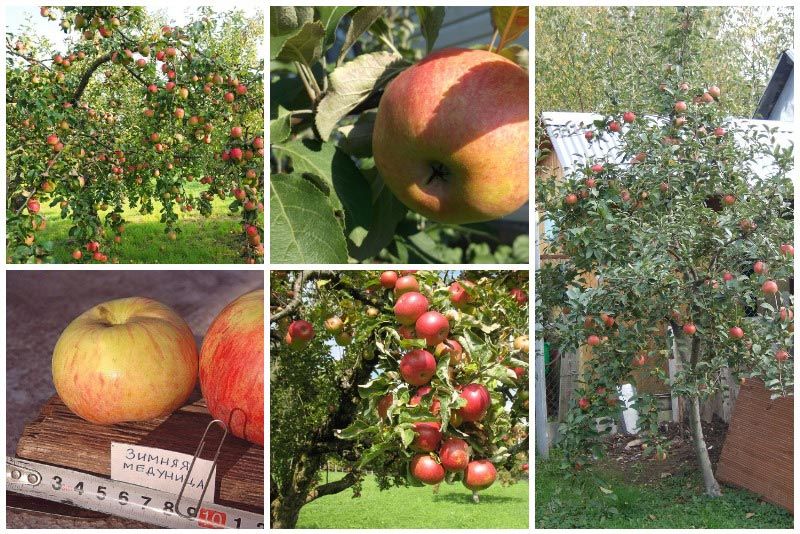
The tree itself resembles a pyramid with spreading branches, through which gaps are clearly visible. The leaves are rough to the touch, textured, and densely cover the crown in shades of green and yellow. New shoots form in relatively small numbers and are pale brown. The apple tree's roots are strong and highly branched. The flowers are large (about 4.5 cm), with milky-white petals.
Fetus
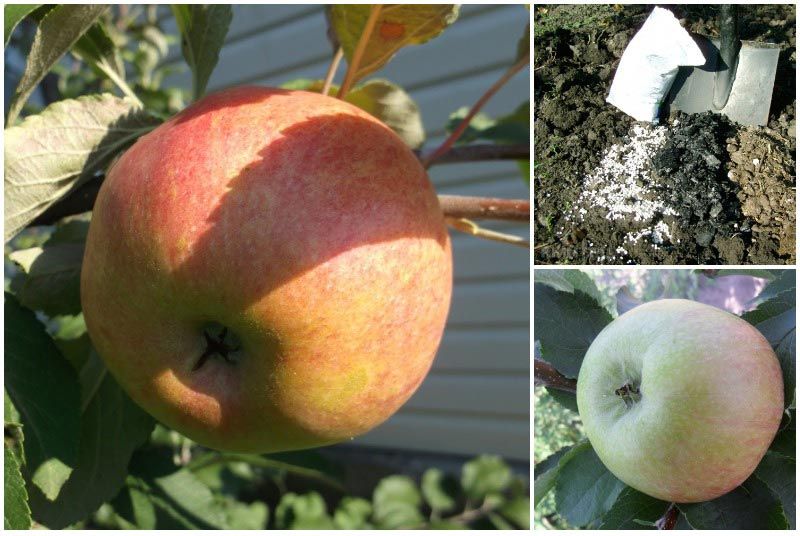
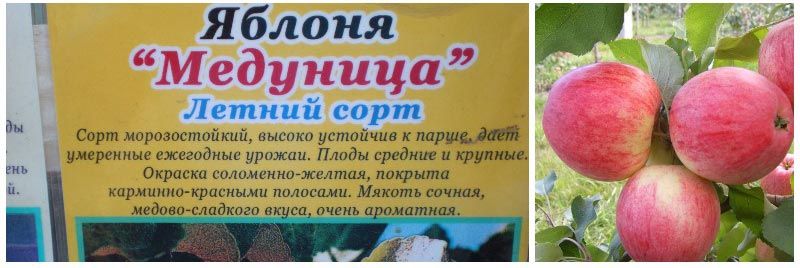
The resulting apples are medium-sized, slightly compressed at the stem. The fruit is yellowish-green in color, though some apples have red sides or dark burgundy stripes. Their skin is quite thin, and the flesh is rich in juice and quite sweet, hence the variety's name. Each fruit weighs 80-160 grams. The flavor only improves with storage.
Pros and cons of the variety
Like any garden plant, the apple tree has its positive and negative sides.
Pros:
- has high frost resistance;
- the apples taste like honey;
- easy to care for;
- reduced sensitivity to fungal infections such as rot and scab;
- almost all seedlings take root;
- early fruiting;
- big harvest;
- ripe fruits remain on the tree for a long time;
- the variety is self-pollinating;
- apples ripen early;
- The fruits contain a minimum of sugars, which makes it a dietary variety.
Cons:
- the harvest does not have a long shelf life;
- apples ripen unevenly;
- the need for regular tree care, which will ensure the collection of a decent amount of fruit;
- large size of the tree, which makes harvesting difficult.
The beginning of fruiting and ripening time
Lungwort on seed rootstock begins to bear apples as early as 5-6 years. With proper care, the plant's vigor can continue for 50 years or more. For the first 12-15 years of the tree's life, a gardener will be able to reap a bountiful harvest annually. After that, it's important to monitor the number of ovaries and regulate them if you need to harvest apples every summer.
Uneven ripening of the fruit is caused by the large amount of foliage, which creates shade. Therefore, harvesting is extended from late August to September.
Varieties of the Lungwort variety
When choosing a seedling, it's important to pay close attention to the rootstock. Many factors depend on it:
- the height of the tree, its size and appearance;
- fruiting and ripening periods;
- apple tree planting scheme;
- the lifespan of a tree and its ability to bear fruit.
Seed rootstock
With proper care, a tree on this rootstock will delight the gardener with annual apple production for 50-60 years. In this case, the total lifespan can reach 90 years. These apple trees grow up to 8 m in height, bearing fruit as early as the fifth year, and require approximately 4.5-5 m between plants when planted.
It is important to ensure that the branches do not touch or mix with each other, this will ensure a large harvest.
Semi-dwarf rootstock
Agronomists recommend purchasing tall-growing apple tree varieties on semi-dwarf rootstocks. They are easier to harvest and facilitate regular pruning. These trees are typically shorter than their counterparts on seedling rootstocks, but they also bear fruit earlier. These apple trees reach 4.5-5 m in height, producing fruit in 3.5-4.5 years, with planting intervals reduced to 4 m. Semi-dwarf varieties can thrive even in high groundwater levels, as they tolerate waterlogged soils well. This quality is enhanced by the rootstock.
Dwarf and columnar rootstock
Demand for miniature varieties has recently emerged. They offer a decorative appearance, and the tree is easy to harvest and maintain. Lungwort has a pyramid-shaped crown, but dwarf varieties can have a spherical or triangular shape. These trees grow to a maximum height of 2 meters and begin bearing fruit early—as early as 3 years old. Plant spacing can be reduced to 1 meter.
Dwarf varieties have one drawback: a weak root system, which can lead to the tree falling over in strong winds or under the weight of ripe fruit. However, this is easily remedied by staking the branches, which will protect the tree from harm. Due to the massive fruit production, the lifespan of these apple trees is reduced to 12 years.
Lungworts on columnar rootstocks are extremely rare commercially, due directly to the natural structure of their crown. Therefore, with this type of rootstock, the result is a dwarf apple tree with a pyramidal shape.
Winter option
The Lungwort's flavor and other qualities have led to the need for a winter variety. It differs from the summer variety in that its apples ripen later—at the end of September. However, it also has the advantage of a long shelf life (until spring). The fruit has a slightly more tart flavor, even though the varieties share the same name.
Planting rules for the Medunitsa variety
Caring for and planting Lungwort is virtually the same as caring for any summer apple variety. It's important to time the planting and choose the right location for the tree.
Planting dates
These can vary and directly depend on the natural conditions of the area where the apple tree will be grown. In temperate climates, autumn is the best time to plant, while in harsher climates (such as Siberia), spring is preferable. This gradation will allow the tree to establish itself in the soil, protecting it from early frosts.
In regions with little snow in winter, it is also preferable to plant seedlings, as in northern latitudes.
Trees can be planted in the spring only when the temperature is above zero and the ground has thawed to a depth of 60 cm or more. When choosing a fall planting time, remember that there should be at least 21 days before the first frost, but it's important not to plant too early, as this could result in shoots that die.
The landing process
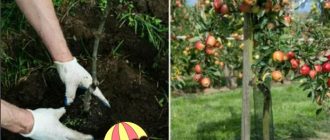
It occurs in several stages. It begins with preparation. The planting hole is dug six months before the actual planting of the seedling. To do this, dig a circular hole with a radius of 50 cm in the chosen location, suitable for a two-year-old plant. The principle is to make the hole slightly larger than the tree's root system. The excavated soil is then divided into the fertile portion (mixed with fertilizer and poured back halfway into the hole) and the remaining soil (discarded). A stake is inserted into the center, to which the young apple tree is then tied. Then, the Lungwort is placed in the center, its roots are spread out, and the remaining fertile soil mixture is added. Finally, the soil around the seedling is watered and compacted.
If subsidence of the soil occurs after these actions, add the required amount of soil.
Agricultural technology of cultivation
When growing Lungwort, it is important to follow the tree care rules, which include the following steps:
Watering
In the first year after planting, it is worth paying attention to the correct watering of the young tree, and all other procedures should be carried out when it grows and becomes stronger.
When the top layer of soil is completely dry, water it for one month. After that, watering the soil as frequently as possible is no longer necessary; watering should be done once every seven days.
Crown formation
In the second year, you can begin pruning the branches to create the correct crown for the Lungwort. Layers are formed at a distance of 35-40 cm and should be spaced apart. This helps maintain the natural pyramidal shape of the crown. You can also shape the tree into a bowl by removing the central shoot and replacing it with 5-6 lateral shoots.
Due to its vigorous growth, shoot formation is weak. It's important to follow a few rules:
- Sanitary pruning should be performed annually in spring and fall. This involves removing damaged branches.
- In spring, the crown is thinned, which stimulates the growth of young branches and new shoots.
- During the summer, new growth is pinched and branches that heavily shade the fruit are removed.
Necessary fertilizers
They are carried out every six months. Spring fertilization helps the tree gain foliage, grow, and produce fruit. Nitrogen-containing fertilizers are best for this. Autumn fertilization helps the wood mature and prepare for winter cold. Potassium- and phosphorus-containing fertilizers are also good choices.
It's important to remember that when using any fertilizer, you need to adhere to the correct dosage, otherwise you could cause harm rather than benefit to the plant.
Harvesting and storage
When harvesting summer apples, consider the growing region. For example, in areas with a hotter climate, they ripen by mid-August, while in harsher climates, they ripen in the first half of September. Winter apples are ready for harvest in September to early October. If necessary, apples can be picked slightly earlier than these dates, which will ensure they are at what's known as "technical ripeness."
Fully ripened summer-ripened berries can be stored for approximately 30 days, while those harvested earlier can be stored for 3-4 months. Winter-ripened berries can be stored until spring.
It's important to remember that apples tend to change flavor: it will reach its peak after 14 days, and then gradually deteriorate.
Prevention and control of diseases and pests
Although Lungwort has increased resistance to pests and infections, it's still worth treating the trees to prevent damage. To do this, spray with copper-containing solutions, such as copper sulfate, in the first weeks of spring before bud break. Dilute the solution at a ratio of 100 g of dry matter per 10 liters of water.
To prevent the development of scab and fruit rot, the area around the tree trunk should be treated with a 10% solution of ammonium nitrate (before flowering), and the tree itself should be sprayed with a solution of Bordeaux mixture (2%).
Every spring and fall, the trunks of mature apple trees are whitewashed, and young trees are wrapped in spruce branches to protect them from rodents. Tar paper, roofing felt, synthetic tights, and other materials are also suitable for this purpose.
Top.tomathouse.com recommends: pollinators for the Medunitsa apple tree
Because Lungwort is self-sterile, pollinating varieties should be planted in the garden to encourage fruit production. These include White Filling, Sverdlovsky Anis, Bellefleur-Kitayka, and others.
Easy to care for and maintain, the Medunitsa apple tree does not require much physical or material investment, but will delight gardeners with an annual and abundant harvest for quite a long time.