Jacobinia is a perennial herbaceous plant native to South America. It belongs to the Acanthaceae family, whose species are characterized by rapid growth and shrubby habit.
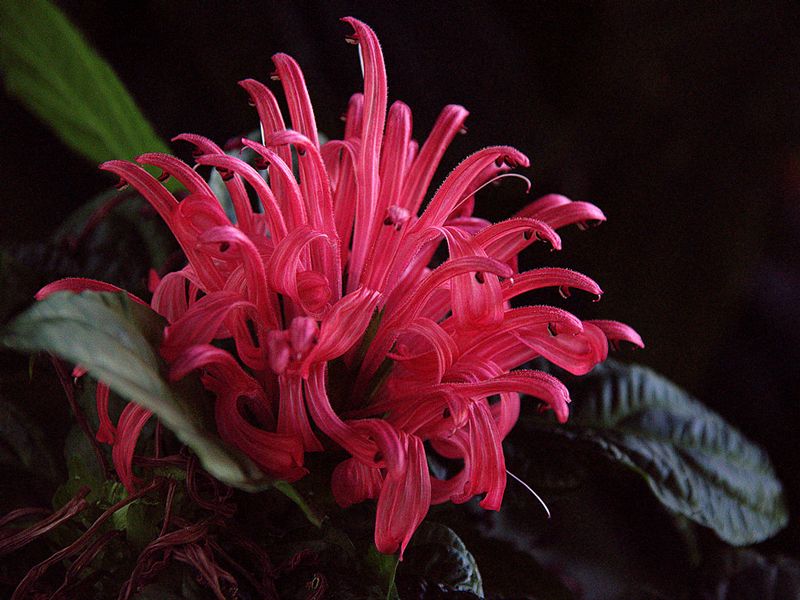
The genus is popular among indoor flower lovers due to its beauty.
Description of Jacobinia
Jacobinia spp. grows up to 1.5 meters tall. The branched roots of the 'justice' plant include numerous small offshoots, the green-pink stem is straight, and the reddish internodes are stiff. Most shoots have lateral shoots. The lance-shaped green leaves grow in pairs and are covered with fine veins and tubercles. The flowers are tiered inflorescences, comprising rows of pink, red, and white petals. The buds usually open in February-March or fall, depending on the species.
Types of Jacobinism or Justice
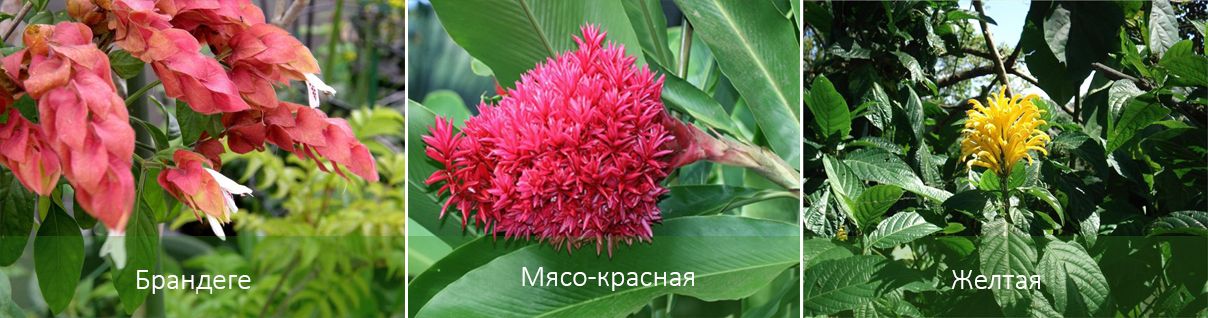
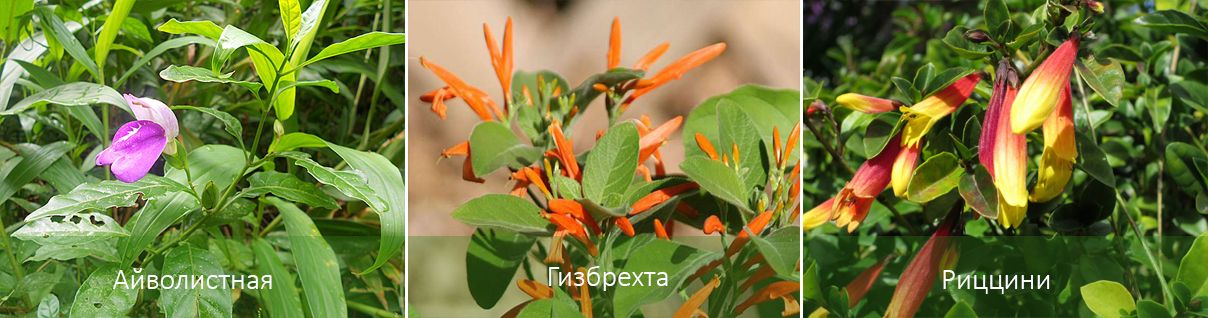
The genus Justice includes a wide variety of species forms, each of which is characterized by its own size and color of flowers.
| View | Description | Leaves | Flowers |
| Brandege | Reaches 80-100 cm. | 7 cm long, green with a matte sheen, oval elongated shape. | White, with yellow bracts. They bloom alternately, with a 10 cm inflorescence. |
| Meat-red | Bush 70-150 cm. | 15-20 cm, wavy, tapered. | Large, pink or red in color. The bifurcated bract is purple. |
| Yellow | Height - 45 cm. | Ovate, dark green, arranged oppositely. | Yellow, forking towards the end. Dense inflorescences. |
| Willow-leaved | Ampelous type. 50-80 cm. | 3 cm long. White corolla with purple lip. | |
| Giesbrecht | 100-150 cm. Internodes are compacted, with a red tint. | 10-15 cm, elliptical, leathery. | Bright red, bilobed. Corolla - 4 cm. |
| Rizzini | 40-60 cm. Shoots are branched. | 7 cm long, 2.5 cm wide. | 2 cm. Yellow with a red tint. The corolla tube is covered with spots. |
| Plumbago | 120-150 cm. Almost no branches. | Pointed at the ends, rigid. | 4-6 cm, purple-red. Inflorescences are terminal. |
| Carthaginian | Ampelous semi-shrub 100 cm in height. | 3-5 cm. Gray-green, densely spaced. | Small, white with purple spots. Pink-yellow bract. |
Caring for Jacobinia at Home
For Jacobinia to thrive, it requires proper care, which depends on the time of year.
| Factor | Spring/summer | Autumn/Winter |
| Location | Place on a balcony, in a greenhouse, in a garden, or in another open space. Protect from heavy rain and strong winds. | Place the pot on the east or west side. Avoid drafts. |
| Lighting | Cover with a thin cloth only in midday sun. The flower tolerates direct sunlight, so avoid shading unless absolutely necessary. | Extend daylight hours with phytolamps. If lack of sunlight is affecting the plant, fluorescent lamps can be used. |
| Temperature | +23…+28 °С. Sudden changes are undesirable. | +12…+17 °C. Tolerates temperatures down to +7 °C. If the temperature is lower, the justicia will die. |
| Humidity | More than 80%, spray at least 3 times every day. | 60-70%. |
| Watering | Abundant. Especially in hot weather, use warm, settled water as the soil dries out. | If the temperature doesn't drop, don't reduce it. If it does drop, reduce it. |
| Top dressing | Mineral and organic fertilizers no more than once every 13 days. | Not commonly used. |
| Trimming | In spring, cut the shoots back to half their size, leaving at least 3 internodes to prevent the plant from stopping flowering. | Not carried out. |
Rules and subtleties of plant transplantation
Jacobinia grows quickly and requires repotting every two years. Young plants should be repotted twice a year (in spring and summer). If roots emerge from the holes in the bottom of the pot, it's time to prepare a new container. It should be 10 cm larger in diameter than the previous one to ensure the root system feels comfortable. The substrate should be made from peat, humus, sand, and compost. You can also buy houseplant soil at the store, adding perlite. Repotting involves several steps:
- Cover the bottom of the new container with expanded clay or pebbles, and add soil on top.
- Take out the Jacobinia and water it first (30 minutes before).
- Using a pre-disinfected knife, remove 1 cm from each root.
- Place the plant in the prepared pot. Distribute the soil evenly, shaking the container twice.
- Water, shade for 3 days.
- After this period, the flower can be returned to its original location and normal care can be resumed.
Growing from seeds and propagation by cuttings
To propagate Jacobinia, you can use two methods: cuttings or seeds.
Justice seeds are small and black. Sowing period: February-April.
- Prepare small containers with a substrate including peat and sand.
- Lightly water the soil, plant the seeds, covering with soil.
- Cover the top with polyethylene or film, creating greenhouse conditions.
- Place in a well-lit area.
- The air temperature should not go beyond +22…+25 °C.
- Water as the soil dries, no more than once a day.
- If all conditions are met, sprouts should appear in 5-7 days.
- When 3-4 leaves appear, transplant the Jacobinia into a standard pot.
The second most effective and fastest method is vegetative, carried out in the spring:
- Prepare a substrate based on humus and peat.
- Using a disinfected knife, cut off the apical or lateral shoots.
- The shoot should be at least 8 cm long, with 2 internodes.
- Place the cuttings in separate containers, maintain a temperature of +18…+22 °C.
- When the justice forms a root system (2-3 weeks), transplant the seedlings into standard pots.
Pests and potential problems of justice
During growth, Jacobinia may be subject to insect attacks and diseases:
| Symptom | Cause | Methods of elimination |
| The leaves are turning yellow. | Jacobinia lacks nutrients and light, and the soil is too damp. | Reduce watering to once every 4 days, add lighting using phytolamps. |
| The bracts turn black and rot. | When watered, some amount of water remains on them. | Gently wipe the bracts with a dry cloth. |
| White translucent marks on the leaf blade. | Burn. | Shade or move away from light and increase the frequency of spraying. |
| Numerous white waxy clots, large elongated insects. Does not grow. | Mealybug. | Remove wax deposits and pests, spray the bulb with an alcohol solution. Then use Actellic or Calypso. |
| Cavities on the leaf blade and stem, shoots and sprouts droop and die. | Scale insect. | Treat the plant with a soap or lemon solution and water thoroughly. Then apply Permethrin, Bi 58, Phosphamide, and Methylmercaptophos. |
| The leaves are falling. | Lack of moisture. | Increase air humidity and water the soil. Make sure the soil doesn't dry out. |
| Green small parasites on leaves and shoots, Jacobinia stops growing. | Aphid. | Increase watering frequency and air humidity. Use Intavir and Actofit. |
| White, very small butterflies appear in the flower itself. | Whitefly. | Use Fitoverm or Actellic twice a week. Place syrup traps around the Jacobinia. |
| Burgundy or orange circles on the leaves, thick whitish webbing all over the plant. | Spider mite. | Spray the ducks at least twice until symptoms disappear. Use products such as Neoron, Omite, or Fitoverm. |