Zephyranthes, a member of the Amaryllis family, is a bulbous perennial native to the tropics of southern and central America.
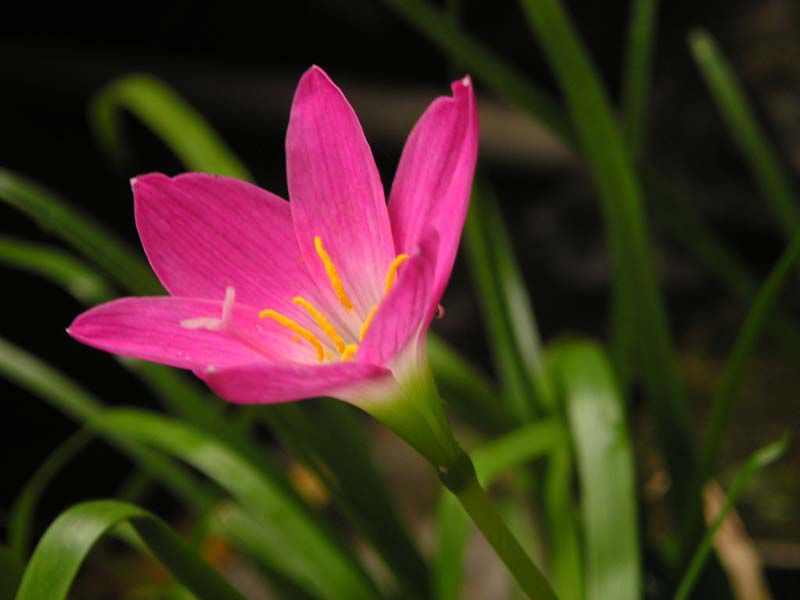
Description of the flower
The plant's bulbs are round or oblong, reaching approximately 35 mm in length. They have a small basal collar, which facilitates the formation of a rosette of leaves. The foliage is narrow, belt-shaped, and richly green. The leaves can reach 20-35 cm in length.
It blooms from early April until late summer. The flowers are similar in shape to crocuses, and come in white, yellow, and pink. The diameter of the flower ranges from 40 to 80 mm. The bud lasts 1-3 days.
Popular types for home
There are about 40 varieties of zephyranthes, of which no more than 10 can be grown at home:
| View | Description | Flowering period |
| Atamas | A herbaceous plant with a small bulb and neck. It has 6-8 tubular leaves, up to 20 cm long. The buds are white with a yellow center, ranging in diameter from 25 to 40 mm. | Beginning of March – May. |
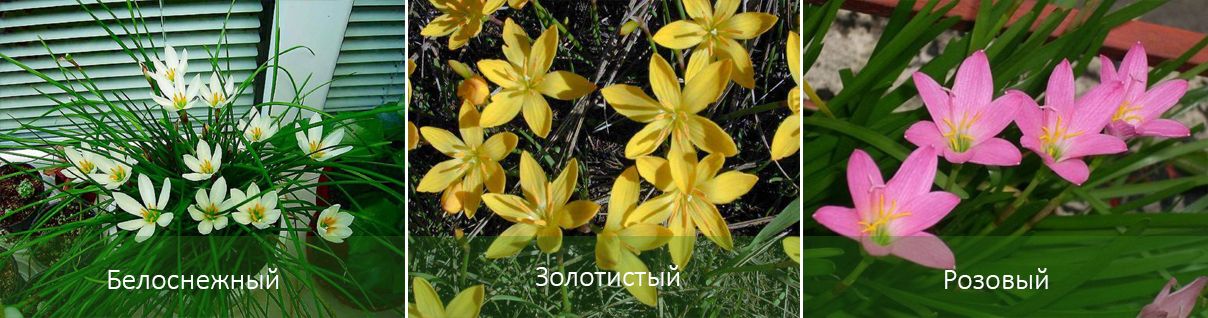
| Snow-white | The flower reaches a height of 30 cm. The bulb diameter is up to 30 mm, with an elongated neck. The buds are white, and the perianths are funnel-shaped. | From July to October. |
| Golden | The bulb grows up to 30 cm tall, has a rounded shape, and the foliage is narrow. The flowers are funnel-shaped and yellow. | March-April is the middle of summer. |
| Pink | The bulb is elongated, about 3 cm in diameter. The flowers are light pink with a yellow center. | Mid-spring – July. |
| Multicolored | It stands out for its original coloring, which combines shades of red. |
Home care
When caring for zephyranthes at home, it is recommended to consider a number of key points:
| Parameter | Actions |
| Resting stage | Directly related to the flower variety: September-November or December-February. It is necessary to lower the temperature and reduce the lighting. |
| Lighting | Prefers diffused sun. Avoid placing it on a north-facing window. |
| Temperature | In spring and summer +18…+25°C. In cold weather +10…+12°C. |
| Humidity | There are no humidity requirements. Mist occasionally in dry air. |
| Watering | During flowering, water twice a week. In winter, depending on the condition of the flower, if the foliage is still alive, water the soil occasionally. When the above-ground parts completely die back, stop watering. |
| Top dressing | Use a liquid complex fertilizer (Agricola, Kemira-Lux) every two weeks. Start applying it when the leaves begin to form. Stop after the flowering stage. |
| Soil | Light, nutritious soil. The best substrates are those with sand, humus, and turf in equal proportions. To improve growth, add a phosphorus fertilizer (superphosphate). |
| Transfer | Annually or every 2 years. Use low but wide pots. |
Street views for the middle zone
There are several varieties of zephyranthes that grow well in open ground in central Russia: large-flowered and pink.
The large-flowered variety can produce a 30-cm-long flower stalk. It bears large pink-orange buds. In central Russia, it can only be grown if the bulb is dug up in the fall.
Pink zephyranthes are suitable for growing in open ground only during the summer season.
Open-ground cultivation technology
Planting and caring for zephyranthes in open ground isn't difficult, but there are a number of important considerations. First, you need to choose the right location. Sunny, elevated sites are preferred.
The soil should be loose and fertile. If planting in loam, sand must be added (about 10 kg per square meter). When planting in sandy soil, it should be pre-fertilized with humus.
It is recommended to plant the flower at the end of May, by which time the soil is already sufficiently warmed up.
A drainage layer consisting of pebbles or crushed stone and clean sand must be placed at the bottom of the hole. Next, cover the drainage layer with soil, and place the bulb in it. Before placing the plant in the soil, it is recommended to soak the bulb in Maxim for about 30 minutes. After planting, water the holes generously.
Reproduction
Zephyranthes can be propagated in several ways:
- seed;
- by dividing the bulb babies.
Sow the seeds immediately after they form, as they completely lose their ability to germinate after two to three months. They are planted in medium-depth boxes filled with a mixture of sand and peat. The seeds are placed in small holes spaced 30-40 mm apart. The soil is misted, and then the box is covered with plastic wrap.
The greenhouse should be placed in an area with a temperature of 22°C (72°F), with the flowers opened daily for ventilation. The first shoots form within 13-20 days. After this, the seedlings are transported to containers with soil intended for mature plants. The first flowering occurs within two to four years.
Propagation using bulbs is much more popular among gardeners, as about 4-5 babies are formed around them every day.
To do this, during spring repotting, carefully separate the soil from the bulbs without damaging the root system and plant them more loosely. This method of propagating zephyranthes doesn't require any special care. The first blooms can be seen in about a year.
Diseases and pests
During growth, zephyranthes can suffer from a variety of diseases and pests:
| Disease/pest | Signs | Treatment |
| Scale insect | Brown plaques form on the foliage and stems. The leaves become dull and deformed. | The affected areas are wiped with Actellik solution. |
| Amaryllis mealybug | Small white insects are found between the bulb scales. Plant growth is slowed, and the foliage dries up and dies. | The soil is treated with an insecticide. Severely affected bulbs are removed. |
| Spider mite | The flowers fall off, the plant gradually withers and becomes covered with a thin white web. | Zephyranthes are treated with a solution of water and soap. In severe cases, Actellic is sprayed. |
| Whitefly | The leaves turn yellow and fall off, there is no flowering. | The plant is sprayed with products containing permethrin. In severe cases, Actellik is used. Reduce the amount of watering. |
| Fusarium A bulb severely affected by the disease is destroyed. | The roots rot, the leaves wither and turn yellow. | Neighboring plants are kept in a solution of the Maxim preparation for 30 minutes and then planted in new soil. |
Top.tomathouse.com informs: Zephyranthes – a disruptor of harmony
It is believed that zephyranthes disrupts harmony in the home. Placing the flower in the marital bedroom will worsen the relationship between husband and wife and may lead to extramarital affairs. Because of these properties, it is recommended to place it in the library, study, or living room, where its active energy will be beneficial.