Bugleweed (Ajuga) is an annual and perennial herbaceous plant from the Lamiaceae family. Commonly known as ajuga, gourd, oak grove, heart grass, oak grove, and bitter grass, it blooms in May, as soon as the snow melts. It grows throughout the world except for the Arctic Circle, preferring moist, shaded forests and rocky soils exposed to the sun. It spreads quickly through its shallow rhizome.
In Russia, the most common species is creeping bugleweed (Ajuga reptans).
Description of tenacious
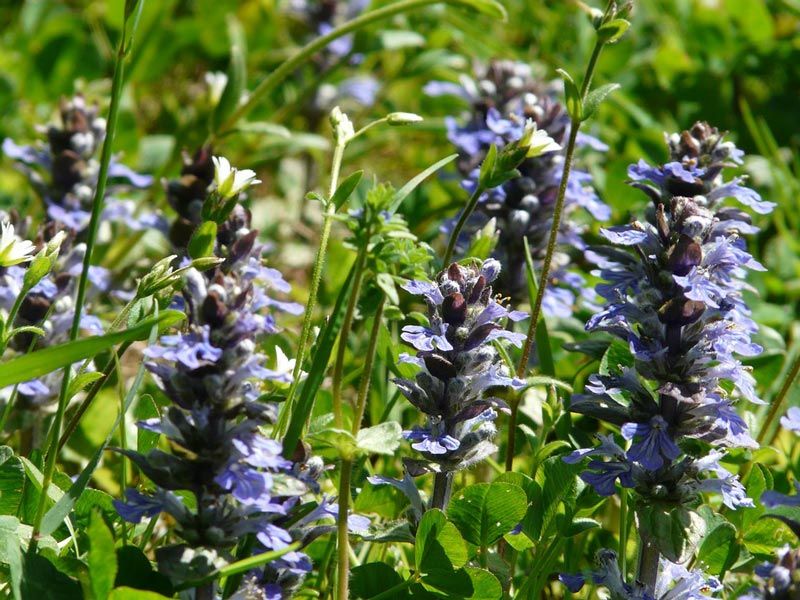
A herbaceous plant with eight-lipped flowers, ranging from blue to white, gathered in small inflorescences (spikelets). The corolla has an upper two-lobed lip and a lower three-lobed lip.
The seeds ripen by the end of summer—the third ten days of July. By early August, they appear as four bright brown, hairy nuts. Under unfavorable weather conditions, the bugleweed becomes self-pollinating, but under favorable conditions, it is pollinated by bees.
The stem of this plant is erect, up to 0.5 m tall, four-sided, and can droop. Its base bears long, oblong leaves, while the upper leaves are short and serrated at the edges. Ajuga repens has the characteristic creeping shoots of this species. Over time, about 45 cultivars of Ajuga repens have been bred (each differing in the color of both their foliage and flowers).
Gardeners love it for its unpretentiousness, preferring to plant it along fences and in the shade around trees and shrubs, on alpine hills, and also to create a creeping carpet.
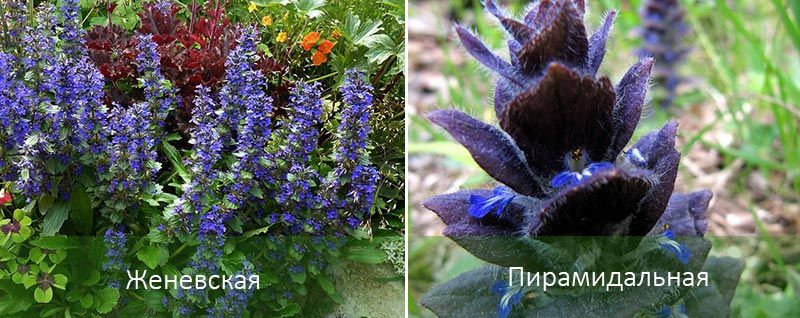
Ajuga repens, Genevan, pyramidal, and Chios: photos and descriptions
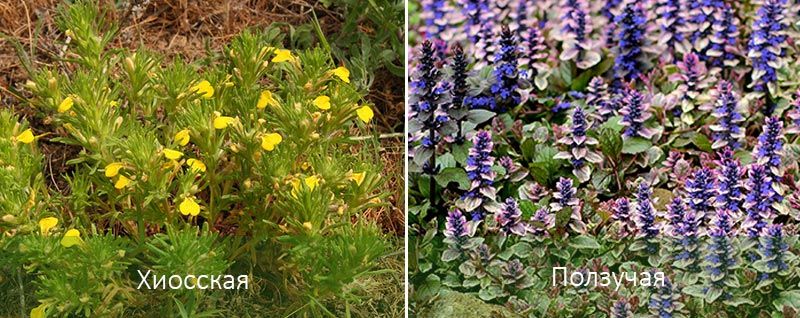
The most popular types of tenacious are:
| Type and its characteristics | Varieties and their description | Leaves | Inflorescences |
| Creeping. A groundcover plant with beautiful flowering. | Metallica Crispa. Shoots creep along the ground. | Dark brown with a metallic sheen. | Bright blue, terry. |
| Atropurpurea. Loves sun. Height up to 20 cm, creeping. Self-growing, requires little care. | Thick brick color with a bronze sheen. | Dark blue, growing in clusters on the stem. | |
| Burgundy Glow. | Light green, blue, reddish, with pink spots and fine veins. The color depends on the soil, fertilizer, and light. The more light, the brighter and redder the color. A lack of micronutrients will result in a pale appearance. | Burgundy, blue-light blue. | |
| Multicolor. | The color changes depending on the lighting: in the sun it becomes a bright purple with thin red or orange stripes, in the shade it becomes a deep green with pink or yellow veins. | Blue. | |
| Chocolate Chip. Spreads quickly across loamy soils in partial shade and full sun, forming a 5 cm tall carpet. | Oval, green, small, can be purple (5-6 cm). | Cobalt shade. | |
| Pink Elf. Small bush. Long-blooming. | Very small. | Pink. | |
| Rainbow. A creeping, very dense variety without gaps. | Spotted from yellow to white on a dark green background. Similar to the Multicolor variety, but more vibrant. | Lilac. | |
| Arctic fox. Loves sunny places and water. | The usual green ones are covered with white streaks (multicolored lines), under which you can’t even see the color of the leaf itself. | Pale blue. | |
| Polar snow (Arcticsnow). | Green, corrugated with a large milky spot and whitish edges. (8-10 cm) | White. | |
| Chios. Low-growing, reaching up to 20 cm, the stem branches into three at the base, creating creeping shoots. It thrives in rocky soils, enclosed spaces, and rock gardens. | There are no varieties. | Thin green, dark shade with fluff. | Small, yellow with scarlet specks. |
| Geneva or hairy rhododendron. Dark green, hairy stems grow up to 50 cm. No trailing shoots. Successfully used by folk healers. | Helena. | Narrow, elongated oval. | Lilac. |
| Blue sea. | Up to 20 cm, dense green, elongated, drooping. | Light blue, with clearly visible adjacent leaves. | |
| Pyramidal. It has no creeping roots, is drought-resistant, grows slowly, and resembles a pyramid. The stems are fleshy but fragile. It is listed in the Red Book. | Metallica Crispa. | Deep dark green, oval, serrated at the edges, with thin white lines. | Deep purple in color, can be white or pink. |
Growing tenacious from seeds
Ajuga seeds are sown in the spring, despite frost, or in the fall before winter. It is recommended to plant in a dark area, usually under trees. Before sowing, dig the soil and apply mineral and organic fertilizers (double superphosphate can be substituted).
Caring for Ajuga in the Garden
Until new leaves appear, the plant needs to be watered. The soil should be moist; it's best to shade the seedlings to prevent them from being exposed to direct sunlight. Once the plant has established itself and is growing, water sparingly, only when the soil is completely dry.
Due to its superficial creeping roots, tenacious plants quickly fill an area. To avoid this, you need to press the plant slightly into the ground, or you can surround it with stones or gravel.
Other methods of reproduction
Growing Ajuga from seed is recommended only for first-time gardening. Ajuga can propagate by self-seeding, with the resulting specimens differing in leaf and flower color from the parent plant. This also applies to hand-sown seeds.
To prevent the emergence of "other" species of this plant, you should pluck the stems of exclusively deciduous plants, such as the tenacious plant, which delights with its various shades of inflorescences, when they have finished flowering.
If you want a completely identical plant, propagate it by rosettes (this term refers to low-growing plants with leaves closely clustered around the root) at the end of May or before September 20th, transplanting them to a new location. Once the plant has established itself and begins to grow, stop watering it.
Jenny does not like damp soil and adapts well to dry lands.
After flowering
Collecting seeds is impractical; preventing self-seeding is possible, but it's laborious, as different plants (not resembling the mother plant) can quickly spread across the plot. For the same reason, collecting seeds by hand is also not recommended, which is why many gardeners propagate Ajuga from rosettes.
This plant can easily survive a snowy winter, but if there's little snow, it's best to cover it with spruce branches, peat, or dead wood. Young plants should be covered at least for the first year.
Diseases and pests
| Name | Signs | Methods of elimination |
| Fungal rot | If water is overabundant, the roots and stems become infected with gray mold. As a result, the bugleweed stops growing, flowering, and producing new rosettes. | Remove affected stems and leaves immediately, and treat the remaining ones with Rovral, Kuproskat, Fundazol, copper sulfate, or Bordeaux mixture. If a root is affected, remove it as well and treat the remaining ones with crushed activated charcoal or ash. |
| Slugs and snails | They eat the stem and leaves. |
If a large infestation of slugs is detected on the ajuga, the first products to use are Meta and Groza. You can also spray with a homemade mustard solution (250 g of mustard per 10 liters of water) or crushed pepper. Another method for fighting slugs is to place plastic cups in the ground next to the plant, filling them with a little beer or milk. In the morning, you will be able to find the slugs' catch in these cups. |
Medicinal properties of tenacious
The composition of bugleweed is poorly studied, but it is known to contain tannins. A decoction of this plant, as well as its juice, are widely used to treat:
- For gastrointestinal diseases (stomach ulcers and gastritis), crushed leaves are brewed with boiling water in a glass, infused for 2 hours, poured into a thermos or wrapped in a warm scarf, then drunk warm, 1 tablespoon three times a day.
- For the female organs and genitourinary system, as a pain reliever and expectorant, and also for malaria. Use the decoction described above, but take it 5 times a day, also warm.
- For colds, brew equal amounts of bugleweed, linden blossom, lemon balm, and oregano. Drink warm several times a day; the mixture induces increased sweating, which removes harmful substances and reduces fever.
- If your hair is growing poorly, you should rinse it more often with a decoction of ajuga.
- Healing wounds or bites. Make a paste from a freshly picked leaf and apply it to a bee or other insect sting, as well as to a non-healing wound.
- For anorexia (painful thinness), take a bath at night, adding an infusion of the herb to the water.