Zygopetalum is a plant native to tropical South America. This genus of the Orchidaceae family includes 14 varieties. It is most widespread in Brazil.
Description and distinctive features
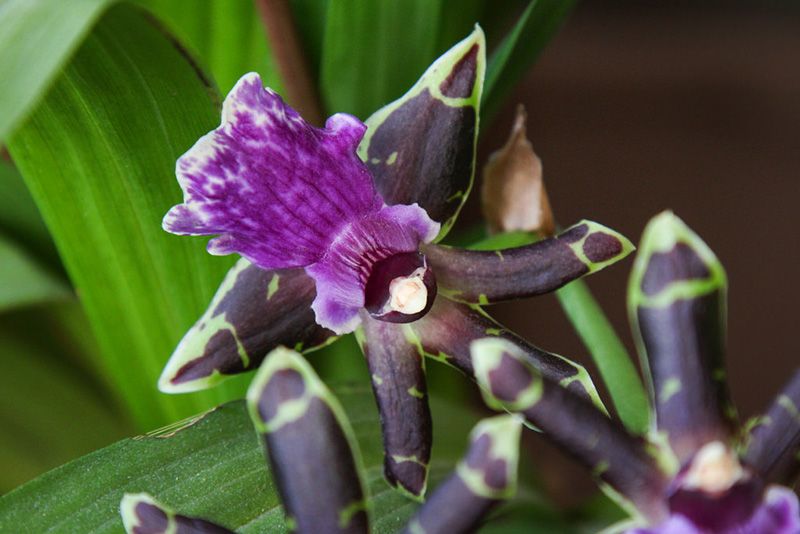
The plant has oblong leaves with pointed tips covered with longitudinal veins. During flowering, a stem up to 60 cm long forms, bearing an inflorescence of 12 buds (hybrid varieties have more). These open into large, intensely fragrant flowers. The inflorescences are typically variegated, with shades of purple and green flecked with white; solid-colored petals are rare. Flowering lasts up to 9 weeks.
The near-ground portion of the stem, the pseudobulb, is oval in shape and grows up to 6 cm in length. It is surrounded by lower leaf blades, which die off as the zygopetalum grows.
Types
There are 14 main varieties and numerous hybrids. Breeders are constantly developing new hybrid orchid combinations.
| View | Peculiarity |
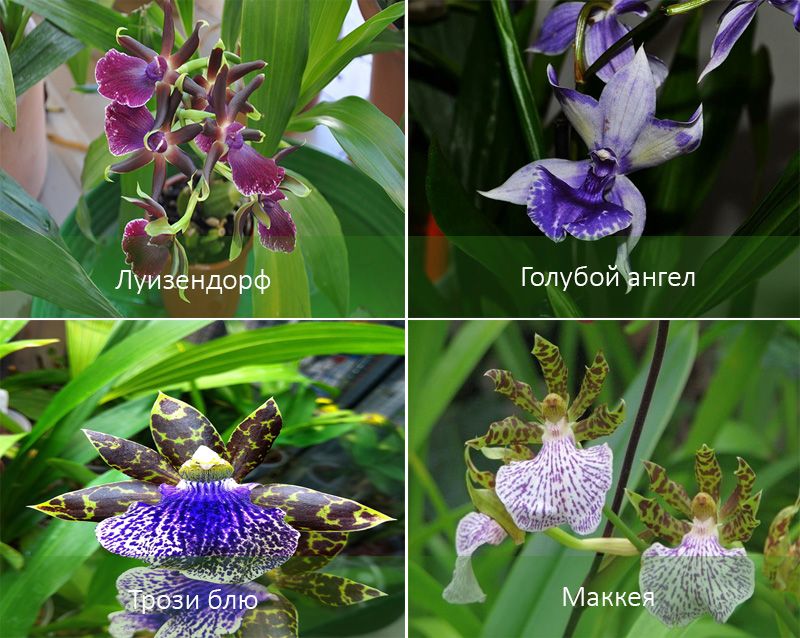
| Luisendorf | Prized for its strong, sweet aroma, it blooms for three months, with burgundy-brown petals and a green base. There are up to eight buds per stem. |
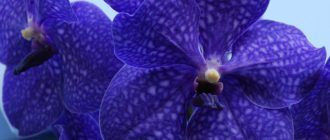
| Blue Angel | The flowers are blue with hints of lilac and splashes of cream. This variety is difficult to care for. The aroma is reminiscent of black pepper. |
| Trozi blue | The leaf blades are long, the flowers are yellow-blue or white with burgundy speckles. The petals are varied, ranging from thick to thin. |
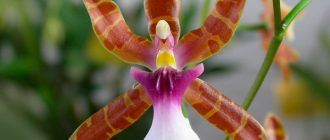
| Mackay | An epiphyte, vibrant throughout all seasons. The flowers are delicate, light green with brown speckles, and the lip is white with red spots. |
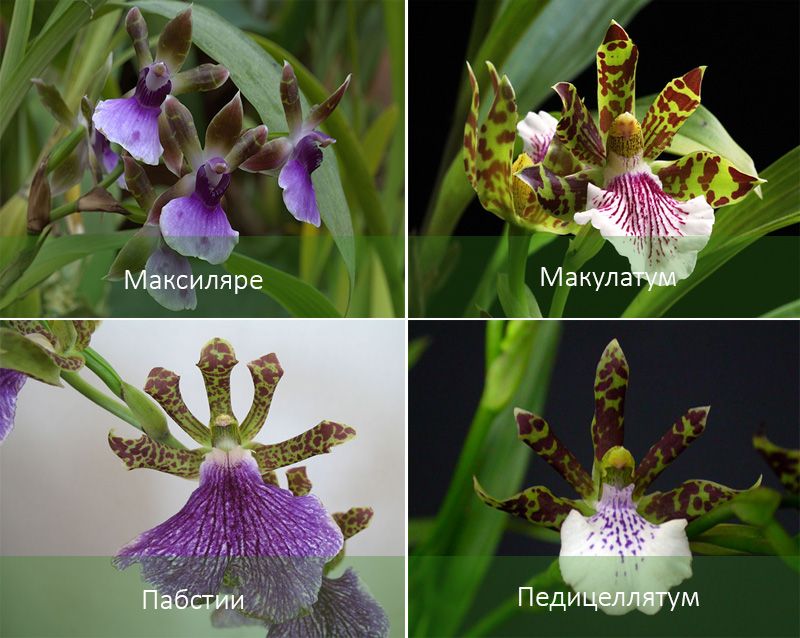
| Maxilyare | The inflorescences are brown with a green border, the lip turns into a purple or white shade. |
| Maculatum | The petals are light green with chocolate spots. The white lip is covered with purple strokes. |
| Pabstii | The largest variety, up to 90 cm in height. The buds are up to 10 cm in diameter. |
| Pedicellatum | It is distinguished by a narrow white lip covered with lilac specks. |
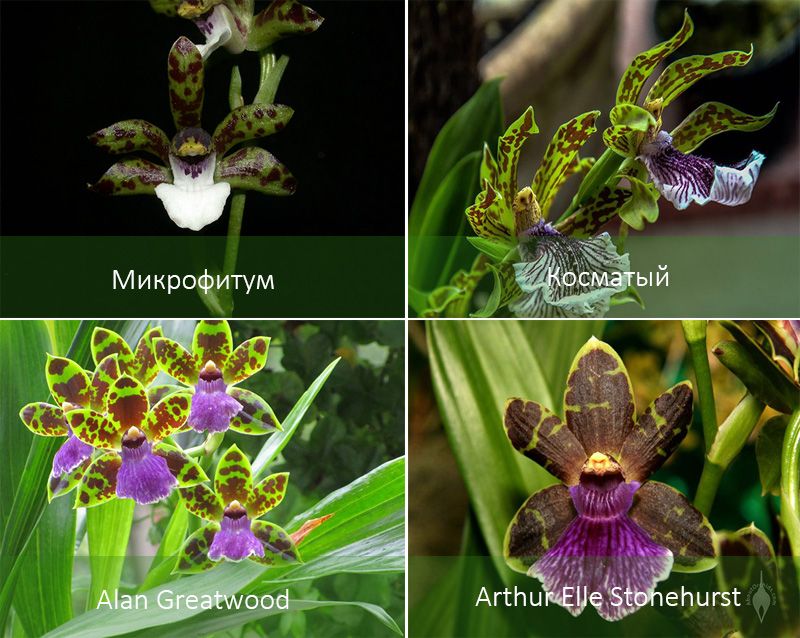
| Microphytum | Blooms longer than other varieties. Height no more than 25 cm. |
| Shaggy | The inflorescences are fragrant, with wavy, light-green petals. The lip is covered with longitudinal purple stripes. |
| Alan Greatwood | The buds are large and chocolate-colored. The lip is wide, purple at the base, white with purple speckles at the bottom. |
| Arthur Elle Stonehurst | The petals are dark cherry in color, and the lower part of the flower is burgundy with a white border. |
| Merlin's Magic | It is distinguished by its light green inflorescences with chocolate-colored merging spots. |
Caring for Zazygopetalum at home
| Conditions | Spring | Summer | Autumn | Winter |
| Lighting | Scattered, on the western window. | Keep away from windows (or shade). | South or west facing window, shade at the beginning of the season. | South window, turn on UV lamps if necessary. |
| Temperature | Daytime temperatures +20…+22 °C, nighttime temperatures +16…+18 °C | Daytime temperatures +24…+25 °C, nighttime temperatures +18…+19 °C | Daytime temperatures +18…+21 °C, nighttime temperatures +13…+16 °C | Daytime temperatures +18…+21 °C, nighttime temperatures +13…+16 °C |
| Humidity | 70-90% | Not less than 60%, use a steam generator. | 70-90%, while not allowing the temperature to drop (rotting is possible). | 60-90%, it is recommended to remove the pot from the radiator or place a container of water nearby. |
| Watering | Watering once every 1-2 days. | Morning spraying, daily watering. | Every 2-3 days. | As the top layer of soil dries out. |
| Top dressing | 1-2 times a week. | 2 times a week. | Once every 2 weeks. | Once a month. |
When watering, submerge the pot in water, as liquid can damage the orchid's leaves. Leave the pot in the water for 15 minutes, then lift it out and allow the excess to drain. The water should be warm, no colder than 18°C.
Regardless of the season, a warm shower twice a month is necessary. Nitrogen, potassium, and phosphorus fertilizers can be used for fertilizing.
Planting, replanting, pot, soil
The plant is demanding of its substrate; if poorly selected, it will grow slowly or rot at the roots. After purchasing, the zygopetalum should be repotted in more suitable soil.
The soil mixture for the flower should consist of the following components in the proportion 2:3:3:2:
- large fraction pine bark (bottom layer above expanded clay);
- medium-sized pine bark (top layer);
- peat (mix with medium pine bark);
- sphagnum moss (finely chop and add to both layers of substrate).
If we take a 1-liter pot as the basis for the calculation, to fill it you will need 200 ml of coarse bark, 300 ml each of peat and medium-sized bark, and 200 ml of moss.
You can use not only pine bark, but also any other coniferous tree bark (larch, spruce, cedar).
Since this orchid is prone to root rot, excess moisture must be removed. Charcoal is a good choice for this purpose. It should be added to the bottom layer of soil. A ready-made orchid soil mix can be used instead of the soil mix described above.
When planting, don't bury the plant deeply; the pseudobulbs should remain on the surface. They easily rot when buried in the soil. It's recommended to use a transparent pot to monitor the condition of the roots.
Repot no more than once a year, otherwise the plant will wilt. A new container will be needed when 3-5 new shoots appear or the root system becomes crowded. If a flower stalk begins to form, wait until the flowering period is over.
Flowering, dormant period
Zygopetalum blooms for two to three months. Sometimes, inflorescences fail to form, due to poor growing conditions or the plant's weakness. Flower stalks appear on new shoots when they are approximately half-grown. These shoots have not yet formed a pseudobulb.
When the petals fall off or dry out, trim the flower stalk. This begins the dormant period. During this time, the plant recovers, and it's important to provide it with the right conditions. Reduce watering and periodically mist the top layer of soil with warm water. Move the pot to a cooler room, with a temperature of 13 to 18°C. The average daily temperature fluctuation should be between 4 and 5°C. Once the flower sprouts, it can be returned to its previous conditions.
If a ground tuber has already formed at the base of the new shoots, you should not expect flowering this year.
Reproduction
Zygopetalum is propagated by division. Simply divide the rhizome and plant the resulting sections in different containers. Here's the exact procedure:
- Remove the rhizome from the soil and clean off any remaining substrate. You can rinse it with water, but be sure to dry it thoroughly afterwards.
- Remove dried or rotting roots.
- Divide the plant into several parts. Each separate part should have at least two pseudobulbs.
- Dry by dipping the flower into crushed charcoal.
- Replant the sections in sphagnum moss. Wait for new shoots to emerge, moistening the substrate daily.
Seed propagation is practiced only in industrial settings. Achieving proper seed germination at home is too difficult.
Errors and their elimination
Zygopetalum is a capricious plant; if not properly cared for at home, it can rot, dry out, or grow slowly. If spots or rotten areas appear on the leaves, immediate resuscitation is necessary.
| Problem | Cause | Solution |
| Flower stalks are not formed. | Weakened condition of the flower, excessive air heating, lack of sunlight. | Provide the plant with the correct dormant period. |
| Small, stunted buds. | Excessive sunlight, overheating. | Remove the pot from the windowsill, lower the air temperature to +20…+22 °C. |
| Yellowing of foliage. | Lack of moisture. | Monitor the condition of the substrate, moistening it as it dries out. Place a humidifier or containers of water near the plant. |
| The appearance of black spots on the leaves. | Excess fluid. | Stop waterlogging the soil. If rot is present, repot the zygopetalum in a new pot, removing any rotted roots. |
Diseases and pests, measures to control them
| Disease or pest | Description | Solution |
| Powdery mildew | A light coating on the leaves with a faint pinkish tint. | Apply Alirin or Quadris fungicides with a one-week break until the plaque disappears. Quadris is not recommended for use without protective measures. |
| Black rot | Dark spots that appear due to pests or excess nitrogen in the soil. | Get rid of the root cause of the disease, then add Trichodermin to the soil. |
| Gray mold | Brown spots on leaves, spreading from older parts of the plant to new growth. | Remove affected parts of the plant; if the soil is excessively wet, repot it in a new container. Treat with Trichodermin, Alirin, or Quadris. |
| Anthracnose | Dark spots that eventually become covered with pink mold. | Repot the plant in a new pot, removing any affected leaves. Do not water the plant for 2-3 days. Treat it with Quadris. |
| Snails and slugs | Holes in leaves due to outdoor or patio conditions. | Treat with Mesurol and take the plant back into the house. |
| Spider mite | Small cobwebs on the stems. | Hold the orchid under a warm shower and treat with Fitoverm. Repeat twice, 10 days apart. |
| Fusarium fungi | Clogged blood vessels, dehydration, and wilting of the flower. Yellowing of the leaf blade, softening of the rhizome. | Improve growing conditions: increase the temperature to 18–22°C, reduce watering, and change the substrate. Treat with Quadris every 10–12 days until the disease is completely eliminated. |