Porcini mushrooms are renowned for their excellent taste and numerous health benefits. But few people know that these mushrooms can not only be found in the forest but also grown in your own garden.
Content
- 1 Where can I grow porcini mushrooms?
- 2 Methods for growing porcini mushrooms
- 3 Features of preparing your own material (spores and tubular layer) for growing porcini mushrooms
- 4 Peculiarities of growing porcini mushrooms from purchased mycelium
- 5 Growing porcini mushrooms on a windowsill
- 6 Growing porcini mushrooms in your garden: 3 steps
- 7 How to Grow Porcini Mushrooms Indoors: A Step-by-Step Guide
- 7.1 Features of choosing a room for growing porcini mushrooms
- 7.2 Preparing a substrate for growing porcini mushrooms indoors
- 7.3 How to select high-quality planting material for growing porcini mushrooms indoors
- 7.4 Step-by-step instructions for planting porcini mushrooms indoors
- 7.5 Caring for porcini mushrooms in greenhouses
- 7.6 The correct method for harvesting porcini mushrooms in greenhouses
- 8 Growing Porcini Mushrooms as a Business: A Step-by-Step Guide + Income and Expenses
- 9 Tips from mushroom pickers on growing porcini mushrooms
Where can I grow porcini mushrooms?
For a long time, it was believed that mushrooms other than butter mushrooms, oyster mushrooms, and champignons could be grown at home, but they don't like artificial conditions. However, this is not true; growing boletus mushrooms is entirely possible both at home and commercially, provided all the necessary guidelines are followed.
Methods for growing porcini mushrooms
Porcini mushrooms are grown in artificial conditions in three main ways:
- industrial,
- at the summer cottage,
- on the windowsill.
Growing mushrooms on an industrial scale is the easiest, as this method requires resources and a dedicated facility. It was long believed that porcini mushrooms could not be grown artificially, until Dutch scientists refuted this hypothesis. The success of this method lies in the use of special mycelium bred for artificial cultivation. Wild mushrooms, from which spores can be harvested for further use, cannot grow without trees, unlike bred boletus species.
Special greenhouse structures with minimal light are built for cultivation. They are often located in basements. Maintaining the right humidity is crucial when growing mushrooms, so a sprinkler system and barrels of water should be installed throughout the area. Sawdust spread over the soil retains moisture well.
To grow mushrooms in your garden, you'll need suitable trees – oak, birch, pine, or spruce – then you can use the mycelium of forest white mushrooms.
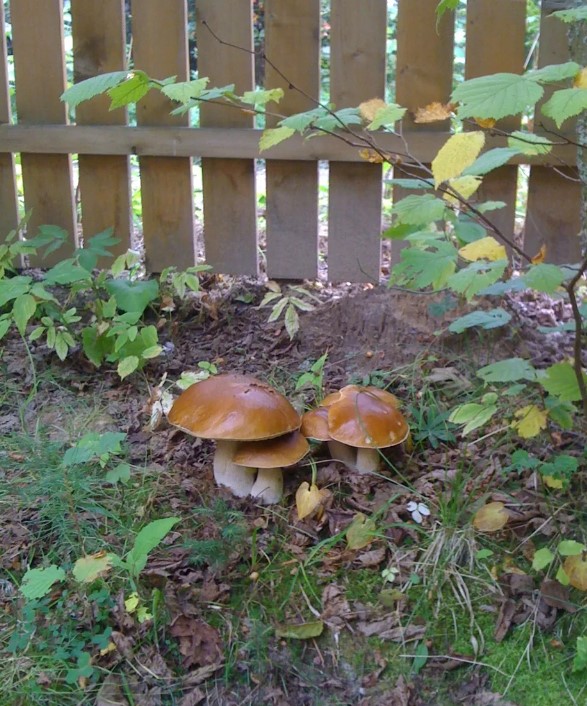
You can grow mushrooms on your windowsill if you take pre-grown mycelium from the forest and place it in flower boxes. White mushrooms produce best with lilies. Just protect the windowsill from direct sunlight, maintain humidity at 90%, and a temperature of 10 to 15 degrees Celsius.
Features of preparing your own material (spores and tubular layer) for growing porcini mushrooms
You can collect your own mycelium for growing porcini mushrooms. Large boletus mushrooms, even if they're old and wormy, are ideal for this purpose. Separate the 10 mushrooms into caps and stems; you'll only need the top portion.
Next, the nutrient medium is prepared:
- water – 10 l,
- 4 tbsp granulated sugar.
Add 2 kg of crushed mushroom caps to the solution and leave in a warm place for 24 hours. Then, crush the caps by hand, and strain the solution. This will serve as a spore reserve for the future mycelium. The strained mixture should not be discarded; it will serve as a platform for the mycelium.

Another way to prepare mycelium is to use the tubular layer. To do this, remove the lower layer of flesh from the cap, cut it into cubes, and dry it at the lowest temperature. Afterwards, you can plant them near the roots of trees, watering them thoroughly.
Peculiarities of growing porcini mushrooms from purchased mycelium
Purchased mycelium makes the task of growing porcini mushrooms much easier.
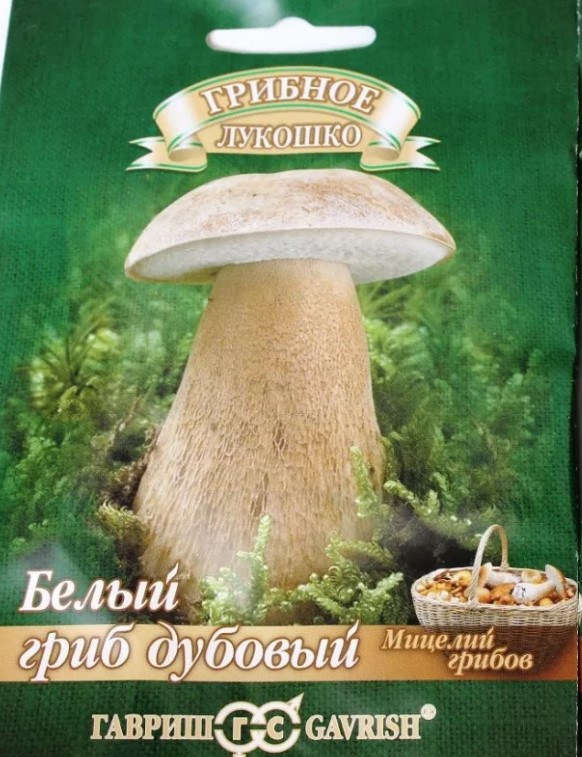
Planting mushrooms through ready-made mycelium is carried out as follows:
- A planting site is created near the roots of a suitable tree by removing the top layer of soil.
- A 5 cm layer of peat or specialized compost is placed into the hole.
- Mycelium is placed on top at a distance of 5-10 cm from each other.
- The mycelium is covered with the same soil that was removed earlier.
- Watering is carried out with a flow rate of 20 to 30 liters per tree.
- To retain moisture inside, you can mulch the mycelium with a 50 cm layer of straw.
For more information on the different types of porcini mushrooms, where and when to find them, and how to cook them, read the following articles:
Where porcini mushrooms grow, where to look for them, when to pick them + distribution map;
Growing porcini mushrooms on a windowsill
Under certain conditions, porcini mushrooms can be grown on a windowsill and produce a good harvest.
Conditions for growing porcini mushrooms on a windowsill
The most important requirement for mushrooms is humidity of at least 90%; otherwise, the mycelium will not grow. The temperature should be maintained at 10-15 degrees Celsius, avoiding sudden changes or fluctuations. The growing area should be protected from direct sunlight. These conditions are best achieved in a room not inhabited or on a balcony.
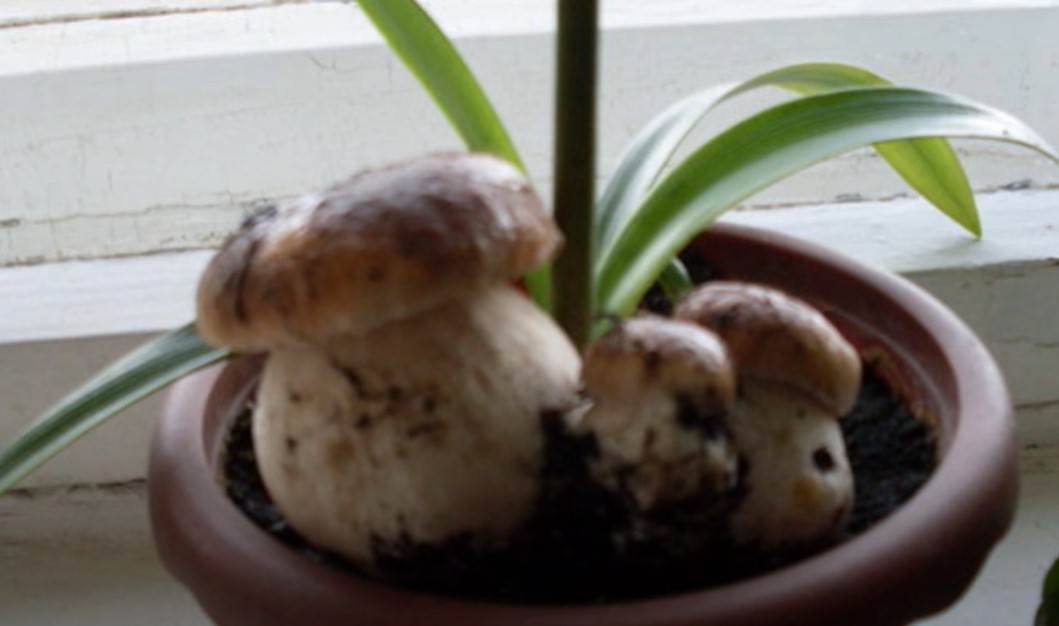
Step-by-step instructions for growing porcini mushrooms on a windowsill
Growing mushrooms on a windowsill is carried out in several stages:
- Planting the mycelium. The prepared mycelium is poured into a flowerpot or box containing flowers, preferably lilies.
- Watering. As the soil dries out, water the mycelium with warm water.
- To ensure mushrooms thrive, it's recommended to grow them in the same soil they grew in in the forest. If you're using homemade soil, be sure to add some chopped leaves and twigs from the forest mycelium. Steamed sawdust should also be mixed into this soil mixture, after which it should rot for a week.
Growing porcini mushrooms in your garden: 3 steps
The easiest way to grow porcini mushrooms is in areas where birch, oak, and other trees that boletus loves grow.
Preparing a site for planting porcini mushrooms
To grow porcini mushrooms in your garden, you need to find a suitable location protected from direct sunlight. Indoor mushrooms also require a partner tree, so the mycelium should be located near a birch, oak, pine, or spruce tree.
Planting mycelium
It's best to buy mycelium from a store, but you can also prepare it yourself. Before planting, carefully clear a 1.5-meter-diameter, 30-cm-deep hole near the chosen tree, being careful not to damage the roots. Line the bottom of the hole with fallen leaves and disinfected sawdust, then add a layer of soil from the mushroom forest. Next, place the mycelium in the hole at intervals of 30 cm, then cover it completely with the removed soil. Finally, water the mycelium using a watering can with a diffuser to avoid disturbing the mycelium.
In case of cold nights, you need to prepare sawdust and spruce branches to cover the mycelium and protect it from freezing.
Planting a spore solution
At home, many people use a spore solution for planting. The hole for the future mycelium is prepared as described above, but instead of store-bought mycelium, a slurry of caps is carefully placed on a layer of soil and watered with the spore solution.
Planting porcini mushrooms using a tubular layer.
A clearing for the future mycelium is made under the selected tree with which the porcini mushroom will form mycorrhiza. It's important not to damage the roots, but to slightly expose them. Next, a layer of forest leaves is placed there, and mycelium from the tubular layer is poured on top of them, planting at a depth of 3 cm. Regular watering is then necessary to ensure the mycelium develops comfortably.
How to Grow Porcini Mushrooms Indoors: A Step-by-Step Guide
You can grow porcini mushrooms at home not only outdoors but also indoors. Any sun-protected area of approximately 10 square meters is suitable.
Features of choosing a room for growing porcini mushrooms
Porcini mushrooms are sensitive to various microorganisms, so the chosen room must be carefully prepared. It's best if the floors are smooth, without seams or cracks, as this will make it easier to keep them sterile. Household linoleum or tile are suitable. The ceiling and walls can be covered with drywall, plywood, or simply plastered.
All surfaces in the room should be thoroughly disinfected, for example, with bleach or specialized disinfectants. This treatment should be repeated during the porcini mushroom growing season.
To ensure you enjoy a boletus harvest, you need to provide the following conditions for the mycelium:
- Humidity levels should be no lower than 40%. Humidifiers can be used to regulate humidity, but in small spaces, a spray bottle will suffice.
- Lighting should be artificial, with lamps turned on for 3-5 hours a day. Initially, until the mushrooms emerge from the surface, there's no need to turn on the lights. Only growing mushrooms require supplemental lighting.
- Air temperature between 18 and 28 degrees Celsius. A split system is best, but a high-quality gas heating system will also work, although it will be more difficult to regulate.
- Forced ventilation for oxygen supply. All ventilation openings should be located along the floor to minimize the amount of spores in the air.
- It is recommended to place mushrooms on metal shelves painted with antibacterial paint.
Preparing a substrate for growing porcini mushrooms indoors
In the wild, porcini mushrooms grow near certain tree species in loamy and sandy loam soils. To prepare a high-quality substrate, you will need:
- 4 parts calcined sand,
- 1 part clay,
- sawdust of maple, oak, aspen or birch,
- buckwheat pulp,
- corn cobs and stalks,
- cereal straw,
- sunflower seed husks.
All ingredients are crushed and poured with hot water (70-80 degrees Celsius). They should sit in this state for at least 3 hours, after which the substrate is strained and cooled. It is important that the mixture springs back when squeezed, rather than releasing moisture.
You can buy the soil mixture in a specialty store; the main thing is to check its freshness and the integrity of the packaging.
For growing, you can use plastic bags, wooden crates, or cardboard boxes. They are placed on shelves, spaced 5 cm apart. When placing the soil, wear sterile gloves. It's important to make holes in the containers to ensure natural ventilation.
How to select high-quality planting material for growing porcini mushrooms indoors
The mycelium yield and the success of porcini mushroom cultivation depend on the quality of the mycelium. Ideally, it is orange in color, without green or brown inclusions. A smell of ammonia or alcohol also indicates spoilage. There are two types of mycelium:
- Liquid. Unaffected by external influences, hermetically sealed, and has a long shelf life.
- Grain. Has a shorter shelf life but higher yield.
Consumption per 100 kg of soil mixture is:
- 500 ml liquid mycelium,
- 400 g grain mycelium.
Step-by-step instructions for planting porcini mushrooms indoors
Planting porcini mushrooms is carried out as follows:
- The substrate is laid out in containers.
- Liquid mycelium is poured from above, granular mycelium is added to a depth of 4 cm with an interval of 20 cm between holes.
- Place newspaper or cloth on top, periodically moistening it with water to maintain moisture. Avoid allowing a dry crust to form on the substrate.
- During this period, the temperature should be maintained between 18 and 28 degrees Celsius, but after 4 days, it is reduced to 10 degrees Celsius. After another 14 days, the substrate should be covered with a 3-4 cm layer of peat and chalk (9:1).
Caring for porcini mushrooms in greenhouses
The appearance of thin white threads on the surface will indicate normal mycelial development. At this point, you can begin ventilating the room twice a day. Lighting should be no more than 5 hours, which is sufficient. Humidity should be maintained at 95%, and the air temperature at 18-20 degrees Celsius. To prevent the substrate from drying out, periodically add a small amount of peat on top.
The correct method for harvesting porcini mushrooms in greenhouses
The first mushrooms can be harvested within 3-4 months after planting the mycelium. The boletus is carefully unscrewed from the soil, the remaining hole is covered with soil, and lightly watered. With proper care and harvesting, fruiting will last up to 5 months. The yield per square meter can reach 20 kg.
Growing Porcini Mushrooms as a Business: A Step-by-Step Guide + Income and Expenses
It's generally believed that only oyster mushrooms and button mushrooms can generate income, but recently, growing white mushrooms has become increasingly popular. They are valued higher both financially and for their taste.
Starting a business growing porcini mushrooms
Before starting a mushroom business, there are many nuances to consider:
- current legislation, GOSTs, codes;
- cost of equipment and rent;
- possible risks;
- the need for workers and the costs of paying them;
- phytosanitary requirements for the growing site;
- the feasibility of the undertaking based on the existing conditions;
- possibility of storage, marketing, processing;
- advertising.
Business plan and idea evaluation
Growing porcini mushrooms has its undeniable advantages: there's little competition, the price is quite high, especially if you're selling to restaurants, and the costs are low. But this only applies to outdoor cultivation.
Below we will consider the costs and productivity of growing porcini mushrooms.
Is registration required when growing porcini mushrooms?
To legalize your mushroom business, simply become a sole proprietor and complete all the necessary paperwork. You can also try participating in a federal program by registering as a peasant farm. This option is only suitable for those living in rural areas.
All that remains is to pay the state fee, fill out the application, and wait three business days. If you plan to sell the mushrooms to other legal entities, you will also need to complete the following documents:
- phytosanitary certificate,
- declarations of conformity with the requirements of GOST 51074-2003, 52467-2005.
Premises and equipment
If a suitable plot of land isn't available, a suitable building must be found for the mushrooms. The further it is located from the house, the better. It's virtually impossible to grow porcini mushrooms on an industrial scale in existing basements or cellars. Therefore, a separate building will have to be constructed for them. It's best to have two rooms: one for mycelium production and one for cultivation.
Setting up a 120 square meter space will cost approximately 500,000 rubles. This includes finishing, paneling, and cleaning. Another 200,000 rubles will be needed for equipment (split air conditioners, steam generators, lighting, heaters, humidifiers, and maintenance tools). Another 5,000 rubles will be spent on registration, along with supplies and an agronomist's services. A good estimate for other expenses is at least 30,000 rubles. Therefore, growing mushrooms at home for commercial purposes will cost approximately 750,000 rubles, not including planting material, which will cost at least 1 million rubles.
Planting and care
When choosing planting material, it's important to understand that porcini mushrooms grow under different types of trees. You should choose based on the specific trees growing in your area.
It is best to use ready-made mycelium, which is sold in specialized stores.
The substrate also needs to be special; it's recommended to consult an agronomist to create it. A ready-made mixture is also available, although this increases the cost of the growing process.
The substrate is packed into 30 kg bags. The mycelium consumption is 900 g per bag. It is placed in a staggered pattern through pre-dug holes, spaced 15 cm apart. The bags are either hung around the room or placed on racks.
From planting to harvest, there are 3 stages of mycelium development:
- IncubationDuring this time, mycelium actively develops and spreads throughout the substrate. The air temperature should be maintained at 25 degrees Celsius, and the humidity should be no lower than 90%.
- HeightThe growing season lasts 3-4 weeks. The air temperature should be lowered to 16 degrees Celsius, humidity maintained at the same level, and lamps should be turned on for 6 hours a day.
- FruitingAll mushrooms, regardless of size, should be picked immediately. They are cleaned of soil and debris and placed in containers for sale.
During this time, it's important to ensure the substrate doesn't dry out and the humidity doesn't drop. After harvesting the boletus mushrooms, disinfect the area, then reintroduce the mycelium.
Features of harvesting and marketing
It takes 2-3 months from the time the mycelium is planted until the first harvest. The mushrooms are cut from the bag. This must be done at the same time for all the boletus mushrooms, otherwise the mycelium productivity will be significantly reduced. By the time they ripen, you need to have customers and think through distribution channels, as porcini mushrooms don't have a long shelf life.
There are several options for where and to whom you can sell your harvest:
- Restaurants are the most profitable clients; they pay well and receive orders constantly. However, quality certificates are required for cooperation.
- Resellers pay less, but do not require additional paperwork.
- Market – you will have to spend money on renting a space and stand behind the counter yourself.
- Social media and advertising – you can find regular customers if you regularly post ads and provide advertising.
Expenses and income
As mentioned above, to launch a business idea you will need the following expenses:
- renovation and arrangement of premises – 500,000 rubles,
- purchase of equipment – 200,000 rubles,
- registration – 5,000 rubles,
- agronomist services – 5,000 rubles,
- work clothes – 5,000 rubles,
- other expenses – 30,000 rubles.
In addition to this, there are annual costs:
- purchase of mycelium – 1,200,000 rubles,
- substrate – 40,000 rubles,
- bags – 10,000 rubles,
- solutions – 5,000 rubles,
- advertising and fuel and lubricants – 20,000 rubles,
- taxes and documentation – 50,000 rubles,
- utility costs – 90,000 rubles,
- other expenses – 10,000 rubles.
Considering that one bag yields approximately 10 kg of porcini mushrooms, a 120 square meter area yields 6,000 kg per year. The cost per kg hovers around 300 rubles. This translates to an annual income of 1,800,000 rubles. Accordingly, after all the calculations are completed, the net profit will be 370,000 rubles, with breakeven expected in two years of operation, representing a business profitability of 20%.
Thus, the business idea of growing porcini mushrooms is quite viable if you approach this issue competently and responsibly.
Tips from mushroom pickers on growing porcini mushrooms
Here are some ways to grow noble mushrooms: There are three ways to cultivate porcini mushrooms in your garden. The first (the simplest, but the least effective): Within a 1.5-meter radius from birch tree trunks, place pieces of ripe boletus mushrooms under leaf litter, compact the soil, and water with room-temperature water.
After 3-4 days, remove the mushroom pieces and moisten the area where they were. Second (spore release): Place the old boletus mushrooms in a bucket and fill it with pre-prepared well or rainwater. Keep the mushrooms in this state for several days at room temperature. During this time, the mushrooms will disintegrate into threads. Stir the resulting mixture and water the area of the garden designated for growing boletus mushrooms.
Using mycelium (spawn): Dig up mushrooms in the forest along with thin layers of soil and transfer them to the site. Be careful not to disturb the soil when transferring them. Plant the spawn immediately, preventing it from drying out. To do this, dig a hole of appropriate size under the chosen tree and transfer the mushroom layers into it. Plant the forest spawn in the morning or evening. The optimal planting season is considered to be late summer and early fall, when it is still warm and the soil is sufficiently moist. After planting, water the spawn for the first few days, preferably with rainwater.
Watering is necessary even in damp weather. If all goes well, boletus mushrooms will appear in the garden the following year. They will grow at the same time of year as their wild counterparts. To maintain the fertility of the mushroom plot, you can sow spores there each year or bring new mushroom beds from the forest.
Aspen mushrooms, birch boletes, saffron milk caps and butter mushrooms are grown in a similar manner.
There are, of course, some specific factors. Lighting conditions and tree species with which, as noted below, the mushrooms form mycorrhiza. Regarding grass, it's not the mushrooms that compete with the grass. Both mushrooms and grass depend on a third factor: soil acidity and microflora. The herbaceous plant species are merely an indicator, as mushroom pickers have noted. This is especially true for certain fern species and European asarum—they thrive in acidic soils.
Pears, plums, and apple trees belong to the same family, Rosaceae. They are closely related, and their impact on the soil is similar. Porcini mushrooms can grow under these trees if the litter is rich and you don't rigorously clear away the leaves every year. The dense canopy of the trees provides the necessary light and moisture conditions for porcini mushrooms.
I was planning to start growing porcini mushrooms at my dacha, so I read a lot and looked at all sorts of information. And my mushrooms sprouted, you could say, unexpectedly and spontaneously))). And this, you could say, is the third method. It turns out you can grow porcini mushrooms this way too. My wife and I went to the dacha and bought some porcini mushrooms on the way.
My wife was cleaning mushrooms outside near our house (we have an outdoor water supply there). Afterwards, she poured the peelings, small pieces of stems, and cap trimmings along with the water under the nearby plum and cherry trees. Since these trees are located near the water supply, we water them this way quite often.
We wouldn't have even thought about it if our first mushrooms hadn't appeared this year. We arrived at the dacha, and there we had a whole bed of mushrooms! After such a successful experiment, we now (consciously) poured the water with the mushroom peelings under the neighboring trees. We've expanded the beds, so to speak. And we've even gained some excitement!
A friend of mine's father-in-law regularly scattered wormy porcini mushrooms under the birch trees near his bathhouse on his property. It wasn't the first time, but some porcini mushrooms appeared under the birch trees.
The porcini mushroom is a mycorrhizal fungus, meaning its mycelium grows together with nearby trees, forming a complex symbiosis. Therefore, growing porcini mushrooms indoors is impossible. However, with some effort, they can be grown in your own garden plot where there are trees. And this would only be a seasonal cultivation.
Growing porcini mushrooms is a laborious undertaking that requires experience and a certain amount of investment. It's not attractive as a business. It's more profitable to earn money in other ways. It's worth trying as an experiment, but what's the point? Last summer, my brother and I collected over 300 boletus mushrooms in a three-hour walk?
I read an article about growing porcini mushrooms in the magazine "Young Naturalist" a long time ago. So, I tried it right away. It suggested collecting overgrown porcini caps, crushing them, soaking them in water, adding three lumps of sugar per bucket of water, and pouring it all into the furrows I'd dug under the trees. I had trees on my property, so I followed the instructions, applied them, and watered them. Nothing grew. Apparently, it wasn't the climate that was to blame.
Porcini mushrooms are generally capricious; even in nature, they don't grow everywhere, only where conditions are ideal. Mistakes in maintaining temperature and humidity could have occurred, even when following the instructions precisely.
First, prepare the area: remove the sod, add compost or peat, then mycelium, followed by fertile soil. For warmth, add a thick layer of straw. Add Baikal EM-1 to the water.
By the way, I forgot to mention that it's best to choose a planting site around a living tree, preferably a pine or spruce. Remove the sod around the tree so that it's centered. And don't buy mycelium from someone, but from reputable stores that specialize in mushrooms.
Try growing honey mushrooms, saffron milk caps, or milk mushrooms—they're less demanding in terms of soil and growing conditions. Afterwards, sow porcini mushrooms in the same area. It's also best to sow them in the fall, after the first drop in temperature.
Of course, it's best to choose planting sites under living trees, preferably young ones (no older than 10 years). It's also a good idea to treat the planting site with a tanning solution (black tea, oak bark infusion).