Streptocarpus is a creeping plant distinguished by abundant blooms and unique inflorescences resembling an elongated bell. It belongs to the Gesneriad family and is closely related to African violets. However, compared to African violets, it is more resilient and easy to care for, which makes it a popular choice among gardeners and hobbyists.
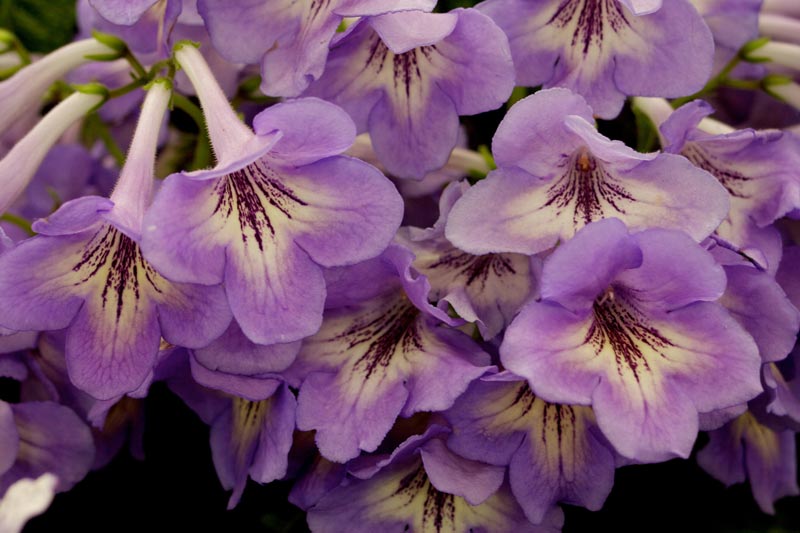
Description of Streptocarpus
In the wild, streptocarpus occurs as epiphytes or lithophytes, growing on other plants or on rock surfaces. They were first discovered by James Bowie in 1818 in the subtropical mountains of the Cape Province in southern Africa, hence the name "Cape primrose."
They are often confused with indoor violets due to their similar structure:
- a branched fibrous rhizome is located in the upper soil layer and turns into a thickening without a stem;
- at the base begins a rosette of oval leaves with a wavy, slightly velvety surface;
- in the axils of each leaf there are inflorescences consisting of several tubular buds;
- the flower has five petals of a certain color and reaches 2-10 cm in diameter;
- As a result of pollination, it produces a fruit in the form of a twisted pod containing a large number of seeds inside.
Also read the article about indoor violet or Saintpaulia.
There are several types of streptocarpus:
- Polyphyllous plants are stemless, with a rosette of two or more leaves at the base. They are always perennial and are the most common and popular in indoor gardening.
- Unifoliate – with a single leaf growing directly from the root, often quite large. Some are monocarpic, dying immediately after flowering and seed set. Perennial species produce a new leaf blade immediately after the old one dies.
- Stem plants are distinguished by their distinct, flexible stems with a rough surface. They spread along the ground and produce profuse bushes, producing small flowers.
They begin to bloom from April until late autumn, but with proper care they can delight you with lush buds at any time of the year.
Types and varieties of streptocarpus
Streptocarpus is divided into many subspecies, differing in shape, texture, and color of leaves and inflorescences. Natural cultivars have blue or purple buds, while hybrids have various variations.
| Type/variety | Leaves | Flowers |
| Natural | ||
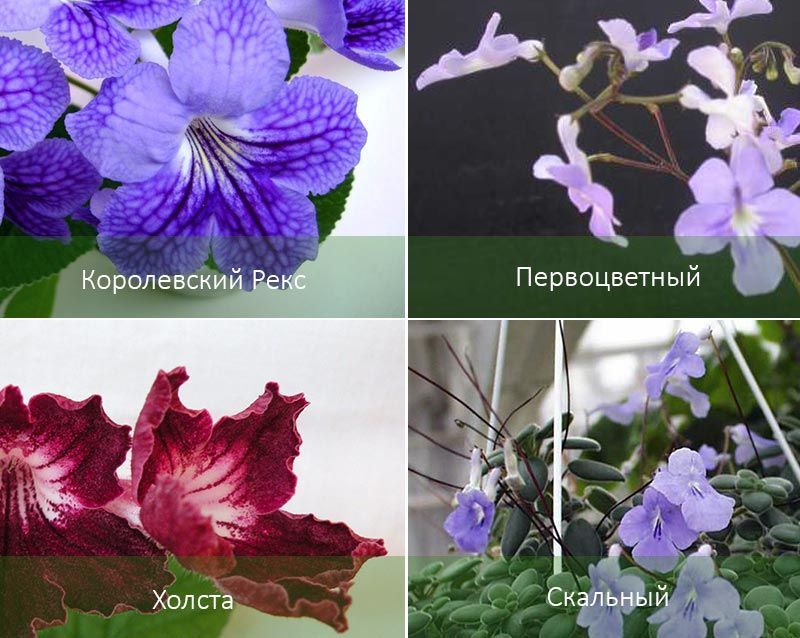
| Rex, royal (rexii) | Pubescent, light green in color, up to 25 cm by 5 cm, collected in a rosette. | Lilac with purple stripes inside, often patterned. Up to 2.5 cm in diameter, they protrude 20 cm above the ground. |
| Rock (saxorum) | Light-colored, 25 x 30 mm, oval, and sparsely hairy, they are borne on flexible stems up to 45 cm long. | A delicate purple hue with a snow-white center. Larger than the leaves, they bloom in clusters on 7-cm-long stems. |
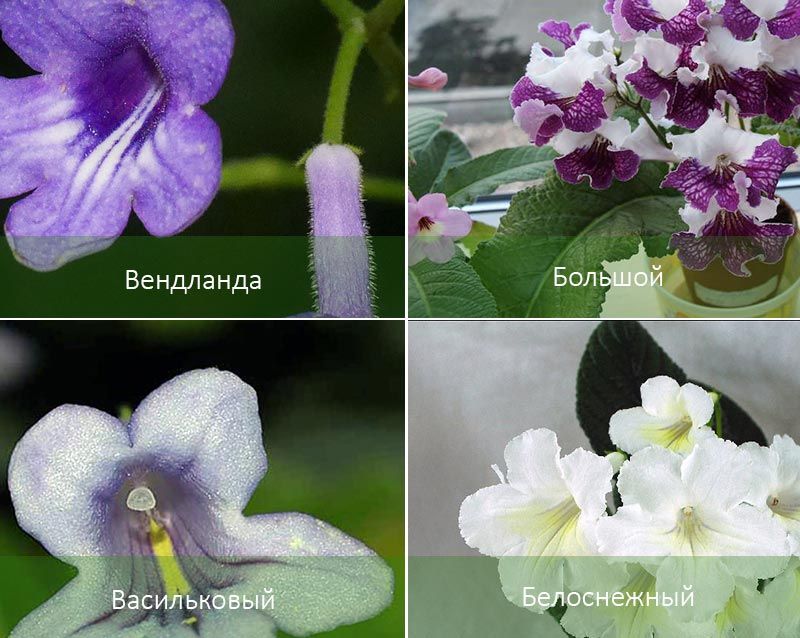
| Wendland (wendlandii) | The only one, reaching 60 by 90 cm, is purple underneath. It dies after flowering in the second year of life. | Funnel-shaped, blue-violet, and dark-veined inside, they reach up to 5 cm in diameter. They are arranged in groups of 15-20 on uncoiled, fern-like stems. |
| Snow-white (candidus) | Wrinkled, dark green, up to 15 x 45 cm in size. | Numerous, white, with cream or yellowish spots and purple lines. 25 mm long. |
| Large (grandis) | One, reaches 0.3 by 0.4 m. | At the top of the stem, up to 0.5 m long, is a racemose inflorescence. The flower is pale purple with a dark throat and a white lower lip. |
| Cornflower (cyaneus) | Rosette, light green. | Violet-pink, with a yellow center and purple stripes. Two buds per stem up to 15 cm tall. |
| Primrose (polyanthus) | The only one, velvety, up to 0.3 m long, covered with white pile. | Pale lavender-blue with a yellow center, up to 4 cm in size, shaped like a keyhole. |
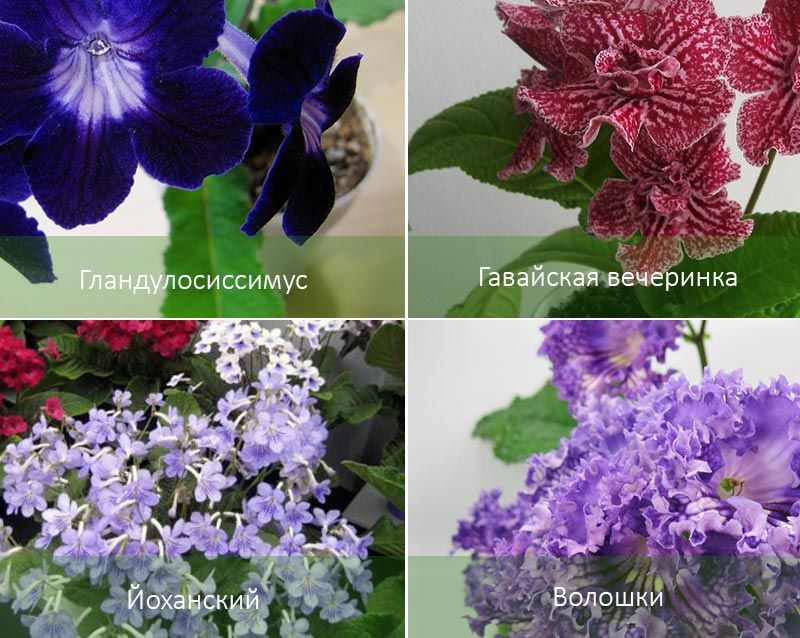
| Johannis | Green, fuzzy, 10 x 45 cm. Grow in a rosette. | Small, up to 18 mm long. Bluish-purple with a light center. Up to 30 on a straight stem. |
| Canvas (holstii) | The fleshy and flexible shoots reach half a meter, with oppositely arranged wrinkled leaves, 40-50 mm each. | Purple, with a white corolla tube, about 2.5-3 cm in diameter. |
| Glandulosissimus (glandulosissimus) |
Dark green, oval. | Flowers range in shades from dark blue to purple. They are located on a peduncle up to 15 cm long. |
|
Primrose-leaved (primulifolius) |
Wrinkled, covered with sparse hairs. | No more than 4 pieces on a 25 cm stem. Color from white to pale purple, with dots and stripes. |
| Dunn (dunni) | The single leaf is densely pubescent, with virtually no petiole. | Copper-red, downward-drooping flowers are located on a 25 cm stem. They bloom for a short time (mid- to late summer). |
| Pickaxe (kirkii) | Small, 5 cm long and 2.5–3 cm wide. | The low inflorescence, no higher than 15 cm, has the shape of an umbrella and is pale lilac in color. |
| Hybrid | ||
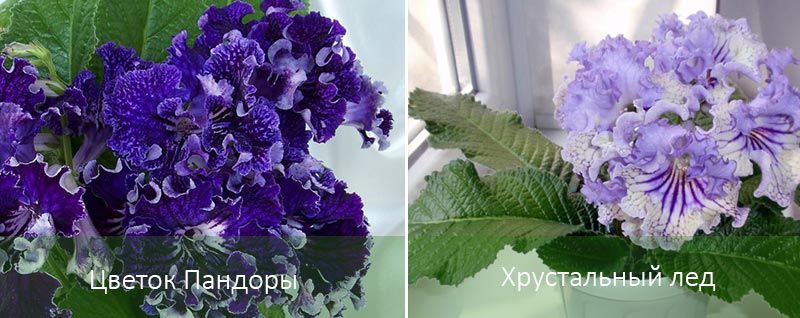
| Crystal Ice | Dark green, narrow and long. | Light-colored with blue-violet veins, blooming all year round. |
| Albatross | Dark, round and small. | Snow-white, on tall stems. |
| Corps de ballet (Chorus Line) | Green, elongated. | Terry, with light purple veins on white. |
| Hairy lice | A rosette of several long leaves. | Lilac with dark stripes and veins, serrated edges of petals. |
| Black swan | Oval, light green. | Velvety, dark purple, tinged with black purple and ruffled edges, up to 8-9 cm long. |
| Waterfall | Serrated edges, velvety base, small and elongated. | The upper petals are violet and wavy, while the lower ones have purple veins and texture. About 7-8 cm in diameter, up to 10 petals per stem. |
| Hawaiian party | Elongated, lowered to the ground. | Double, pinkish flowers with a wine-red mesh and speckles. 5-6 cm each, on a long stem. |
| Margarita | Turned down, fuzzy, with wavy edges. | Huge, up to 10 cm, of a deep wine shade and with large frills. |
| Pandora flower | Rosette, large. | Purple with dark stripes and a thin light border, with large waves of petals. |
Caring for streptocarpus at home
The Cape primrose is a less demanding plant than the houseplant. Caring for it indoors involves choosing the optimal location and ensuring adequate air and soil humidity.
| Factor | Time of year | |
| Spring/summer | Autumn/Winter | |
| Location/lighting | Bright, diffused light is essential, but avoid direct sunlight. Place the plant on windows, balconies, or loggias facing west or east. | Place the pot closer to the south. If daylight is insufficient, use fluorescent or phytolamps to extend daylight to 14 hours. |
| Temperature | Optimal temperature is +20…+27 °C. Avoid extreme heat, ventilate rooms frequently. | Beginning in October, gradually lower the temperature. The acceptable range is +14…+18 °C. |
| Humidity | About 65–70%. Regularly spray water around the area; you can use a humidifier, damp moss, or coconut fiber in the tray. After showering in the summer, dry only in the shade. | Water no more than once a week. Avoid getting flowers and leaves wet. Keep away from heating appliances that dry out the air. |
| Watering | Water around the edge of the pot every 2-3 days, draining the water from the tray after an hour. Avoid pouring water directly onto the plant. Allow the soil to dry 2-4 cm between waterings. Use purified or settled water at room temperature. | Reduce the soil in mid-autumn. Just make sure the substrate doesn't dry out (turning reddish) and doesn't become waterlogged. |
With proper care, growing the Cape primrose will yield lush blooms. Most subspecies bloom in mid-spring, but there are exceptions, including varieties that bloom year-round.
Wilted flowers should be carefully removed with a sharp knife, as should dried leaves. This will stimulate renewal.
Planting and replanting Cape primrose
Most streptocarpus are perennials. Maintaining their blooming and healthy appearance requires not only proper care but also regular repotting.
Before beginning the process, it's important to select a suitable container and soil. Experienced gardeners, who have been growing for years, prefer to create their own soil mixture. Avoid acidic substrates and instead use the following mixtures:
- peat, leaf soil, perlite or vermiculite and chopped sphagnum moss (2:1:0.5:0.5);
- leaf soil, humus and peat crumbs 3:1:2 are used with crushed birch charcoal (about 20 g per 1 liter of soil);
- pure peat will require frequent watering, but with vermiculite in a 1:1 ratio this can be avoided;
- Leaf manure, coarse sand and fertile turf 2:1:3 is suitable for mature flowers.
The pot should be wide and shallow, based on the size of the plant. It's important to remember that the rhizomes are branched and located on the surface. When repotting streptocarpus, choose a container 2-3 cm wider than the previous one. Place 2 cm of expanded clay, red brick chips, or any drainage material at the bottom to facilitate drainage.
Top dressing
Fertilizing the soil is equally important for the health of streptocarpus. It's best to fertilize it weekly:
- at the beginning of spring, start adding nitrogenous substances to the water when watering for the growth of greenery (Uniflor-rost);
- During the flowering period, choose preparations with phosphorus and potassium to maintain the beauty of the buds (Uniflor-bud).
It's best to halve the dosages indicated on the packaging to avoid overdosing. When applied correctly, the plant's immunity is boosted, its growth and flowering time are extended.
Propagation of streptocarpus
Their reproduction occurs in the following ways:
- From seed. This method is often used to produce new hybrids. Scatter the seed over the soil, moisten it, and cover with plastic wrap. Create a greenhouse-like environment, place the pot in a warm spot, and ventilate the plantings twice a day for 20 minutes, wiping away any condensation. After two weeks, when the seedlings emerge, increase the ventilation time, and replant after the leaves appear.
- Using a leaf cutting. Fill a glass with purified or rainwater. Sprinkle the leaf cut end with crushed activated charcoal and lower it into the water to a depth of 1-1.5 cm. When roots appear, in about 7 days, begin planting.
- From leaf blade sections. Remove the central vein and plant both halves in the substrate to a depth of 5 mm. Moisten the soil, cover with plastic, and ventilate. After a couple of months, when small rosettes emerge, they can be transplanted. This will produce more plants.
- Dividing the bush. This is suitable for mature plants 2-3 years old. In spring, the rhizomes should be removed from the soil and divided into sections, being careful not to damage them. Trim any runners with a knife, treating the cuts with crushed activated charcoal. Plant the separated "babies" and cover them with transparent material for a few days.
Problems with growing streptocarpus, pests, diseases
Growing Cape primrose can be marked by a number of problems, the appearance of which negatively affects its condition.
| Manifestation | Reasons | Elimination measures |
| Withering | Lack of humidity. | Timely watering. |
| Yellow and falling leaves | Lack of nutrients. | Top dressing with complex fertilizers. |
| Lack of flowering, pale color and reduction in size | Lack of light, improper conditions. | Providing proper lighting, temperature, change of location. |
| A tight pot. | Transplantation with division of the rhizome. | |
| Abundant watering. | Reduce the frequency of watering, you need to let the soil dry out. | |
| Drying of leaf tips and buds | Dry air. | Spraying water around the flower. |
| There is not enough space in the pot. | Transfer. | |
| Rusty coating | Heavy watering. | Less frequent watering. |
| Excessive concentration of nutrients. | Planting in a peat medium, fertilizing once every 2 weeks. | |
| Small leaves instead of flowers | Lack of light. | Improved lighting, up to 14 hours a day. |
| Black petioles | Lots of moisture and cool. | Warm place, less frequent watering, the soil needs to dry out. |
| Blurred yellow or colorless spots | Burn caused by exposure to direct sunlight. | Remove from the sunny side and move to windows with diffused light. |
It's important to know the main pathogens that cause various streptocarpus diseases. Understanding the cause will help with further treatment and restoration of the plant.
| Disease/pest | Manifestation | Elimination measures |
| Root rot | Brown fungal spots on leaves, black slimy roots. | Remove from the container, wash the roots, and trim off any discolored parts. Soak the remaining plant in 0.25 g of manganese per liter of liquid. Replant in a container with new substrate. Water for 4 months with a 0.5% solution of Skor, Bayleton, or Maxim. |
| Gray mold | Light brown, fluffy spots that become covered with a light gray coating. They appear in damp and cool conditions. | Remove damaged parts and sprinkle the cuts with charcoal, chalk, or cinnamon powder. Apply a diluted 0.2% solution of Fundazol or Topsin-M. If there is no effect, apply Horus or Teldor 2-3 times (according to the instructions). |
| Powdery mildew | Whitish spots on leaves, flowers and stems. | Remove the plaque with a brush dipped in a soda solution, trim off any severely damaged areas, and sprinkle with wood ash. Water the soil with Benlate or Fundazol. Repeat the treatment after a week, and then add a weak solution of potassium permanganate for up to three weeks. |
| Thrips | Silvery lines on the underside of the leaf, light spots and small black sticks. | Remove all corollas and infected leaves. Wipe the remaining material and spray the soil with Aktara, Spintor, or Karate, and then spray 2-3 more times a week. Wrap the plant in plastic for a couple of days, allowing it to air out. |
| Spider mite | Almost transparent webs, with spots of them on the reverse side. | Water thoroughly and leave for a couple of days under plastic wrap next to a container of chopped onions, garlic, or turpentine. If that doesn't help, treat the plant 3-4 times with Fitoverm, Apollo, or Omite, alternating the treatments. |
| Scale insect | Spots of varying shades of brown along the veins on the underside of the leaf blade. Over time, they enlarge and turn red. | Coat each growth with oil, acetic acid, or kerosene, and remove the insects after a few hours. Apply an onion paste to the affected areas. Water the soil a couple of times a week with a solution of Admiral, Fufanon, or Permethrin. |
| Whitefly | It looks like a small moth, lives on the underside of a leaf and flies off when touched. | Use sticky tape and insect repellent. Replace the top couple of centimeters of the substrate. Spray the soil with pepper, tobacco, or mustard infusion. Alternatively, try Fitoverm, Bitoxibacillin, or Bankol. |
| Aphid | Small green insects, sticky coating on the plant and deformation of its individual parts. | Clean aphids from surfaces with a brush or cotton wool. Place dried orange peels and herbs on the soil. Alternatively, use Biotlin, Fury, or Iskra-Bio. |
| Weevil | Wingless small black beetles eat leaves starting from the edges. | Treat with Fitoverm, Akarin, Actellic or another insecticidal preparation, and repeat after a week. |
Therefore, at the first sign of disease, it's important to carefully examine the plant for pests. If pests are present, isolate the diseased streptocarpus from uninfected plants. As a preventative measure, they can be treated with Fitoverm, following the instructions.