Many people prefer pink tomatoes. This is due to their meaty, juicy flesh and sweet flavor. The first-generation hybrid Pink Spam is one of these tomatoes.
Northern, Northwestern, Central, Volga-Vyatka, Central Black Earth, North Caucasian, Middle Volga. Inclusion in the register
Disease resistance
Verticillium, fusarium, cladosporiosis, TMV.
Agricultural technology
Pinching out side shoots, garter, shaping.
Growing regions
Any.
2010
Originator
OOO SEMKO-JUNIOR
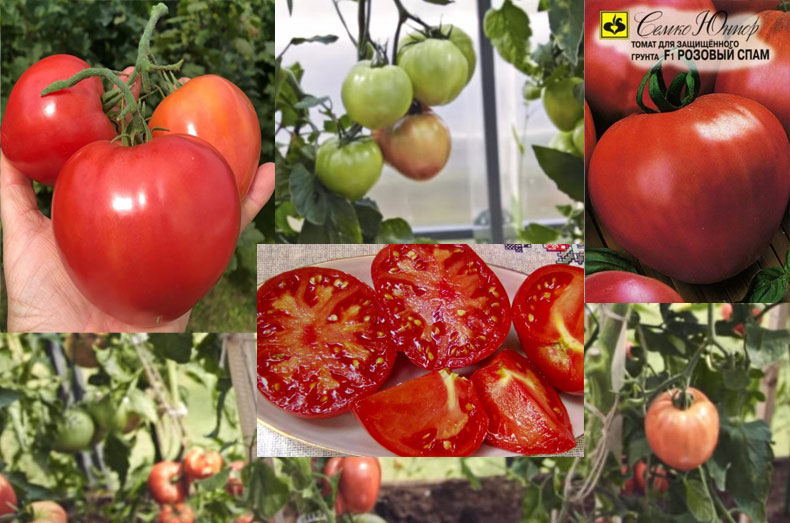
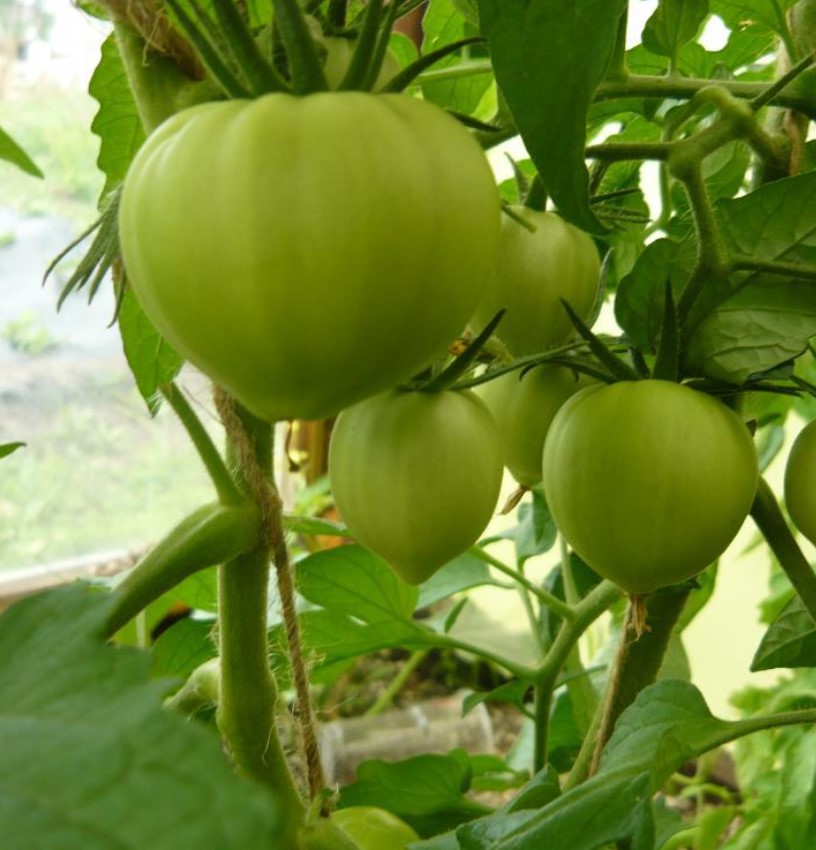
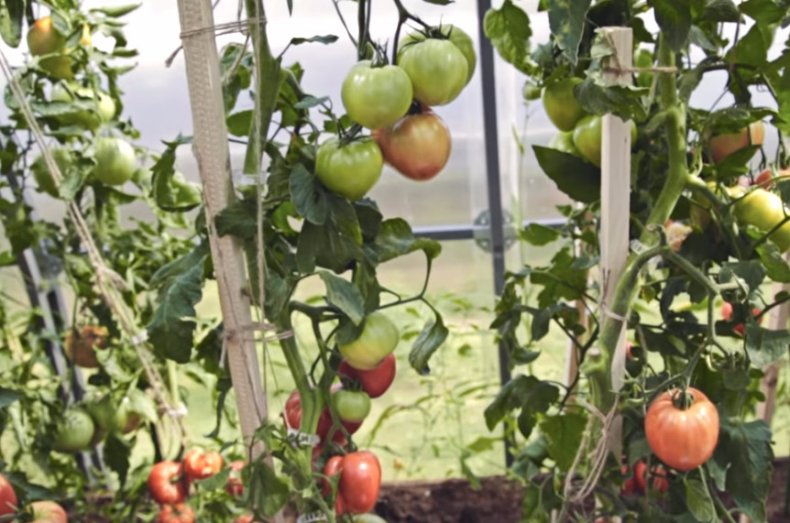
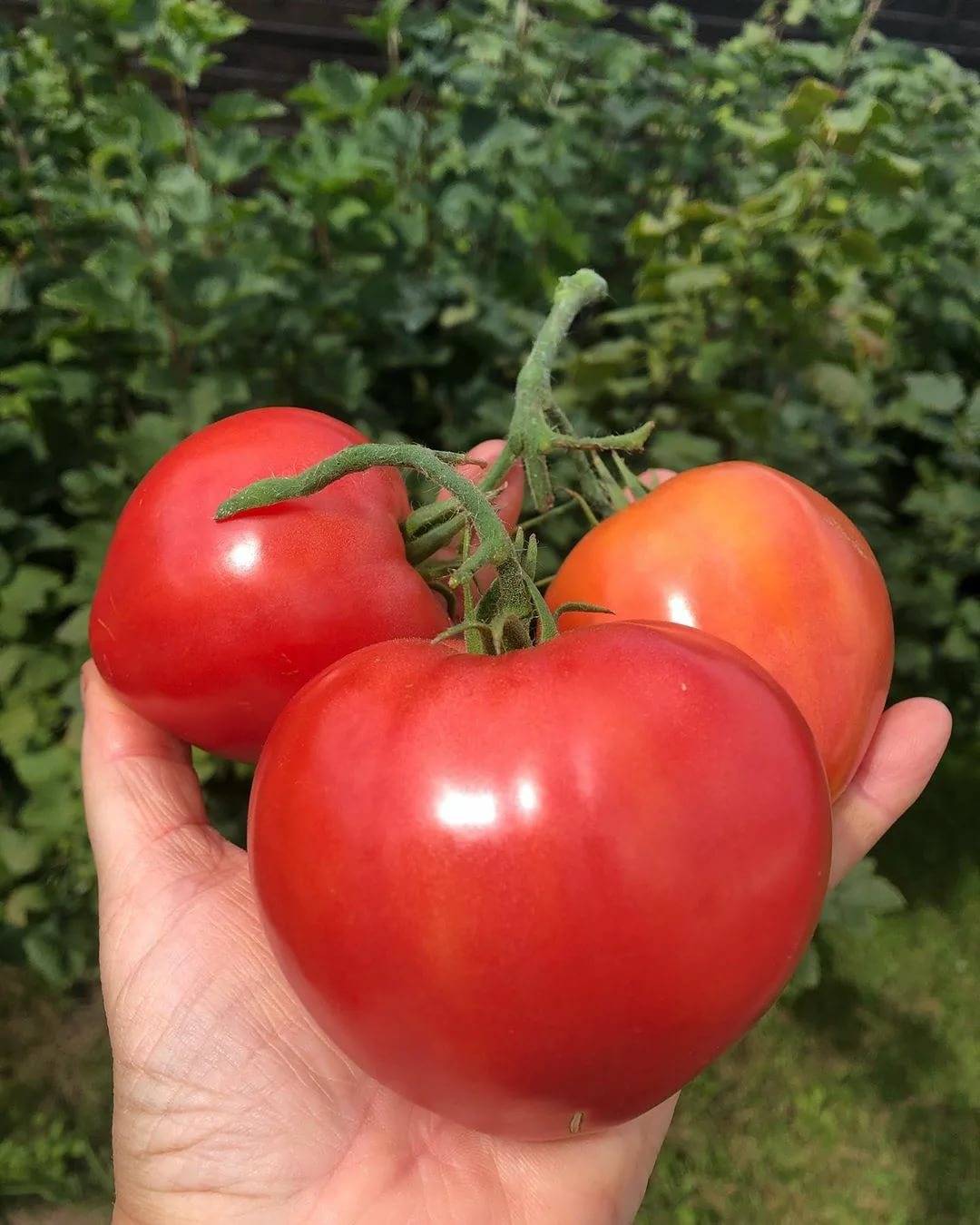
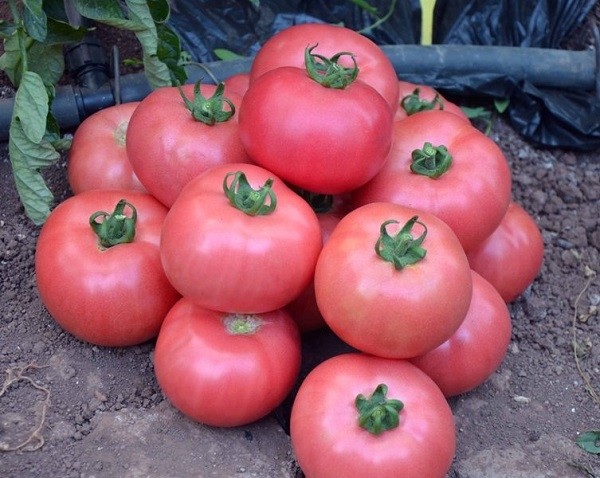
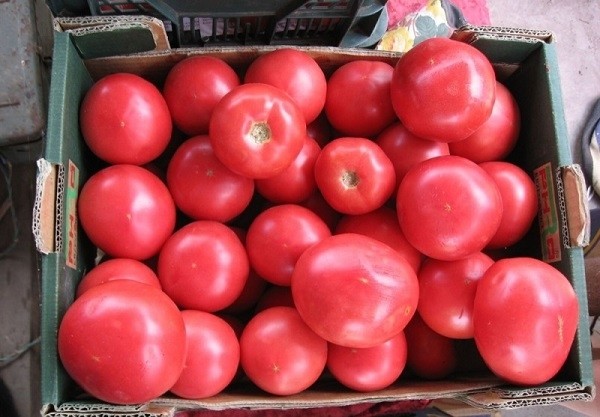
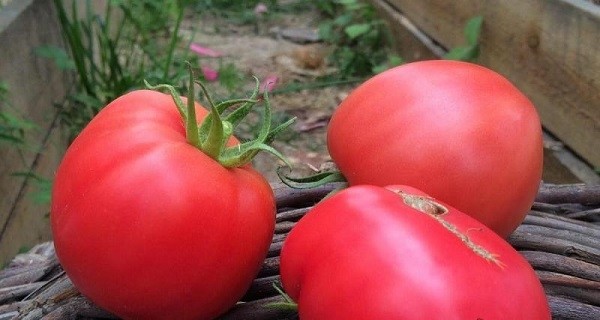
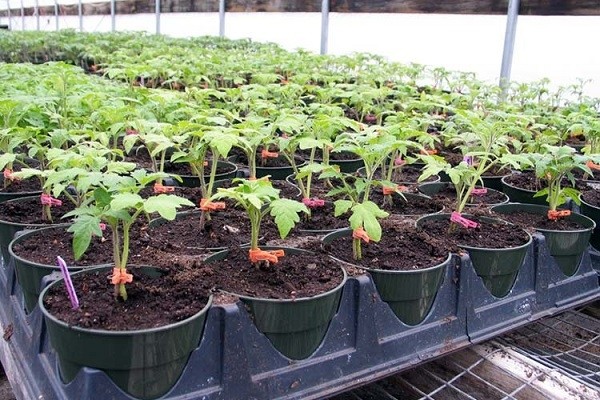
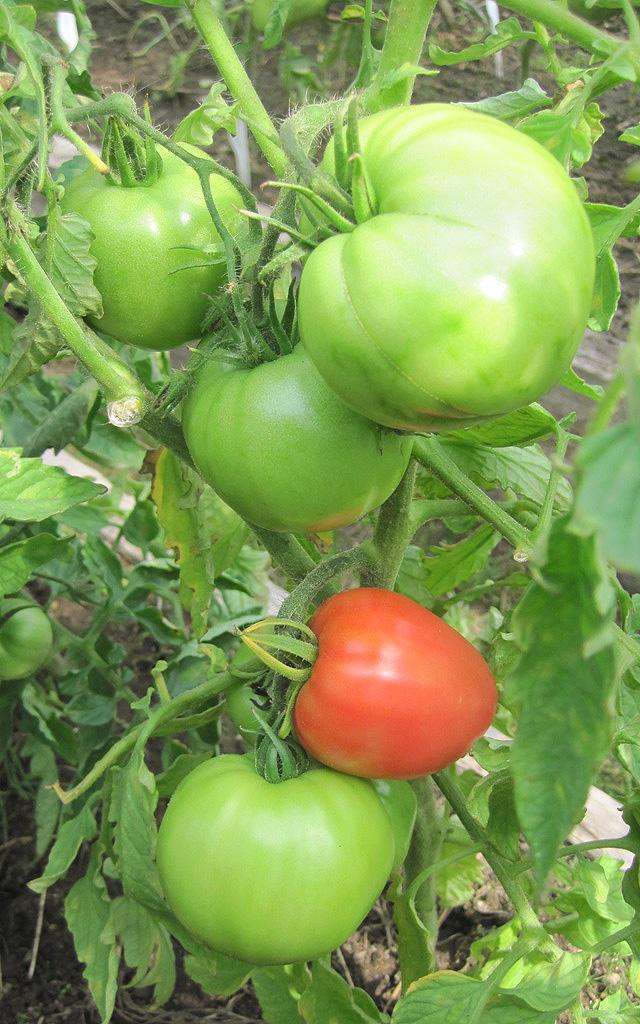
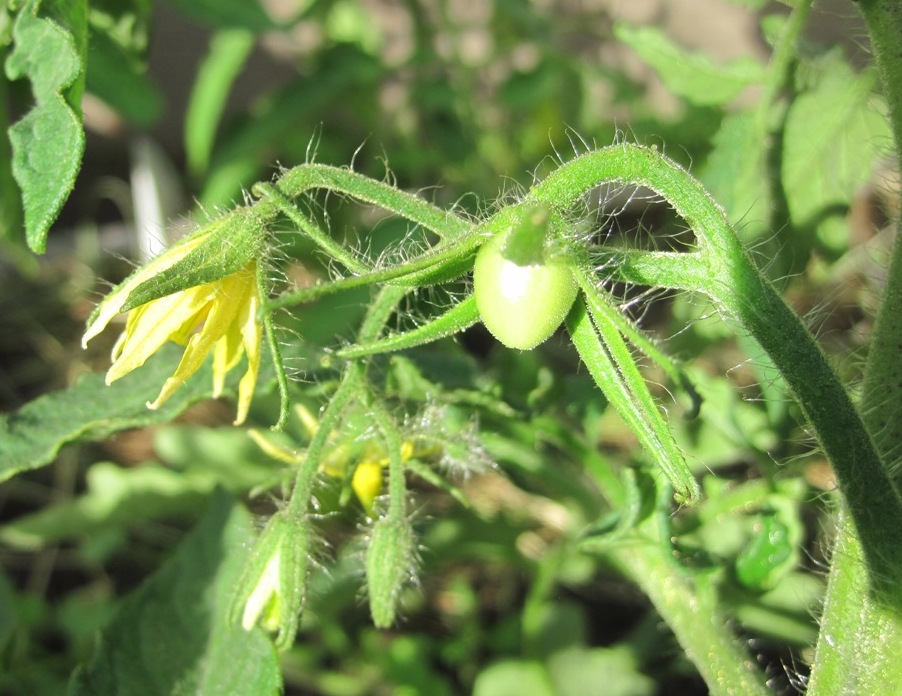
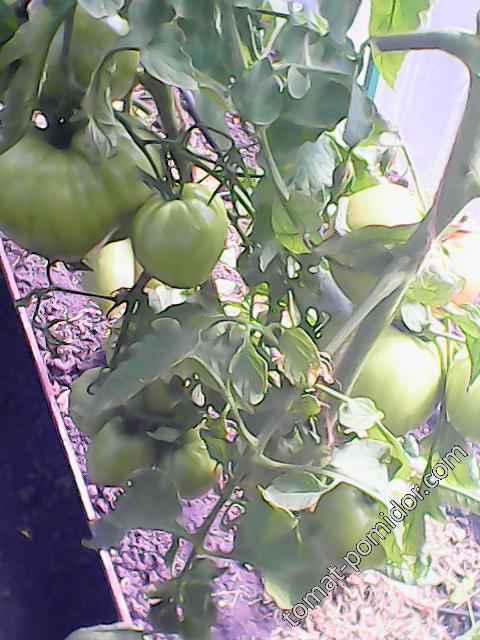
Photo gallery of the Pink Spam tomato variety
The history of the Pink Spam tomato variety
The originator is Yu. B. Alekseev, a breeder at the SEMKO-JUNIOR agricultural firm. The application for access was filed in 2009. By 2010, the hybrid had been included in the Russian state register.
A detailed description of the Pink Spam tomato variety
It's important to note that this hybrid isn't recommended for planting in all regions of our country. It grows best in the European part of Russia, including its northern regions. It's not intended for cultivation in the Urals or Siberia. While you can certainly try planting tomatoes in these regions, they likely won't have the advertised characteristics.
Bush characteristics
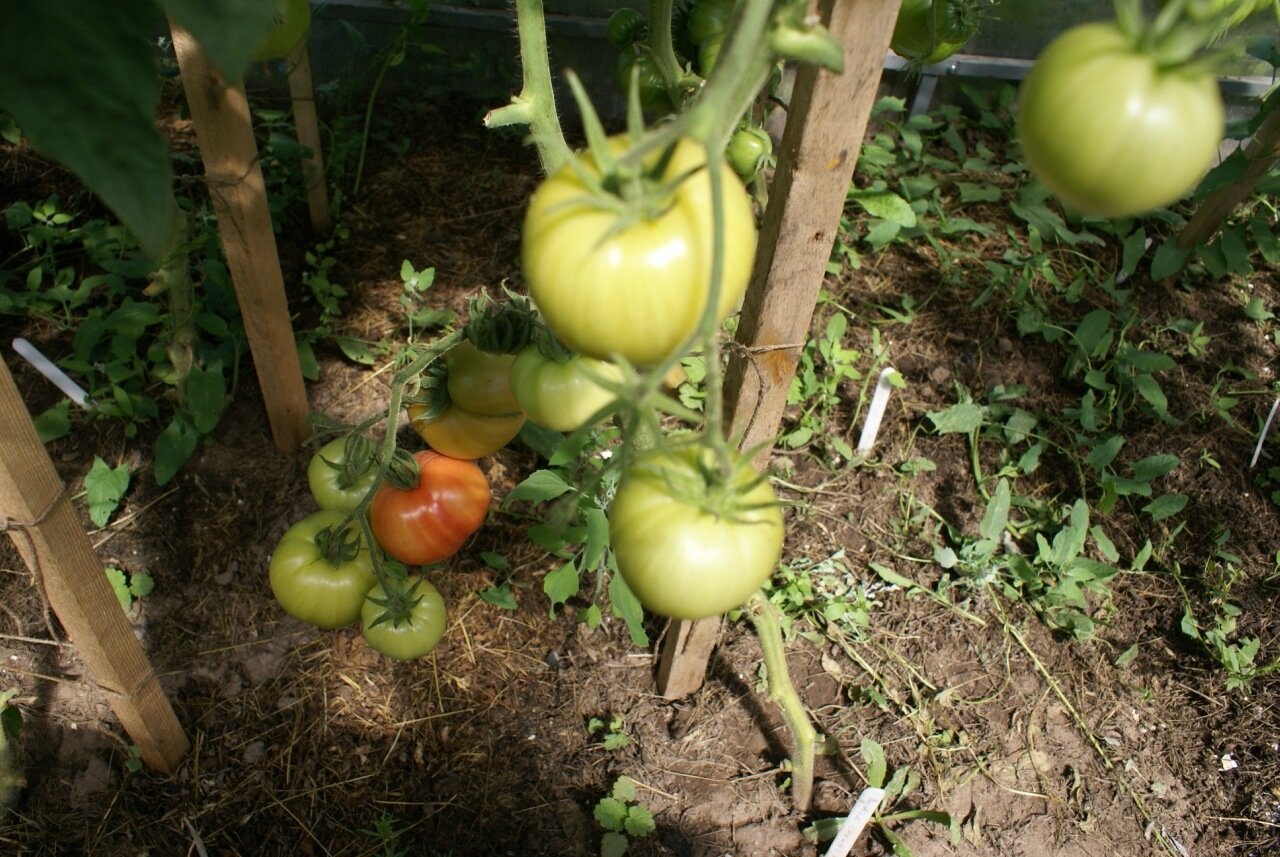
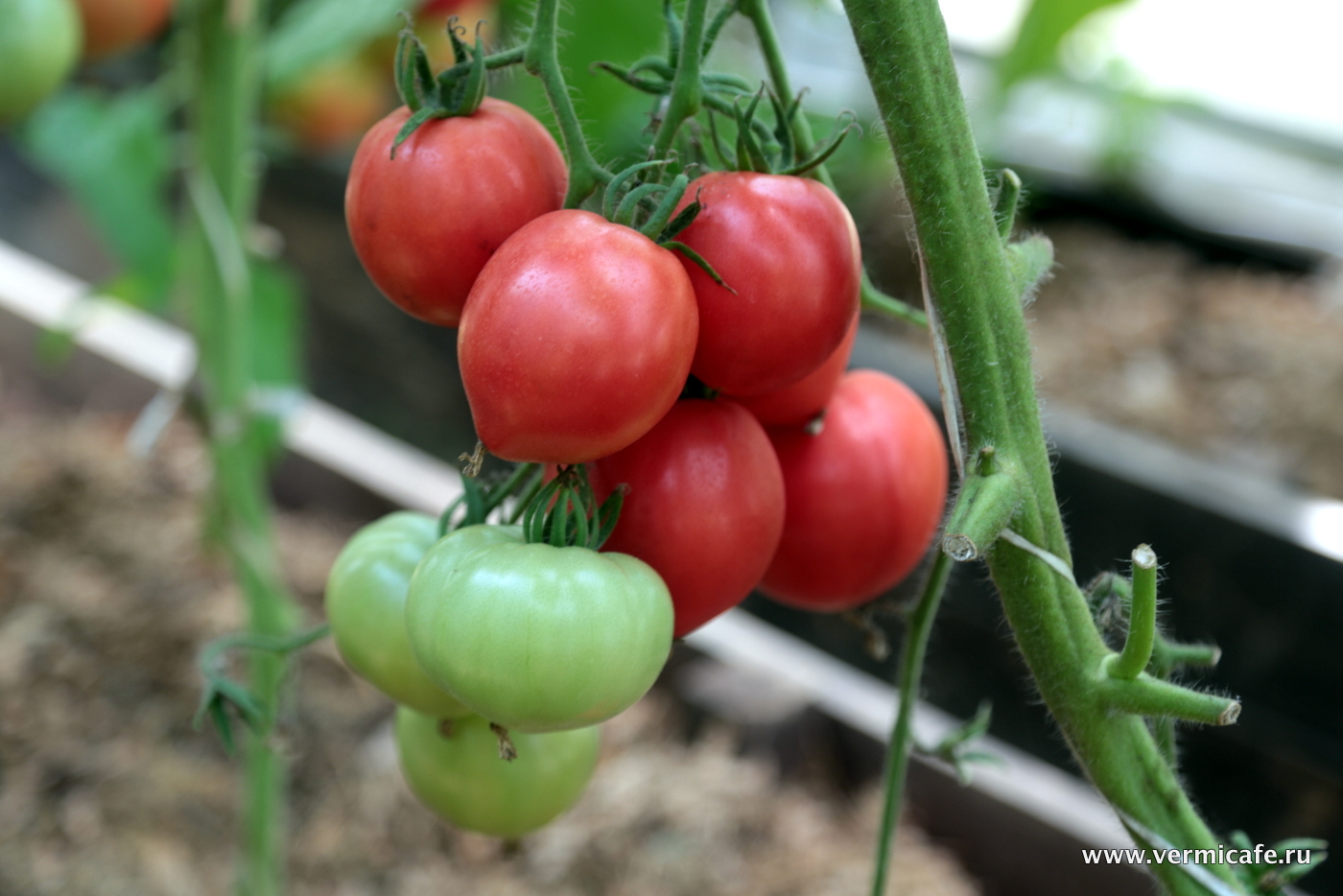
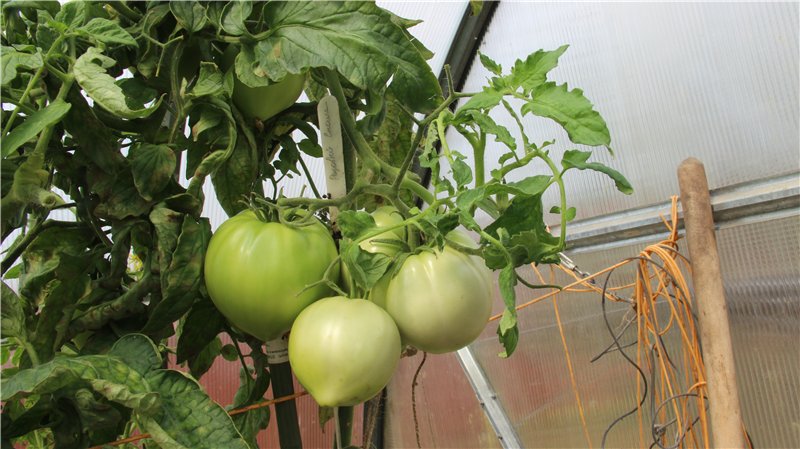
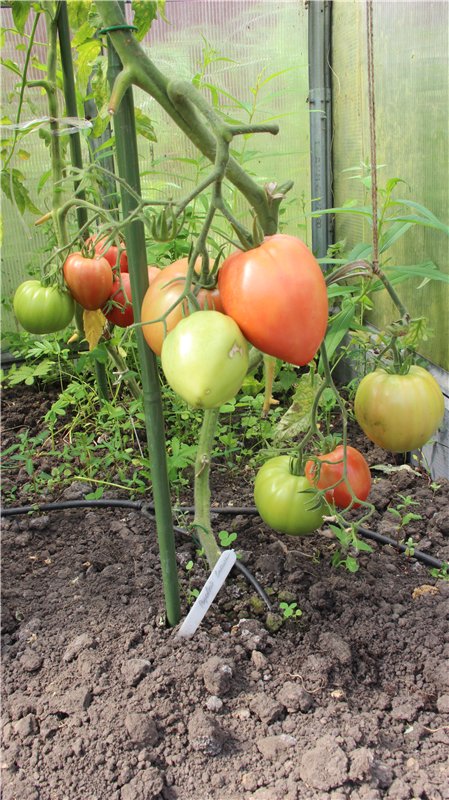
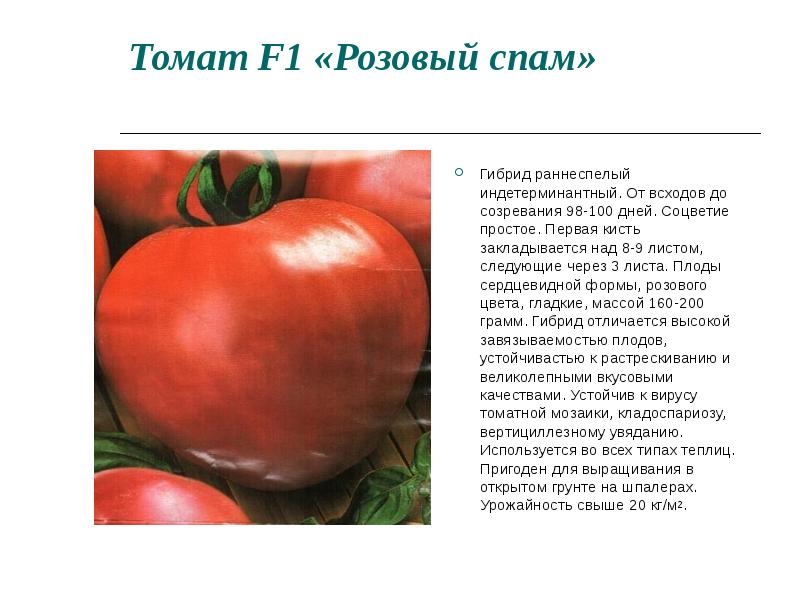
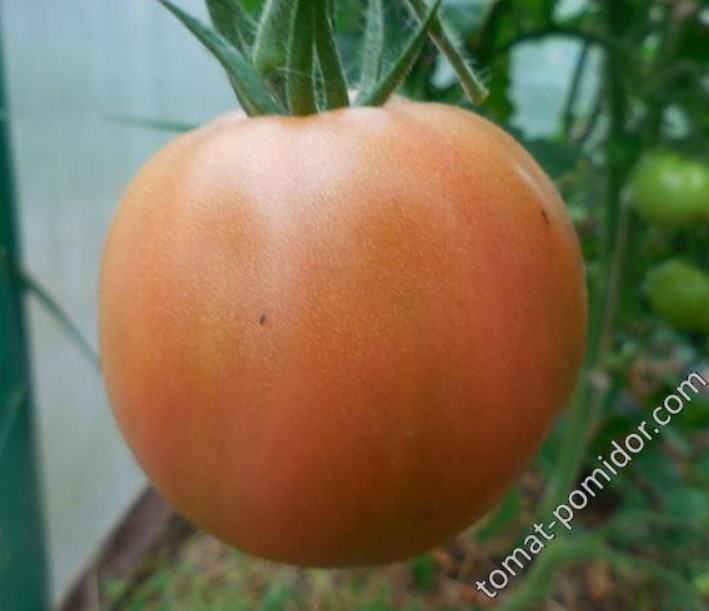
Forms tall, indeterminate bushes. In greenhouses, their main stem can grow continuously upward. In open ground, their growth stops at 100-150 cm. The bushes stop growing upward when the outside temperature reaches 15°C. The first inflorescence appears above the 7th to 9th leaf. Subsequent inflorescences appear every 3rd leaf blade. Each cluster produces 7 to 9 tomatoes. The greenish spot near the stalk is absent. The fruits are a uniform pink color.
Fruit characteristics
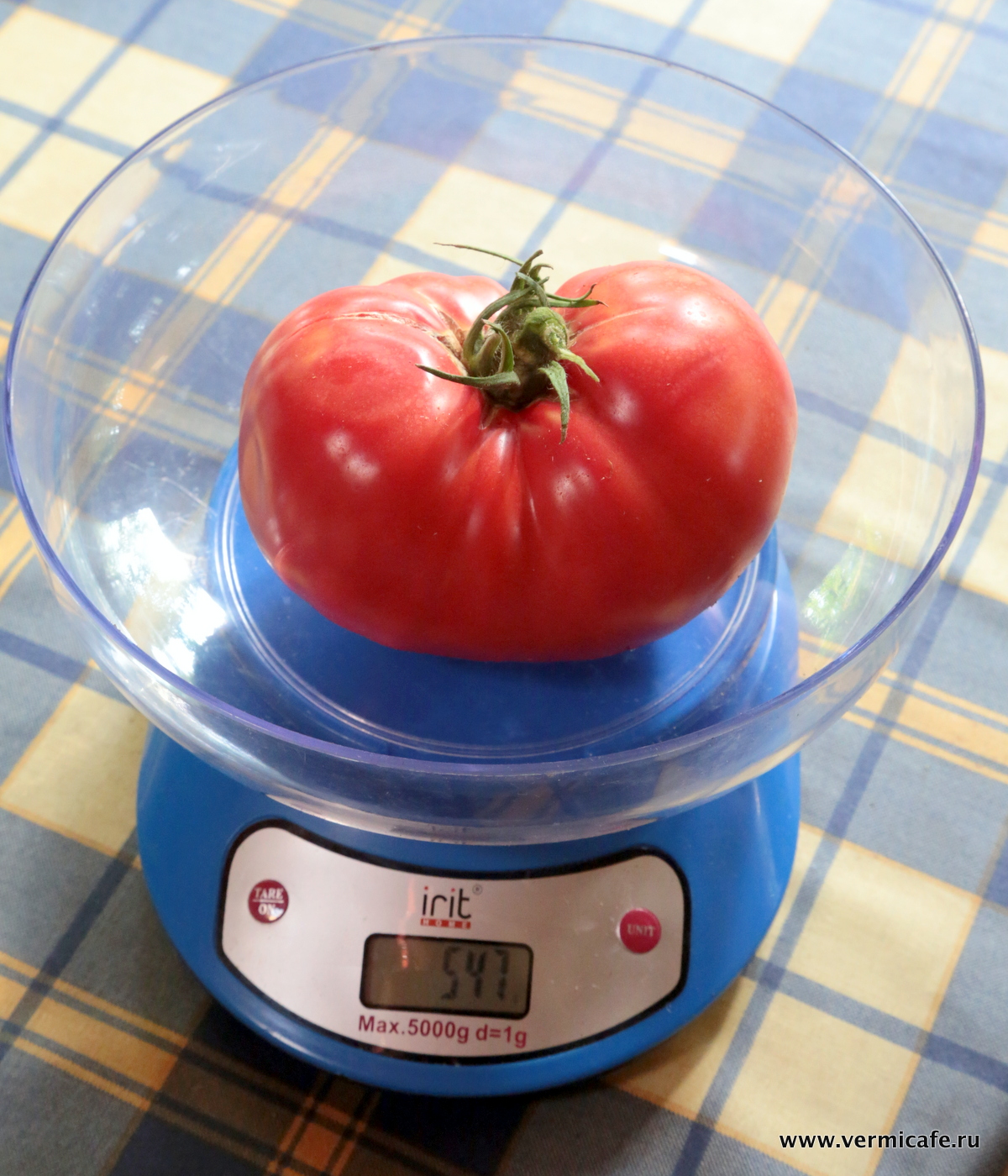
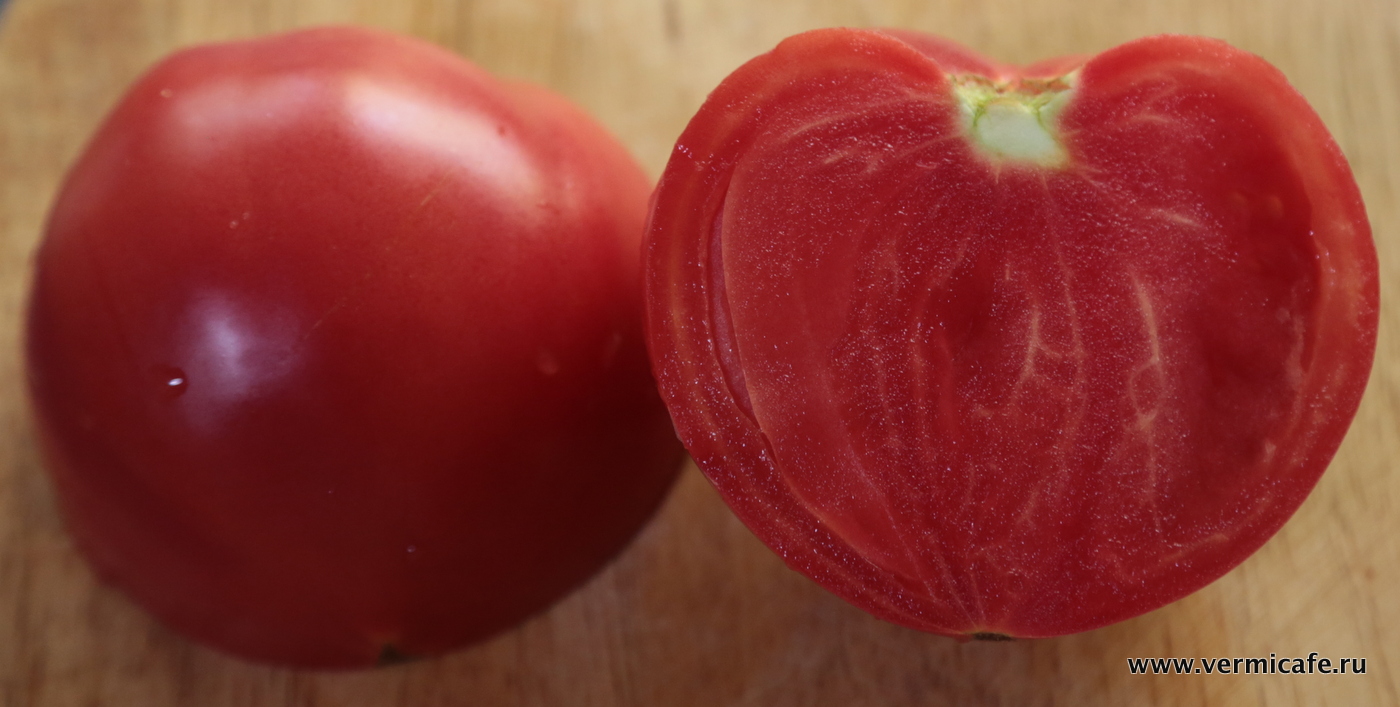
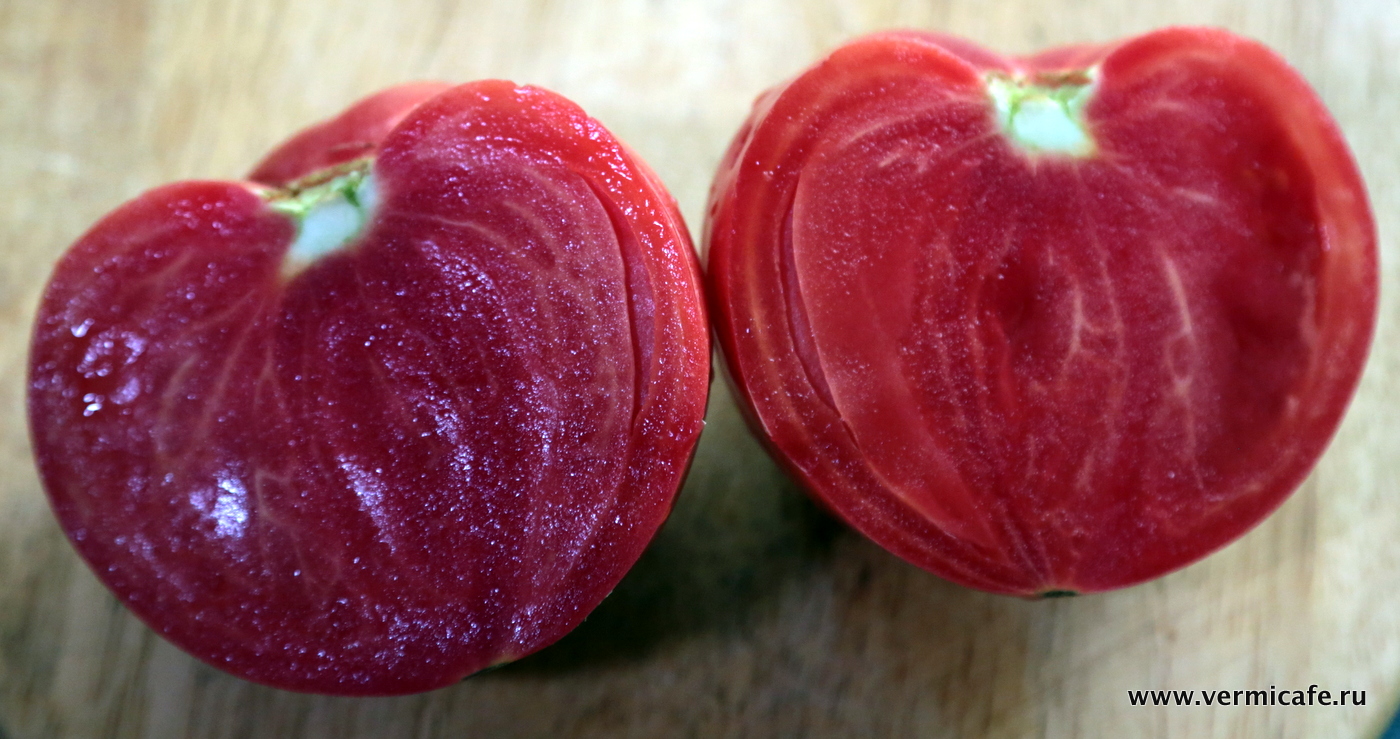
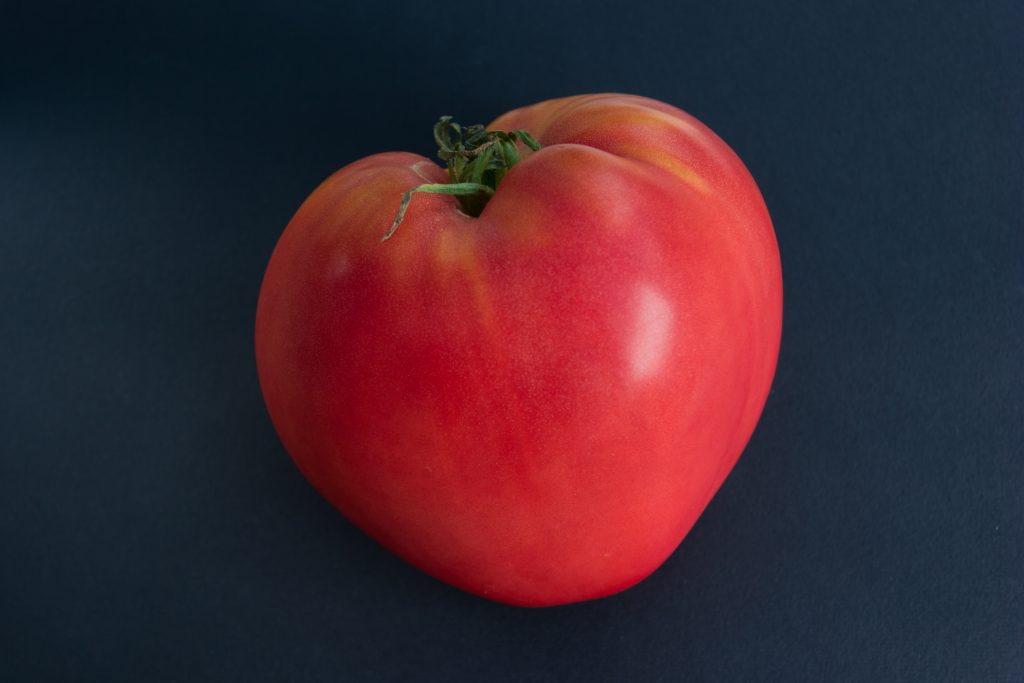
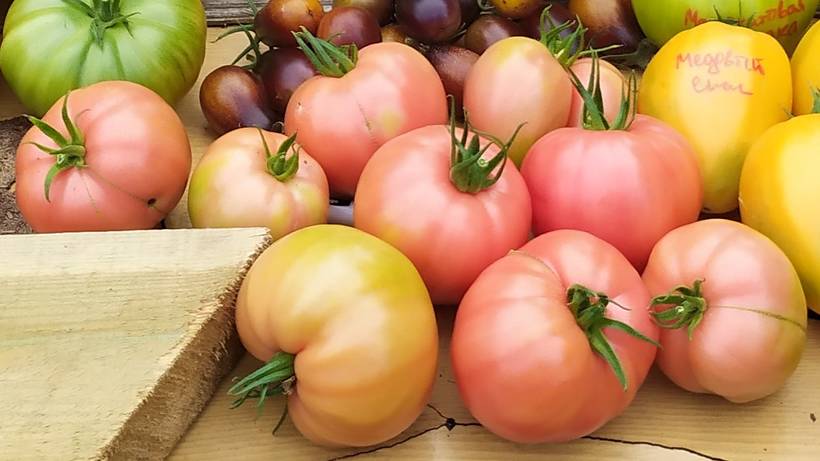
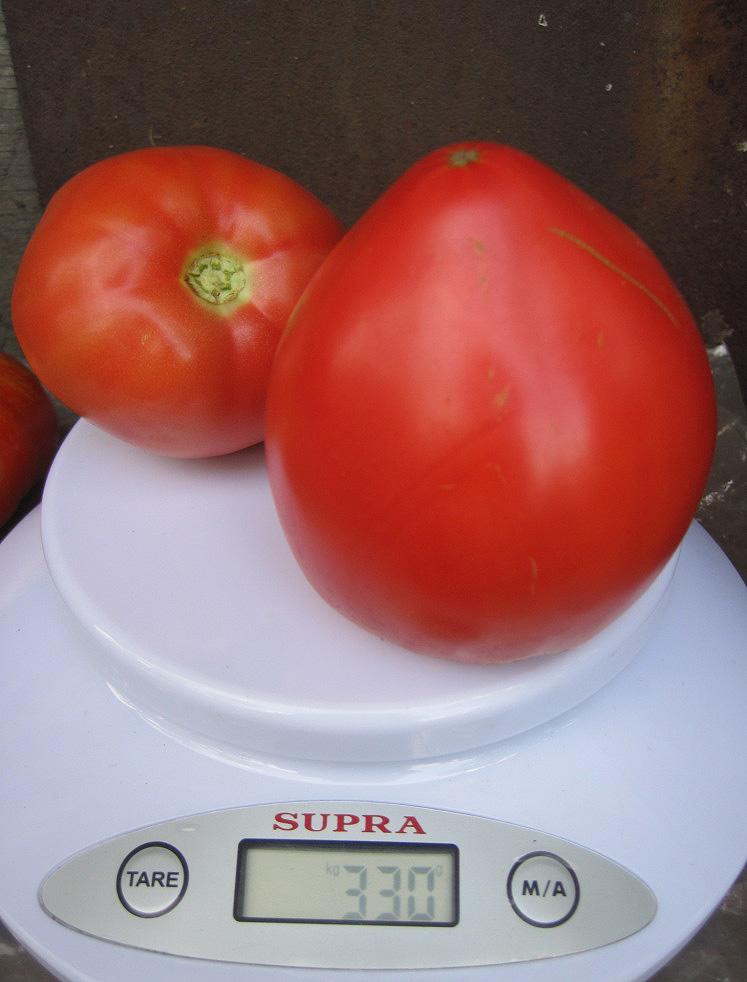
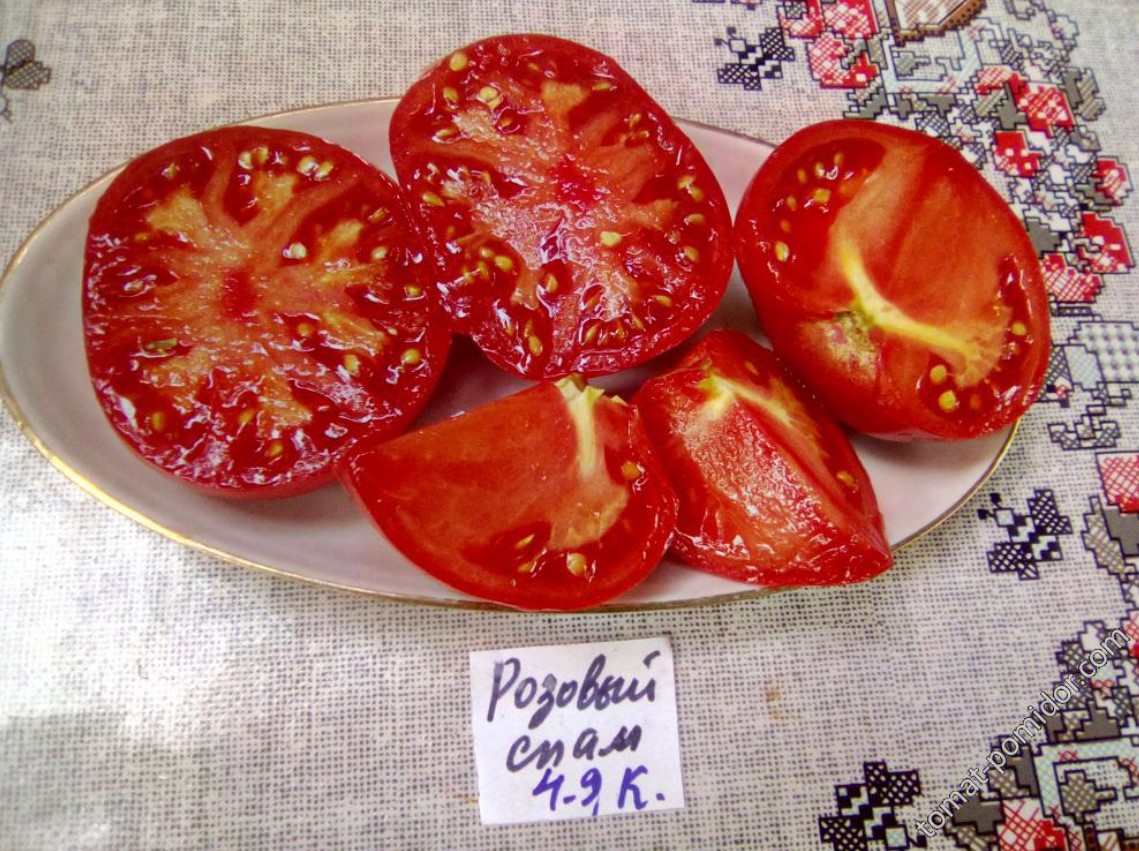
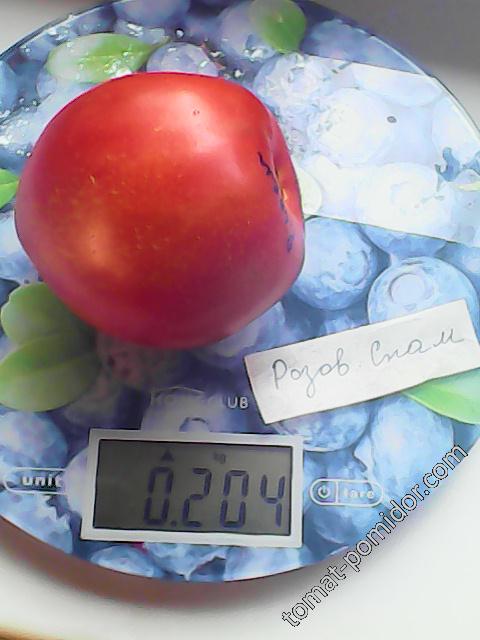
Tomatoes weigh 160-190 g. The fruits are smooth, usually heart-shaped, but can also be round. They have a thin but strong skin. The flesh is dense, juicy, and delicious. Tomatoes withstand transportation and storage well and are not prone to cracking. However, when very overripe, the skin does split. The flesh contains six seed chambers, but they are small and empty.
Ripening time
The hybrid has a mid-early ripening period. Only 99 days pass between the first shoots appearing and harvest.
Productivity
A square meter can yield 25.6 kg of tomatoes. Each bush produces 5-6 clusters, each weighing 0.8-1 kg.
Pros and cons of the Pink Spam tomato variety
The advantages of this hybrid include:
excellent fertility;
early ripening;
excellent taste;
good transportability and long storage.
Disadvantages include the need for staking and training, and high yields only in a greenhouse. Pink Spam is a hybrid, meaning you won't be able to grow tomatoes with true varietal characteristics from seeds collected in your own garden. And seed from the grower is quite expensive—around 100 rubles for 20 seeds.
Growing the Pink Spam tomato variety
In the south, seeds can be sown directly into greenhouses. In colder regions, they are grown using seedlings.
Sowing seeds and growing seedlings
Sowing begins in late March or early April. To prevent infections to which tomatoes are not resistant, the seeds should be disinfected beforehand.
You can soak them in a light pink solution of potassium permanganate. If sowing directly into a greenhouse, the beds should be treated with a fungicide, such as Bordeaux mixture. Also treat doors, walls, trellises, and all other surfaces. When growing seedlings indoors, bake the soil in an oven or pour boiling water over it to disinfect.
Sow the seeds to a depth of 1 cm. Cover the containers with plastic wrap or glass and move them to a warm location. At a temperature of 25°C, sprouts will appear in 5-7 days.
The seedlings will immediately begin to grow vigorously. Therefore, at the first true leaf stage, they should be transplanted into separate containers:
immediately transplant into 0.5 l cups;
First, transplant into 0.2-liter cups, and when the seedlings become cramped in them, transplant into 0.5-liter containers.
Classic care: watering, fertilizing, hardening.
Planting in the ground
Seedlings can be planted in a greenhouse in late-early-mid May. If planting in garden beds is planned, this should be done in late spring or early June. By this time, the seedlings should reach 20 cm in height and have 7 true leaves.
The site should be prepared in the fall before planting. A sunny location is preferable. Sandy or loamy soil is ideal for tomatoes. Avoid planting tomatoes in beds previously occupied by nightshades. Cabbage, onions, and zucchini are ideal predecessors.
The optimal planting pattern is 50 x 50 cm. However, you can also choose 60 x 60 cm or 70 x 40 cm.
Caring for the Pink Spam tomato variety
Tomatoes require periodic but timely watering. Water the roots twice a week, morning or evening after sunset. After watering, mulch the plants to retain moisture.
Regular loosening and weed removal are necessary to ensure that sufficient oxygen reaches the root system.
To ensure more intensive root development, the bushes are hilled.
Fertilizers are applied for the first time two weeks after planting. Subsequently, the bushes are fed with mineral mixtures and organic matter every month. Fertilizers are applied during or immediately after watering.
There's no height limit for the bushes. Therefore, when they reach the desired size, the tops should be pinched to stop growth. They should also be trained into two stems and supported to prevent heavy tomatoes from breaking the branches.
The manufacturer recommends leaving only 4-6 of the largest, select ovaries per cluster. This will ensure a large and uniform harvest.
Resistance of the Pink Spam tomato variety to infections
The variety exhibits good resistance to verticillium wilt, fusarium wilt, cladosporiosis, and TMV. However, it is not resistant to brown spot and blossom-end rot. To prevent infection, it is necessary to follow agricultural practices and carry out timely treatments. To prevent late blight, blackleg, and other fungal infections, seeds are disinfected before sowing.
Harvesting, using and storing the Pink Spam tomato variety
The harvest is completed as soon as the tomatoes ripen. Because tomatoes have a pinkish color, many beginning gardeners hesitate to begin harvesting. When ripe, the fruits are the color of unripe tomatoes. When pressed with your fingers, they yield but remain firm. There are no green spots when cut, and the flesh is firm.
It's important to harvest the fruit on time. When overripe, the flesh turns dark red and becomes translucent through the skin. The fruits burst, becoming watery and tasteless.
Comparison of the Pink Spam tomato variety with other varieties in the table
Please note! How can you easily convert centners/ha to kg/sq.m? Simply divide by 100! For example, the Abakansky Pink tomato yields 400 centners of marketable fruit per hectare. This equals 4 kg per square meter. It's that simple! Also, keep in mind that typically no more than 3-4 plants are planted per square meter. This way, you can calculate the yield per bush. In the case of the Abakansky Pink, it's about 1 kg.
Variety
Ripening period (number of days from full germination to ripening)
Yield of commercial fruits
Brief description
Fetus
Pink spam
99 days
2560 c/ha
An early-ripening indeterminate variety for greenhouses. Suitable for salads and canning.
Heart-shaped, firm, smooth, pink, 190 g. Excellent taste.
A mid-season determinate variety for open ground and greenhouses. Suitable for salads. Marketability is 96%, and the yield of ripe marketable fruits is 90%.
A late-ripening determinate variety for open ground and greenhouses. Requires staking and training. Suitable for salads and processing into tomato products.
Flat-round, slightly ribbed, medium density and pink in color, 200-500 g. Good taste.
Rosy cheeks
110-112 days
550 c/ha
A mid-early determinate variety for greenhouses. Requires staking and training. Suitable for salads and processing into tomato products.
Flat-round, slightly ribbed, pink, 180-260 g. Excellent taste.
Pink giant
115-125 days
580-640 c/ha
A mid-season indeterminate variety for open ground. Requires staking and shaping. Suitable for salads.
Flat-round, strongly ribbed, pink, 350 g. Excellent taste.
Pink heart
110-120 days
610 c/ha
A mid-season indeterminate variety for open ground and greenhouses. Requires staking and shaping. Suitable for salads. Produces good fruit.
Heart-shaped, slightly ribbed, medium density, resistant to cracking, pink, 200-230 g. Excellent taste.
Wild rose
110-115 days
600 c/ha
An early-ripening indeterminate variety for open ground and greenhouses. Requires staking and training. Suitable for salads. Heat- and salinity-tolerant.
Round, smooth, pink, 300-350 g. Excellent taste.
Favorite holiday
105-110 days
750 c/ha
An early-ripening determinate variety for open ground. Suitable for salads.
Heart-shaped, slightly ribbed, medium density, pink, 350 g. Good taste.
A mid-early indeterminate variety for greenhouses. Suitable for salads.
Flat-round, large, ribbed, medium density, pink, 300-360 g. Excellent taste.
Pink Paradise
100-110 days
390 c/ha
A mid-season indeterminate variety for open ground and greenhouses. Requires staking and shaping. Suitable for salads.
Flat-round, slightly ribbed, dense, pink, 125-140 g. Excellent taste.
Pink elephant
112 days
620-820 c/ha
A mid-season semi-determinate variety for greenhouses. Suitable for salads, canning, and processing into tomato products.
Flat-round, fleshy, medium- to strongly ribbed, notched to smooth top, pink, 280 g. Excellent taste.
Wind rose
about 100 days
600-700 c/ha
An early-ripening, determinate, standard variety for open ground. Requires staking and shaping. Suitable for salads. Drought-resistant.
Round, smooth, pink, 140-160 g. Excellent taste.
Sweet Million
95-100 days
Commercial yield 4.8-7.0 kg/sq.m.
An early-ripening, indeterminate, medium-sized variety for greenhouses. Suitable for salads.
Round, smooth, red, 15-20 g. Excellent taste.
Chinese pink
about 110 days
up to 1500 c/ha (open ground), up to 2000 c/ha (greenhouse)
A mid-early semi-determinate variety for open ground and greenhouses. Requires staking and training. Suitable for salads and processing into tomato products.
Heart-shaped, fleshy, sweet, pink, 300-350 g. Excellent taste.
The Pink King
100-112 days
680 c/ha (greenhouse and under film)
A mid-season indeterminate variety for open ground and greenhouses. Requires staking and shaping. Suitable for salads.
Flat-round, ribbed, medium density, pink, 200-300 g. Excellent taste.
Reviews of the Pink Spam tomato variety
Gardeners recommend growing tomatoes only in greenhouses to ensure they meet their stated characteristics; planting them in open ground will result in lower yields.
Hybrid from Semko
Early (the very first tomato this year was from Pink Spam)
Tasty, despite being a hybrid
Beautiful in color and shape (almost) heart-shaped fruits
Stores well
It should be indeterminate and very productive, but mine didn't turn out that way. It still yielded better than many varieties grown in the greenhouse this year.
Disadvantages: not resistant to cladosporiosis, seeds are quite expensive.
Rose spam
I planted 2 bushes this summer (2013) in a greenhouse, tender, thin skin, tasty, my yield was average,
I've been planting PINK SPAM for many years. It pleases me with both its taste and its yield. I cultivate it in two trunks. I'll be planting it again this year, despite the availability of new seeds.
I planted the Pink Spam variety from V. Monakhova on the advice of Valentina Zakharovna from Izhevsk. Thanks to her for the seeds :thx: :hat: The variety turned out to be very productive, tasty, and heat-resistant in the PCT. The fruits were beautiful, set all the way to the top. The fruits were larger higher up. On the sunny side in the heat, unlike other heart-shaped varieties, it had no shoulders or veins. I will definitely be growing it again.
I planted this in 2019. I was delighted with the hybrid. It had a long fruiting period (I'd already picked everything, but it was still blooming and producing new fruit). The fruit was just like in the picture—even and bright pink. I got 2.3 kg per bush, with fruit weighing 170-282 g. I picked the fruit unripe to allow the new ones to ripen. They ripened beautifully in the crate. The ripe fruit was a stunning color, but I didn't take a photo of them. got wrapped up.
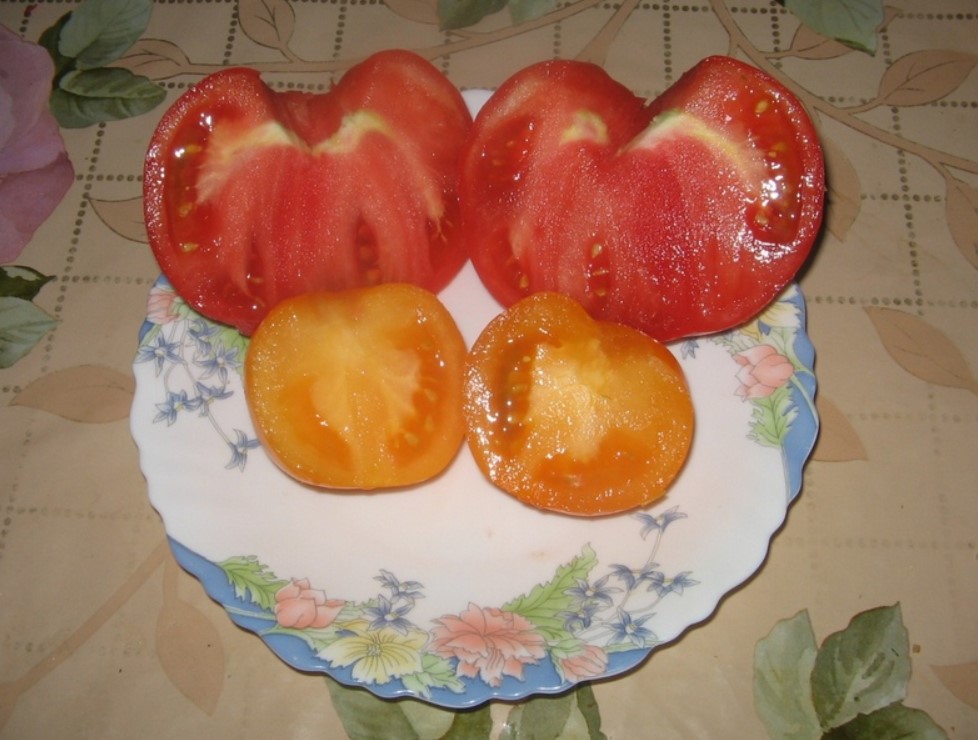
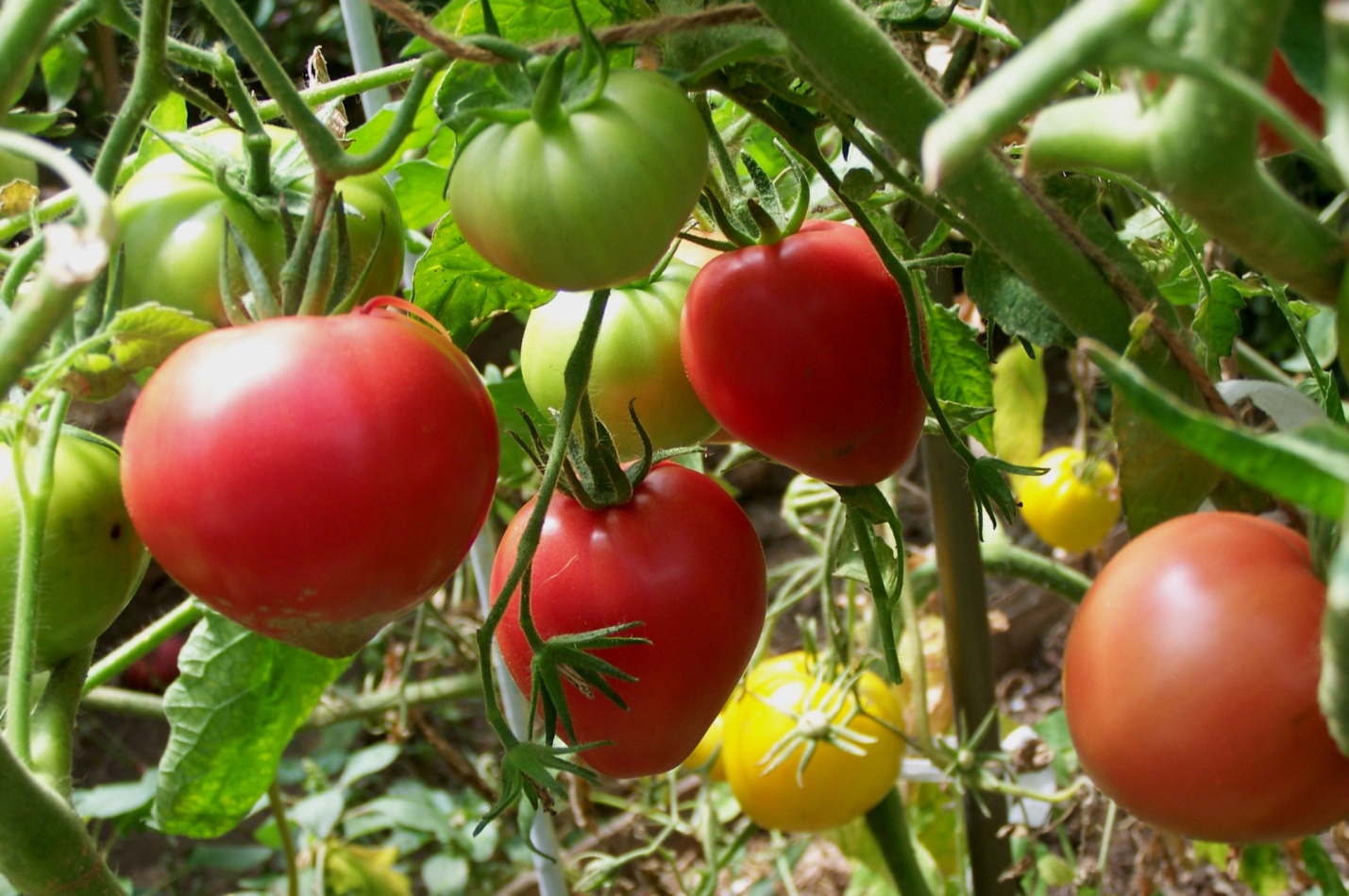
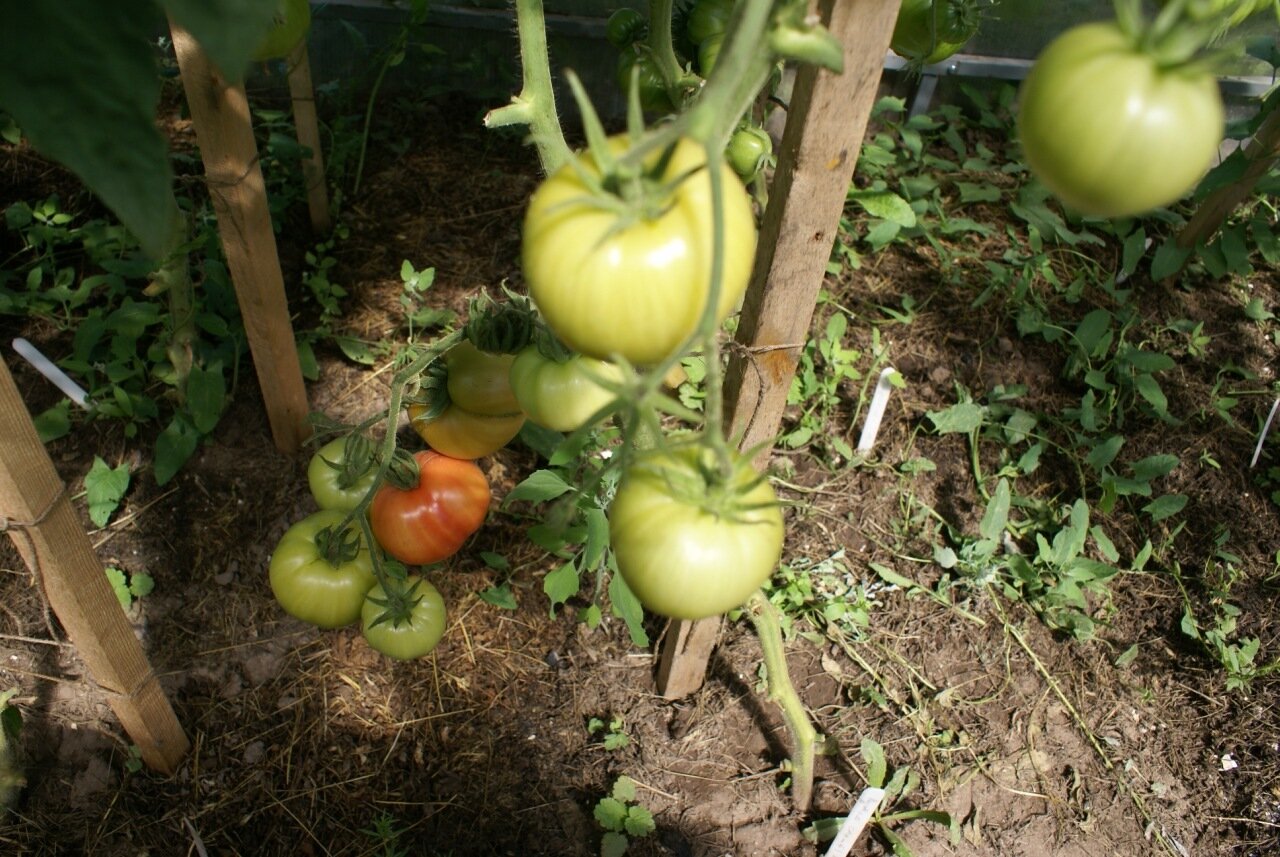
I grew Pink Spam last year in an unheated greenhouse. It's a good pink-fruited indeterminate. However, you shouldn't be stingy and plant no more than 2-2.5 per square meter. Be sure to regulate each cluster. 1-3 clusters should have no more than three fruits, the rest should have four. The fruits were 250-350 g. I managed to grow six clusters, each weighing between 800 g and 1000 g. Then there was a failure in flowering and fruit set. But this was mainly due to my poor nutrition at the time and poor weather conditions. Here it is in the photo, together with Diorange (an orange indeterminate from Semko). Of course, I assume that R. Spam isn't the tastiest pink-fruited variety; there are better varieties, like Pink Flamingo or something from Sibsad. But in terms of the overall characteristics, resistance, especially to cracking, I am quite satisfied with it, I will continue to grow it.
The fruits are pink, heart-shaped, the bush is tall, I got 2-3 trunks, the fruits are about 130-150g, but this hybrid is affected by blossom-end rot (3 bushes out of 6).
I really like it. It can even grow into three trunks. This year, I saw double flowers, which grew into huge fruits. If it hangs pink on the bush for too long, it cracks. The taste is good. For now, my favorite one is in the greenhouse.
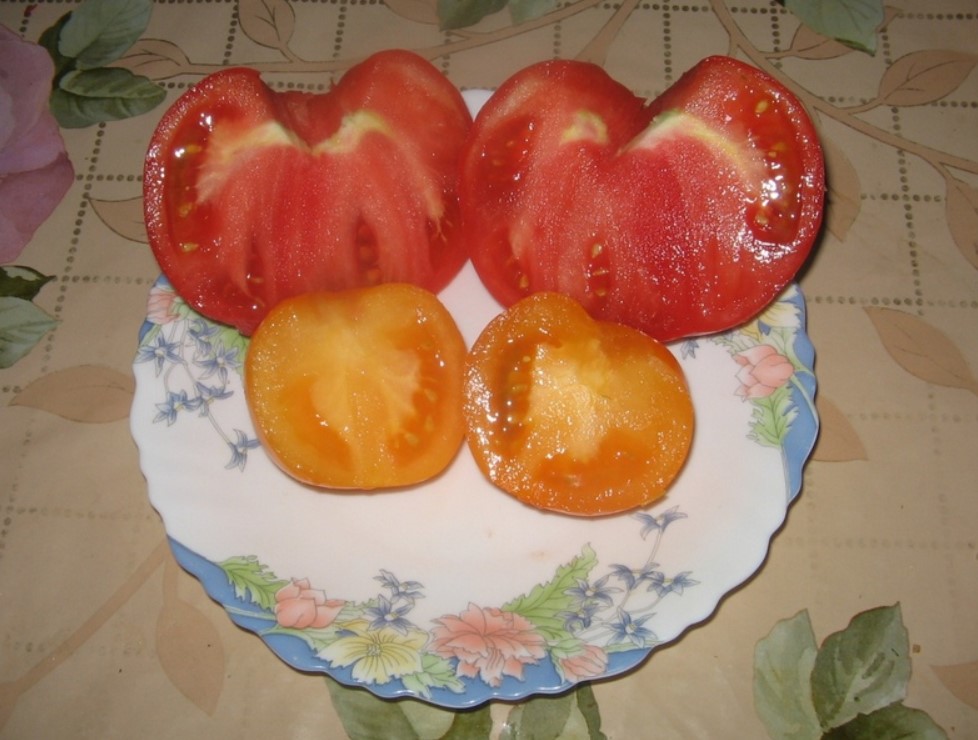
When it hangs ripe for a long time, it can crack – the skin is thin. And inside it seems red
Reduced to 79% Attached image 1400 x 739 (565.94 kilobytes)
Actually, it's pink on the outside:
Here's my Pink Spam F1 from Semko. It started to ripen earlier than all the other early tomatoes, but it was also one of the first to produce a harvest. It tastes good, but I prefer the flavor of Pink Gel F1 and Pink Unicum F1; they're juicier. It's a single-stemmed variety.





got wrapped up.