The health benefits of champignons have long been proven; they're used in various diets, and adults eat them for weight loss. But how these mushrooms affect the health of children of different ages remains a contentious issue. Evgeny Olegovich Komarovsky is a renowned pediatrician with the highest qualifications. Mothers around the world heed his advice and recommendations. In this article, we'll explore his opinion on mushrooms, and more specifically, at what age children can be given champignons.
Content
- 1 Are children allowed to eat champignons?
- 2 Benefits and harms
- 3 Dr. Komarovsky's opinion on when children can start eating mushrooms
- 4 Choosing champignons for baby food
- 5 Rules for introducing champignons into a child's diet
- 6 6 mushroom recipes for children
- 7 Serving instructions and portion sizes
- 8 Reviews from mothers about feeding children champignons, and expert recommendations
Are children allowed to eat champignons?
Pediatricians debate the age at which mushrooms are safe for children. There's no definitive answer. Some sources recommend introducing mushrooms into children's diets after age two. However, others argue that introducing mushrooms so early isn't beneficial, so it's best to start at age ten. At a young age, a child's digestive system isn't fully developed, so some nutrients may not be absorbed. However, the decision ultimately rests with the parents.
Please note! Parents need to know not only at what age to introduce mushrooms to their child, but also how to do so correctly. They should be introduced gradually and in small portions.
Benefits and harms
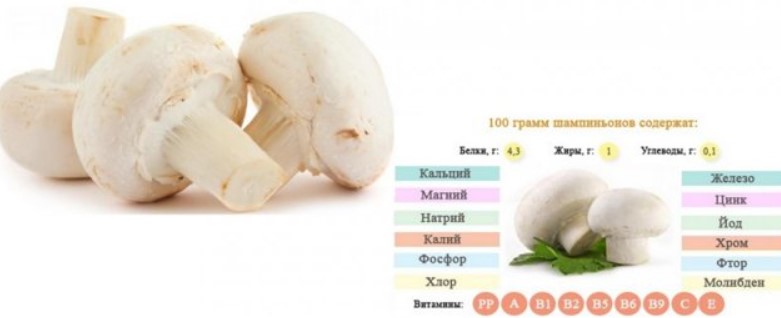
High-quality champignons are a valuable food. They contain a large amount of protein, easily digestible fats, dietary fiber, and various vitamins and minerals. Most of the valuable nutrients are found in the cap, so it's best to give it priority when feeding champignons to children. Including caps in the diet improves digestion and helps prevent anemia.
However, it's important to note that excessive consumption of champignons can be harmful due to their chitin content. It's indigestible and can interfere with the absorption of other nutrients.
Ah, you know that Adults can eat raw champignons. And use in your menu if you want to lose weight.
Dr. Komarovsky's opinion on when children can start eating mushrooms
Dr. Komarovsky believes that children can begin to be introduced to champignons as early as two years old. This applies to commercially grown mushrooms. When first introduced, they should be used in sauces or as a garnish for main dishes. Children under five can be given champignons once a week.
Choosing champignons for baby food
When choosing mushrooms for a child, you should give preference to those sold in the store rather than those grown in the forest, as they can absorb harmful substances from the soil.
Well, if you want to enjoy fresh mushrooms yourself, feel free to pick them. forest or field mushrooms. And also grow them yourself in a greenhouse, at home, at the dacha.
You should buy mushrooms that are small in size, light in color, and without any dark spots. However, when buying royal, you need to know that they have a brown cap.
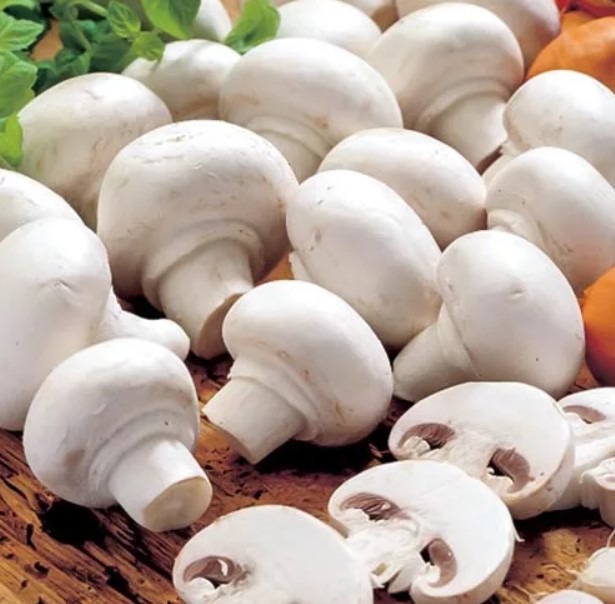
It is better not to buy too large ones, because they are considered overripe and contain little nutritional value.
Once you bring the purchased mushrooms home, you need to remove them from their packaging and keep them in the refrigerator for no more than 24 hours.
You can also freeze them, which extends their shelf life to up to a year.
How to dry champignons You can find out more on our website Top.tomathouse.com.
Rules for introducing champignons into a child's diet
When introducing champignons into a child's diet, consider the frequency and quantity. Start with a small piece and monitor its effect over several hours. If no allergies or abdominal discomfort occur, increase the amount of mushrooms.
From the age of ten, larger portions are allowed. This is because the body is already beginning to produce the enzymes responsible for processing mushrooms.
6 mushroom recipes for children
Mushrooms go great with vegetable and meat dishes. They can be used to make omelets, casseroles, soups, and cabbage rolls. Before cooking When eating champignons, especially for children, you need to clean them.
Children under 14 years of age should not be offered baked goods containing mushrooms, as they are difficult for the body to digest when combined with dough.
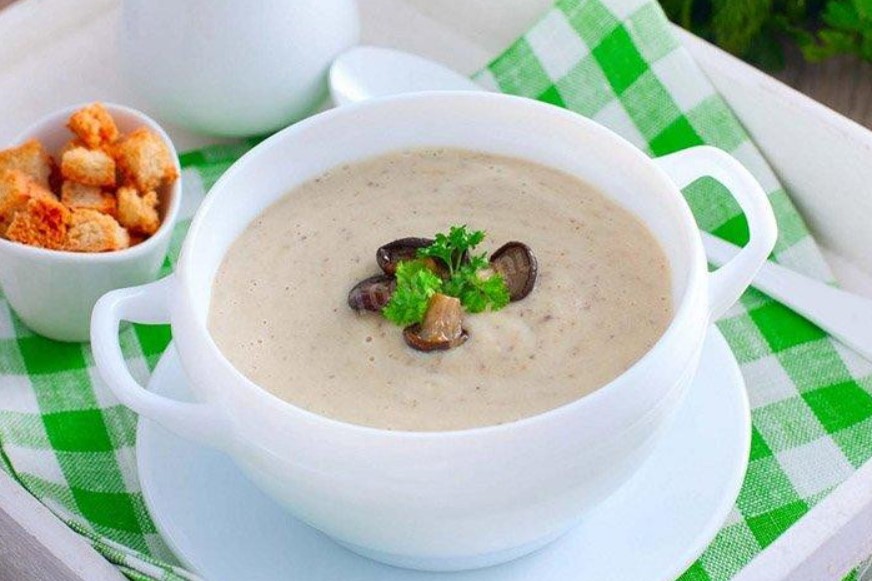
Creamy soup
For cooking you will need the following products:
- water - 500 ml;
- onion - 1 pc.;
- potatoes - 1 pc.;
- carrots - 1 medium-sized piece;
- champignons - 0.5 kg.
Step-by-step recipe:
- Pour 500 ml of water into a saucepan, place on the fire and wait until it boils.
- Wash and peel the onion, carrot, and potato. Chop them finely and place them in boiling water.
- Wash, clean and chop the mushrooms.
- Add them to the broth. Wait until all ingredients are fully cooked.
- After cooking, puree all ingredients in a blender until the soup has a creamy consistency.
- Season with salt to taste, add herbs, and top with sour cream. You can also add croutons.
Children really like this dish, but it can only be given to those who are already familiar with mushrooms.
Mushroom sauce
Ingredients required:
- champignons - 8-12 small pcs.;
- onion - 1 pc.;
- flour - 1 tbsp;
- water - 500 ml;
- a small amount of vegetable oil;
- butter - 2 tbsp.
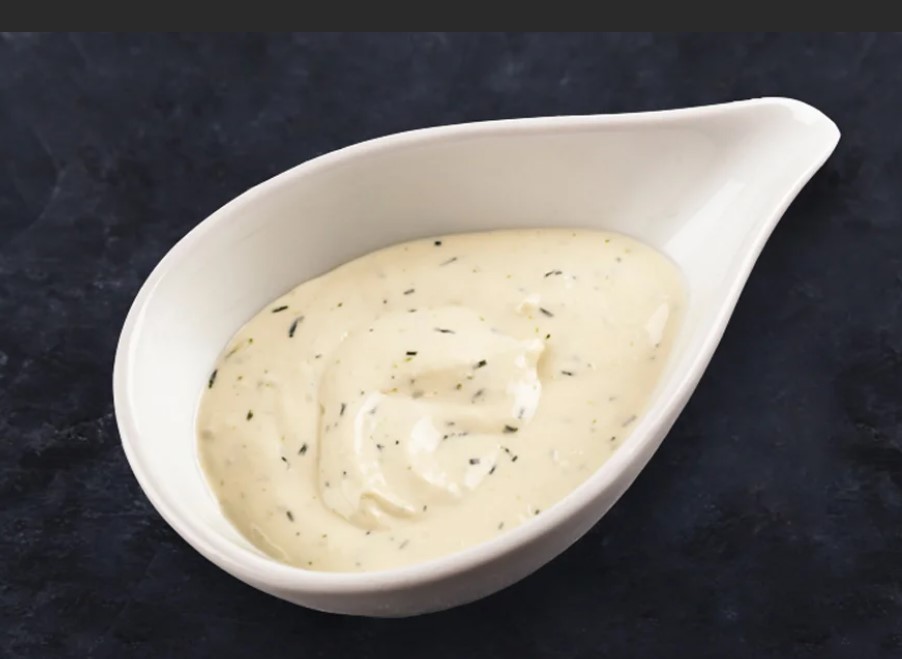
Step-by-step preparation:
- Wash, clean and boil the mushrooms in water.
- Chop the onion, fry it in vegetable oil and add to the broth.
- Toast the flour in a dry frying pan. When it turns golden, add salt and pour in the mushroom broth, stirring constantly.
- Cook for about 10 minutes. Remove from heat and add butter. You can add some herbs.
Please note that before giving the sauce to your child, it must be cooled to room temperature.
Casserole
Necessary products:
- potatoes - 6 pcs.;
- mozzarella cheese - 200 g;
- champignons - 0.5 kg;
- onions - 2 pcs.;
- eggs - 2 pcs.;
- rosemary - 1 sprig;
- garlic - 3 cloves;
- cream - 200 ml;
- salt and pepper to taste.
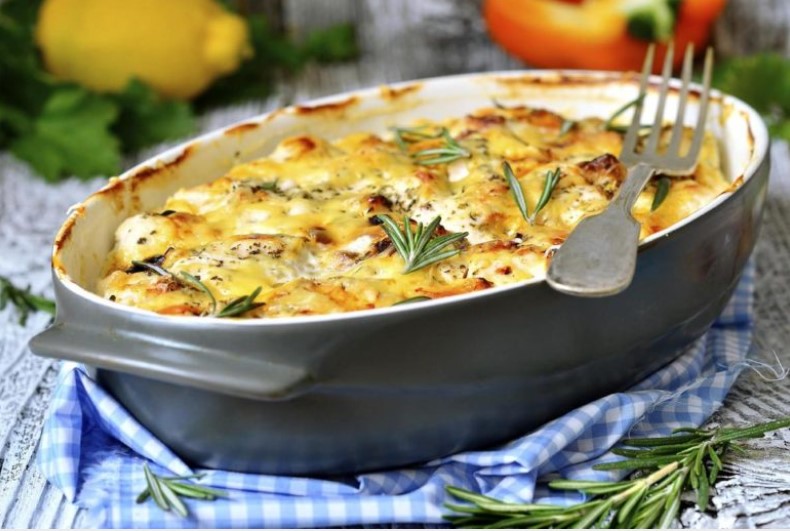
How to cook:
- Fry the onion and garlic, add rosemary.
- Add grated mushrooms and cook for a quarter of an hour.
- Boil the potatoes in their skins. Once cooked, peel and slice them into rounds.
- In a separate bowl, beat eggs, cream and grated cheese.
- Place the mushrooms in a baking dish. Top with cheese cubes. Next comes the potatoes, which are sprinkled with salt and pepper. Finally, pour in the beaten eggs.
- Place the pan in the oven preheated to 180° for 25 minutes.
Please note that this dish can be given to a child from the age of 7 years.
Mushroom meatballs
Ingredients:
- champignons - 500 g;
- flour - 5 tbsp;
- potatoes - 5 pcs.;
- dill - 1 bunch;
- salt to taste;
- a small amount of vegetable oil.
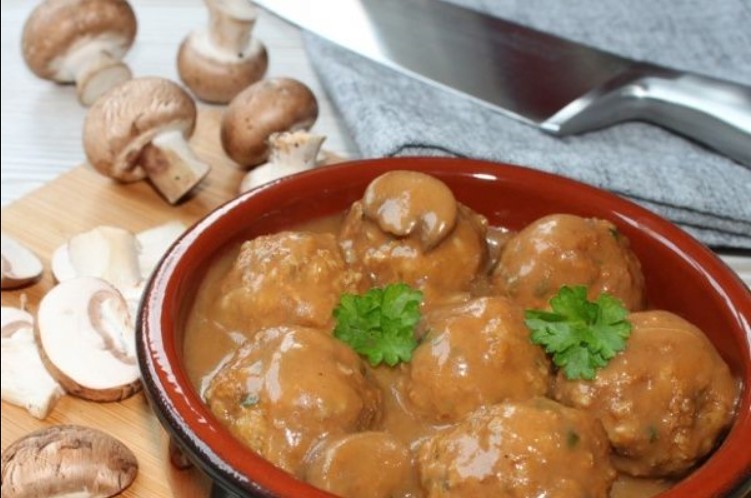
How to cook:
- Boil the potatoes in their skins. Once cooked and cooled, peel them.
- Fry finely chopped mushrooms in vegetable oil for a quarter of an hour.
- Place the potatoes and mushrooms in a bowl and blend. Add finely chopped dill.
- Add flour and form meatballs.
- Boil in boiling water for 10 minutes.
This dish can be given to children from 4 years old.
Cabbage rolls with mushrooms
Necessary products:
- cabbage - 1 head;
- champignons - 250 g;
- onion - 1 pc.;
- rice - 0.5 tbsp;
- a small amount of sunflower oil.
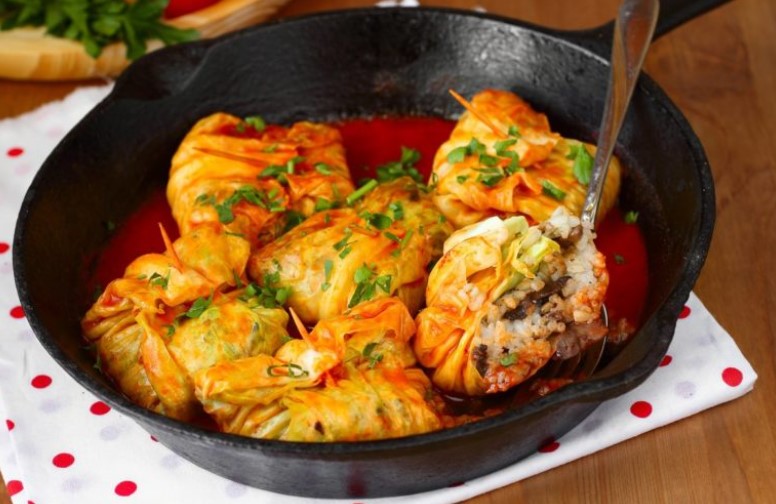
Recipe:
- Wash and clean the mushrooms, cut them into small pieces.
- Fry the onion in vegetable oil and add the mushrooms.
- Boil the rice until half cooked.
- Mix the mushroom filling with rice.
- Place the cabbage head in a suitable sized saucepan filled with water.
- When ready, remove the top sheets.
- Stuff the cooled sheets with the filling and wrap them into an envelope.
- Place them in a deep saucepan, cover with a small amount of water, and simmer for half an hour over medium heat.
Before serving, the dish can be garnished with herbs.
Champignons and chicken fillet
Necessary products
- chicken fillet - 700 g;
- carrots - 1 pc.;
- water - 1 glass;
- champignons - 400 g;
- flour - 1 tbsp;
- salt and pepper to taste.
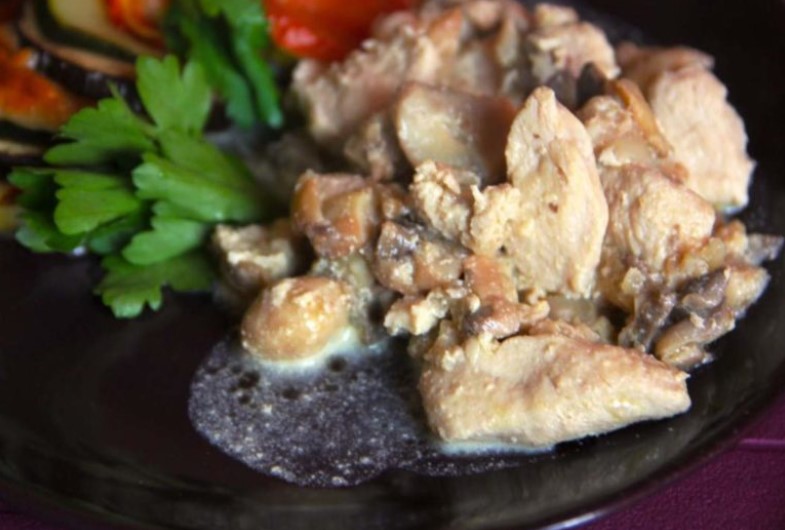
Recipe:
- Cut the chicken into small pieces and fry.
- Cut the carrots into cubes and add to the bird.
- Cut mushrooms and onions into half rings.
- Add to the meat. Simmer under a closed lid until the moisture evaporates.
- Add water, flour, pepper and salt.
- Mix everything thoroughly and simmer for another 20 minutes on low heat.
The dish is suitable for children 7-10 years old.
Serving instructions and portion sizes
Children should be offered mushroom dishes no more than once a week in small portions. It's best to eat them in the first half of the day to facilitate digestion.
It's important to monitor your child's bowel movements. If constipation occurs after eating mushrooms, avoid them altogether.
Portion sizes will vary depending on age:
- Starting from two years of age, it is allowed to give one small mushroom per week.
- For children three years old, the number can be increased to two.
- At the age of four, you are allowed to eat 3 mushrooms.
- Children aged five and six years should be given 4 and 5 pieces respectively.
According to Dr. Komarovsky, champignons can be introduced into a child's diet starting at age two. However, in any case, the decision to introduce them rests with the parents. There is no urgent need for this product, so its introduction can be delayed until later. This will help eliminate the risk of unwanted side effects such as allergies and gastrointestinal problems.
Reviews from mothers about feeding children champignons, and expert recommendations
Wild mushrooms are not allowed. Farmed champignons and oyster mushrooms can be introduced in small quantities from the age of 1.5. There are baby food products containing these mushrooms.
I've learned from personal experience that it's best not to give children mushrooms at that age. I love them too and often add them to various dishes. I decided to give my child a try. She ate them, but then they came out in poop. That is, she didn't digest them, even though they were chopped very finely.
My son is 1.3 years old, and he's been eating everything we eat for a long time now (I'm a big believer in healthy food). He's my second child. There are also mothers who are introducing him to food "from jars," and I can tell you, there are no products without preservatives, which last SO LONG! It's better to let him get used to normal food gradually! I have a friend who's a complete vegetarian! She practically fed her little one mushrooms and all that stuff from the womb, and after he turned one, she started introducing him to "the common table," and everything is great (considering what vegetarians eat)! I can tell you, it's all individual; you can gradually introduce any food (on the tip of a teaspoon)! In different countries, everything is completely different... There are even places where even our beloved carrots are considered exclusively cattle feed! And accordingly, they are not given to the child...
The main question is, why? What vitamins are so valuable that they need to be given urgently? My eldest was so poisoned by them at 2.5 that he didn't eat mushrooms at all until he was 10. He grew up just fine. We won't give them to the youngest.
My daughter started giving them to her when she was about 3, in mushroom soup. She loved it; mushroom soup is still her favorite! She adores it! My son ate it even earlier, when he was about 2. My sister eats soup and he needs it, and maybe even earlier—maybe he was "fishing" mushrooms out of soup and eating them when he was about 6 months old. :)) She's never had any stomach issues. But mushrooms (mostly champignons) are mostly given to us in soup—two or three times a month. Fried, stewed, and other kinds are given very rarely, and we eat wild mushrooms a couple of times a year.
I live abroad, and here they give everything to children. Some mothers even scare me. For example, my one-year-old devours chocolate and chips. My 2.3-year-old only recently tried baby chocolate mousse. I don't give her candy. I also saw canned mushroom food with meat and mushrooms at the store for children starting from 7 months. I was surprised. I sometimes cook dishes with greenhouse porcini mushrooms or champignons, but she doesn't eat them. I try to remove them from her stews, but they are present. Nothing has happened to her. But I think not until she's 3-4 years old, and then it's up to you. I've read on foreign websites now, and they also don't recommend giving them to small children, especially those picked in the forest, because it can cause poisoning, stomach problems, and allergies.
They don't recommend giving lamellar mushrooms (chanterelles, champignons, etc.) to children under 12 years of age... And tubular mushrooms (porcini mushrooms, etc.) to children under 7 years of age... Some doctor told me this on a health forum... And then I came across it online, more than once... And my aunt, who is a doctor, said the same thing... Perhaps they are right: a child's stomach is not adapted to such heavy food...
But as children, we ate, and grandma didn’t have time to adjust to us: there were 11 of us grandchildren, and then there was the farm and work in the field, there was no way for everyone to get ready!
Don't throw tomatoes... I fed my daughter at 1.1 years old soup with champignons, I didn't give her the mushrooms themselves, only mushroom broth, potatoes, noodles, carrots... and this happened 4 times, everything is fine with the child.
He's been eating mushrooms since he was 2 years old. Why are they harder to digest than meat?
Mushrooms are my obsession. I've eaten fried milk mushrooms, in soup, and salted milk mushrooms in sour cream. Just a little bit, of course.
My child is now 1.8 years old. I've been giving him mushrooms since he was a year old. I add them to mashed potatoes and soup. He's doing just fine, he's just munching away! When he was a year old, we went to Germany to visit relatives, and I saw mushrooms in the baby food there. I've been giving them to him confidently ever since.
Mushrooms are "plant meat" encased in a chitinous shell—a substance that's very difficult to digest even in adults (for comparison, the shells of crustaceans are made of chitin). Not to mention a child's immature digestive system. Mushrooms are also capable of absorbing toxic substances, which are abundant in the environment, like a sponge. In this regard, farmed champignons and oyster mushrooms are healthier. Don't risk it before age 10-12; there are plenty of other foods around.
Pediatrician SaifulinaChildren under two years of age should not be fed mushrooms under any circumstances.
"Children under two years of age should not be given mushrooms. From age two, they can be gradually introduced into their diet, but only farmed varieties, such as button mushrooms. At age three, mushroom puree can be offered as a supplement to the main meal, but no more than once a month," the doctor warns.
From age five, children can be served oyster mushrooms or champignons in sauces or as an addition to a main dish, using one or two spoonfuls. After age five, porcini mushrooms (boletus) can be eaten, but only the caps. However, according to Saifulina, much depends on the cooking method.
"After five years, you can add fried mushrooms to your child's diet. Marinated or salted mushrooms are recommended only for children over ten years of age," she clarified.
Pediatricians do not recommend introducing other wild mushrooms such as chanterelles, aspen mushrooms, and birch boletes into a child's diet until at least the age of ten.