Honey mushrooms grow throughout Russia and are edible. They can be harvested year-round, including winter. Most species in this family share several characteristics: they are parasitic mushrooms that grow on trees, stumps, and in large groups. They are almost never worm-infested and have excellent flavor.
Types of honey mushrooms
In our country you can find 4 edible species of these mushrooms:
- real, autumnal;
- meadow;
- summer;
- winter.
They differ from each other in appearance, growing season, and growing places.
Meadow honey mushrooms (non-rotting mushroom, meadow mushroom)
These mushrooms are the first to appear, in early spring.
Collection season: from May to July.
They grow in circles in clearings and along forest roadsides. Like many members of their family, meadow honey mushrooms glow faintly in the dark. This has given rise to many superstitions. For example, our ancestors believed that these mushrooms grew in places where witches danced and that their light could lead and bewitch travelers.
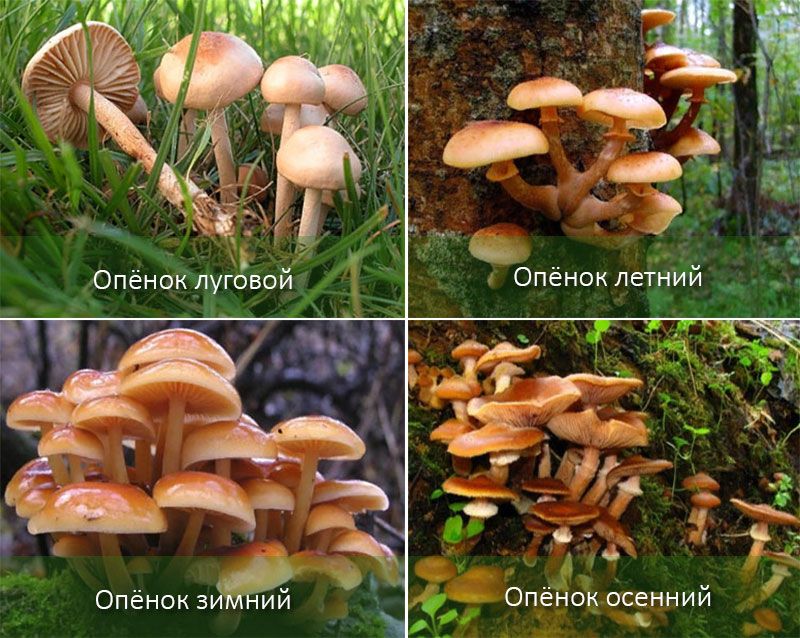
Appearance: A thick, thin stem up to 10 cm long, a yellow-brown cap that darkens toward the center, and gills are closely attached to the cap. The mushrooms themselves are very small, weighing about 1 gram.
Unlike their other relatives, meadow grasses love open space and do not grow on stumps and trees.
Read more in the article about meadow honey mushrooms.
Summer (linden, talker)
Summer honey mushrooms can be found in mixed or deciduous forests in northern latitudes with a temperate climate. However, in mountainous areas, they nest in spruce and pine trees.
Harvest season: April-November.
In a favorable climate, they can bear fruit year-round. They grow in large clusters on rotten wood and stumps. Appearance: a stem up to 7 cm tall, a dark brown cap with a lighter tubercle in the center, and closely spaced gills.
Young mushrooms have a clearly visible, narrow, membranous veil arranged in a ring, but this may disappear with age. The absence of a ring is also characteristic of similar poisonous mushrooms.
Also read the article about summer honey mushrooms.
Autumn (real)
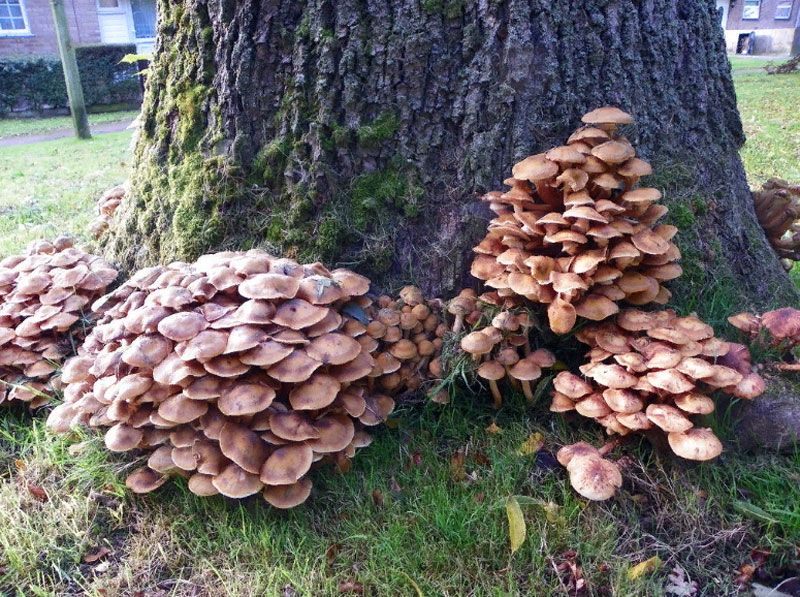
The most common species of honey fungus, it grows in any climate except permafrost regions. It prefers tree trunks and stumps. Like most of its relatives, it is parasitic, but this species attacks not only trees but also herbaceous plants, including potatoes. It grows in large groups, preferring moist areas.
Harvest season: from August until the first frost.
Appearance: a larger cap (average size 9-10 cm, sometimes grows up to 17 cm) can be different shades of yellow (from greenish-yellow to brownish), a dense stem up to 10 cm high covered with scales, a clearly visible ring under the cap.
The cap's color depends on the tree where the mushrooms grow: brown ones grow on conifers and oaks; lighter ones on deciduous trees; and yellow ones on poplars. The cap is inseparable from the stem.
Read more in article about autumn honey mushrooms on the portal Top.tomathouse.com.
Winter (winter mushroom)
Winter honey mushrooms are the only mushrooms that cannot be confused with their poisonous counterparts. Unlike all other mushrooms, winter honey mushrooms tolerate frost well, simply stopping their growth during cold spells.
With the arrival of warmer weather, they "wake up" and continue growing. They also take up tree trunks and stumps to grow. They are most often found on poplar and maple trees. They grow in the temperate climate of the Northern Hemisphere.
Harvesting season: November-March.
They grow higher up the trunk, so a long stick with a hook is required for "hunting." They are similar in appearance to summer mushrooms, but have a bright orange-red cap and lack a "skirt." Experts recommend subjecting this species to longer heat treatments, as they can accumulate toxins.
Winter honey mushrooms are very popular in the East (in Japan, Korea), and are grown in industrial quantities of up to 100 tons per year.
Be sure to read the article about it, How to grow honey mushrooms at home.
Top.tomathouse.com recommends: rules for harvesting honey mushrooms
The most important thing when collecting mushrooms is to be able to distinguish edible from inedible ones. In the forest, you can find many false mushrooms that are dangerous to humans but look like honey mushrooms.
Important: If you have any doubts about the edibility of a mushroom, do not eat it. Read about false honey mushrooms.
Signs that a mushroom is inedible:
- Lack of a "skirt".
- An unpleasant or earthy smell (real ones have a pleasant mushroomy aroma, with light woody notes).
- The winter variety has a brightly colored cap, while false mushrooms are smooth and edible mushrooms have small scales. Old honey mushrooms can also be smooth, but inexperienced mushroom pickers shouldn't risk it.
- The gills are yellow or green (edible mushroom with light-colored gills, sometimes yellowish).
- Bitter taste. But this method of testing is for the most extreme cases.
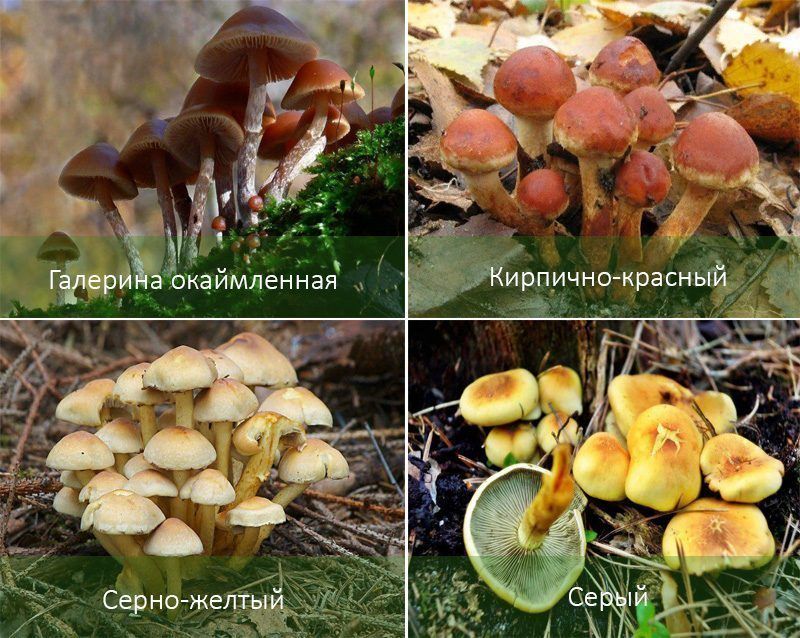
To be sure, it is better to consult with an experienced person.
Also, avoid picking honey mushrooms near industrial facilities. They, like many other mushrooms, can accumulate heavy metals.
It's best to pick honey mushrooms after a rainy season, when the weather clears. The mushrooms are usually most abundant 3-4 days after rain.
Once you've harvested the mushrooms, it's worth remembering their location. These mushrooms don't like to change their habitat, preferring the same one year after year.
The weather alone will determine when honey mushrooms will be available in the Moscow region, but traditionally, autumn mushrooms can be picked as early as September. When picking, be very careful, as brick-red mushrooms, which are not suitable for eating, are often found in the forests near Moscow. The distinguishing characteristics are the same.
In addition to their wonderful taste, honey mushrooms have traditionally been used in cosmetology and medicine. In the East, they are still used to treat joints, cramps, and muscle relaxation.
Contraindications to the use of honey mushrooms
It is worth taking with caution:
- people prone to intestinal and stomach diseases;
- children under 7 years old;
- women during pregnancy and breastfeeding.
Honey mushrooms are delicious and healthy mushrooms, rich in vitamins and minerals. However, like any other food, they require moderation in consumption. This will only provide health benefits.