The golden scaly cap differs from the common honey fungus in appearance: it's larger, with small scales on its cap that resemble a hedgehog's spines. In Japan, the mushroom is grown on rotten tree stumps, but in Russia, for some reason, mushroom pickers often distrust it, not considering it edible. It's best to harvest royal honey fungus in late summer or early October.
Description and characteristics of the mushroom
| Parameter | Characteristic |
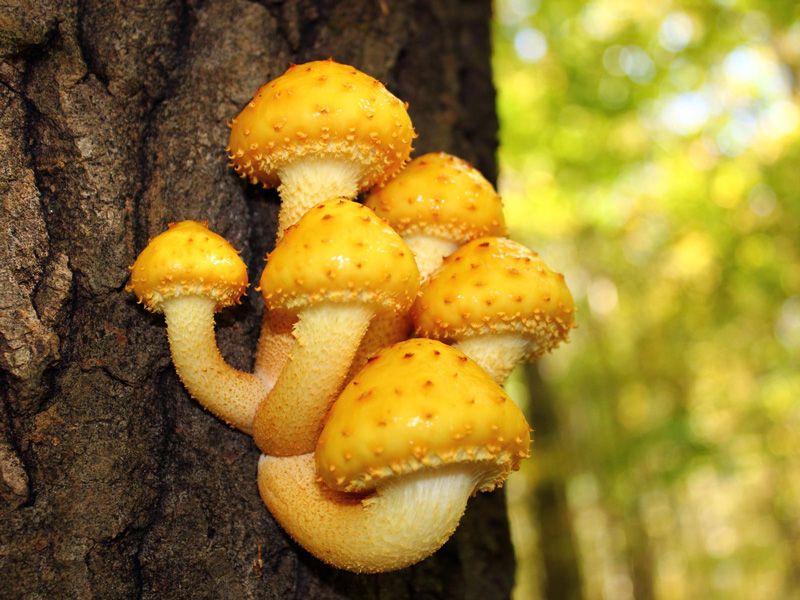
| hat | Young mushrooms are 5-10 centimeters in diameter, while mature mushrooms are 10-20 centimeters. The cap is broadly bell-shaped, becoming flattened and rounded with age. The color ranges from yellow and bright red to golden. Numerous red scales, resembling flakes, are scattered throughout the cap. |
| Leg | Length: 6-12 centimeters, diameter: 2 centimeters. Dense, with fuzzy yellow or golden scales. It has a fibrous ring that disappears over time. |
| Records | The wide, dark-brown gills on the stem begin as light straw, darkening over time. |
| Pulp | Light yellow, has a pleasant smell. |
For more information on other types of honey mushrooms and where they grow, read the following articles:
Honey mushrooms: all types and their characteristics;
Summer honey mushrooms and their differences from false ones;
Autumn honey fungus: when and where to collect?;
What are false honey mushrooms and how do they differ from edible ones?.
Where do golden scales grow and when to collect them?
Scaly honey mushrooms grow in swampy forested areas, most often near old stumps, next to alder, willow, poplar, and less often, birch trees.
The peak season for picking these mushrooms is late August and mid-October. In Primorsky Krai, where the climate is warmer, they can be picked from late May. King honey mushrooms are fairly easy to find: they grow in large families. However, precisely because of the timing of their collection, they are often confused with their poisonous lookalikes.
The main way to distinguish edible mushrooms from false ones is to look at where they grow. Good honey mushrooms grow on dead trees.
Read the article to find out where and when to collect different types of honey mushrooms.Where do honey mushrooms grow and when to collect them depending on the species?.
Top.tomathouse.com warns of dangerous lookalikes
The edible royal honey fungus is difficult to confuse with its poisonous lookalikes, thanks to its red coloring and sharp, needle-like scales. However, novice mushroom pickers may be mistaken and collect the golden scales instead:
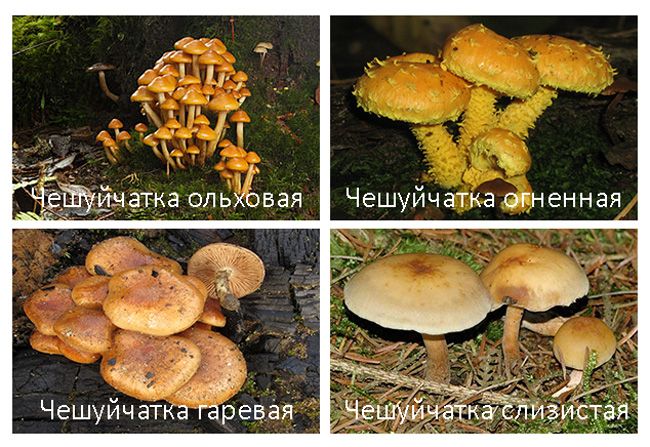
- Alder moth (Pholiota alnicola). Its main distinguishing feature is its small size. The stems never exceed 8 centimeters in length, and the cap (yellowish) is 6 centimeters in diameter. It is only 0.4 centimeters thick. It has a bitter and unpleasant odor.
- The Flame Oyster (Pholiota flammans) is distinguished by its very bright color and perfectly shaped scales (a shade lighter than those of the edible mushroom). This false honey fungus is easily identified by its habitat; unlike the royal mushrooms, which grow in clusters, it prefers solitary growth and is found in mixed and coniferous forests. It is not poisonous, but should not be consumed.
- The charred wood cap (Pholiota highlandensis) is a small mushroom with a dark brown cap covered in fuzzy scales. The cap and stem are often coated in mucus. This mushroom prefers charred wood.
- Slimy scale cap (Pholiota lubrica). It is considered conditionally edible. The cap is large, but the scales are few and always light-colored. Rings are absent from the very beginning.
Read more about false honey mushrooms in the articleWhat are false honey mushrooms and how do they differ from edible ones?.
Calorie content, benefits, and harms of royal honey mushrooms
Nutritional value per 100 grams: 21 kcal.
Golden scaly mushrooms contain a lot of phosphorus, calcium, iron, and magnesium. They strengthen the immune system, normalize blood composition (increase the number of erythrocytes (red blood cells) in the blood), improve thyroid function, and replenish potassium. In folk medicine, these mushrooms are used to treat diabetes, thrombophlebitis, and anemia.
When preparing honey fungus, it's essential to boil it, then stew or fry it. The caps are used for most dishes; the stems are best marinated.
The mushroom is prohibited for consumption in case of gastrointestinal disorders and food allergies.