The honey fungus is an edible parasitic mushroom that grows on wood (less commonly on herbaceous plants) and gradually destroys it. Most species in the genus are saprophytes, meaning they grow on stumps and dead trees. It has a wide range of habitats, and is not found in permafrost areas.
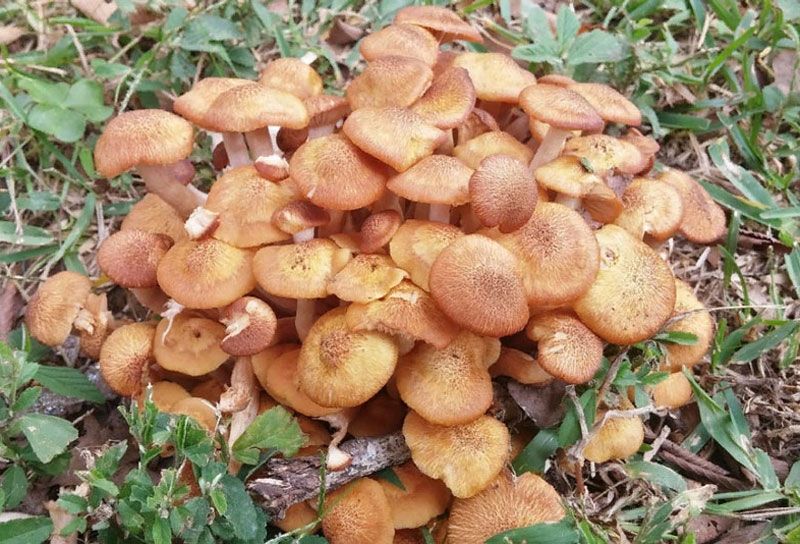
Honey mushrooms spread between trees using mycelium, the length of which can reach several meters.
Because the mycelium accumulates phosphorus, it can be seen at night by its faint glow. The mushrooms grow in large groups, preferring the same locations year after year. The harvesting season is year-round.
Honey mushrooms of different species, and even of the same species, can look different, depending on the forest and wood on which they grew.
Types of honey mushrooms
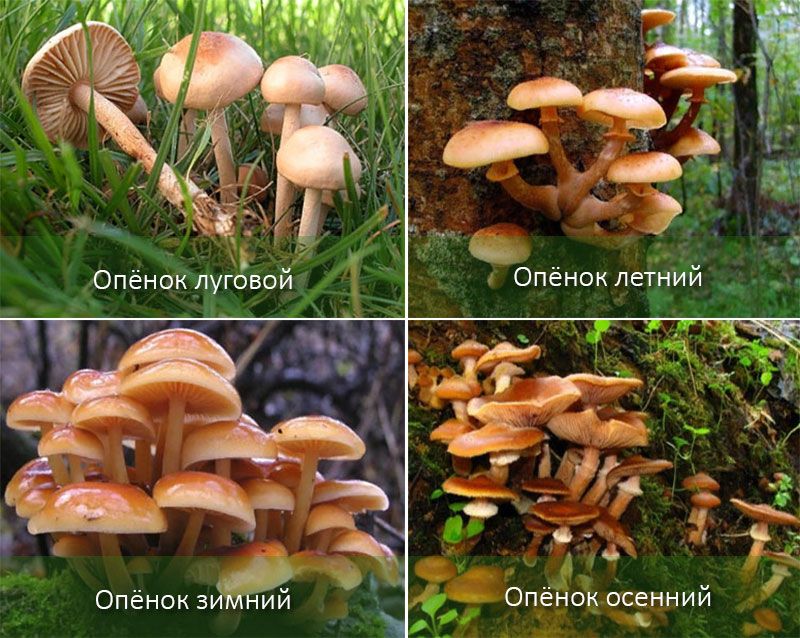
The most common ones are:
| View | External signs | Where they grow Harvest season |
Facts |
| Summer | Cap: yellow-brown, up to 8 cm in diameter, lighter in the center. Plates: light yellow, adnate. Stem: 3-8 cm, curved, rigid, with a dark ring. |
Deciduous trees, on stumps and rotting wood. Less commonly in coniferous forests. From June to October. |
The species is highly variable depending on the weather and growing location. It often loses its characteristic features. Hence the species' Latin name, "variable." |
| Autumn (real) | Cap: 5-10 cm, spherical, straightens with age, grey-yellow or yellowish-brown, covered with small scales. Plates: frequent, brown. Stem: 6-12 cm, white ring at the top. |
Deciduous forests. They settle on both dead and living trees.
August-October. |
It grows in several "waves" at two-week intervals. It is the most popular of the entire family. |
| Winter (Flammulina, Collybia, Winter Mushroom) | Cap: yellow, hemispherical, straightens out over time. Plates: free, fused. Leg: up to 8 cm, hard. |
Deciduous trees, located high on the trunk.
Autumn-winter. |
The Japanese call it the "noodle mushroom." It's unique: its cells, damaged by the cold, are restored during the thaw, and the mushroom continues to grow. There are no poisonous mushrooms similar to it in nature. |
| Spring (meadow, non-rotting, meadow, marasmus) | Cap: diameter 2-5 cm, conical (straightens in older mushrooms), yellow-brown. Plates: sparse, wide, light cream. Stem: 3-6 cm, solid, rigid. |
Meadows, roadsides of forest roads, forest clearings.
Beginning of summer until the end of October. |
It grows in circles and is harvested with scissors. It's the very first mushroom of the year. |
| Seroplated (poppy) | Cap, 3-7 cm, hygrophanous, color depends on humidity (from dull yellow to light brown when wet). Plates: frequent, adherent, light, poppy seed-colored. Stem: 5-10 cm, curved. |
Found only in coniferous forests, on stumps and roots. Temperate climate zone in the Northern Hemisphere. Spring-autumn (in mild climates and in winter). |
Old mushrooms acquire an unpleasant musty taste. |
| Dark (ground, spruce) | Cap: yellow, up to 10 cm, dense, edges hanging down. Leg: high, has a ring, no smell. |
Mixed forests, settles at the base of stumps.
Late summer – mid-autumn. |
Similar to the autumn honey fungus, it has firmer flesh and a bitter taste. |
| Thick-legged (bulbous) | Cap: 3-8 cm, hemispherical, straightens with growth, color varies depending on the place of growth. Plates: frequent, yellowish-white. Stem: 4-8 cm, has a ring, characteristic thickening at the bottom. |
On rotting trees and ground.
August-October. |
It bears fruit constantly and grows in smaller groups than the autumn variety. |
| Shrinking | Cap: 3-10 cm, convex shape: a noticeable tubercle in the center of the cap, the cap itself is dry with scales, reddish-brown. Plates: white or pinkish. Leg: 7-20 cm, no ring. The flesh is brown or white and has a strong odor. |
Tree trunks and branches, stumps.
June - mid-December. |
First described in 1772. Edible mushroom, considered tasty. |
| Royal | Cap: up to 20 cm, bell-shaped, rusty-yellow, covered with scales; Leg: up to 20 cm in height, with a ring. |
They grow solitarily in deciduous forests.
Summer-autumn. |
Useful for anemia. |
| Poplar | Cap: dark brown, velvety, spherical. Leg: 15 cm, silky, fluff above the skirt. The pulp has a starchy taste and wine aroma. |
On deciduous trees (mainly poplar, birch, willow).
Summer-autumn |
Cultivated in Italy and France, it contains methionine, an essential amino acid for the human body, and is a natural antibiotic. Lectin, a substance used for cancer prevention, is produced from the poplar honey fungus. |
Also read, When and where to collect honey mushrooms and important tips for collecting them!
Dangerous Doubles
Most often these mushrooms are confused with false honey mushrooms or toadstools.
| Signs of a false honey fungus | Signs of toadstools |
|
|
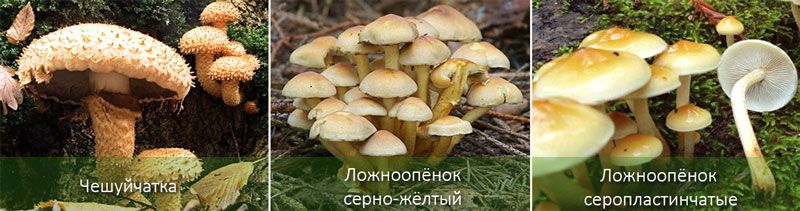
Read more about false honey mushrooms in the articleWhat are false honey mushrooms and how do they differ from edible ones?.
Benefits and harms
| Beneficial properties | Contraindications |
|
|
If you're curious about how to grow honey mushrooms at home, read about it at Top.tomathouse.com..
Usage options
Usually only the cap is eaten, as the stem is tough.
Basic cooking methods: frying, salting, marinating.
Stores perfectly in dry And frozen form. Before any type of cooking, they require preliminary cooking at least 40 minutes
Winter honey mushrooms require longer heat treatment, as they can accumulate heavy metals.
You should not eat honey mushrooms collected near large industrial enterprises.