
Sometimes the leaves of houseplants begin to turn yellow and dry out. Often, improper care is the culprit. In this article, we'll look at all the possible causes and tell you what to do. But first, a few words about the plant itself.
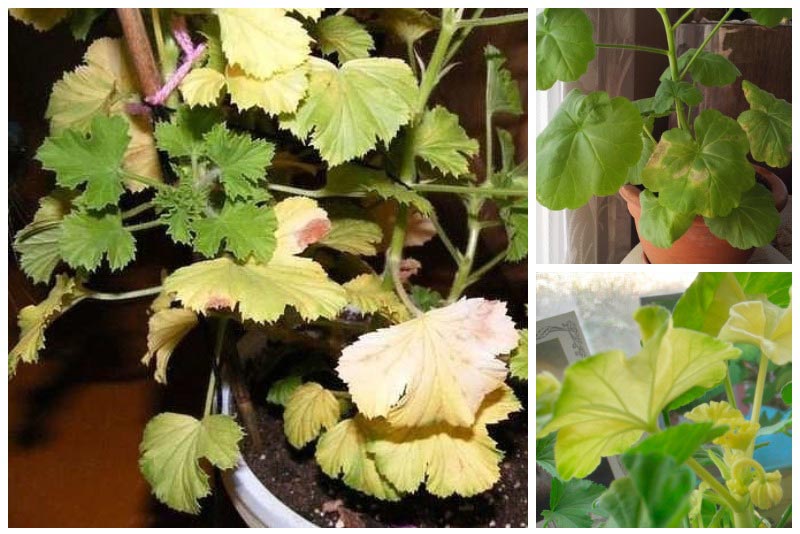
The pelargonium we grow at home (mistakenly called geranium) is a beautiful and easy-to-grow houseplant. It fits perfectly into a garden landscape, as it thrives outdoors. It makes a wonderful home decoration, a bright reminder of summer. Sometimes the foliage of the "geranium" turns yellow at the edges. Gradually, the foliage dries out and falls off, significantly deteriorating its appearance.
If you don't take care of your flowers promptly, they will die. Therefore, it's important to learn the common mistakes when growing geraniums to ensure they always look their best.
Content
The main reasons for yellowing of geranium leaves
The main reasons for yellowness:
- growing conditions are violated;
- the capacity is not selected correctly;
- excess or deficiency of fertilizers;
- diseases;
- irregular watering.
For any reason, all yellow leaves should be removed, then any care deficiencies should be corrected. If this doesn't help, repotting into new soil will be necessary. All roots should be rinsed with a weak solution of potassium permanganate.
Mistakes in caring for indoor geraniums
Improper care is the main reason why geraniums turn yellow. This plant is easy to grow, but basic rules for its development must be followed. Knowing the common mistakes makes it easier to understand what your favorite houseplant needs.
Incorrect capacity
Choosing a pot for pelargoniums requires careful consideration. Some novice gardeners mistakenly believe that the roots need plenty of space. However, this isn't ideal for all plants.
An indoor geranium in a cramped container will quickly become overcrowded with roots, slowing growth. Eventually, the leaves will begin to yellow and dry out. Using a very large pot isn't a solution either. In a spacious pot, the pelargonium will begin to rapidly develop its root system, devoting all its energy to this process. This will delay flowering.
Over a large area there is a risk of moisture stagnation, which will lead to the development of rot.
Too little or too much lighting
Pelargoniums are sun-loving plants. They're best placed on a windowsill with ample light. In the shade, the leaves will develop a yellow border and begin to dry out. However, direct sunlight is also harmful to pelargoniums, causing brown burns.
Too much watering
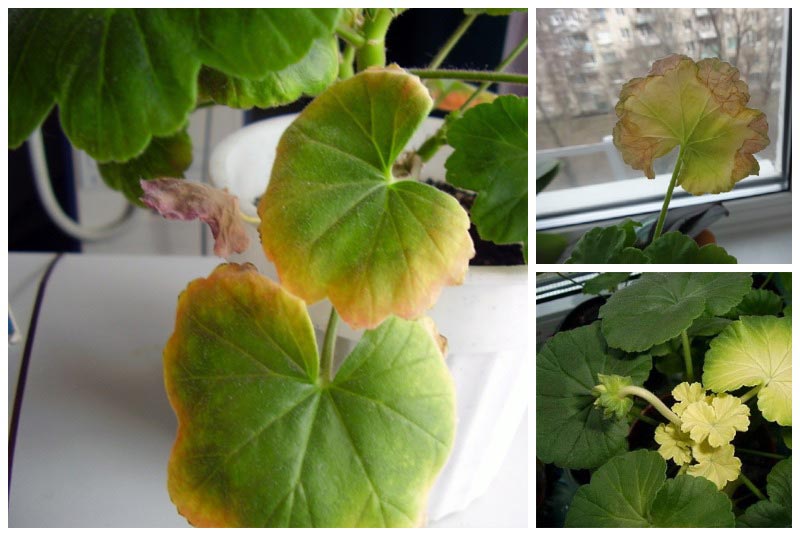
Indoor geraniums are drought-tolerant, so keep this in mind when caring for them. Watering once a week is sufficient. During hot summers, the frequency can be increased. The plant does not tolerate excess moisture. A characteristic sign is yellowing of the foliage.
Lack of regular watering
Indoor geraniums are fussy about watering. They don't tolerate lack of moisture and don't do well with overwatering. Find a compromise: water the soil when it dries out to a depth of 2.5 cm. If this is difficult to maintain, mulching the soil is a good option. Pine bark, peat, crushed stone, tea, moss, and marble chips are all suitable. This will increase the time between waterings, reduce the risk of rot, and prevent leaf yellowing.
Incorrectly selected soil
To ensure proper root growth, pelargoniums require a special loose, fertile soil mix. This can be purchased at a store. Soil collected from a yard or forest may be unsuitable for indoor geraniums and will result in poor growth and a lack of flowering.
Also read the article about varieties of pelargonium and proper care for it.
High air humidity
Not only the root system, but also the leaves are sensitive to excess water.
Avoid spraying the plant with a spray bottle. This will negatively affect the color of the foliage, causing it to turn yellow.
High temperature
Indoor geraniums grow best at temperatures of 20°C (68°F). High temperatures can cause yellowing of the leaves. This is especially common in winter, when radiators overheat the air around the windowsill where the plant is placed. As the weather cools, pelargonium growth slows, and flowering is delayed. It prepares to die.
Lack of fertilizers
Active growth and profuse flowering require good nutrition. This requires iron, phosphorus, and potassium. Nutrients should be applied regularly, once a month. You can purchase a general-purpose, low-nitrogen indoor flowering plant mix.
We recommend reading the article about Why your pelargonium may not bloom.
Herbicide contamination
If the leaves of your indoor geranium turn yellow and dry out, it's possible the plant has been exposed to chemicals, such as weed killers. Pelargoniums are sensitive to household hygiene products and cosmetics, such as air fresheners and hairsprays.
Drafts
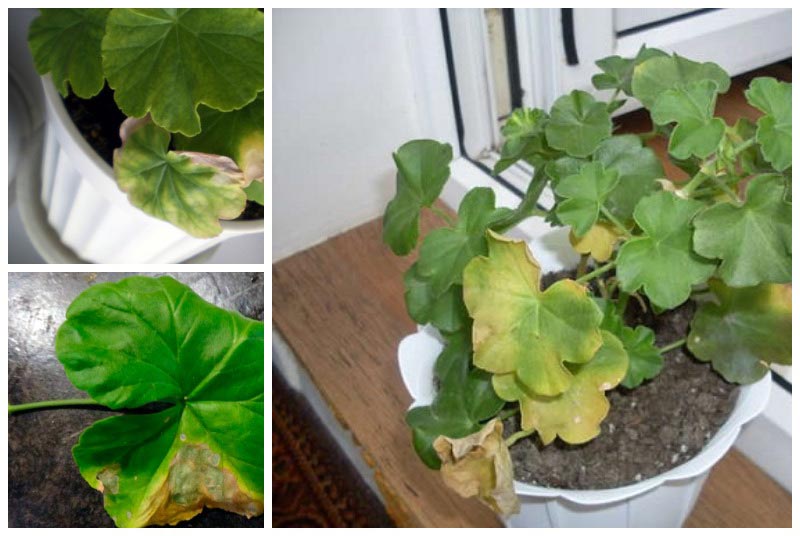
Indoor geraniums are often placed on windowsills. It's no surprise, as this beautiful plant is always a joy to behold. However, regular airing can damage the pelargonium's appearance. The leaves begin to turn yellow and dry out, and eventually they all fall off. This can be remedied by choosing a wind-free location.
Poor or no drainage
To drain excess moisture away from the root system, the pot must have a drainage layer. Without one, rot begins, gradually destroying the entire plant. This can be detected by the leaves, which begin to turn yellow for no apparent reason.
Diseases and pests
If, despite proper care, geranium leaves continue to turn yellow, the cause may be houseplant diseases.
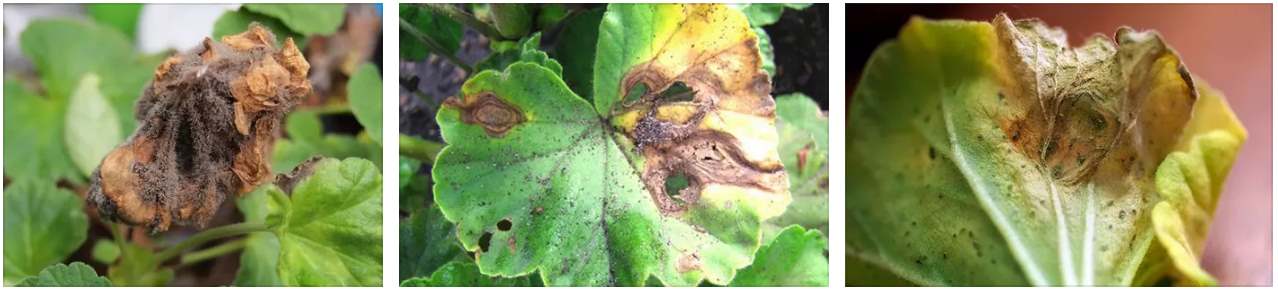
Gray mold
The pathogen is Botrytis cinerea (gray botrytis). It lives in the soil for one to two years. It spreads by wind, soil, water, and other infected plants.
Reasons:
- moisture stagnation:
- high air humidity;
- overspraying;
- large amount of nitrogen in the soil;
- poor ventilation.
The disease is characterized by foliar lesions, which develop into velvety patches and brown spots. The lower leaves are most affected.
First aid: treatment with fungicides (Fundazol, Vitaros).
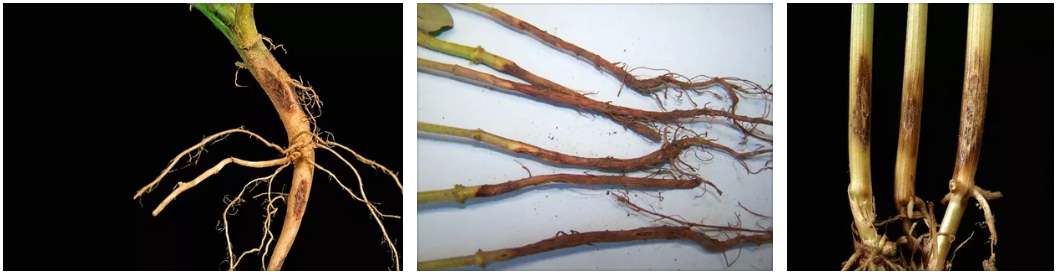
Rhizoctonia leaf rot
Pathogen: Rhizoctonia solani. Infection occurs through soil.
Reasons:
- excessive amount of fertilizers;
- exceeding the permissible maintenance temperature;
- excess moisture;
- lack of light;
- poor ventilation;
- a difference of 6...8 °C between the temperature of the soil and the surrounding air.
The disease attacks the roots and stems of the plant, causing sunken spots to appear on the stem. The fungus then spreads along these spots (to a height of no more than 25 cm).
First aid: stop watering and treat with fungicides (Fundazol, Vitaros, Rovral).
Alternaria
Pathogen: Alternaria alternata. Infection occurs through the soil, especially under greenhouse conditions (warm and humid).
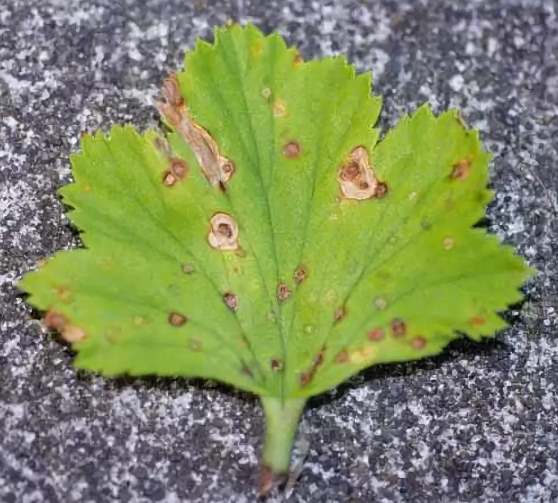
The reason is high humidity.
Yellow and brown spots with light centers appear on the leaves. In high humidity, they become covered with a dark velvety texture. The disease most often affects zonal pelargoniums.
First aid: treatment with fungicides (Skor, Ridomil Gold, Rovral).
Verticillium wilt
Pathogens: Verticillium dahliae and albo-atrum. It lives in the soil for up to 15 years. Infection occurs through damaged roots when rooting cuttings.
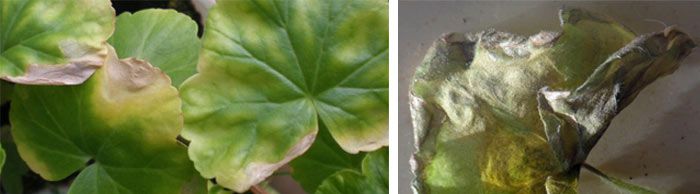
The disease is especially active in summer, when the weather is warm and the soil dries out quickly.
It begins with yellowing of the lower leaves. Eventually, the disease spreads to the entire plant. In severe cases, the pelargonium must be discarded along with the soil.
First aid: maintaining proper soil moisture and treating with fungicides (Fundazol, Vitaros, Rovral).
Rust
Pathogen: Puccinia pelargonii-zonalis. Transmitted through other infected plants via water and air.
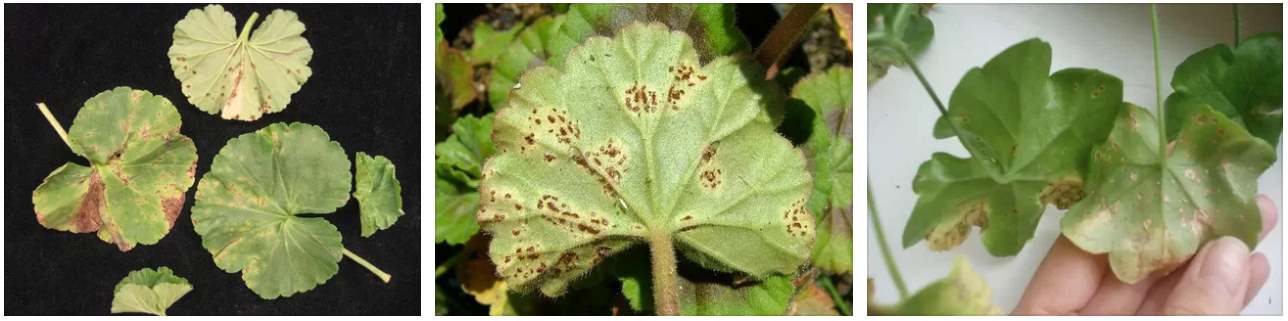
The onset of the disease can be identified by brown spots on the stem. Then the leaves begin to turn yellow. Gradually, they all fall off.
First aid: reduce air humidity, stop spraying, remove diseased leaves, treat with fungicides (Topaz).
If your indoor geranium turns yellow, inspect it; it may be infested with pests. These rarely infest pelargoniums, as their strong, distinctive odor repels them.
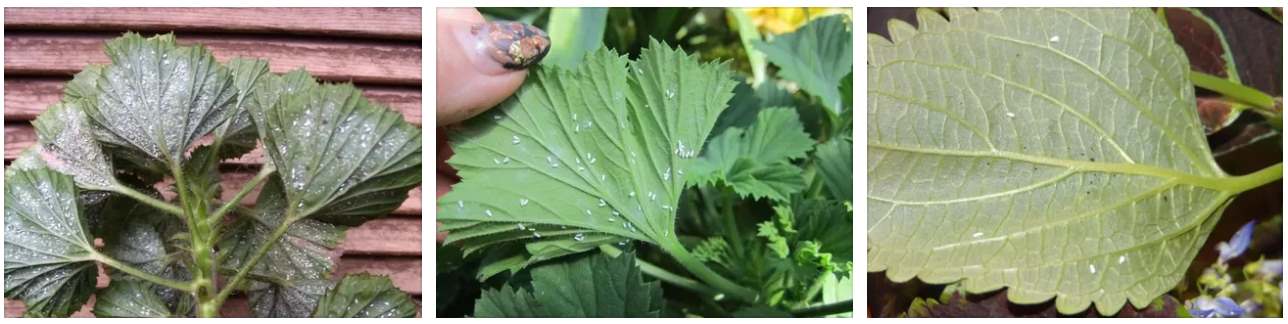
Pelargoniums are commonly plagued by whiteflies. They live and lay their eggs under the flowers. If the pest colony grows to a large size, the leaves turn yellow or brown. Whiteflies can be seen with the naked eye. They are up to 3 mm in size and have white wings.
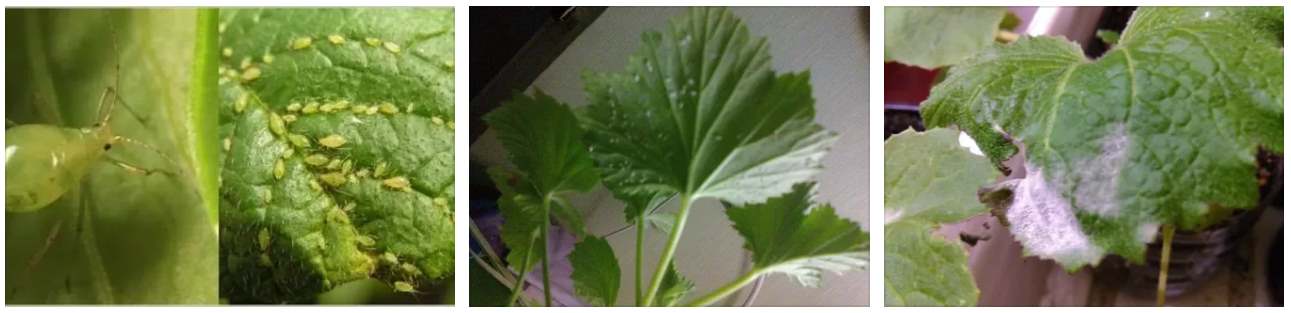
When geranium leaves begin to turn yellow and curl inward, it's an aphid infestation. Getting rid of them is difficult, but possible. To do this, remove all affected parts of the plant and then treat with Fitoverm or Mospilan.
We recommend reading the article about Why do indoor geranium leaves curl and dry out, and what can be done about it?.
Top.tomathouse.com informs: first aid for geraniums and prevention
An indoor geranium with yellowed leaves can be saved. Here are some quick tips for helping your pelargonium:
- When replanting, inspect the roots for rot and disease; if damaged, wash them with a weak solution of potassium permanganate and completely change the soil;
- In autumn and winter, the flower pot is placed further away from heating batteries; it can be taken out onto a glazed balcony (if the temperature there does not drop below +12 °C);
- water with soft water, let it sit for a long time and add a pinch of citric acid or lemon juice (3-4 drops);
- constantly inspect for damage by insects and fungi, and take timely measures to get rid of them;
- The soil is selected in the store; it is a universal soil for indoor plants;
- If the surrounding air is dry, do not moisten the pelargonium with a spray bottle; it is best to place a cup of water or wet expanded clay next to it;
- Feed regularly, as the flower is sensitive to the lack of nutrients (choose complex fertilizers in the store);
- To ensure pelargonium blooms profusely, prune it in the spring, leaving a few shoots;
- if the plant stretches to one side, the pot is turned towards the sunny side with different sides;
- Before watering, loosen the soil, the root system of pelargonium needs oxygen;
- in winter, make sure the leaves do not touch the cold glass, as this will cause them to dry out, turn yellow and fall off prematurely;
- on a hot summer day, the window on the sunny side is shaded with a sheet of paper or a piece of gauze;
- If the windowsill is cold in winter, to insulate the roots, place a wooden kitchen trivet, a towel, or several layers of woolen fabric under the pot;
- If there is no drainage layer in the pot with geranium, and replanting is not going to happen soon, then regularly pierce the soil in several places with a hot knitting needle;
- In winter, cover the radiators with a damp, thick towel; this will help eliminate the high temperature in the room and the air that is too dry for the pelargonium on the windowsill;
- A ceramic pot is a good container for indoor geraniums. The porous clay allows air to pass through, excess water evaporates faster, and air reaches the root system.
Beautiful green leaves of pelargoniums indicate a healthy plant and proper care. Changes in color indicate disease, pests, or plant problems.
I disagree about the soil. I grow geraniums only in outdoor soil. I dig under old trees. I fertilize it with a little humus. I used to grow them in store-bought soil. The difference is colossal.