Siberian Garland is a young tomato variety that was officially recognized only in 2021. Gardeners love it for its juicy fruits that ripen very early.
Content
- 1 Characteristics of the Siberian Garland tomato variety
- 2 Photo gallery of the Siberian Garland tomato variety:
- 3 The origin of the Siberian Garland tomato variety
- 4 A detailed description of the Siberian Garland tomato variety
- 5 Advantages and disadvantages of the Siberian Garland tomato variety
- 6 Growing the Siberian Garland tomato variety
- 7 Resistance of the Siberian Garland tomato variety to diseases and pests
- 8 Collection, use and storage
- 9 Comparison of the Siberian Garland tomato variety with other varieties in the table
- 10 Gardeners' reviews of the Siberian Garland tomato variety
Characteristics of the Siberian Garland tomato variety
| Characteristic | Description |
| Description | The tomato belongs to the hybrid indeterminate varieties; due to the early ripening period, it is recommended to grow tomatoes in a greenhouse. |
| Ripening period | 90-95 days (from the moment of emergence) |
| Fruit weight | 250-300 g |
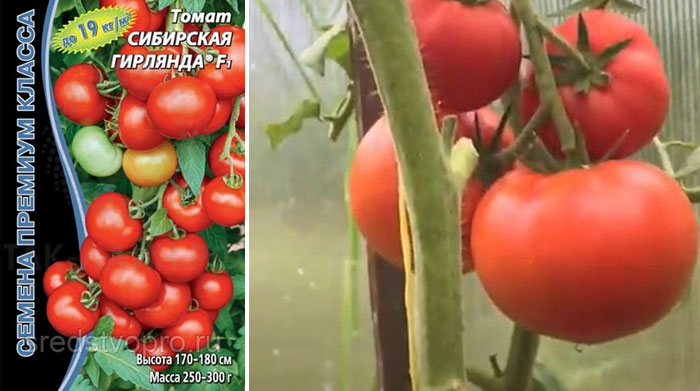
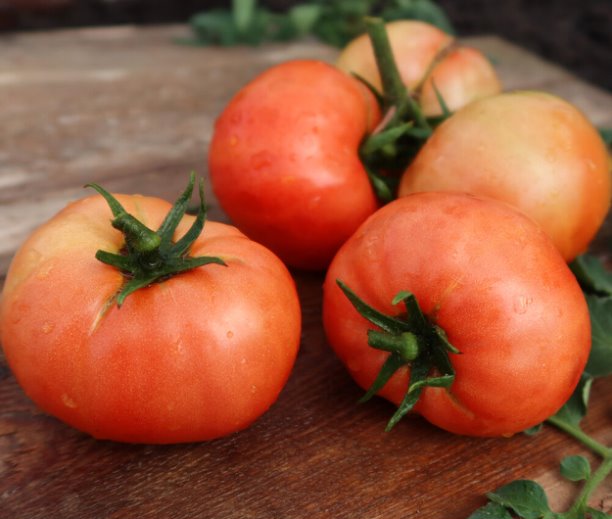
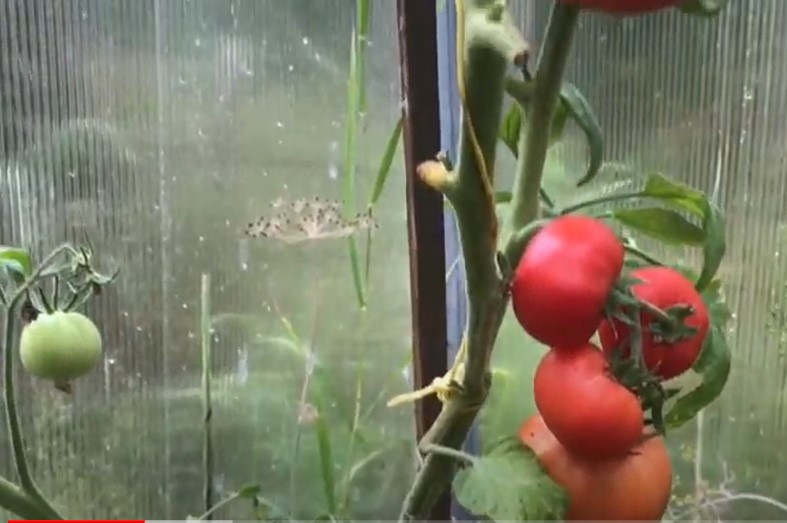
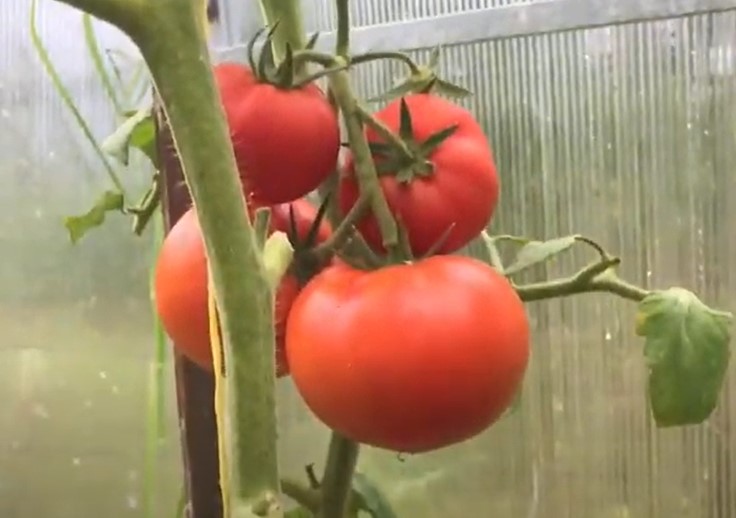
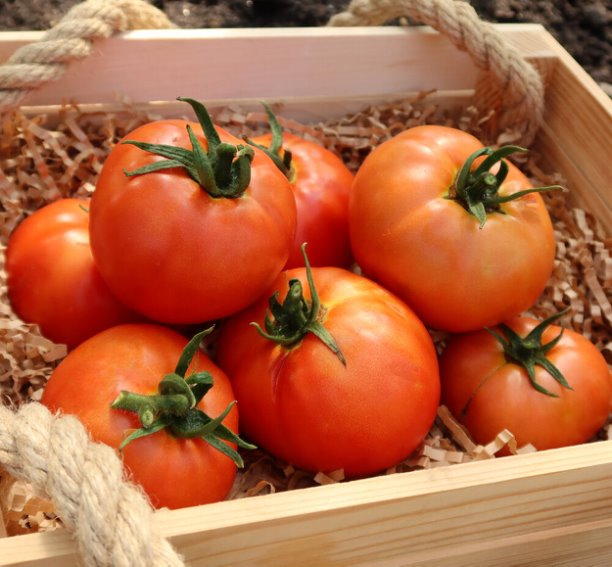
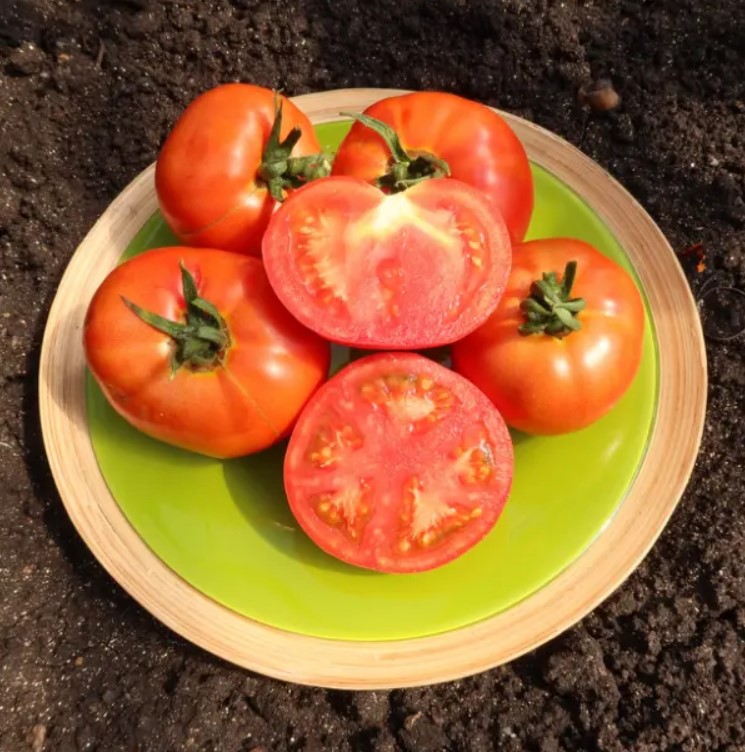
| Description of the fruit | The fruits are medium-sized. They grow on clusters, like a garland, with 6-8 fruits on each. They are bright red in color, round in shape, and have smooth, dense skin. |
| Productivity | 17-19 kg per square meter |
| Usage | Tomatoes are recommended for eating fresh, but if desired, they can be pickled or processed into juice. |
| Preferred growing regions | Suitable for cultivation in all regions. It can even grow and bear fruit in Siberia and the Far East, provided proper agricultural practices are followed. |
| Disease resistance | It has good immunity. Early ripening virtually eliminates late blight activity. |
| Agricultural technology | Tomatoes can only be planted in a greenhouse, unless you live in a hot climate. The stems need to be trained and supported. |
| 2021 | |
| Originator | Heterosis Selection LLC |
Photo gallery of the Siberian Garland tomato variety:
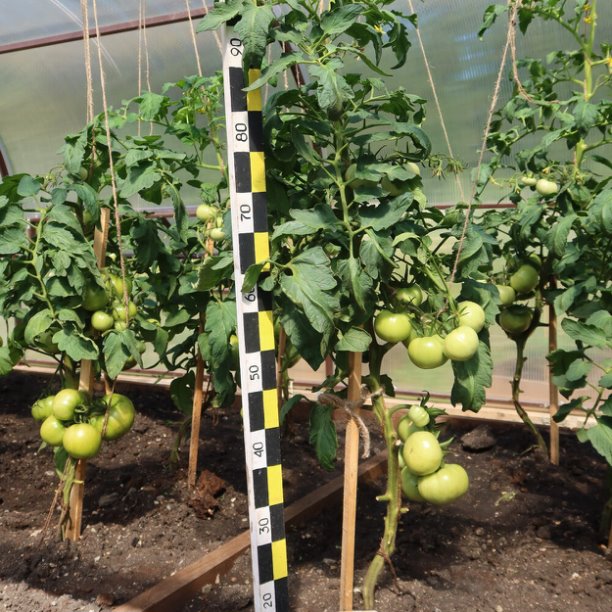
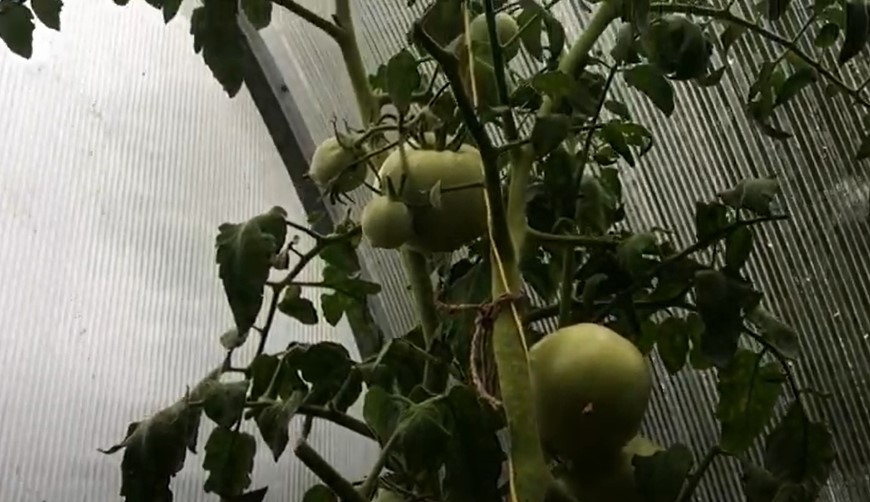
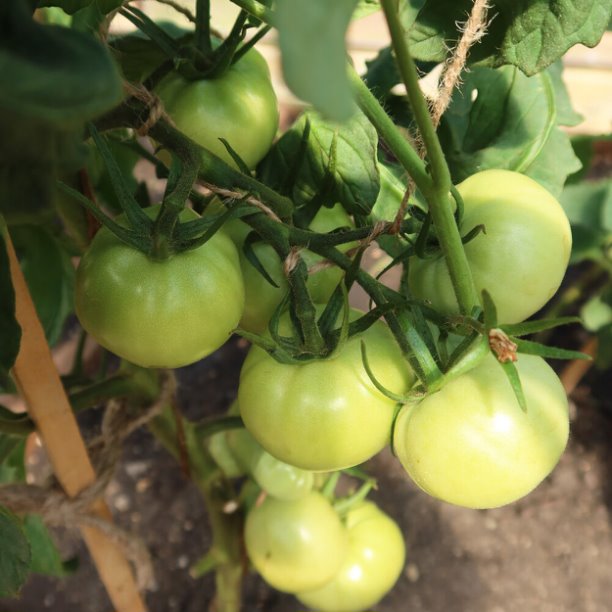
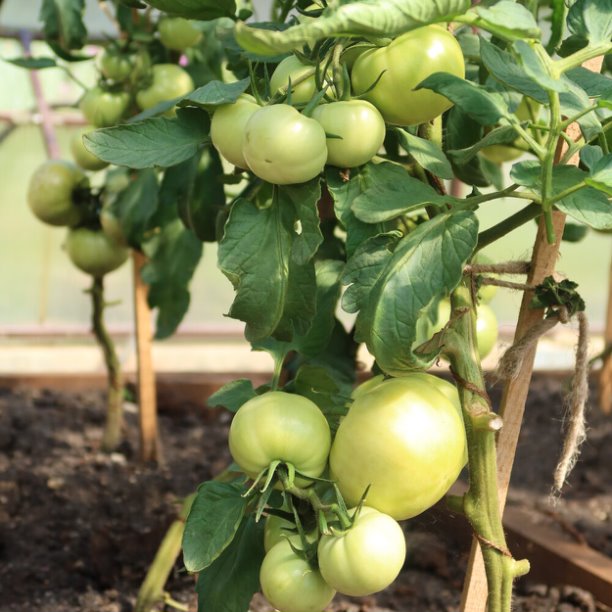
The origin of the Siberian Garland tomato variety
In 2016, Heterosis Selection LLC opened a testing laboratory, where top specialists developed new, viable vegetable varieties. Thanks to their efforts, a large number of diverse vegetables with excellent agronomic characteristics have been developed. In 2021, another breeding masterpiece, the early tomato Siberian Garland, was added to the register.
A detailed description of the Siberian Garland tomato variety
Siberian Garland is characterized by early ripening, tasty fruits and ease of cultivation.
Bushes
Siberian Garland is an indeterminate hybrid plant with vigorous shoots that can reach 170-180 cm in length. During cultivation, the tomato requires staking and shaping. It is recommended to do this with 1-2 stems to avoid crowding the plantings.
Fruit
Siberian Garland tomatoes are produced in clusters. A single plant can produce 10-11 clusters at a time, each producing 6-8 tomatoes.
The tomatoes are round, sometimes slightly flattened at the ends. They are bright red in color and medium in size. The skin is thick, preventing the fruits from splitting on the vine. Each tomato weighs between 250 and 300 grams.
Productivity
The Siberian Garland variety is considered very productive. With proper farming practices, you can harvest 17 to 19 kg of ripe grapes per square meter.
Ripening time
Siberian Garland is an early-ripening tomato. In many regions, the first harvest can be collected as early as June. From germination to full ripening, it takes no more than 95 days.
Advantages and disadvantages of the Siberian Garland tomato variety
The Siberian Garland variety has advantages and disadvantages, which are presented in the table.
| Advantages | Flaws |
|
|
Growing the Siberian Garland tomato variety
Siberian garland is intended for growing in greenhouses, so it is necessary to plant the seeds and raise seedlings beforehand.
Sowing seeds and growing seedlings
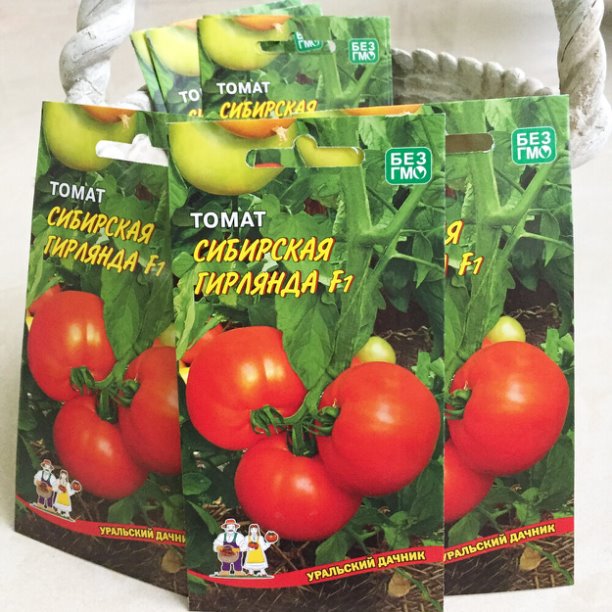
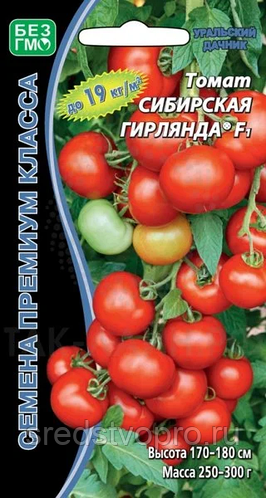
It's best to purchase seeds through an official representative of the Uralskiy Dachnik company. Choose trusted stores to avoid buying counterfeits.
All seeds are typically pre-prepared for sale. This information can be found on the packaging.
If the manufacturer hasn't treated the seeds in any way, you can soak them at home in any stimulating solution to speed up germination. Products such as Epin, Fitosporin, and others are suitable for this purpose.
Planting can be done either dry or wet. However, experts recommend the latter. Years of experiments have shown that pre-soaked seeds germinate faster and more uniformly.
To germinate, place the selected seeds in a damp cloth and place it on a saucer. Keep the cloth damp, but not soaked, to prevent the contents from rotting or molding.

As soon as the first “noses” appear, you can begin planting.
Add equal parts peat, humus, and garden soil to a prepared container. You can buy ready-made soil, but if you're using soil from your own garden, be sure to disinfect it first. You can bake it in the oven or water it with a weak solution of potassium permanganate.
To avoid overwatering, add vermiculite to the container. 10% of the total soil volume is sufficient.
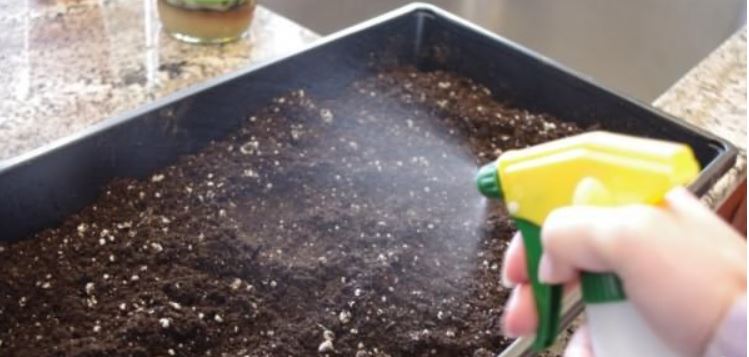
It's recommended to wash the selected container with a disinfectant solution; a potassium permanganate solution can also be used. This is especially important if the same container is used for several years. Next, fill it halfway with prepared soil, and place the seeds on top, spacing them 1.5–2 cm apart. Cover the seeds lightly with soil and moisten them with a spray bottle.
Cover the planted tomatoes with plastic wrap or glass and place them in a warm place until they germinate. Check the greenhouse periodically and remove any condensation that may have accumulated inside. Failure to do so can cause root rot and reduce germination rates.
When the first green shoots appear, the box should be removed from the cover and moved to a cooler room where the temperature does not exceed 22 degrees.
Next, all that remains is to provide the plants with additional lighting using a phytolamp and periodic watering.
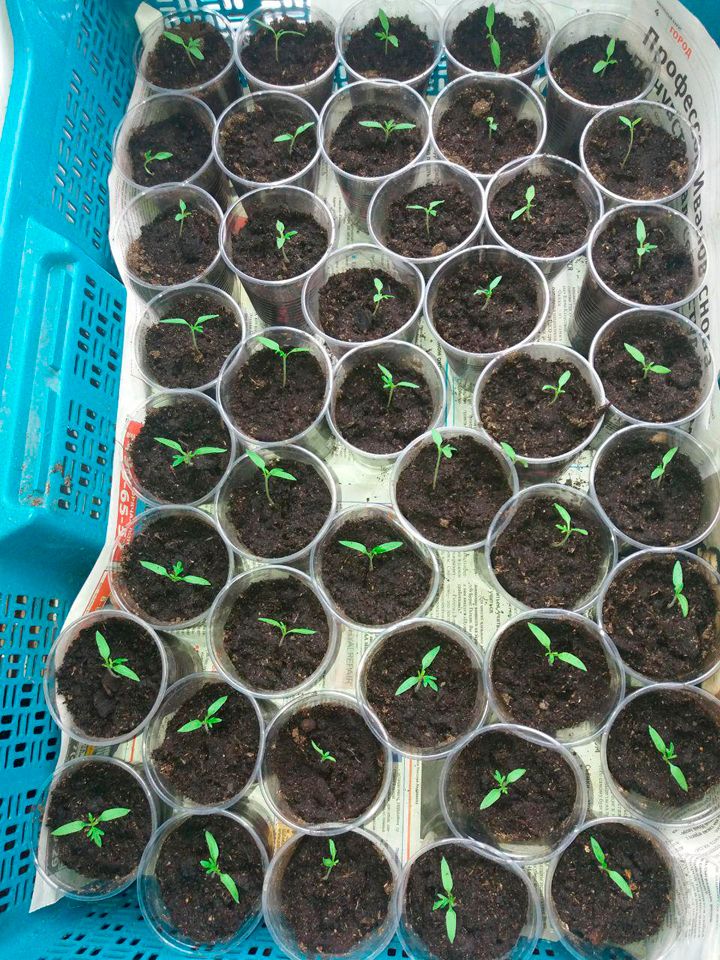
When the shoots produce 3-4 new leaves, they are transplanted into separate containers.
Planting in the ground
The Siberian Garland tomato is designed for greenhouse planting, so it can be done when the soil has warmed to 14 degrees Celsius (55 degrees Fahrenheit). Otherwise, the tomatoes will sit in the ground for a long time without developing. Many gardeners speed up the soil warming process by covering the bed with black plastic film.
The soil is dug over in the fall, and various fertilizers are added at that time. The digging is repeated in the spring.
When planting tomatoes, you should take into account crop rotation rules and not plant them in the same place in the new season.
Siberian Garland is a fairly vigorous tomato variety, so don't overplant. Plant the seedlings 60 cm apart. It's recommended to leave 70 cm between rows to avoid complicating planting.
To protect the roots of the bushes and reduce the risk of exposure to heat, cold, or overwatering, the top of the bed should be covered with a layer of mulch.
Care, watering and fertilizing
The Siberian Garland tomato is easy to grow. For a good harvest, it requires adequate watering, at a rate of 5 liters per plant during flowering. Before this time, it requires three times less water. However, during fruit formation, watering should be avoided entirely.
If the weather is very hot, the beds need to be watered almost every day. In cool weather, the soil should be moistened approximately 1-2 times a week.
Overwatering is dangerous due to the appearance of rot and fungus, which leads to the death of plantings.
In total, tomatoes are fed three times per season:
- Ten days after transplanting tomatoes into the greenhouse, the plants need to be fertilized for the first time. Water-soluble specialized fertilizers, such as Signor Tomato or Aquarin Vegetable, available at a hardware store, work well. However, some prefer organic fertilizers: infused solutions of ash, mullein, weeds, and iodine. Among organic remedies, a mullein solution or a weed infusion with the addition of superphosphate are effective.
- The second feeding is when the fruits on the second cluster begin to set.
- The third feeding is during the first harvest period; here, preference is given to superphosphate and potassium.
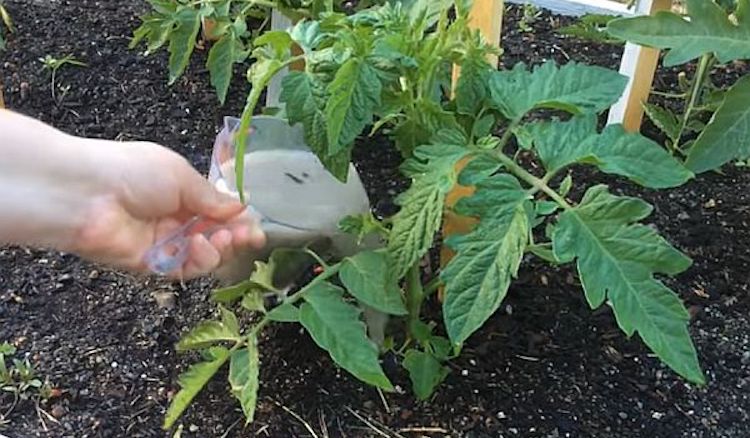
Any manipulation of the bushes ceases only during the period of fruit ripening.
During planting, it is necessary to periodically loosen and weed the soil to improve its aeration and reduce the number of weeds.
Resistance of the Siberian Garland tomato variety to diseases and pests
Siberian Garland is a tomato variety resistant to many diseases. Due to its early ripening period, it is not susceptible to late blight.
To reduce the risk of other bacteria, fungi, or viruses, preventative treatment of the plantings is necessary. For this, you can prepare a solution of Fitosporin or Bordeaux mixture. Spray early in the morning or in the evening after the sun's rays have subsided. Repeat the treatment after two weeks, and repeat this process three times per season.
The most important thing is to stop all interventions 14 days before the start of harvest.
Collection, use and storage
Tomatoes ripen fairly early, with the first harvest already in June. Siberian Garland is considered a variety best eaten fresh. They make a perfect addition to any salad. However, if desired, you can preserve them for the winter, such as pickling or juicing. However, there are other varieties more suitable for these purposes.
Comparison of the Siberian Garland tomato variety with other varieties in the table
Please note! How can you easily convert centners/ha to kg/sq.m? Simply divide by 100! For example, the Abakansky Pink tomato yields 400 centners of marketable fruit per hectare. This equals 4 kg per square meter. It's that simple! Also, keep in mind that typically no more than 3-4 plants are planted per square meter. This way, you can calculate the yield per bush. In the case of the Abakansky Pink, it's about 1 kg.
| Variety | Ripening period (number of days from full germination to ripening)
Yield of commercial fruits |
Brief description | Fetus |
| Siberian garland | 90-95 days
1700-1900 c/ha |
An early-ripening indeterminate variety for open ground and greenhouses. Suitable for salads. | Flat-round, large, smooth, dense, red, 260 g. Excellent taste. |
| Siberian Shan'gi | 100-110 days The yield of commercial fruits in open ground was 5.6 kg/sq.m. |
A mid-season determinate variety for open ground and greenhouses. Suitable for salads. | Flat-round, medium density, slightly ribbed, raspberry, 157 g. Excellent taste. |
| Siberian early ripening | 98-108 days
289-543 c/ha (open ground), 20-43% of the total yield ripens in 15 days of fruiting, 630-950 c/ha (greenhouse and under film), in the first month of fruiting 240-580 c/ha. |
An early-ripening, determinate, low-growing variety for open ground and greenhouses. Suitable for salads. | Round and flat-round, slightly ribbed, medium-sized and large, red, 62-114 g. The taste is satisfactory. |
| Siberian tiger | 110-120 days
Up to 1200 c/ha |
A mid-season indeterminate variety for open ground and greenhouses. Requires staking and training into 1-2 stems. Suitable for salads and processing into tomato products. | Flat-round, ribbed, dark pink with dark purple streaks, 150-250 g. Excellent taste. |
| Siberian big guy | 90-100 days
900-1200 c/ha |
An early-ripening indeterminate variety for open ground and greenhouses. Suitable for salads, processing into tomato products, and preparing first and second courses. | Flat-round, slightly ribbed, red, 500 g. Good to excellent taste. |
| Siberian giant | 115-120 days The commercial yield of fruits was 9.0-11.0 kg/sq.m. |
A mid-early indeterminate variety for greenhouses. Suitable for salads. | Flat-round, large, medium-ribbed, loose, red, 400-500 g. Excellent taste. |
| Silver spruce | 90-100 days
1500-1800 c/ha |
A mid-early determinate variety for open ground and greenhouses. Requires staking and training into 2-3 stems. Suitable for salads and canning. | Flat-round, slightly ribbed, with a little pubescence, red, 300 g. The taste is good and excellent. |
| Abakan pink | 120 days or more
400 c/ha |
A late-ripening determinate variety for open ground and greenhouses. Requires staking and training. Suitable for salads and processing into tomato products. | Flat-round, slightly ribbed, medium density and pink in color, 200-500 g. Good taste. |
| Alsou | 105-110 days
700 c/ha |
An early-ripening, determinate variety for open ground and greenhouses. Requires staking and shaping. Suitable for salads. | Flat-round, slightly ribbed, medium density, red, 312 g. Good taste. |
| Blagovest | 101-105 days
1500-1600 c/ha |
An early-ripening determinate variety for greenhouses. Suitable for salads and canning. | Flat-round, slightly ribbed, glossy, red, 100-110 g. Excellent taste. |
| Big Momma | 85-95 days (greenhouse), about 100 days (open ground)
700-900 c/ha |
A mid-early determinate variety for open ground and greenhouses (greenhouses only, according to the register). Suitable for salads, canning, pickling, and juice. | Round, large, slightly ribbed, medium density, red, 200-250 g. Excellent taste. |
| Debut | about 90 days
910 c/ha |
An early-ripening determinate variety for open ground and greenhouses. Suitable for salads. | Flat-round, slightly ribbed, medium density, red, 210-230 g. Good to excellent taste. |
| King of the Early | 85-95 days depending on the growing location
1200 c/ha |
An early-ripening determinate variety for open ground and greenhouses. Suitable for salads and processing into tomato products. | Flat-round, smooth, red, 150-200 g (up to 400 g). Good taste. |
| Kostroma | 105-110 days
1350-1500 c/ha |
A mid-season determinate variety for greenhouses. Requires staking and training. Suitable for salads, whole-fruit canning, and processing into tomato products. | Flat-round, slightly ribbed, glossy, red or orange, 80-150 g. Good taste, sweet and sour. |
Gardeners' reviews of the Siberian Garland tomato variety
Siberian Garland has won the hearts of gardeners with its early ripening time. According to reviews, the variety requires little cultivation, is rarely susceptible to disease, and boasts incredible yields.
Tomato SIBIRSKAYA GIRLANDA F1
An extremely early hybrid, the period from germination to the beginning of ripening is 90-95 days. The plant is vigorous, reaching a height of 170-180 cm, and should be trained into at least two trunks. The first cluster forms above the sixth leaf, with subsequent clusters forming 2-3 leaves later. A cluster bears 6-8 fruits, with 10-11 clusters forming on the plant – all this splendor is simply mesmerizing, with the clusters resembling veritable garlands of vibrant fruit. The fruits are intensely red, round, smooth, and dense, weighing 250-300 g, combining superior flavor with excellent transportability. The yield of standard fruits is astounding: 17-19 kg/m².
Recommended for obtaining early products in film greenhouses and open ground in trellis culture.
Siberian Garland (Tomato) is included in the register of the Russian Federation for cultivation in film greenhouses and under temporary film shelters in private farmsteads. Early-ripening salad hybrid. Indeterminate plant. Medium-length, dark green leaves. Intermediate inflorescence. Articulated peduncle. Flat-round fruit, dense, slightly ribbed. Unripe fruit is green without a spot near the peduncle, while ripe fruit is red. Number of locules: 4-6. Fruit weight: 260-285 g. Good taste. The yield of marketable fruits in film greenhouses was 18.8 kg/sq.m.
Year of inclusion in the register of admitted: 2021
Region: Northern, Northwestern, Central, Volga-Vyatka, Central Black Earth Region, North Caucasian, Middle Volga, Lower Volga, Ural, West Siberian, East Siberian, Far Eastern
Originator(s): Heterosis Selection LLC
Siberian Garland (Tomato) is an early-ripening hybrid, with a period from germination to the beginning of ripening of 90-95 days. The plant is vigorous, reaching a height of 170-180 cm, and should be trained into at least two trunks. The first cluster forms above the sixth leaf, with subsequent clusters occurring 2-3 leaves apart. Each cluster bears 6-8 fruits, with 10-11 clusters forming on the plant, each with brightly colored garland-like fruits. The fruits are intensely red, round, smooth, and dense, weighing 250-300 g, combining excellent taste with excellent transportability. Standard fruit yield is 17-19 kg/m². Recommended for early production in plastic greenhouses and open ground under trellis cultivation.