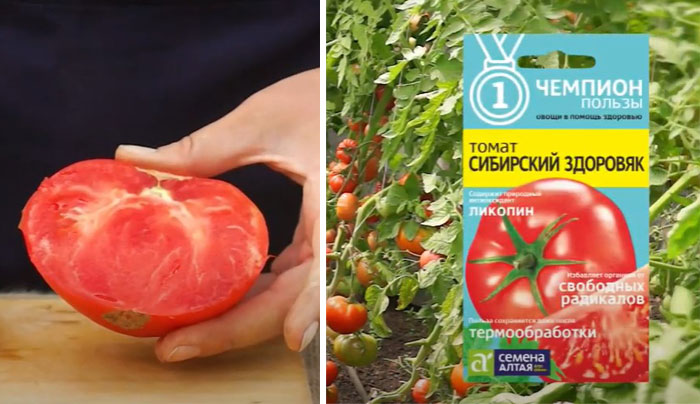
Siberian Zdorovyak is a tomato variety originally bred for cultivation in the harsh conditions of Siberia. It later spread throughout Russia, winning the love and recognition of gardeners. In addition to its excellent yield, it boasts true Siberian health and is completely easy to grow.
Content
- 1 Table of characteristics of the Siberian Zdorovyak tomato variety
- 2 Photo gallery of the Siberian Healthy tomato variety:
- 3 The origin of the Siberian Big Guy tomato variety
- 4 A detailed description of the Siberian Zdorovyak tomato variety, its pros and cons
- 5 Advantages and disadvantages of the Siberian Strongman tomato variety
- 6 Growing the Siberian Strongman tomato variety
- 7 Resistance of the Siberian Healthy tomato variety to diseases and pests
- 8 Harvesting, using and storing the Siberian Healthy tomato variety
- 9 Comparison of the Siberian Healthy tomato variety with other varieties in the table
- 10 Gardeners' reviews of the Siberian Strongman tomato variety
Table of characteristics of the Siberian Zdorovyak tomato variety
| Characteristic | Description |
| Description | An indeterminate tomato variety with early ripening periods |
| Ripening period | 100-110 days |
| Fruit weight | 400-700 g |
| Description of the fruit | Large, juicy tomatoes with a bright red color. Sweet in taste, suitable for dietary use. |
| Productivity | Up to 10 kg |
| Usage | Widely used in sauces, ketchups, and pastes. Eaten fresh. |
| Preferred growing regions | All regions of the country. |
| Disease resistance | It has excellent immunity and is rarely even susceptible to late blight. |
| Agricultural technology | Suitable for both greenhouse and outdoor cultivation, it requires staking and training. |
| Not included | |
| Country of origin | Russia, Agrofirm Semena Altaya. |
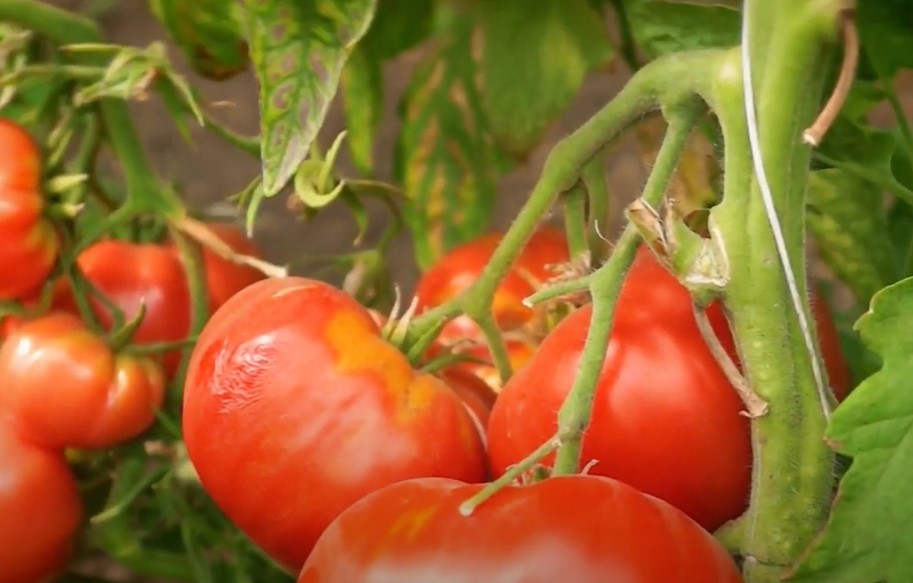
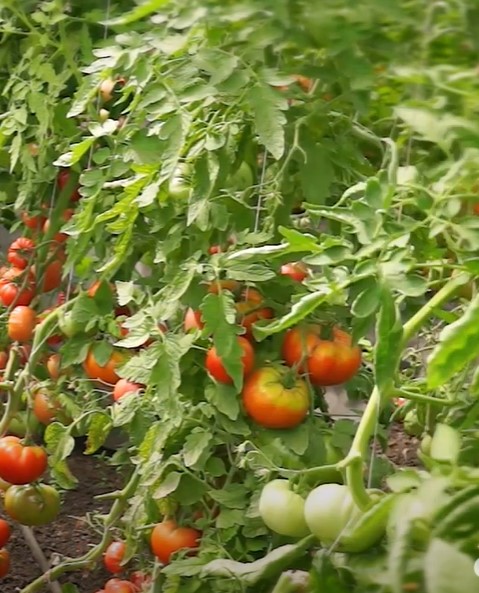
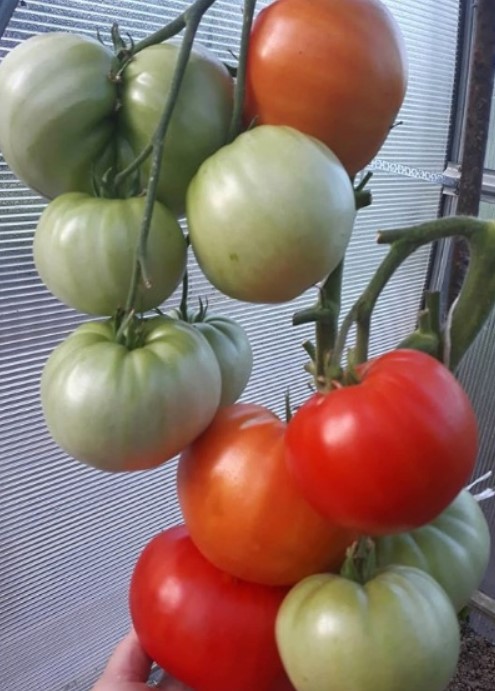
Photo gallery of the Siberian Healthy tomato variety:
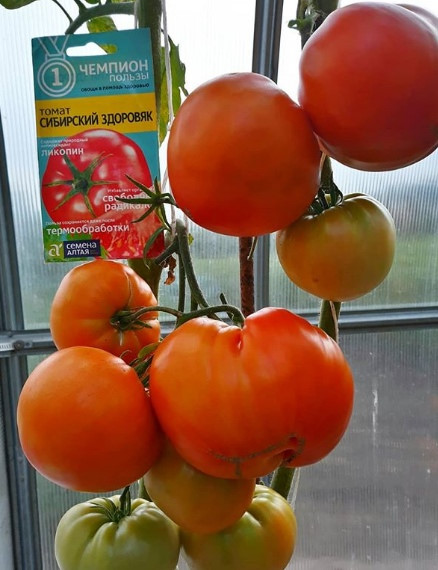
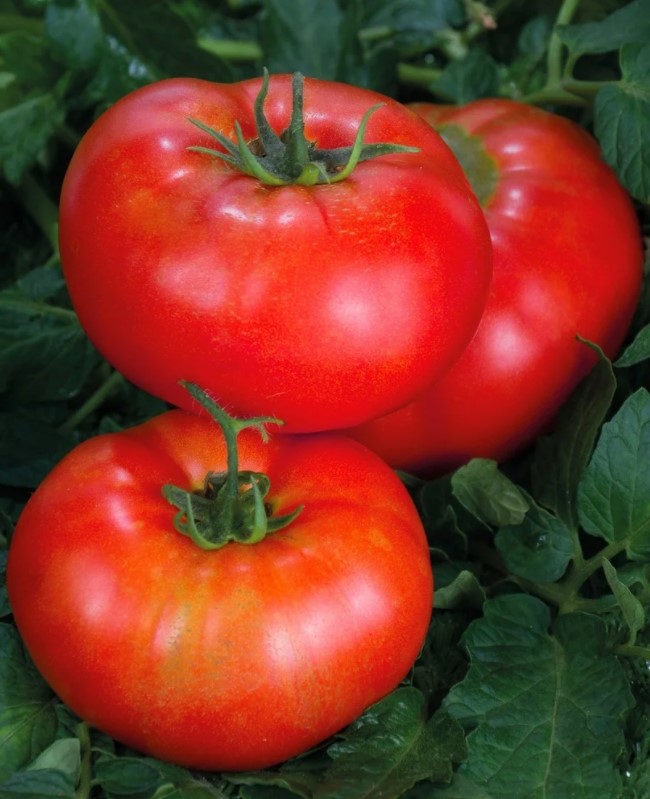
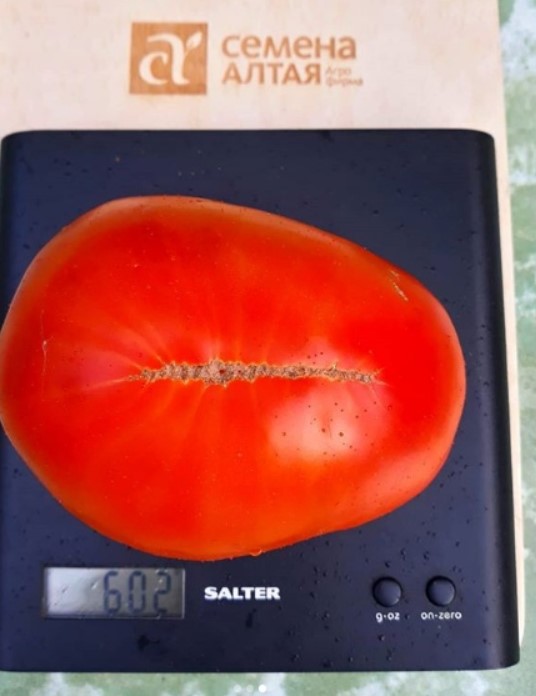
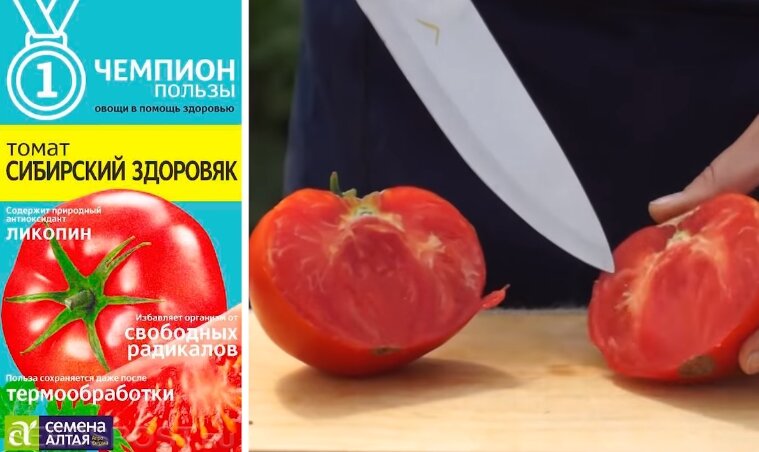
The origin of the Siberian Big Guy tomato variety
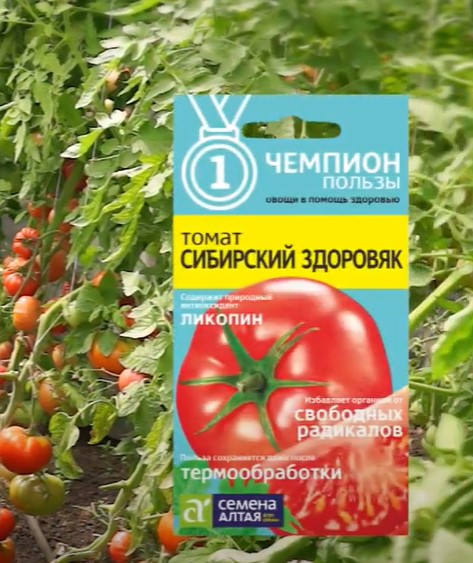
The Siberian Zdorovyak variety was developed by the Semena Altaya agricultural firm. Its breeders are implementing a project called Champions of Health, which presents consumers with the healthiest variety of each crop. In the tomato category, the Siberian Zdorovyak tomato, which contains a significant amount of beneficial substances (lycopene, glutathione, etc.), received the title of Champion of Health. However, despite these properties, this tomato is currently not included in the registry.
A detailed description of the Siberian Zdorovyak tomato variety, its pros and cons
The main distinguishing feature of the Siberian Zdorovyak is its large fruits with a unique beneficial composition.
Bushes
The variety is indeterminate, the shoots grow up to 150-200 cm, the exact height depends on growing conditions.
The stems are fairly leafy, but the leaf blades are not very large. As the crop ripens, they are removed from the lower portion of the shoot.
The plant requires support and tying. The stem itself is quite strong and can easily support the weight of tomatoes. However, to achieve larger tomatoes, you'll need to train the plant into 1-2 shoots.
Fruit
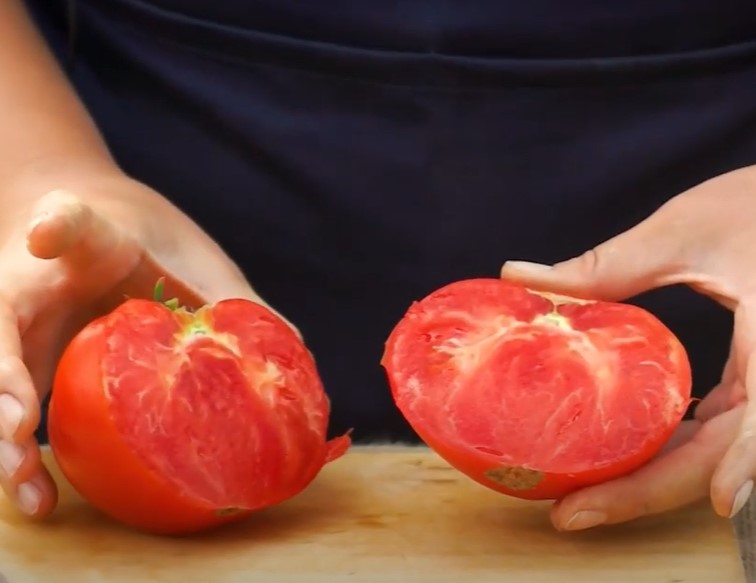
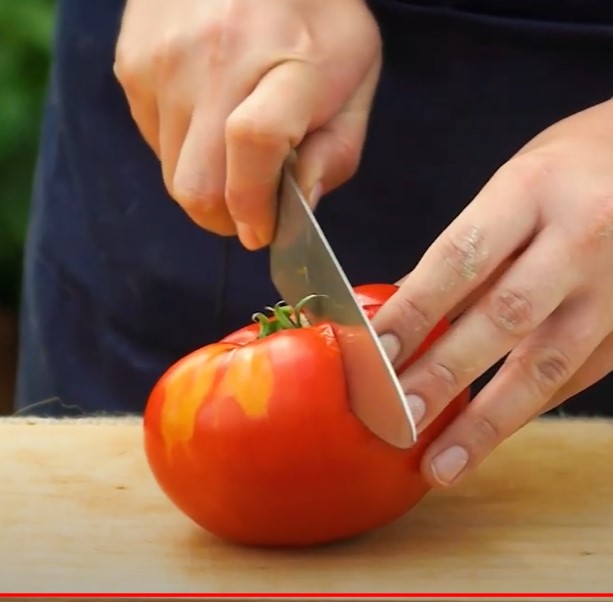
The fruits are the special pride of the Siberian Zdorovyak tomato. They grow large, weighing between 400 and 700 g. They are bright scarlet in color, rounded in shape, without pronounced ribbing, and slightly flattened at the stem.
The pulp is aromatic and very juicy. Tomatoes contain a huge amount of beneficial substances, including the powerful antioxidant lycopene.
The skin is smooth, it holds its shape well and prevents the tomatoes from cracking on the bushes.
Productivity
The Siberian Healthier variety is considered high-yielding; up to 10 kg of harvest can be harvested from each bush if proper cultivation techniques are followed.
Ripening time
Siberian Zdorovyak is considered an early tomato, with 100 to 110 days passing from germination to harvest.
Advantages and disadvantages of the Siberian Strongman tomato variety
The advantages and disadvantages of the Siberian Husky are described in the table below.
| Advantages | Flaws |
|
|
Growing the Siberian Strongman tomato variety
This Siberian giant doesn't require any special cultivation techniques from gardeners; it's quite simple and unpretentious in terms of agricultural technology.
Sowing seeds and growing seedlings
Siberian Bigwig is best grown from seedlings, although direct sowing of seeds in open ground is possible in hotter regions. However, all planting material must be pre-treated:
- soaking in a weak solution of potassium permanganate;
- treatment with a growth stimulator;
- germination.
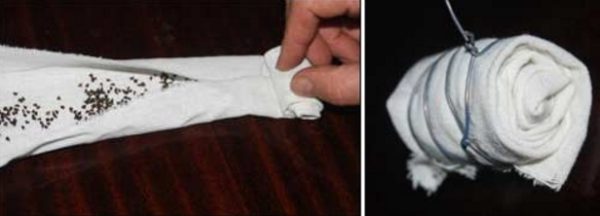
Some gardeners work with dry seeds, but experience shows that sprouted seeds have a better germination rate and stronger immunity. This process doesn't take much time. Simply place the seeds in a damp cloth in a warm place for 48 hours for the first sprouts to appear.
Next, you can plant the tomatoes. This is done approximately 60-65 days before transplanting them to their permanent garden bed.
It's best to use loose, breathable soil. It's a good idea to purchase specialized soil for peppers and tomatoes. Alternatively, you can create a soil mixture from whatever you have in your garden: equal parts soil, peat, humus, and sand. The soil should be disinfected, for example, by baking it in the oven or soaking it in a potassium permanganate solution.
For planting, you can choose any suitable container, half-fill it with prepared soil, and make several furrows 1 cm deep, spaced 2-3 cm apart. Plant the seeds in these furrows, then cover them with soil and water them with a spray bottle. Only then should the container be covered with glass, plastic, or film to create greenhouse conditions and placed in a warm location.
Periodically, it's necessary to ventilate the plantings to prevent condensation from accumulating inside. If the soil becomes very dry, you can water it.
Once the sprouts reach the roof of their greenhouse, you can uncover it completely and move it to a cooler location with a temperature of 20…22°C. Seedlings don't like heat or drafts.
After 2-3 full-fledged leaves appear on the shoots, the seedlings are transplanted into separate containers.
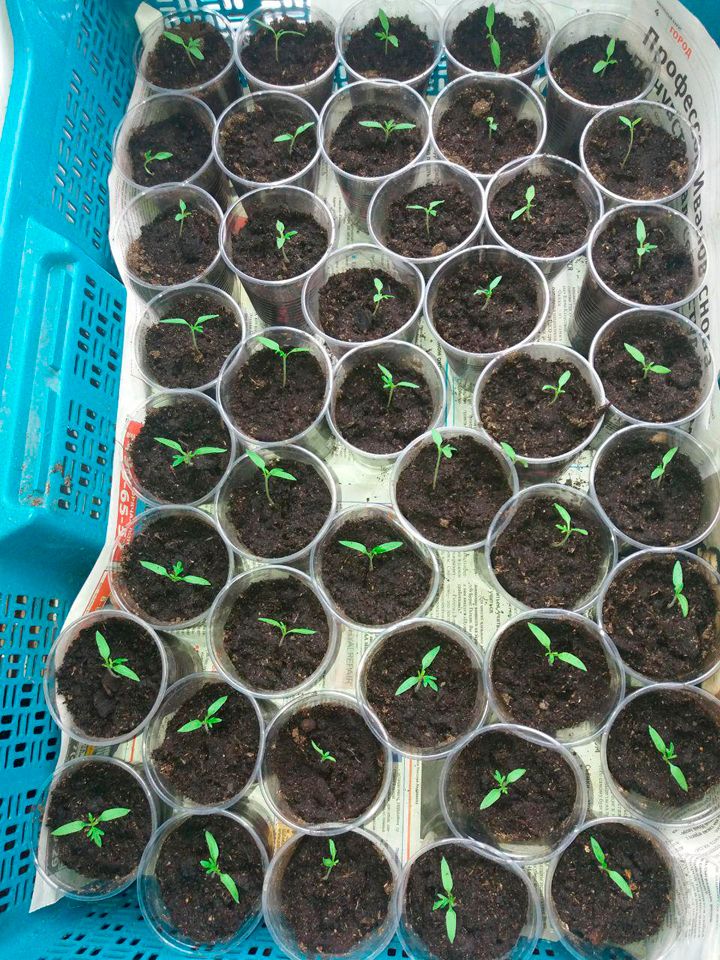
Planting in the ground
For tomatoes, it's crucial that the soil is sufficiently warm before planting. Even though the Siberian giant is resistant to temperature fluctuations, the temperature inside the bed, at a depth of a bayonet, should be no lower than +12…+14°C.
Before permanently transplanting tomatoes into their permanent garden bed, harden them off. First, for an hour, then two, and so on, the seedlings are taken out to the balcony, veranda, or yard to acclimate to natural conditions.
The soil is dug twice. The first time is done in the fall, along with fertilizer. The second time is in the spring, when preparing the bed. Many gardeners sow the soil with green manure a couple of weeks before planting. This enriches the soil with beneficial micronutrients and improves the soil structure.
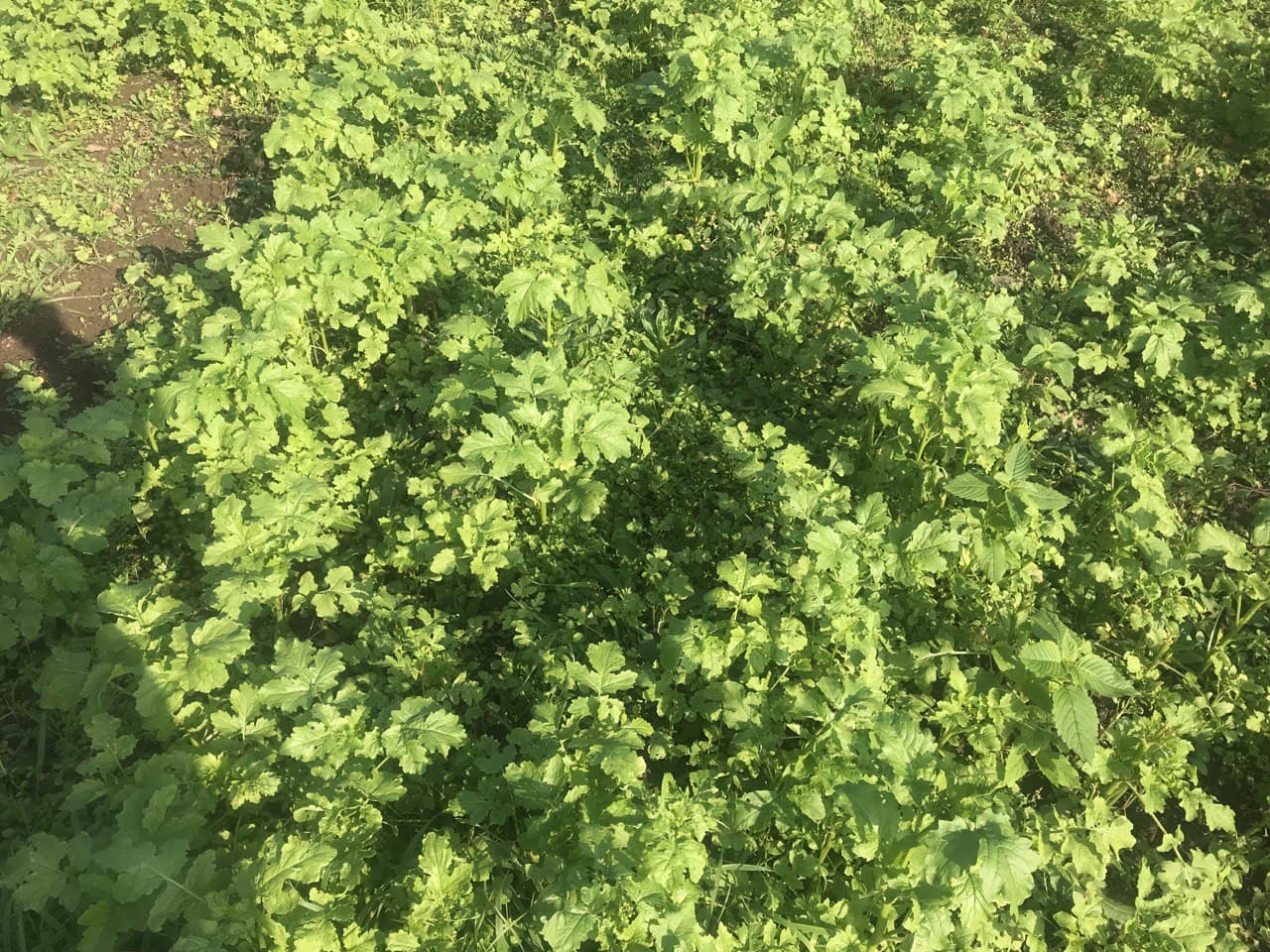
It's also important to follow crop rotation rules and avoid planting tomatoes every year in the same places where tomatoes, potatoes, peppers, or eggplants were previously grown. Legumes, cabbage, cucumbers, and greens make good predecessors.
Tomatoes should be planted in pre-dug holes spaced 35 cm apart. Add a handful of ash or peat to the bottom of each hole, mix it with soil, and sprinkle with onion skins.
It is recommended to leave at least 60 cm between rows to make crop care and harvesting easier, and to prevent plants from interfering with each other during the active growing season.
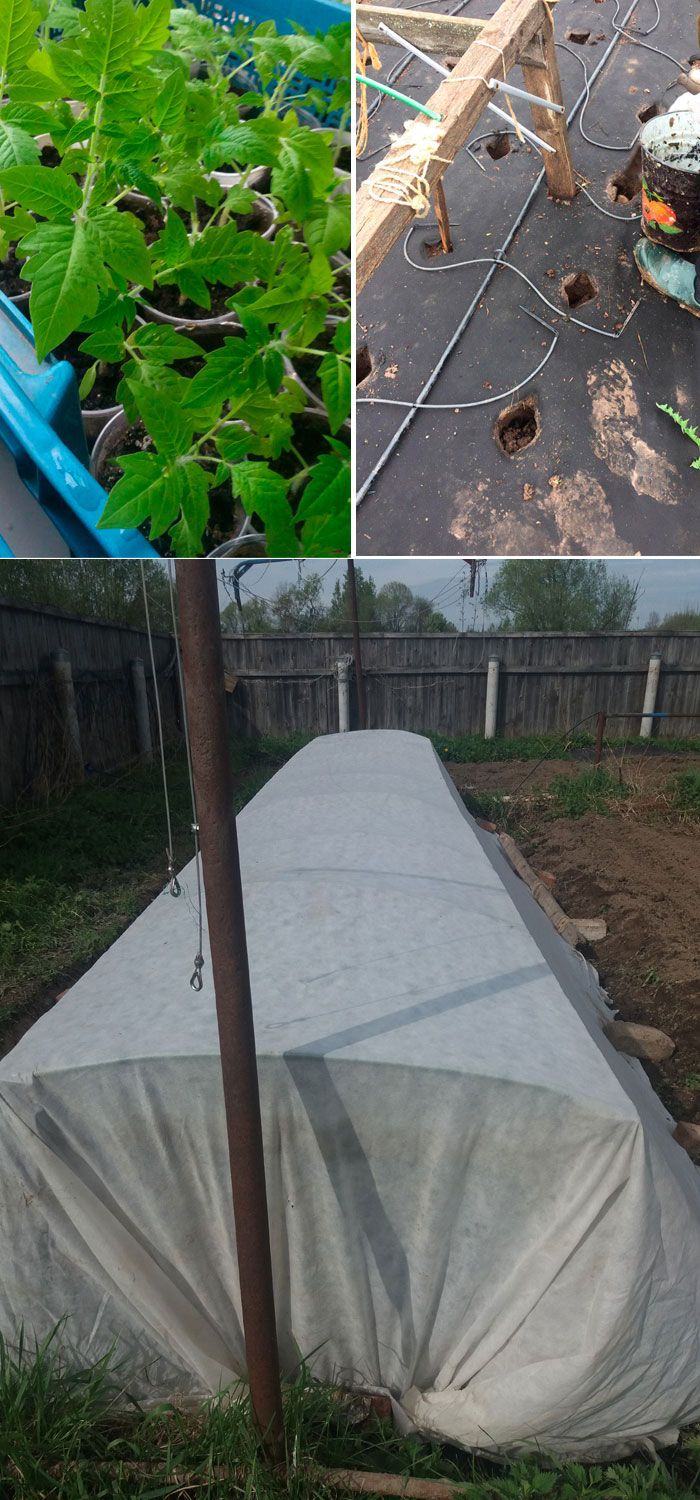
To ensure that moisture is retained within the bed, that weeds do not grow too vigorously, and that the roots do not freeze or get sunburned, mulch with a 7 cm layer of sawdust or mown grass.
If tomatoes are growing in open ground, it is strongly recommended to cover them with film for the first few days after transplanting, especially at night.
Care, watering and fertilizing
This Siberian giant doesn't require complex cultivation techniques. The key is to follow watering guidelines. Watering should be done 7-10 days after transplanting. Initially, water 1-2 liters per plant, and water 1-2 times per week. In hot regions, it's important to follow the weather conditions, as the soil dries out much faster. Water in the evening to prevent residual moisture from lingering on the leaves and causing sunburn.
During the period of active bud formation, watering is increased to 5 liters per bush, and during the ripening of tomatoes, slightly less liquid is required, but the frequency can reach 2 times a day.
Fertilizer is essential for good growth and fruiting of tomatoes. They thrive on organic matter and respond gratefully to an infusion of mullein or weeds. During the fruiting stage, it is recommended to apply fertilizers containing minimal nitrogen but rich in potassium, phosphorus, and calcium. All fertilizers should be applied to moist soil.
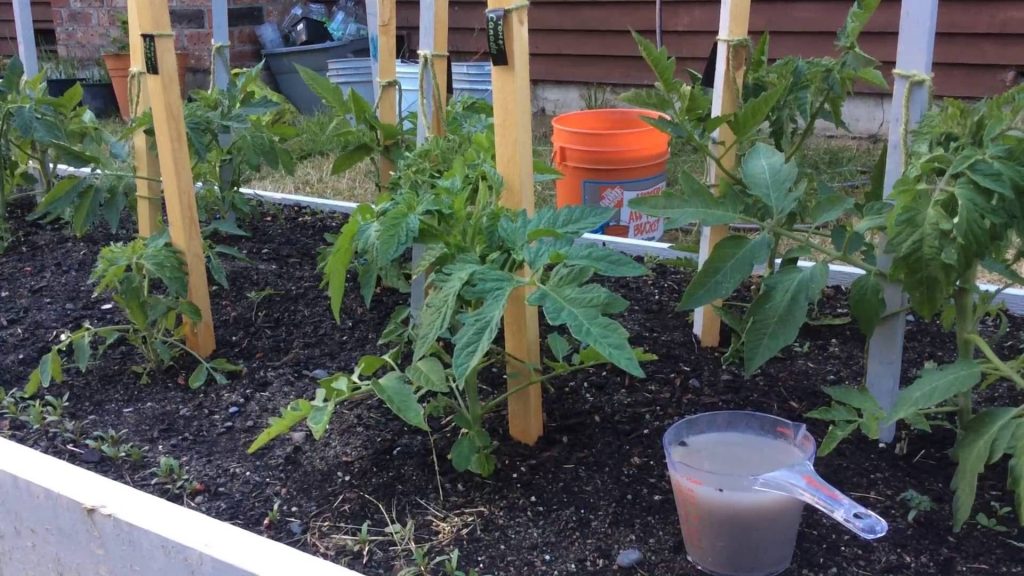
Periodically, the plantings need to be loosened and weeds removed, which not only compete for light, water and nutrients, but also attract pests.
Resistance of the Siberian Healthy tomato variety to diseases and pests
The Siberian Strongman is rightfully named: not only do its fruits grow healthy, but they also have a very strong immune system. The tomato is virtually immune to all common diseases. Furthermore, the fruit ripens before late blight begins to attack.
But even these robust plants can experience problems if weather conditions aren't favorable or care isn't provided properly. This often happens to gardeners who only visit their plots on weekends. Therefore, it's crucial to preventatively treat tomatoes with Fitosporin or Bordeaux mixture every 10 days.
Harvesting, using and storing the Siberian Healthy tomato variety
The Siberian Healthy tomato can be harvested as early as 100 days after germination. If watering guidelines are followed, the skin remains firm and the fruit does not crack, significantly increasing its shelf life.
The Siberian Zdorovyak is not suitable for whole-fruit canning. However, its fruits make excellent juice, delicious pastes, and adjika. The nutrients in the pulp are retained even after heat treatment, making this variety suitable for dietary use.
But tomatoes can't be stored for long. In the refrigerator, they can last no more than 7 days without losing quality.
Comparison of the Siberian Healthy tomato variety with other varieties in the table
Please note! How can you easily convert centners/ha to kg/sq.m? Simply divide by 100! For example, the Abakansky Pink tomato yields 400 centners of marketable fruit per hectare. This equals 4 kg per square meter. It's that simple! Also, keep in mind that typically no more than 3-4 plants are planted per square meter. This way, you can calculate the yield per bush. In the case of the Abakansky Pink, it's about 1 kg.
| Variety | Ripening period (number of days from full germination to ripening)
Yield of commercial fruits |
Brief description | Fetus |
| Siberian big guy | 90-100 days
900-1200 c/ha |
An early-ripening indeterminate variety for open ground and greenhouses. Suitable for salads, processing into tomato products, and preparing first and second courses. | Flat-round, slightly ribbed, red, 500 g. Good to excellent taste. |
| Siberian garland | 90-95 days
1700-1900 c/ha |
An early-ripening indeterminate variety for open ground and greenhouses. Suitable for salads. | Flat-round, large, smooth, dense, red, 260 g. Excellent taste. |
| Siberian Shan'gi | 100-110 days The yield of commercial fruits in open ground was 5.6 kg/sq.m. |
A mid-season determinate variety for open ground and greenhouses. Suitable for salads. | Flat-round, medium density, slightly ribbed, raspberry, 157 g. Excellent taste. |
| Siberian early ripening | 98-108 days
289-543 c/ha (open ground), 20-43% of the total yield ripens in 15 days of fruiting, 630-950 c/ha (greenhouse and under film), in the first month of fruiting 240-580 c/ha. |
An early-ripening, determinate, low-growing variety for open ground and greenhouses. Suitable for salads. | Round and flat-round, slightly ribbed, medium-sized and large, red, 62-114 g. The taste is satisfactory. |
| Siberian tiger | 110-120 days
Up to 1200 c/ha |
A mid-season indeterminate variety for open ground and greenhouses. Requires staking and training into 1-2 stems. Suitable for salads and processing into tomato products. | Flat-round, ribbed, dark pink with dark purple streaks, 150-250 g. Excellent taste. |
| Siberian kilogram | 116-120 days
600-1000 c/ha |
A mid-season indeterminate variety for greenhouses and open ground. Suitable for salads and processing into tomato products. | Round, slightly ribbed, red, 600-1500 g. Good to excellent taste. |
| Siberian giant | 115-120 days The commercial yield of fruits was 9.0-11.0 kg/sq.m. |
A mid-early indeterminate variety for greenhouses. Suitable for salads. | Flat-round, large, medium-ribbed, loose, red, 400-500 g. Excellent taste. |
| Silver spruce | 90-100 days
1500-1800 c/ha |
A mid-early determinate variety for open ground and greenhouses. Requires staking and training into 2-3 stems. Suitable for salads and canning. | Flat-round, slightly ribbed, with a little pubescence, red, 300 g. The taste is good and excellent. |
| Mikado Sibiriko | 90-95 days
800 c/ha |
An early indeterminate variety from Siberian breeders. For salads, juice, and pasta. | Heart-shaped, ribbed, pinkish, 400-600 g. Excellent taste. |
| Abakan pink | 120 days or more
400 c/ha |
A late-ripening determinate variety for open ground and greenhouses. Requires staking and training. Suitable for salads and processing into tomato products. | Flat-round, slightly ribbed, medium density and pink in color, 200-500 g. Good taste. |
| Alyosha Popovich | 125-130 days
600-640 c/ha |
A mid-season indeterminate variety for open ground and greenhouses. Requires staking and training. Suitable for salads. Easy to transport. Resistant to adverse growing conditions. | Round, slightly ribbed, medium density, red, 150-200 g. Good taste. |
| Altai masterpiece | 110-150 days
up to 1000 c/ha (under film) |
A mid-season indeterminate variety for open ground and greenhouses. Requires staking and shaping. Suitable for salads. | Flat-round, medium-ribbed, medium density, red, 300-400 g. Good taste. |
| Grandma's secret | 100-115 days
1690 c/ha |
A mid-season indeterminate variety for open ground and greenhouses. Requires staking and shaping. Suitable for salads. | Flat-round, ribbed, dense, pink, 354 g. Excellent taste. |
| Big Momma | 85-95 days (greenhouse), about 100 days (open ground)
700-900 c/ha |
A mid-early determinate variety for open ground and greenhouses (greenhouses only, according to the register). Suitable for salads, canning, pickling, and juice. | Round, large, slightly ribbed, medium density, red, 200-250 g. Excellent taste. |
| Big Dipper | 100-110 days
1150-1450 c/ha |
An early-ripening indeterminate variety for open ground and greenhouses. Requires staking and shaping. Suitable for salads. | Flat-round, slightly ribbed, medium density, pink, 210-260 g. Good taste. |
| The pride of the feast | 90-100 days
1200-1400 c/ha (in a greenhouse) |
An early-ripening indeterminate variety for open ground and greenhouses. Suitable for salads. | Flat-round, dense, strongly ribbed, red, 320-330 g. Excellent taste. |
| Kostroma | 105-110 days
1350-1500 c/ha |
A mid-season determinate variety for greenhouses. Requires staking and training. Suitable for salads, whole-fruit canning, and processing into tomato products. | Flat-round, slightly ribbed, glossy, red or orange, 80-150 g. Good taste, sweet and sour. |
Gardeners' reviews of the Siberian Strongman tomato variety
Gardeners remark on the tomatoes' excellent taste and excellent yield. Growing them is a pleasure—they rarely get sick and tolerate temperature fluctuations resiliently.
About the variety:
An early-ripening (100-110 days) variety. The plant is indeterminate. The fruits are a rich red color. True to its name, the fruits reach a weight of 500-700 g even with a high yield. The flesh is sweet, juicy, and meaty. The intense red color of the fruit indicates a high content of lycopene, a natural antioxidant that helps reduce the risk of cancer, slow aging, and boost immunity. This flavonoid also stimulates bone formation. Lycopene is heat-resistant and is preserved in tomato juice. This variety can rightfully be considered one of the most beneficial. Glutathione, found in large quantities in the peel, helps the body eliminate free radicals. The high content of potassium, phosphorus, and magnesium makes the "Sibirsky Zdorovyak" tomato beneficial for the nervous and cardiovascular systems. Its low calorie content, 18 kcal*, makes it indispensable for dietary nutrition. * Estimated values are based on the average adult's daily requirement for vitamins and microelements. Calculated per 100 g of product.
Siberian Healthy Tomato - an early-ripening variety @semena.altaya A truly delicious, healthy tomato has grown! ❤ The bush is tall and productive. The fruits are a rich red-scarlet color, large (400-600 g), fleshy, and delicious. The description states that the variety contains the natural antioxidant lycopene and is considered one of the healthiest.