The Boyets (Buyan) tomato has appeared on the market relatively recently, but its characteristics have earned it recognition among gardeners. It can be grown in various regions and is suitable for both greenhouses and open ground.
Content
- 1 Characteristics of the tomato variety Boyets (Buyan) in the table
- 2 Characteristics of the Buyan yellow tomato variety
- 3 The history of the tomato variety Fighter (Buyan)
- 4 A detailed description of the tomato variety Fighter (Buyan)
- 5 Advantages and disadvantages of the tomato variety Fighter (Buyan)
- 6 Planting Features of the Fighter (Buyan) Tomato Variety
- 7 Caring for the tomato variety Fighter (Buyan) in a greenhouse and open ground, features
- 8 Resistance to diseases and pests, prevention
- 9 Harvesting, using and storing tomatoes of the Boyets (Buyan) variety
- 10 Comparison of tomato varieties Boyets (Buyan) with other varieties in the table
- 11 Gardeners' reviews of the red and yellow tomato variety Fighter (Buyan)
Characteristics of the tomato variety Boyets (Buyan) in the table
The Boyets tomato, also known as "Buyan," is relatively easy to grow, and for an early tomato variety, its flavor is considered very good.
| Ripening period (number of days from full seedlings to maturity) |
95 days |
| Description | A determinate tomato variety suitable for growing outdoors and in greenhouses. Drought-resistant. |
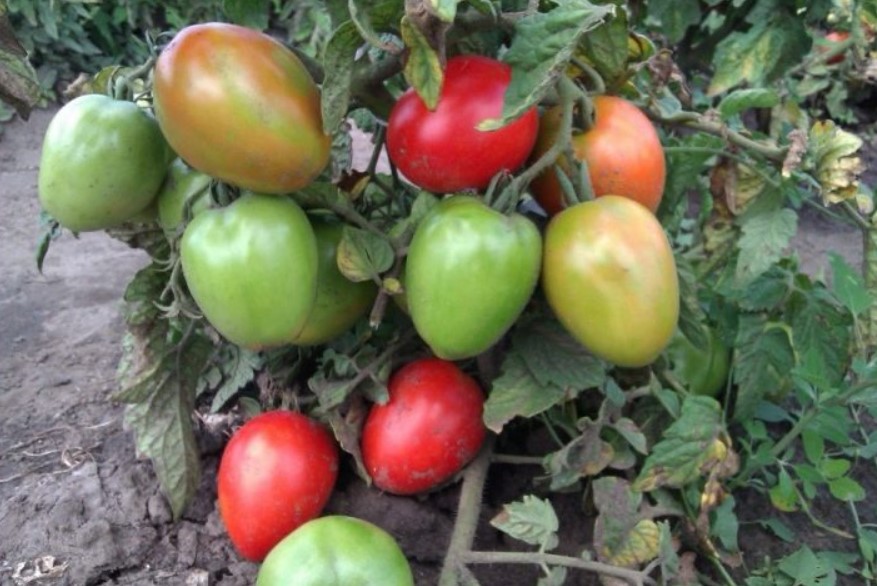
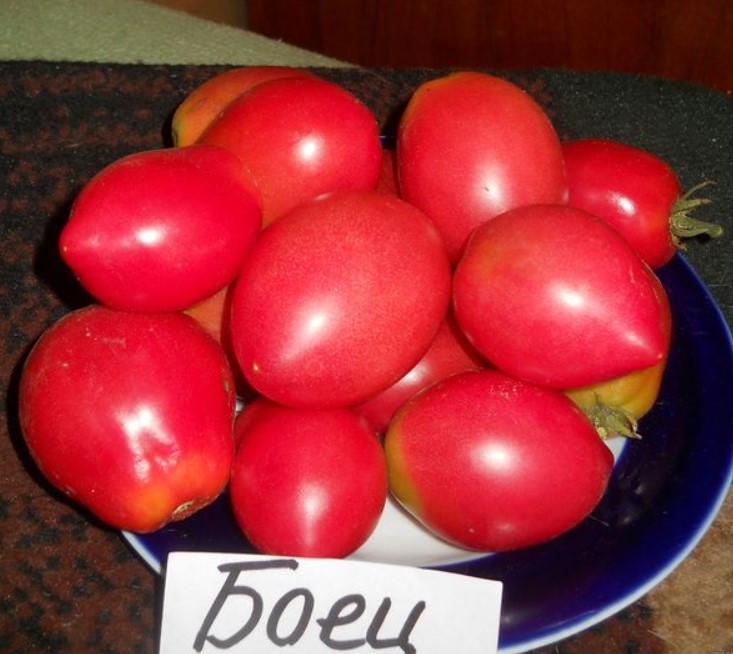
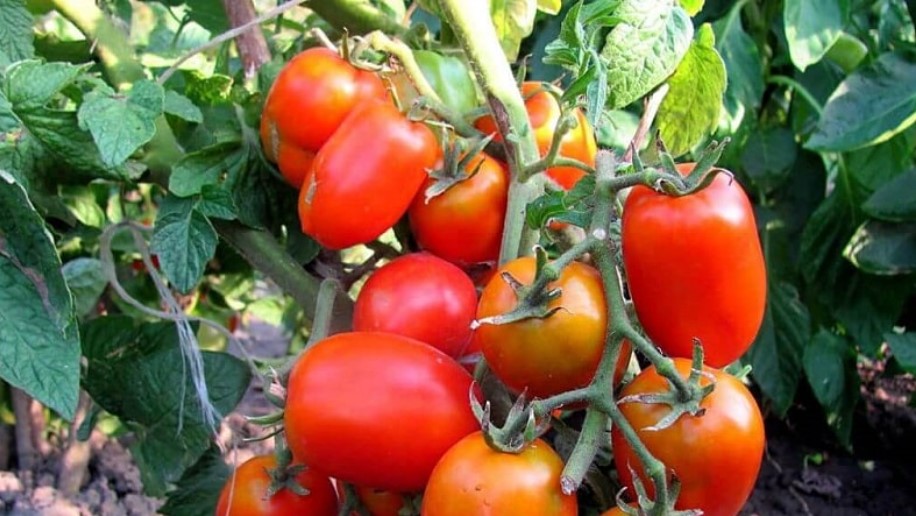
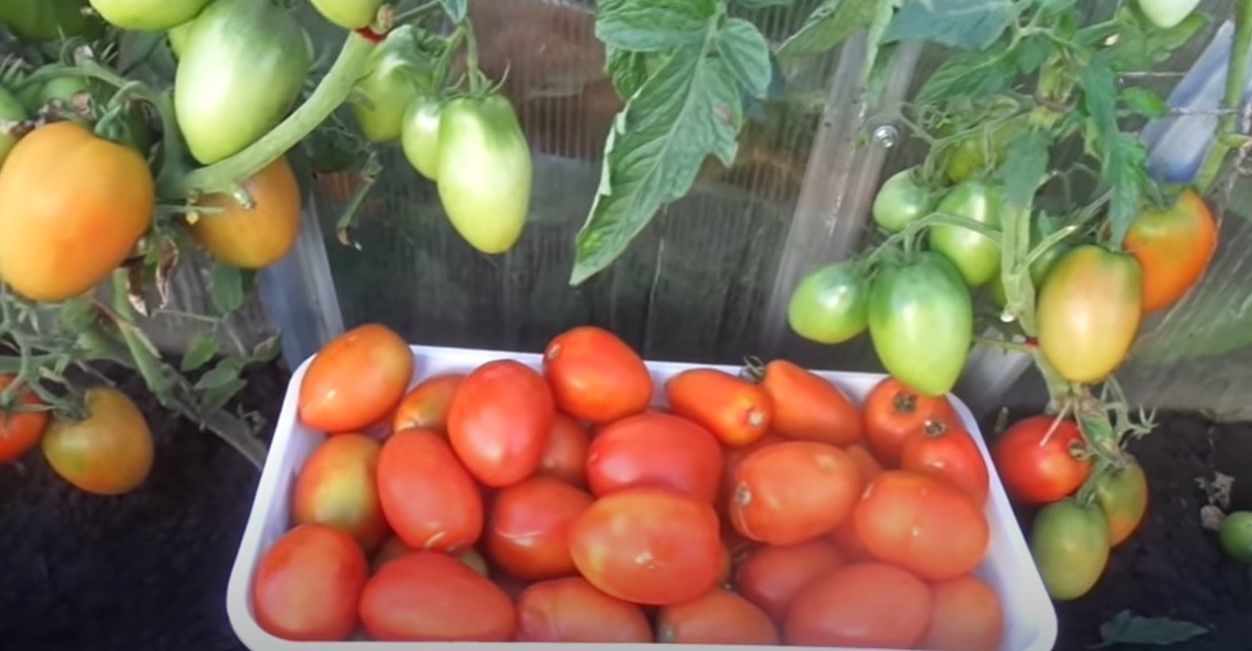
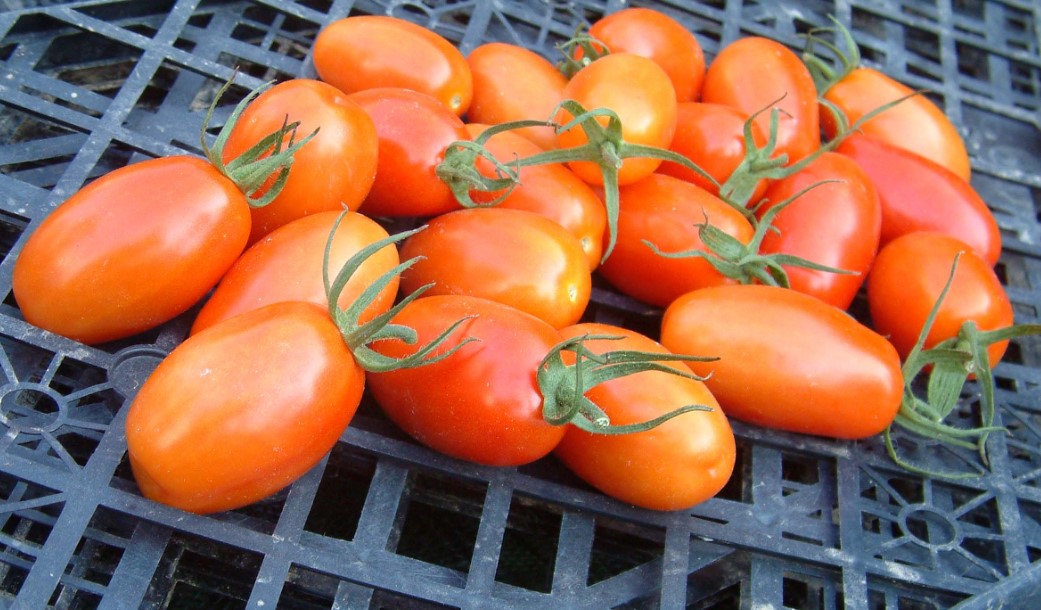
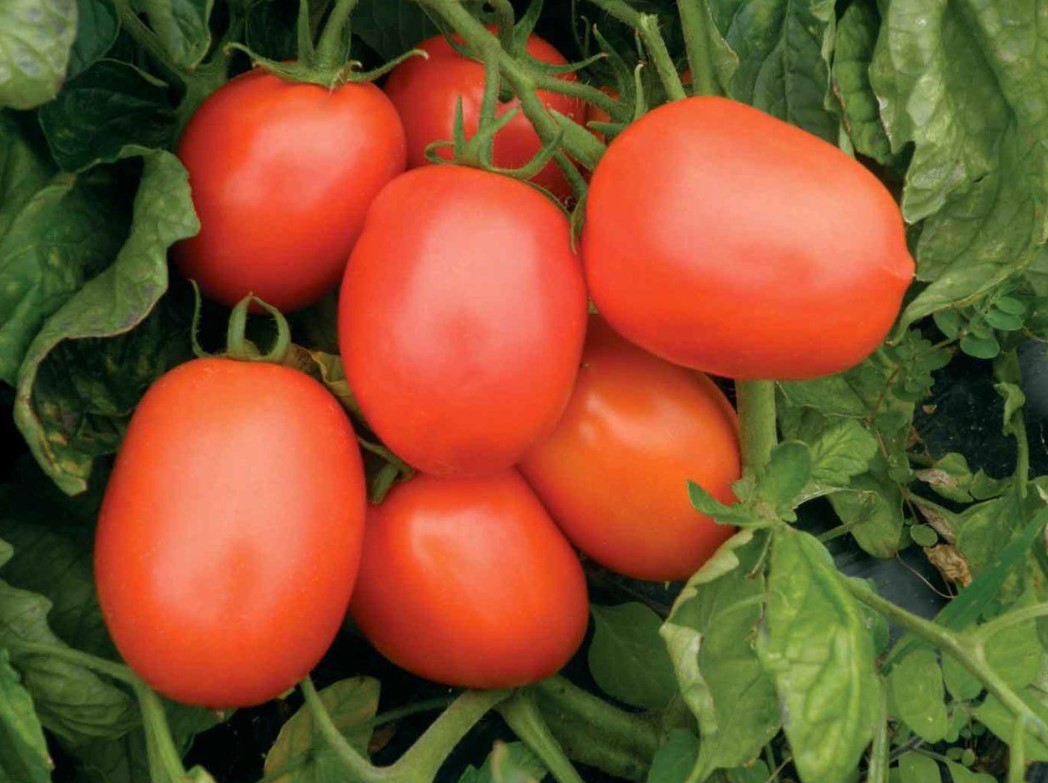
| Fetus | Cylindrical, red in color, smooth surface |
| Fruit weight | 67-88 g. Gardeners achieve a weight of 70 to 180 g. |
| Taste | Rich tomato |
| Usage | Versatile. The fruits are suitable for fresh eating, canning, and main courses. |
| Marketability | 72% |
| Shelf life | Average |
| Yield of commercial fruits | Up to 2.3 kg per square meter |
| Disease resistance | Average resistance to bacterial diseases, high resistance to tobacco mosaic virus |
| Agricultural technology | Compact bushes allow for a 30x40 cm growing pattern. During cultivation, determinate shoots cease to grow on their own; staking may be necessary during fruit formation. |
| Growing regions | Northern, Northwestern, Central, Volga-Vyatka, Central Black Earth Region, North Caucasian, Middle Volga, Lower Volga, Ural, West Siberian, East Siberian, Far Eastern |
| 2000 | |
| Originator | Khristov Yu. A., Domanskaya M. K., Gubko V. N., Zalivakina V. F., Kamanin A. A. (SibNIIRS) Federal Research Center of the Institute of Cytology and Genetics of the Siberian Branch of the Russian Academy of Sciences |
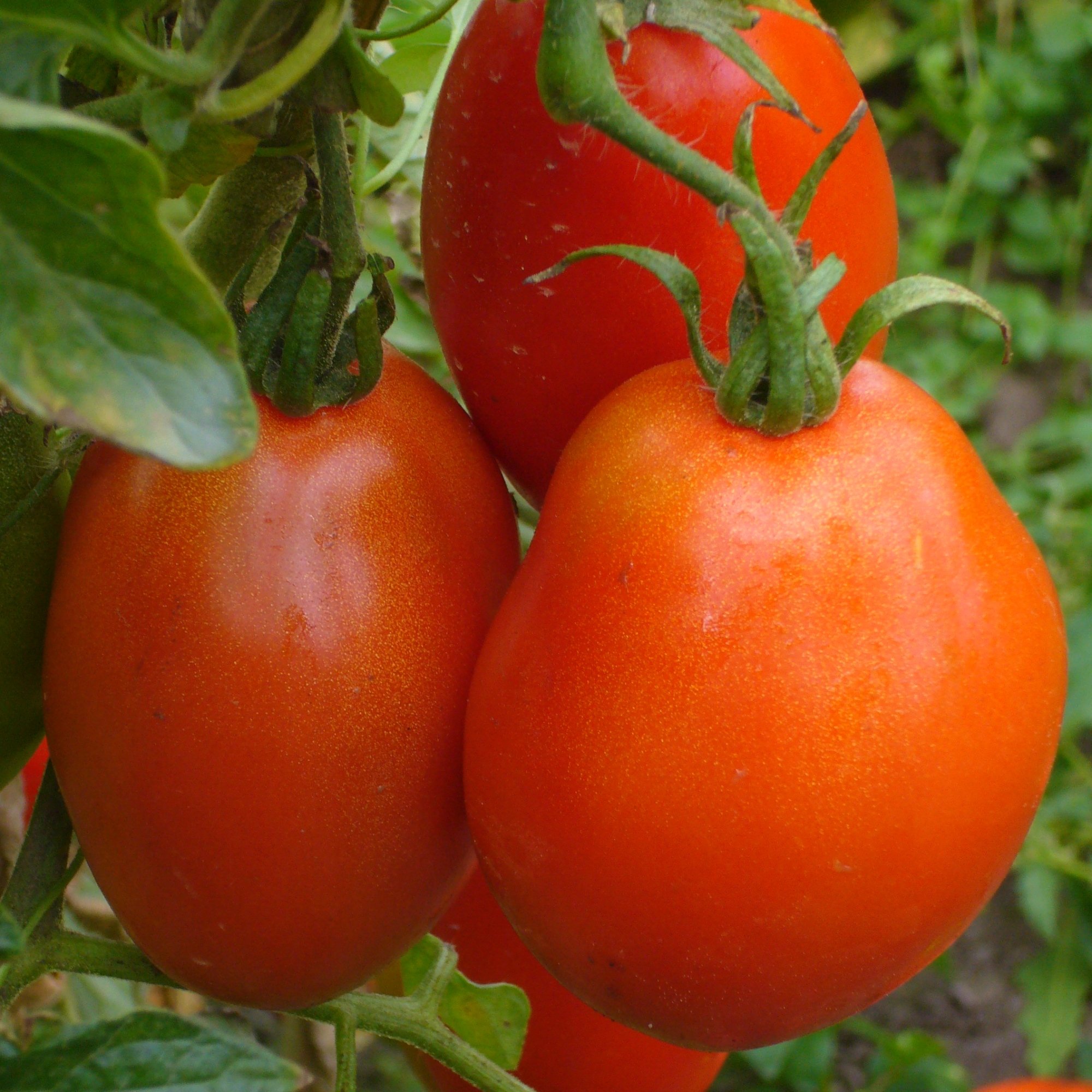
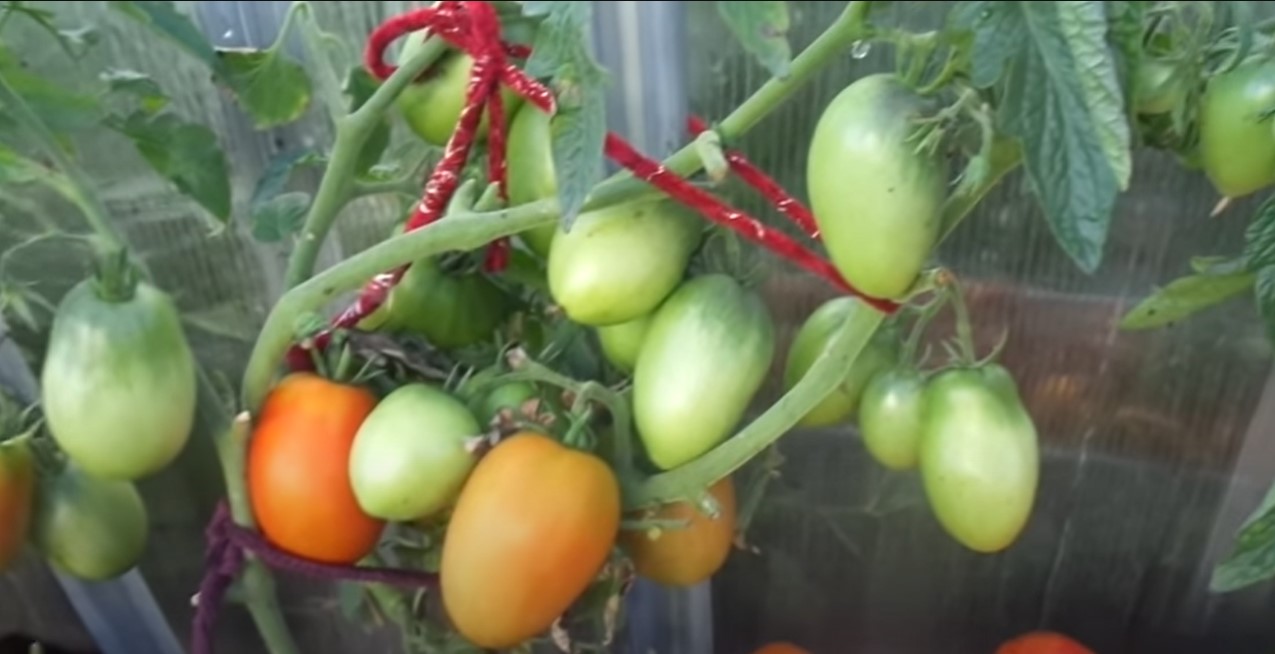
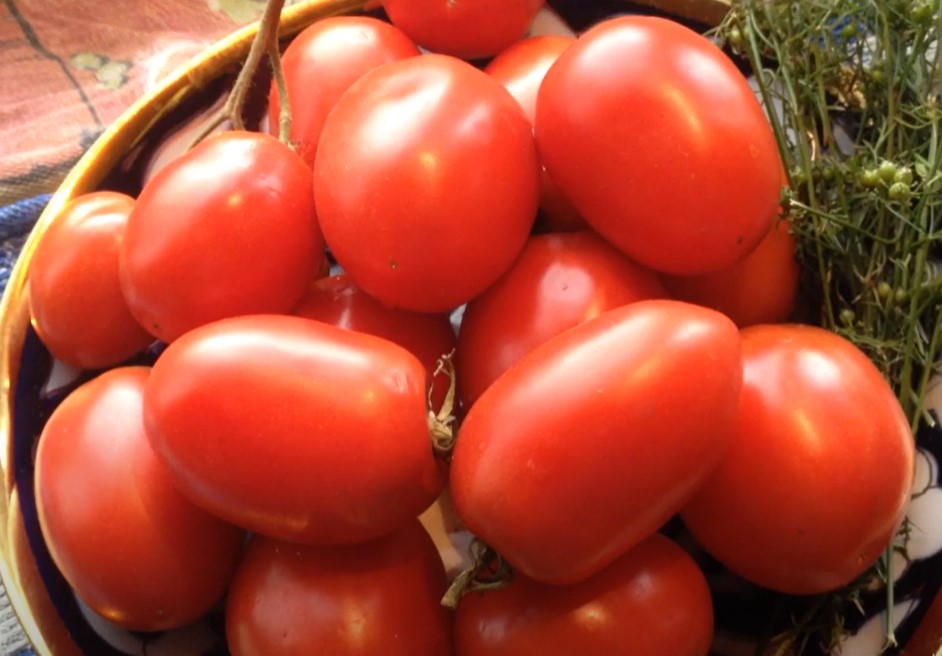
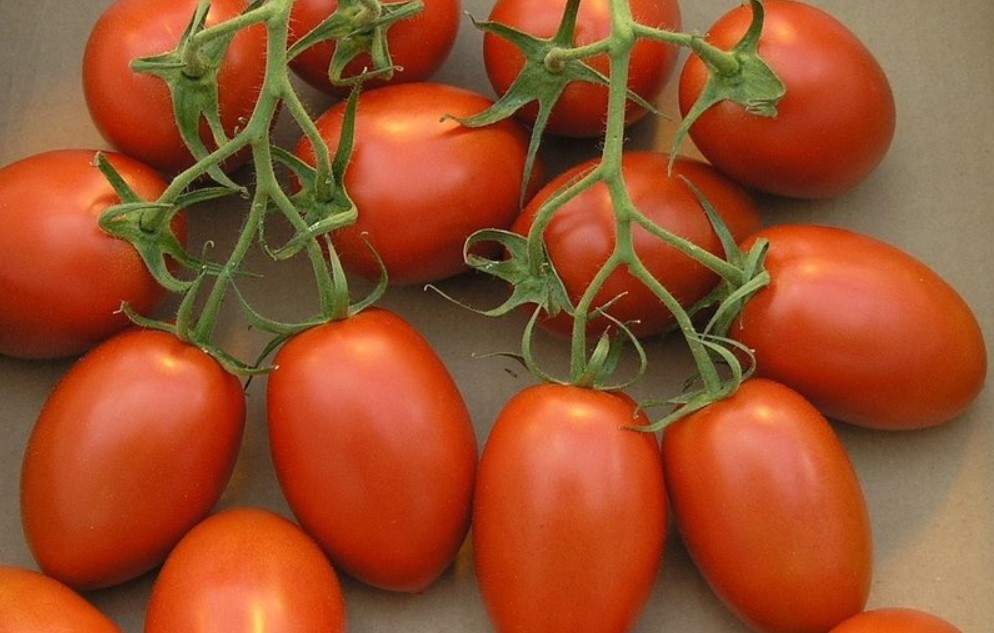
Photo gallery of the tomato variety Fighter (Buyan)
Characteristics of the Buyan yellow tomato variety
| Ripening period (number of days from full seedlings to maturity) |
105-115 days |
| Description | A determinate tomato variety suitable for both open-field and greenhouse cultivation. Resistant to adverse conditions. |
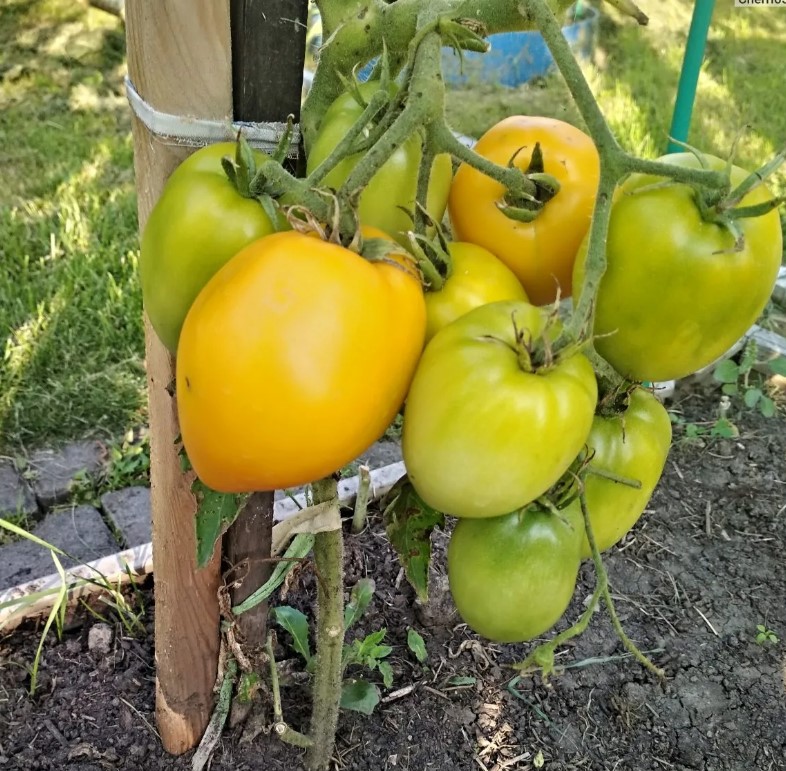
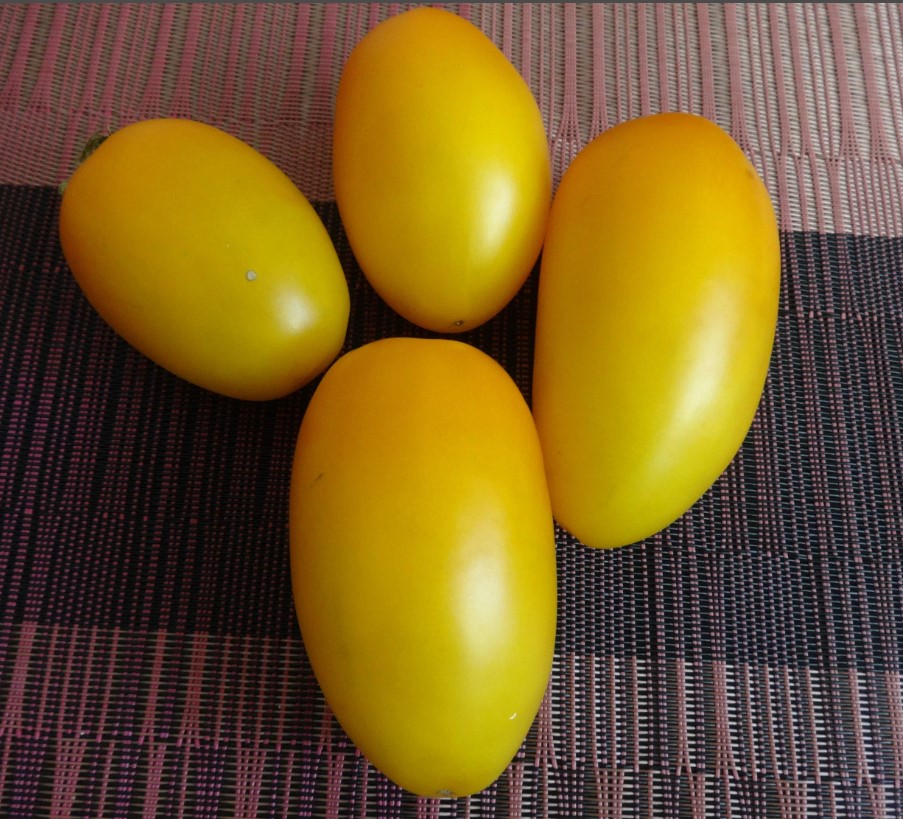
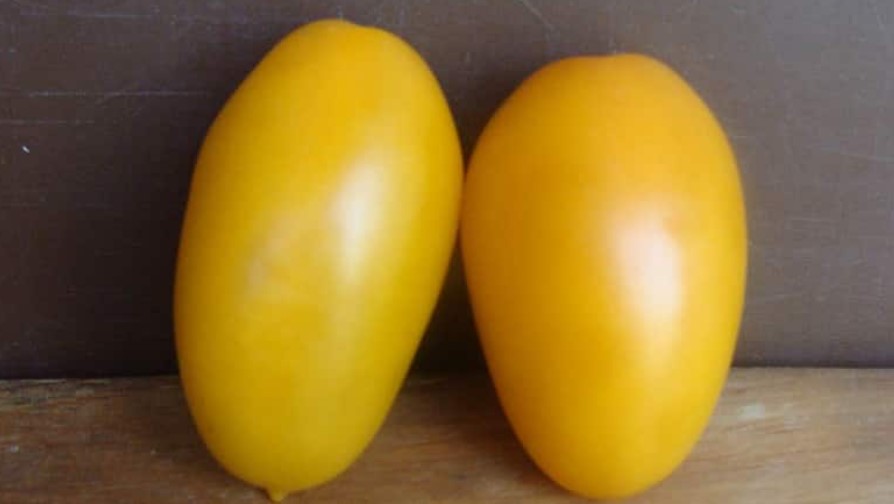
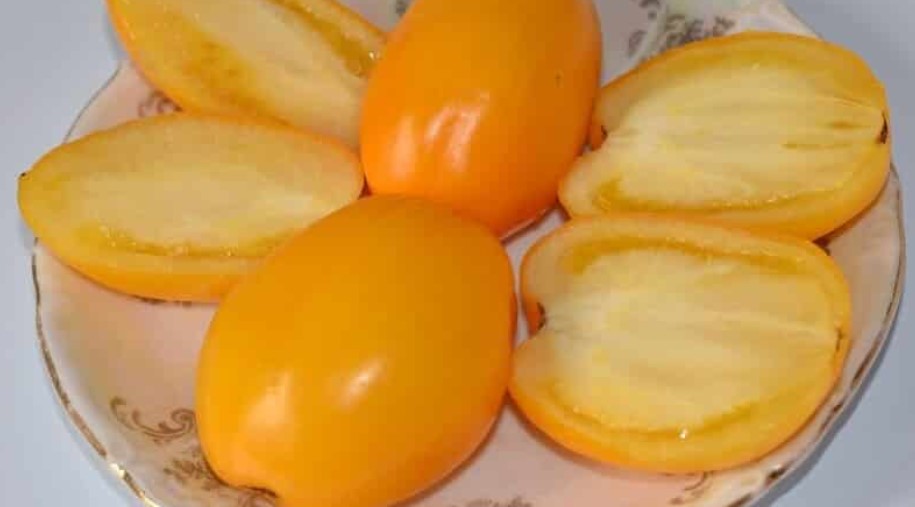
| Fetus | Cylindrical shape, yellow color, smooth surface |
| Fruit weight | 60-120 g. |
| Taste | Good, excellent. |
| Usage | Versatile. The fruits are suitable for fresh eating, canning, and main courses. |
| Marketability | 69-86% |
| Shelf life | Average |
| Yield of commercial fruits | Up to 1.63-4.94 kg per sq.m. |
| Disease resistance | Average resistance to bacterial diseases, high resistance to tobacco mosaic virus |
| Agricultural technology | Spreading bushes reach a height of 80-1000 cm. During cultivation, the growth of determinate shoots ceases on their own; staking may be required during the fruit formation period. |
| Growing regions | West Siberian |
| 2007 | |
| Originator | LLC AGROTECHNOLOGICAL FIRM 'AGROS' |
Photo gallery of the tomato variety Buyan Yellow
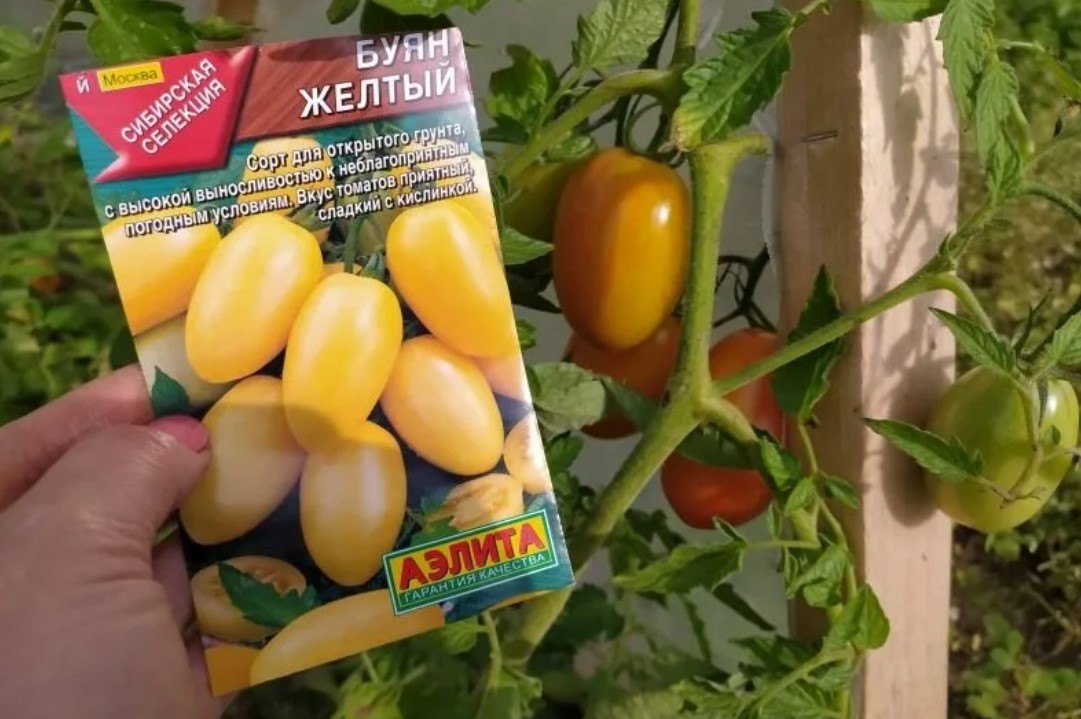
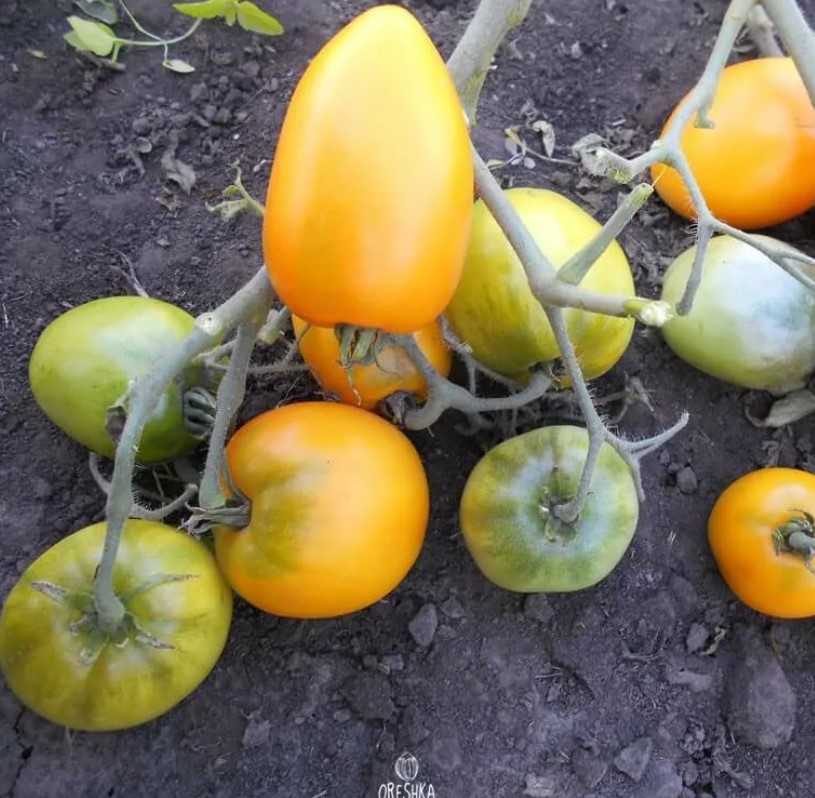
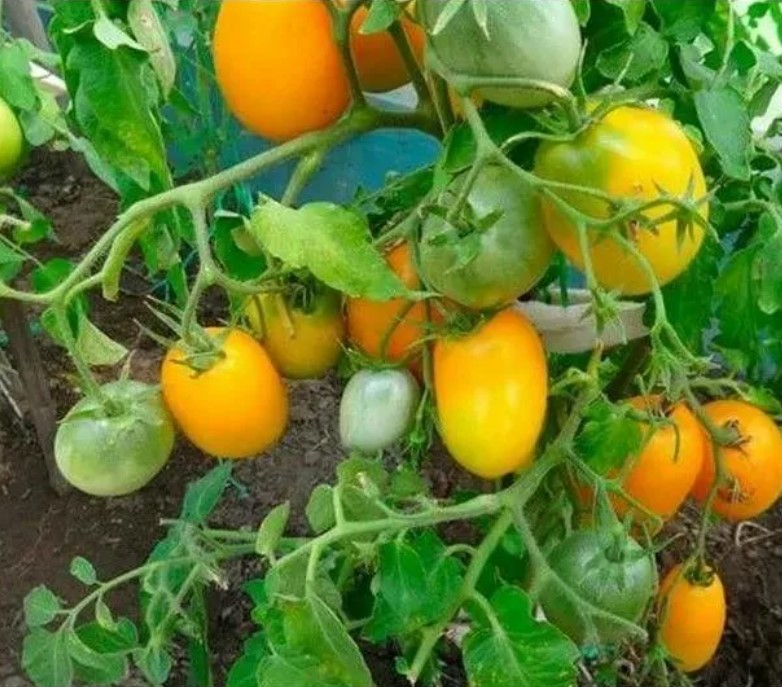
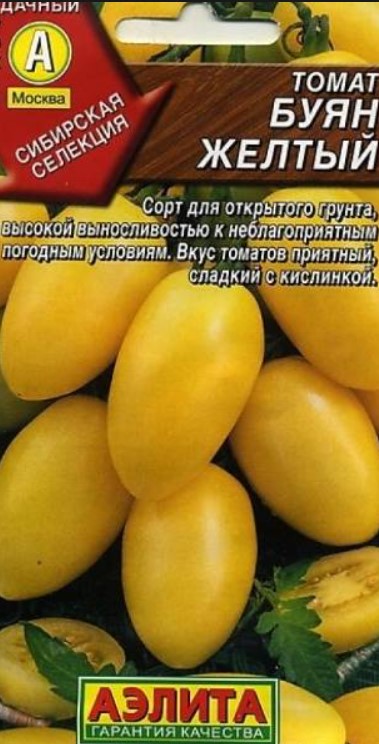
The history of the tomato variety Fighter (Buyan)
Many gardeners know that Boets and Buyan are two names for the same tomato variety. The former is officially recognized and is the one you'll find in Gorseestr. However, you might also see the latter name on the seed packet. The tomato was bred at the Siberian Research Institute of Crop Plants (SibNIISR), and the crop was added to the register in 2000.
Later in 2007, yellow Buyan was introduced.
A detailed description of the tomato variety Fighter (Buyan)
The Boyets (Buyan) tomato is loved by gardeners not only for its quick ripening and excellent yield, but also for its many other remarkable characteristics.
Characteristics of the bush
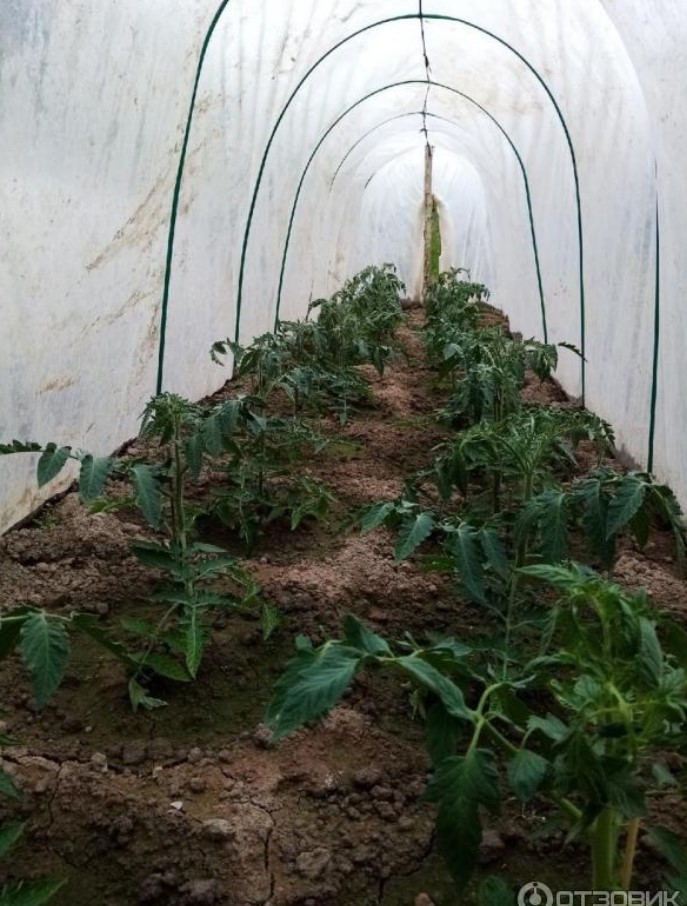
The advantage of the tomato plant is its compact bush. The shoots rarely reach 40 cm in height, and their determinate nature eliminates the need for staking. However, if a single cluster bears many fruits, gardeners recommend shoring it up to prevent it from breaking.
The Boets tomato doesn't take up much space in the garden, so it can be planted more densely than other tomato varieties. The shoots have few, small, dark green leaves with a corrugated surface.
Fruit characteristics
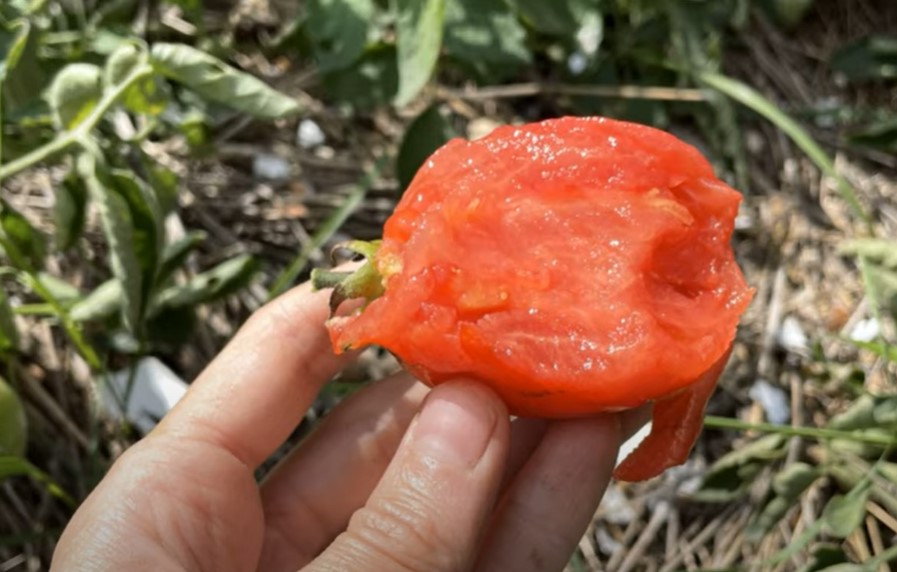
Tomatoes are oval-cylindrical in shape, with a color that ranges from pale green to yellowish and red. The fruits can be picked from the bush at the technical stage of ripeness, and they will ripen to the desired maturity at home. They weigh between 70 and 180 grams, have juicy flesh, and contain 3-4 seed chambers.
Productivity and ripening time
Despite its compact size, the Boyets tomato produces very good yields. Up to 3 kg of ripe fruit can be harvested per square meter, and in a greenhouse, this figure can be 1.5 times higher.
Advantages and disadvantages of the tomato variety Fighter (Buyan)
The Boyets (Buyan) tomato variety has many qualities that make it prized by gardeners. These are listed in the table below.
| Advantages | Flaws |
|
|
Planting Features of the Fighter (Buyan) Tomato Variety
The Boets (Buyan) tomato is suitable for both greenhouse and open-field cultivation. In warm climates, the seeds are sown directly into the ground, but in most other regions, tomato seedlings are used.
Sowing seeds and growing seedlings
The Boets (Buyan) tomato is not a hybrid, so you can collect the seeds yourself. However, you'll need to prepare them for planting at home by disinfecting them in a weak solution of potassium permanganate and treating them with any available growth stimulant to speed germination.
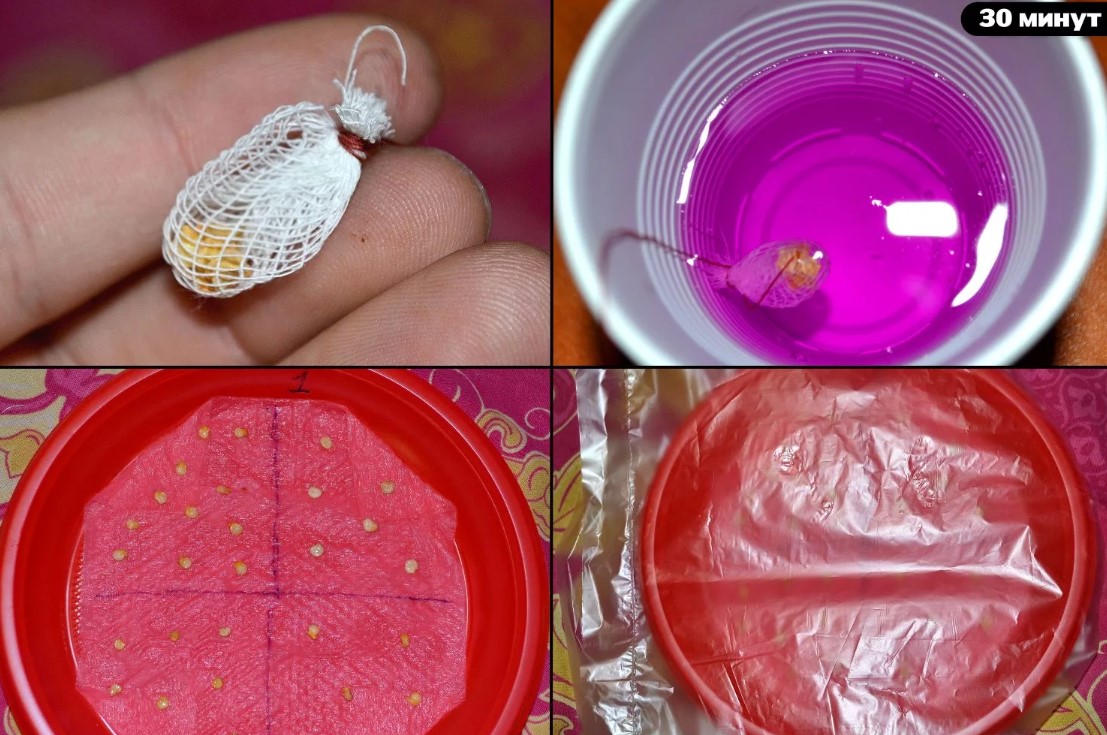
Sowing should be done approximately 60 days before planting in the permanent bed. It's best to purchase specialized soil, but you can make your own if necessary. To do this, mix equal parts garden soil, humus, and sand.
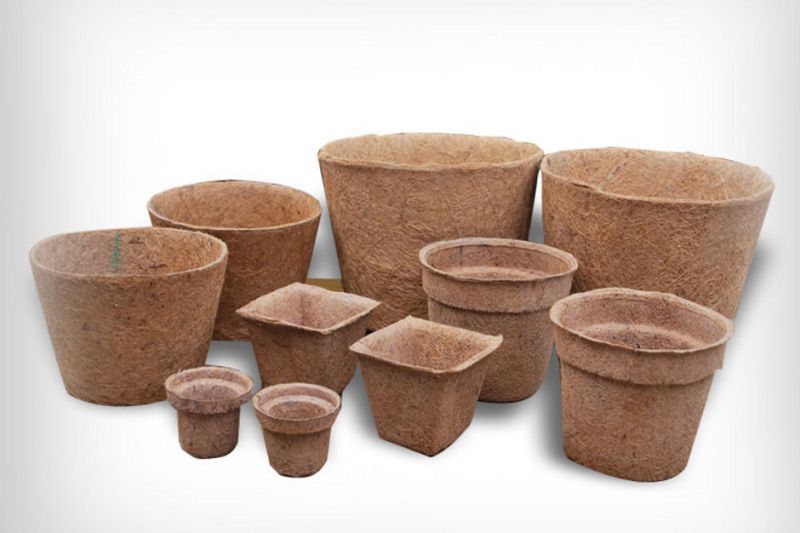
For growing seedlings, you can use large containers, boxes, cut-down boxes, or bottles. However, it's best to purchase peat pots or pellets; they eliminate the need for transplanting, as they are biodegradable and can be planted into the soil along with the seedlings.
Fill the container 2/3 full with soil. Place the planting material into the soil to a depth of no more than 1.5 cm and lightly sprinkle the top with potting soil. Next, water the container with a spray bottle or syringe to prevent soil erosion. Finally, cover the container with glass or plastic and place it in a warm location. It's important to ensure the soil doesn't dry out completely and to periodically ventilate the soil by lifting the cover.
As soon as the first shoots emerge from the light, the film should be removed and the seedlings placed in a cooler room. At this stage, the plants may require additional lighting, which is most easily provided by a phytolamp.
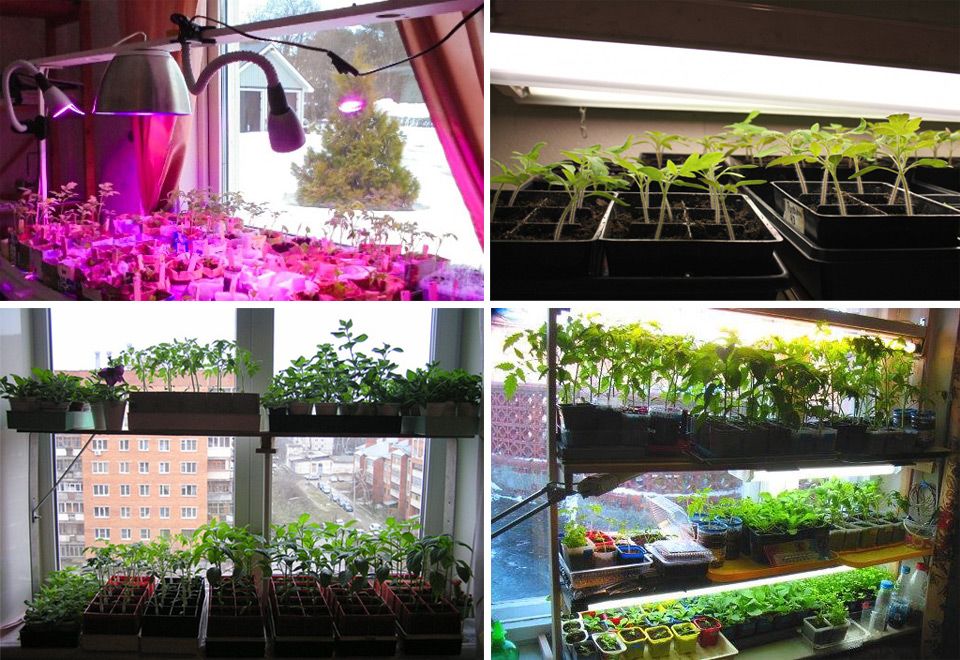
When 2-3 true leaves appear on the tomatoes, you can start picking.
Planting in the ground
The advantage of the Boyets variety is that its shoots do not stretch, and its root system is strong and powerful enough to survive transplantation with minimal stress.
Tomatoes are transplanted into the ground 60 days after planting, by which time the shoots typically have 6-7 true leaves. The soil should have warmed to 12 degrees Celsius (55 degrees Fahrenheit) by now; otherwise, growth will be slower and fruiting will be delayed.
- The tomato bed is prepared in the fall, with the soil dug over and mulched with compost and manure. In the fall, the soil is dug over and loosened again.
- Next, holes are made about 20 cm deep at a distance of 30 cm from each other.
- You can leave a gap of 40 cm between rows. It is recommended to plant in a checkerboard pattern.
- Carefully transfer the tomatoes, along with the root ball, into the hole, cover with soil, and water. If planting outdoors, consider providing a shelter to protect the plants from potential frost damage.
Caring for the tomato variety Fighter (Buyan) in a greenhouse and open ground, features
The primary care procedure is watering. The Boyets (Buyan) variety tolerates drought quite well, so it can be grown even in areas where gardeners can't visit frequently. Watering should be adjusted according to growing conditions.
- In a greenhouse, watering is initially done once a week at a rate of 5 liters per bush. During the fruit formation period, the frequency of watering triples. This rule should also be followed during unusually hot weather.
- When growing outdoors, water the soil when the ground has dried out after precipitation, if any. Excessive moisture increases the risk of rot diseases.
Fertilizing is recommended three times per season, using complex fertilizers. If the soil was initially properly prepared and contains sufficient nutrients, this step can be skipped.
Weeding and loosening should be carried out as necessary to improve aeration and reduce the risk of pests.
Resistance to diseases and pests, prevention
The Boets (Buyan) tomato is characterized by strong immunity and is rarely susceptible to infectious and fungal diseases. However, problems can sometimes arise if cultivation guidelines are not followed.
| Disease | Signs | Treatment |
| Gray mold | A fluffy coating appears on the fruits. Leaves and stems become spotted. | Treatment with Fundazol and Switch. |
| Blackleg | The stem at the base of the bush rots and turns black. | The disease is not treated; the bushes are destroyed and the soil is disinfected with special preparations or a solution of potassium permanganate. |
| Brown rot (phoma) | Brown spots appear on the leaves. Dark spots can be seen on the surface of the fruit, which grow larger over time. | Spraying with Bordeaux mixture or copper oxychloride. |
| Bacterial spot | Early-ripening varieties are most susceptible. Flowers dry out, shoots and leaves become spotted. | Spraying with Abiga-Peak. |
| Stem pith necrosis | The disease progresses during fruiting. The leaf surface becomes covered with light spots, the leaves curl, the stem dries out internally, and cavities form, leading to the death of the plant. | Treatment with Fitolavin-300 and Gamair. |
| Bacterial cancer | Bacteria attack the vascular system of the stem, and the plant dies from below: first, the lower leaves curl and die, then the disease spreads to the fruits, and the bush dies. | Spraying with Baktofit, Gamair, Fitolavin-300. |
About various tomato diseases and how to combat them Read on our website.
As a preventative measure against various diseases, tomatoes can be sprayed with a solution of Fitosporin or Bordeaux mixture three times per season at intervals of 10-14 days.
Harvesting, using and storing tomatoes of the Boyets (Buyan) variety
Buyan (Fighter) tomatoes ripen approximately three months after germination. If necessary, they can be picked from the plant at the technical maturity stage and ripened at home. Experienced gardeners recommend always leaving one ripe tomato on the plant when harvesting to ensure the next crop ripens faster.
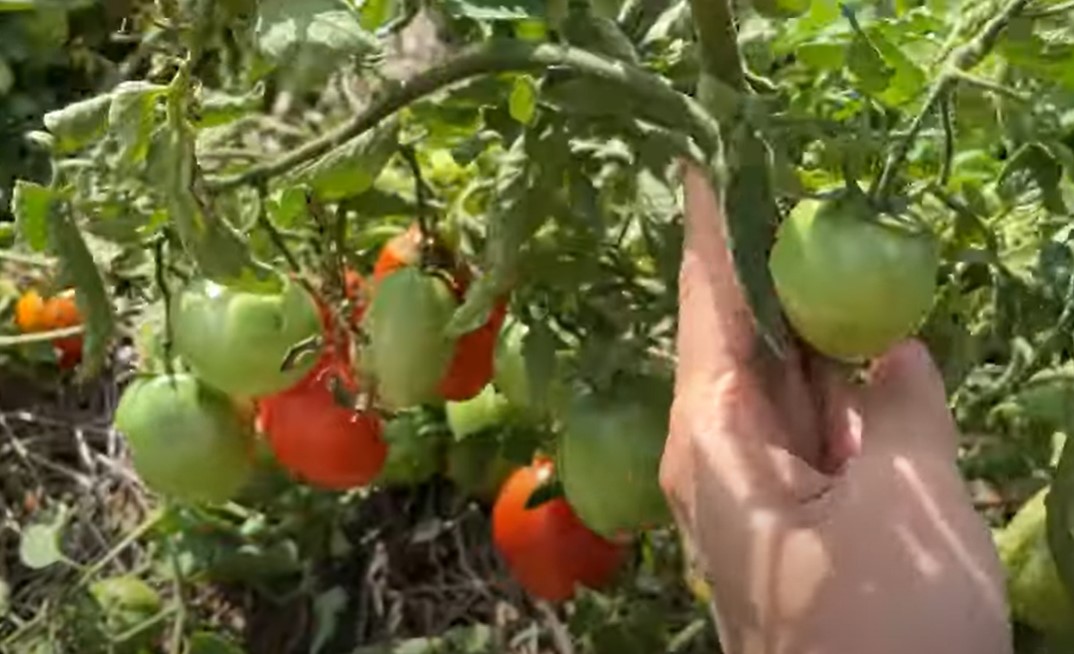
It is better not to allow tomatoes to become overripe, as this will cause them to lose their flavor.
The harvest of the Boyets (Buyan) variety can be used for fresh eating, as well as for canning, drying, and curing.
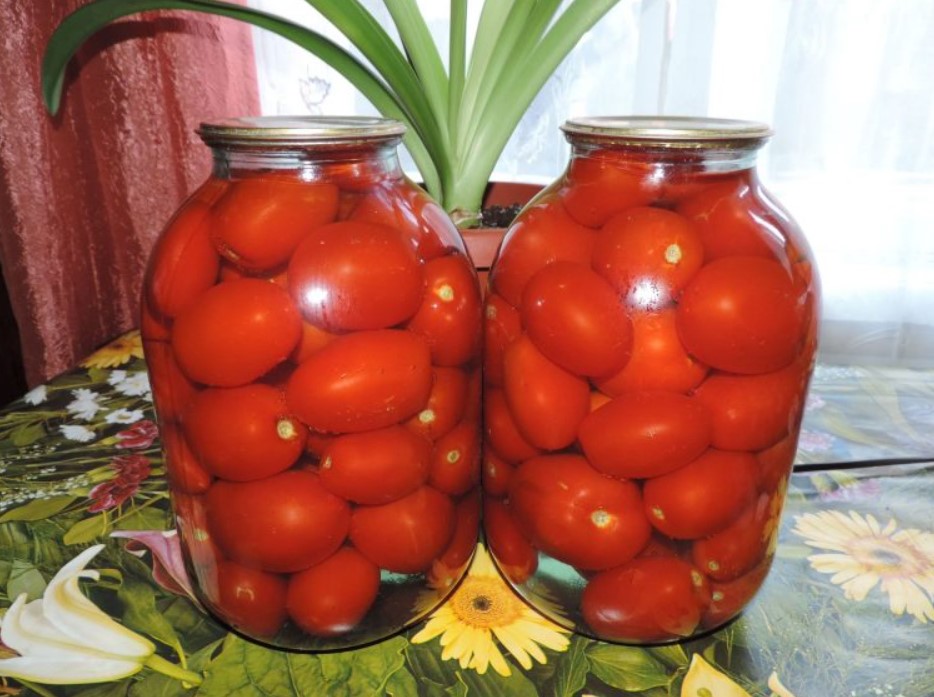
One of the variety's drawbacks is its short shelf life. When stored properly, tomatoes will last for about 10-14 days without losing quality, so they should be processed immediately.
Comparison of tomato varieties Boyets (Buyan) with other varieties in the table
Please note! How can you easily convert centners/ha to kg/sq.m? Simply divide by 100! For example, the Abakansky Pink tomato yields 400 centners of marketable fruit per hectare. This equals 4 kg per square meter. It's that simple! Also, keep in mind that typically no more than 3-4 plants are planted per square meter. This way, you can calculate the yield per bush. In the case of the Abakansky Pink, it's about 1 kg.
| Variety | Ripening period (number of days from full germination to ripening)
Yield of commercial fruits |
Brief description | Fetus |
| Fighter (Buyan) | 95 days 230 c/ha |
An early-ripening, determinate, standard variety for open ground and greenhouses. Suitable for salads, canning, and pickling. Marketability: 72%. Drought-resistant. | Cylindrical, smooth, red, 67-88 g. Good taste. |
| Yellow Buyan | 105-115 days
163-494 c/ha |
A mid-season, determinate, standard variety for open ground and greenhouses. Suitable for salads, canning, and pickling. Marketability: 69-86%. Tolerant of adverse conditions. | Cylindrical, smooth, yellow, 70-120 g. The taste is good, excellent. |
| Rio Grande | 110-115 days
1500-1800 c/ha |
A mid-season determinate variety for open ground and greenhouses. Suitable for salads, processing into tomato products, and canning. | Plum-shaped, slightly ribbed, pinkish-red, 100-115 g. The taste is good to excellent. |
| De Barao red | 120-130 days
500-600 c/ha |
A late-ripening indeterminate variety for open ground and greenhouses. Requires staking and training. Suitable for salads and whole-fruit canning. | Ovoid, smooth, red, 30 g. Excellent taste. |
| De Barao giant | 123-128 days 2000-2400 c/ha |
A high-yielding, indeterminate tomato variety with very large fruits, with shoots growing up to 270 cm. Suitable for both open and closed ground cultivation, it requires support, staking, and training. These tomatoes are suitable for fresh eating, as well as for making juices and pastes. They are not suitable for whole-fruit canning. | The tomatoes are oval-round in shape, have a dense skin, weigh 350 g. The taste is excellent. |
| De Barao yellow | 110-120 days
1200 c/ha |
An indeterminate plant with a bush up to 200 cm tall. Recommended for growing under plastic cover. The bushes are formed into two shoots and require staking. This versatile tomato is well-suited for whole-fruit canning and can be used in dietary menus. | The fruits are round-oval with a smooth surface and a slight indentation at the base. Ripe fruits are bright yellow or golden in color, weighing 80-90 g. The flavor is excellent. |
| De Barao pink | 111-119 days
600-1000 c/ha |
An indeterminate variety with a mid-season ripening period. It is used primarily for greenhouse cultivation. The foliage is medium, and the bushes barely reach 200 cm in height. The shoots are tied and pinched as they grow; the bush requires shaping. It is suitable for salads and all types of canning. | The fruits are oval, with glossy pink skin and a smooth top, 80-100 g. The taste is excellent. |
| De Barao orange | 110-130 days
1000-1200 c/ha |
Grows well in open ground. In cooler regions, it can be planted in unheated greenhouses. This indeterminate, late-ripening variety grows up to 200 cm. It requires staking and training. It is suitable for salads and all types of canning. | The fruits are small, ovoid, with smooth, glossy skin. The flesh and skin are orange, weighing 120 g. The flavor is excellent. |
| Abakan pink | 120 days or more 400 c/ha |
A late-ripening determinate variety for open ground and greenhouses. Requires staking and training. Suitable for salads and processing into tomato products. | Flat-round, slightly ribbed, medium density and pink in color, 200-500 g. Good taste. |
| Adelina | 82-109 days
242-447 c/ha, maximum 669 c/ha |
A mid-season determinate variety for open ground. Suitable for salads, whole-fruit canning, and processing into tomato products. Heat- and drought-resistant. | Egg-shaped, smooth, transportable red, 59-83 g. The taste is good to excellent. |
| Scarlet Mustang | 115-120 days
391 c/ha |
A mid-early, indeterminate variety for open ground and greenhouses. Suitable for canning. It has a very high marketability (97.3%). | Medium, cylindrical, hard, slightly ribbed, red, 95 g. |
| Banana legs | 80-85 days (greenhouse), 90-100 (open ground)
1780 c/ha |
An early-ripening indeterminate variety for open ground and greenhouses. Suitable for salads. | Cylindrical, dense, slightly ribbed, yellow, 80-100 g. Good taste. |
| Ladies' man | 110 days 1000 c/ha (greenhouse) |
A mid-season indeterminate variety for open ground and greenhouses. Requires staking and training. Suitable for salads, whole-fruit canning, and pickling. | Cylindrical, with a spout, smooth, very dense, resistant to cracking, red, 45-60 g. Excellent taste. |
| Raspberry Joy | 90-95 days
1400 c/ha (greenhouse and under film) |
A low-growing determinate variety. Suitable for salads and canning. | Ovoid, bright pink, ribbed, with a dense skin, 100-150 g. Tomato flavor. |
| Rocket | 122-129 days
328-618 c/ha |
A mid-early determinate variety for open ground. Suitable for canning. Requires increased doses of potassium fertilizer. | Elongated plum-shaped with a tapering top, smooth, red, 34-58 g. Good taste. |
| Königsberg | 115 days
460-2000 c/ha |
An indeterminate, mid-season variety for garden beds. Requires staking and training. Suitable for salads and processing into tomato products. Marketability: 56% (Novosibirsk Region). Heat-resistant. | Cylindrical, smooth, dense, good keeping quality, red, 155-230 g (up to 300 g). Excellent taste. |
| Golden Königsberg | 115-120 days
860 c/ha |
An indeterminate mid-late variety for both open and closed ground. Requires staking and shaping. Salad-type. Marketability: 56% (Novosibirsk Region). Heat-resistant. | Cylindrical, slightly ribbed, orange, medium density, 191 g. Excellent taste. |
| Cream (not in the register, group of varieties) | 90-140 days (depending on the specific variety)
700-1000 c/ha |
Early or late-ripening, determinate or indeterminate varieties for open ground and greenhouses. Suitable for canning, freezing, drying, and salads. | Plum-shaped, smooth, red, orange or purple, 50-120 g. Taste good to excellent. |
| Siberian miracle | 110-115 days
The yield of commercial fruits under film covers is 10 kg/sq.m. |
A mid-season indeterminate variety for open ground and greenhouses. Requires staking and shaping. Suitable for salads. | Ovoid, smooth, medium density, red, 150-200 g. Good taste. |
| Siberian Troika | about 120 days
600 c/ha |
A mid-season determinate variety for open ground. Suitable for salads and canning, including whole-fruit preserves. Heat-resistant. | Cylindrical with a spout, smooth, dense, red, 80-100 g (up to 200 g). Excellent taste. |
| Siberian grape | 110-120 days
The yield of commercial fruits in open ground was 8.5 kg/sq.m. |
A mid-late determinate variety for open ground and greenhouses. Suitable for salads. | Cylindrical, medium density, slightly ribbed, red, 89 g. Good taste. |
Gardeners' reviews of the red and yellow tomato variety Fighter (Buyan)
A very easy-to-grow tomato variety, it's almost never susceptible to disease and produces excellent fruit. The seeds germinate evenly, without the seedlings becoming stretched. It tolerates drought well, making it ideal for gardeners.
This year, I'm continuing my experiments with tomato seeds. I'll gradually share more about the new varieties my sister and I planted in separate greenhouses. I'm talking about growing tomatoes in the Tver region during a truly dreadful, rainy summer.
Tomato Boyets (Buyan) of Siberian selection is an ultra-early variety, however, in the conditions of this summer it does not fully justify this.
Our tomato is planted in a greenhouse, although the seed producer emphasizes open ground.
In greenhouse conditions, the bush grows to about 80 cm in height. The variety doesn't require pinching, but excess leaves were removed during growth. Each bush averages about 2 kg of tomatoes. The shape is interesting.
And yet, among the low-growing tomatoes, I strongly recommend paying attention to this variety, which I already wrote a review about last year. Tomato seeds Sedek Betalux - a good tomato variety - one of my favorites.
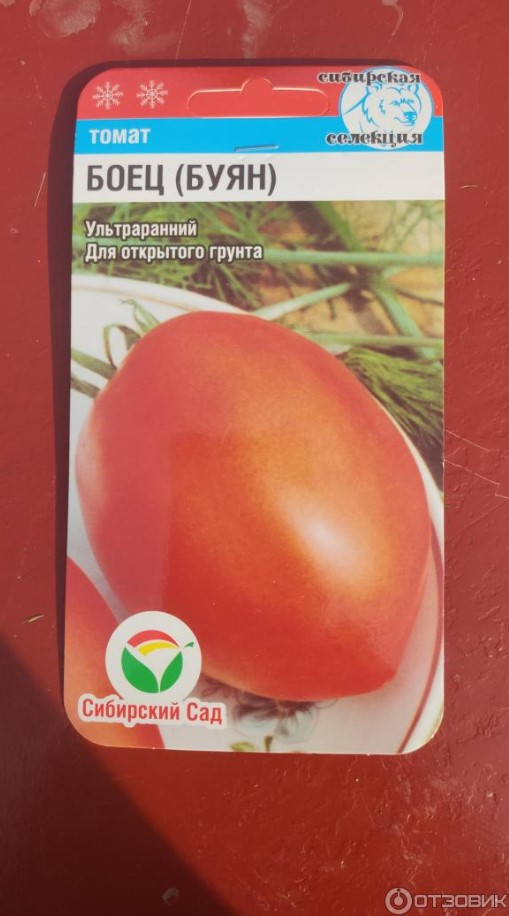
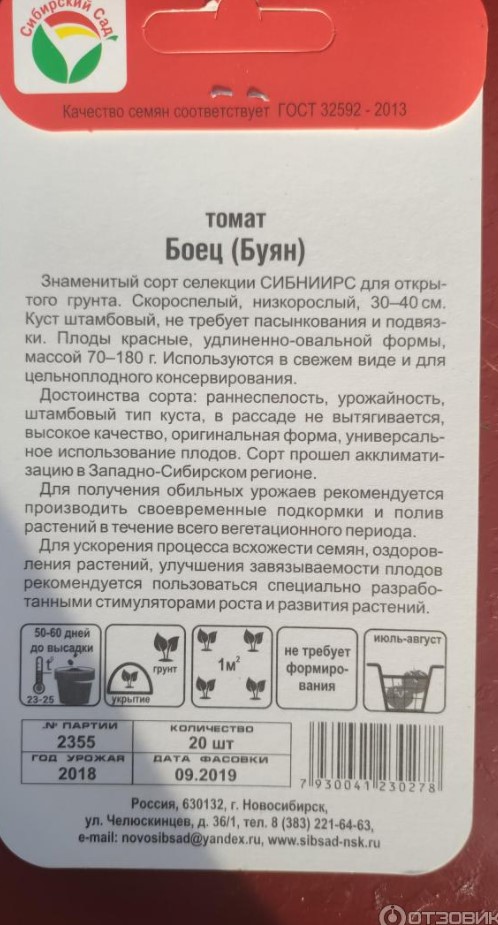
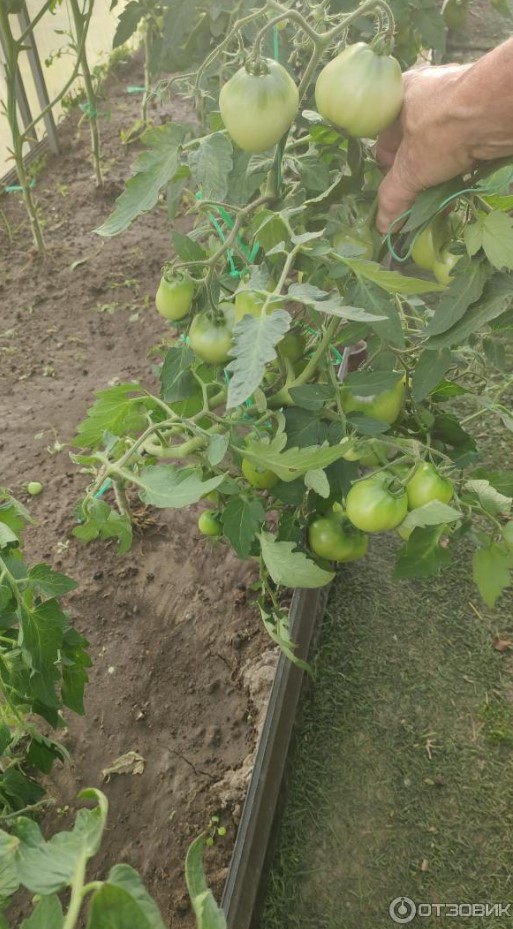
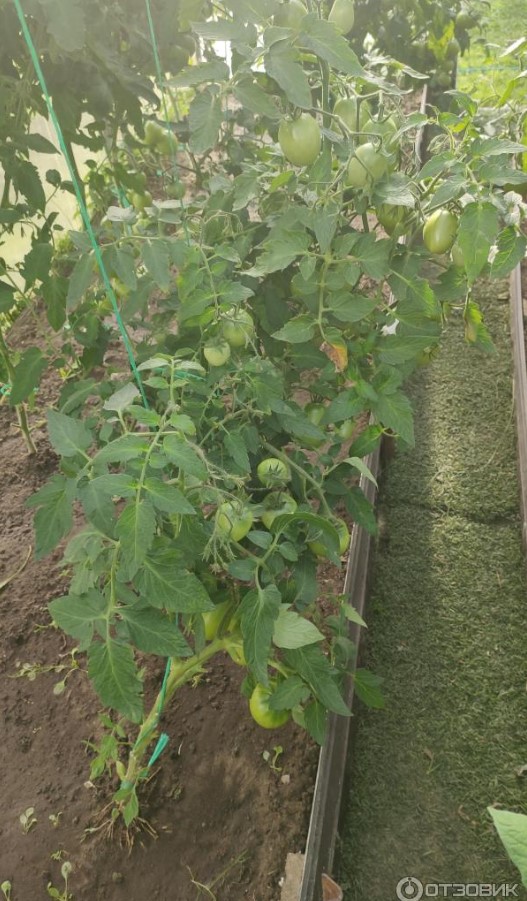
Hi all.
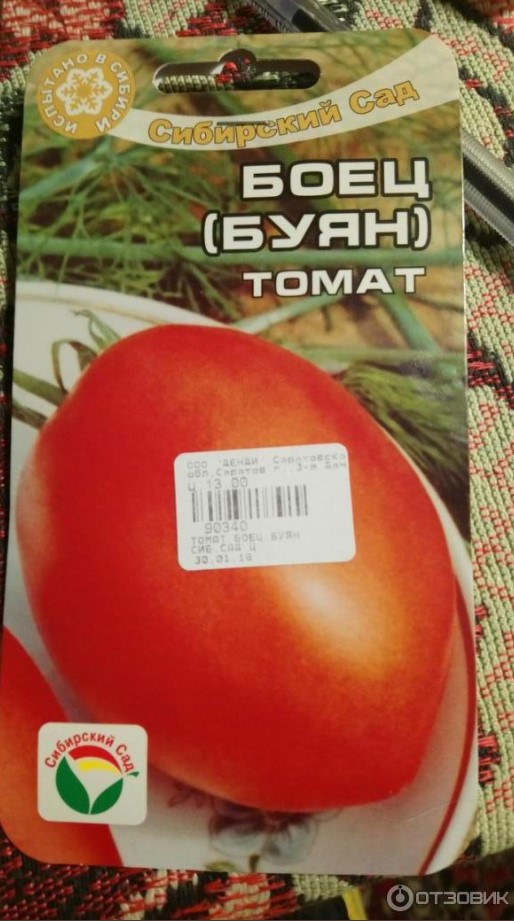
I'd like to share my impressions of the Boets (Buyan) tomato seeds. I like the ones from Sibirsky Sad the best, although I've tried seeds from this variety and other companies.
I live in the middle Volga region of the Saratov region, and we often have a rather cool start to summer, so I prefer the seeds from the Siberian collection; they are more suited to our climate.I'm generally a very lazy gardener, although I love gardening. So, I choose varieties that require less fuss. Growing tomatoes in greenhouses, covering them with special material, tying them up—that's not my thing. I like to plant and forget about them. At least, that's how my grandmother tended to her garden her entire life, without having to worry about every little sprout. So, this variety is a godsend for me.
An early maturing variety, one of the first to begin producing a harvest.The Buyan variety's bushes are low, only 30-40 centimeters tall, so there's no need to bother with staking. To keep them standing, I usually hill them like potatoes, even when planting the seedlings.
The seedlings are one of the best looking, plump, short, and not stretching. They transplant easily and are not affected by temperature fluctuations.
This variety doesn't require pinching, which is absolutely fantastic for me!
The tomatoes themselves aren't very large, just slightly oblong. I prefer this variety for jarring because the skin is quite thick and doesn't crack easily, and the tomatoes fit easily in the jar, even though they're not small.
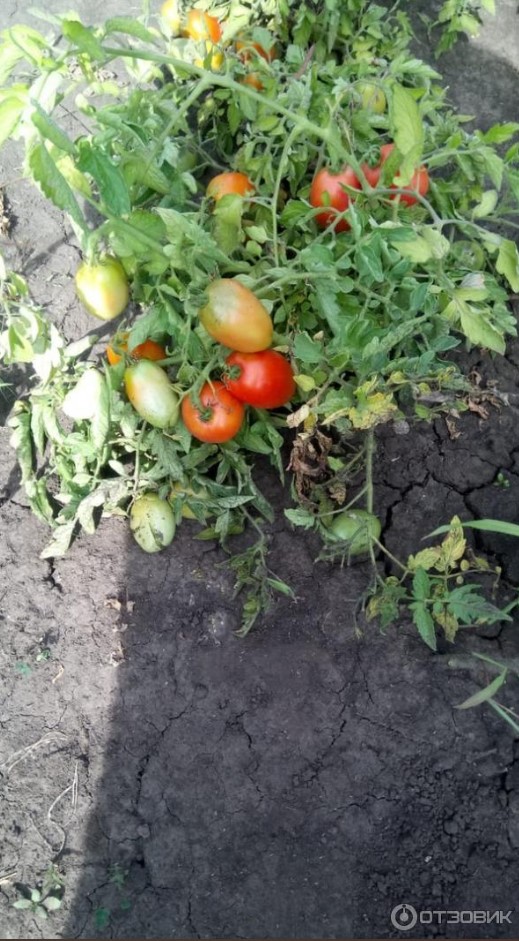
I don't know if this is a plus or a minus, but the fruiting is always abundant and uniform. It turns out that you only pick tomatoes from the bushes two or three times, but by the bucketful. For me, this is more of a plus, because they fruit quickly, and I remove the bushes so they don't take up the soil, and I have time to sow green manure a couple more times before winter.
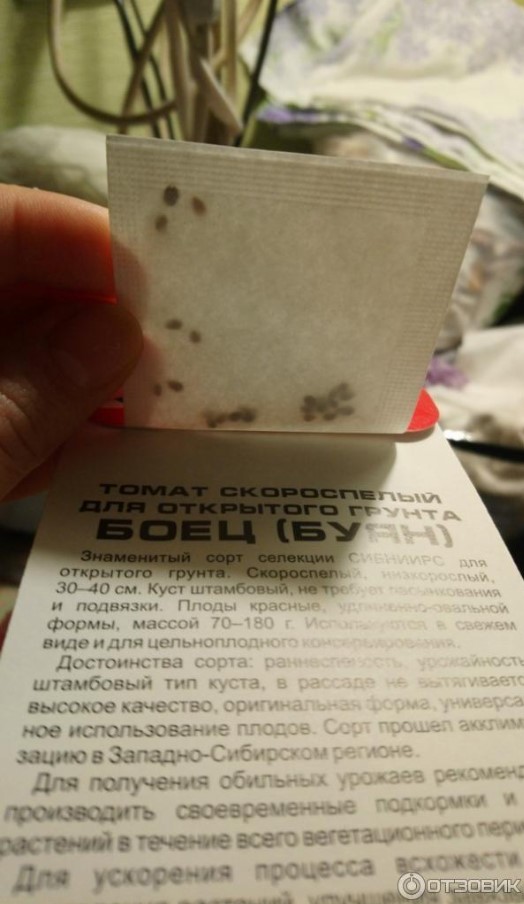
It's worth noting that this isn't a hybrid, so you can collect your own seeds, but I haven't gotten around to it yet. So I buy new ones every year. They're not expensive; I bought mine for 13 rubles. The package says 20 seeds, but in reality, there are 25-27. The germination rate is excellent; last year I planted 22 seeds, and all 22 sprouted, leaving 18 plants left before transplanting into the ground. This year, I want to plant more, as the plants aren't very large. But they can be planted more often than tall tomatoes. This year, I want to plant them along paths, as they look very beautiful.
I recommend buying seeds, as the quality of the seeds is very good, and you will definitely like the variety itself; you will not be left without a harvest.

Good day to all.
Midsummer is the time to start taking stock of the gardening season. Some vegetables are still growing, and the tomatoes are already ripening.
I usually plant seedlings myself, but this year I decided not to bother and buy ready-made ones.
So, tomatoes "Buyan".
The seedlings were strong, short, with thick stems.
We planted them as usual, in early June, and now it's mid-July, and our tomatoes are reddened. It's an early-ripening variety.
Medium-sized, elongated tomatoes with a sweet and sour taste.
There are a lot of fruits, considering that we have never removed any side-children.
This is so great! No extra effort and so many tomatoes!
I recommend planting!
Have a warm, sunny summer and a wonderful mood everyone!
Thank you for your feedback!
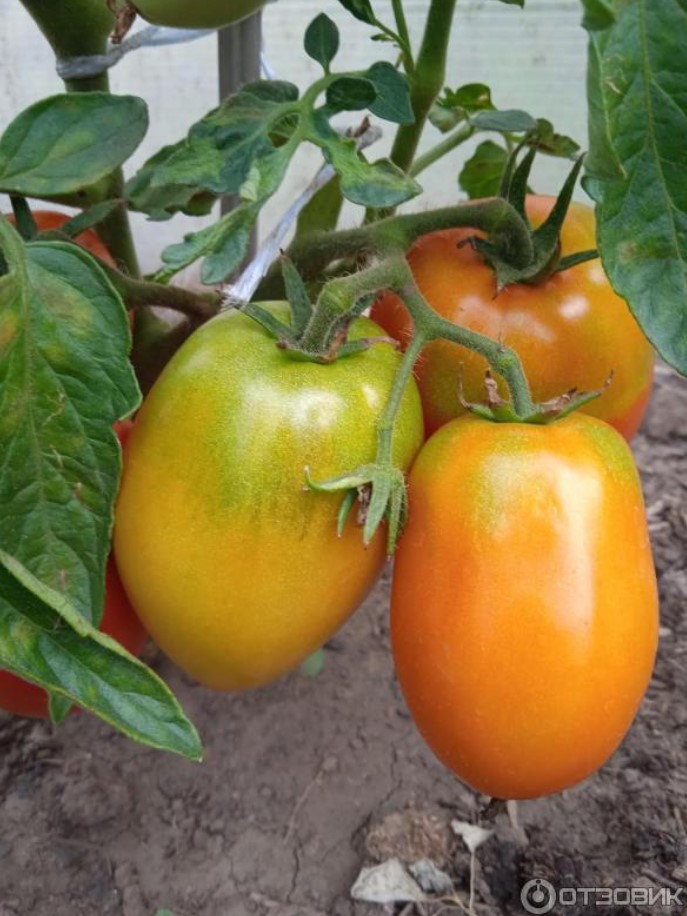
I've been planting Buyan (Fighter) for over 10 years and am always very happy with it! I grow it exclusively in the open ground, as it's a low-growing, determinate variety. It's one of the first to ripen. The fruits are very tasty, good both in salads and for whole-fruit canning. I only pinch them to the first cluster, then I leave the side shoots. It can be grown without staking, but I can't do that; I have to staking it, otherwise the stems can break under the weight of the fruit. There are red and yellow Buyan varieties. I plant both; the only difference is the fruit color.
I grew 'Sakharny Pudovichok', 'French Grapevine', 'Eagle's Heart', 'King of Early', 'Pride of Siberia', 'EM-Champion', and 'Klondike'. These are very good varieties; I plant them almost every year. This year, I planted 'Vida-Nevidimo' and 'Fat Jack' for the first time. I was pleasantly surprised by the number of clusters and the fruit set. 'Fat Jack' even has very large fruit!
I planted a Boets (Buyan) tomato, a superb tomato. I had one plant both in the greenhouse and in the ground. It's very productive, fleshy, and delicious, and won't be tough when canned. During the cold we had in June and the rain, I didn't cover it at all for three weeks, and it ripened equally well in both places, even though we harvested a lot.
Fighter (Buyan) red - description from the Sibsad pack:
This early-ripening, popular (98-100 days) Siberian variety is suitable for open ground and plastic shelters, with a growing season of 98-100 days. The bush grows as a standard, low, 42-48 cm tall. No side shoots or staking are required. The fruits are cylindrical, smooth, and large (the first fruits weigh up to 180 g, the subsequent ones 67-88 g), ripening quickly. The ripe fruit is red. Suitable for all-purpose use. The variety is drought-tolerant, resistant to TMV, and moderately resistant to bacterial diseases.
Overall, the variety matches the description. The only exception is that the fruits (including the first ones) are smaller, weighing less than 180 grams.
An unpretentious little bush that grows well in Siberia. A hard-working variety.The yellow Buyan variety's fruits seemed larger. The fruits are fleshy and few-seeded. They're suitable for salads, pickling, and drying.
Variety Fighter (Buyan) yellow
Information from the State Register of Variety Species:
Included in the register for the West Siberian (10) region for cultivation in open ground on private farms. Salad variety. Mid-season. The plant is a standard, determinate variety. The leaves are medium-sized, dark green. The inflorescence is of an intermediate type. The peduncle is articulated.
The fruit is cylindrical, smooth, and medium-dense. Unripe fruit is green with a small dark spot near the stalk; ripe fruit is yellow. There are 4-6 lobes. Fruit weight ranges from 60-120 g (up to 148 g). The flavor is good to excellent. The juice dry matter content is 4.0-4.6%, and the total sugar content is 2.1-3.3%.
The yield of marketable fruits ranges from 163 to 494 centners per hectare, while the Demidov and Sibirsky Skorospelny varieties yield 194 to 402 centners per hectare. Marketable fruit yield ranges from 69 to 86%. The variety is tolerant of adverse weather conditions. Fruit ripens well.
Description from a pack of Agros (Novosibirsk):
This early-ripening variety is easy to grow. The bush is standard and compact. The fruits are large (up to 180 g), lemon-yellow, oval-elongated, and versatile. Advantages: early maturity, high yield, and does not stretch when seedlings. Recommended for outdoor cultivation. Growing Tips: The plant does not require shaping or support, making it easy to grow.
I really liked this variety! It's small in stature, but the fruits are surprisingly large. Lemon-yellow, fleshy, and firm. Almost seedless! Suitable for salads, pickling, and drying. The fruits are easy to transport and keep well.
Compared to the two Buyans, the yellow one produces larger fruits and is more productive.
The Buyans are low, 30-40 cm if grown in open ground.They do not stretch out in seedlings.
Theoretically, you don’t have to tie them up, but I tie everything up, even the little ones, because cruciferous flea beetles are rampant when we plant the seedlings and they eat the leaves of the tomatoes.
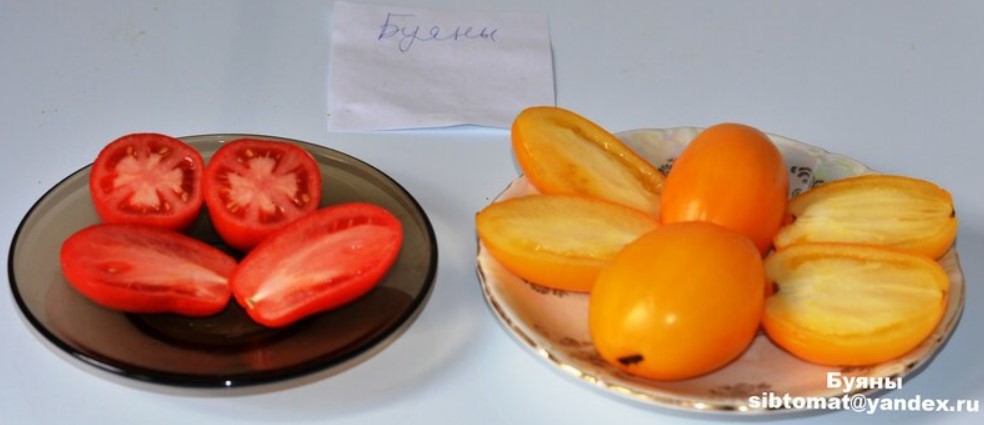
They're not that short. I've grown both yellow and red Buyans (Fighters) to 50-60 cm. They're delicious, sweet and tart, with a pleasant tomato aroma. They're great for jars, salads, or just "live" with fried potatoes. But this year, cutworms ate them (even though I had tomato varieties Orlik, Novato, Summit, and Novichok growing nearby—for some reason, the cutworms didn't touch them). A typhoon on August 20-22 knocked over and broke the Fighters, including their stakes. Two of the eight bushes of this variety (four yellow, four red) never recovered.
I grew it in the summer of 2014. I chose this variety on the advice of a colleague, as it is completely unpretentious.
Confirmed 200%.
It grew like a potato))) in a field, covered in weeds, without any side shoots or tying. I watered it with cold water from a well. It's worth noting that the summer of 2014 in Chelyabinsk was cold and rainy... ultimately, despite my limited experience, it produced fruit beautifully. We ate it in salads and pickled it.
I think with proper care it will yield a good harvest. The bush's appearance reminded me of Petrusha the gardener.
A wonderful variety for open ground in risky farming zones. I bought it again.
This year it was the first one to ripen for me; I sowed it at the end of March. The bush is really small.
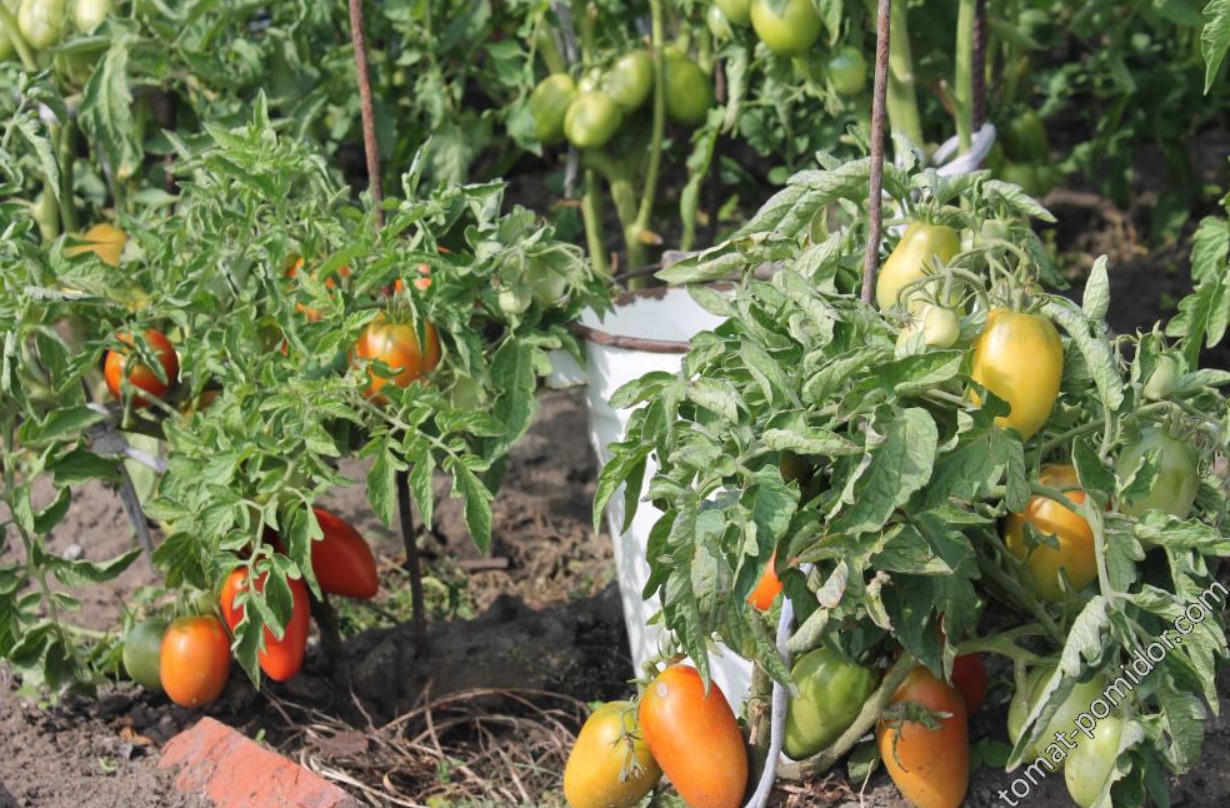
Yellow Buyan pastila this year. Memes from Aelita, from this pack:
Like all the other fruits, I grew them in open ground. I didn't cover them with anything. The bushes are about 60 centimeters tall. They seem to be productive. The taste wasn't impressive. I also didn't like the color inside—not yellow, kind of whitish. The outside is a beautiful color. I don't have any photos of the fully ripe fruits.
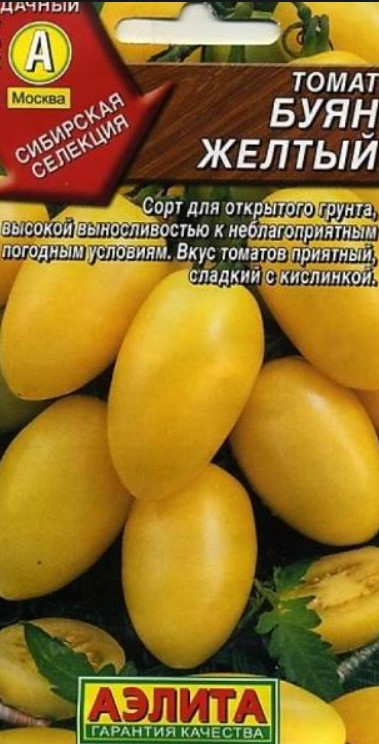
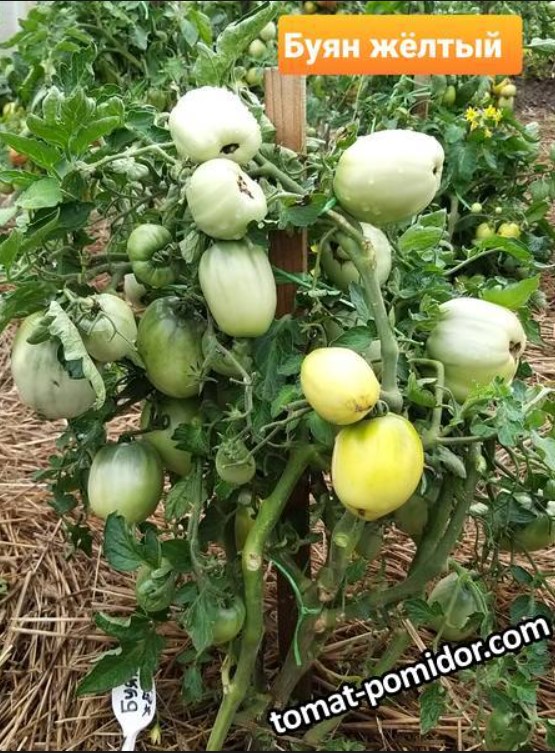
This is our second year planting Yellow Buyan. Last year, we planted a few bushes as a trial. This season, we've planted the entire bed:
Advantages: The seedlings don't stretch. They are all practically the same height. The bush grows low and doesn't need side shoots. The fruits aren't large, but there are many of them on the plant. The tomatoes ripen evenly. This, in my opinion, is the variety's main drawback, as the growing season is quite short. This variety grows well both outdoors and under plastic cover. We grow the tomatoes in a greenhouse until the end of June, then remove the plastic cover.
Buyan has excellent flavor. The fruits are suitable for both salads and canning.
I recommend this variety to all gardeners, you won’t regret it.