Riviera potatoes are beloved by gardeners for their early ripening and excellent shelf life. Furthermore, the tubers have a long shelf life, allowing for harvesting even in winter.
Content
- 1 Table with characteristics of the Riviera potato variety
- 2 The origins of the Riviera potato variety
- 3 Description of the Riviera potato variety
- 4 Advantages and disadvantages of the Riviera potato variety
- 5 Planting Features of the Riviera Potato Variety
- 6 Caring for the Riviera potato variety
- 7 Protection from diseases and pests
- 8 Harvesting and storing the Riviera potato variety
- 9 Top.tomathouse.com's tips on growing the Riviera potato variety
- 10 Comparison of the Riviera potato variety with other varieties in the table
- 11 Reviews of the Riviera potato variety
Table with characteristics of the Riviera potato variety
| Characteristic | An early variety of table potato |
| General information | An early-ripening potato variety with not very tall bushes and medium-spreading shoots. |
| Ripening time | 55-65 days |
| Productivity | 189-366 c/ha |
| Marketability | 80-96% |
| Shelf life | 94% |
| Starch concentration | 11.5-15.9% |
| Color of pulp | Cream |
| Peel color | Light beige |
| Weight of commercial tubers | 101-177 BC |
| Number of tubers per bush, pcs. | 7-12 pcs. |
| Taste characteristics | Pleasant taste |
| Class and purpose in cooking | Culinary type B, intended for table use |
| Suitable regions for growing | Central, Lower Volga, North Caucasian |
| Disease resistance | Susceptible to leaf blight and occasionally tuber blight. Resistant to viruses, canker, golden nematode, and stripe mosaic. |
| Growing specifics | Prefers light soil, is drought-resistant, and requires more nitrogen than other varieties. |
| 2013 | |
| Country of origin | Netherlands |
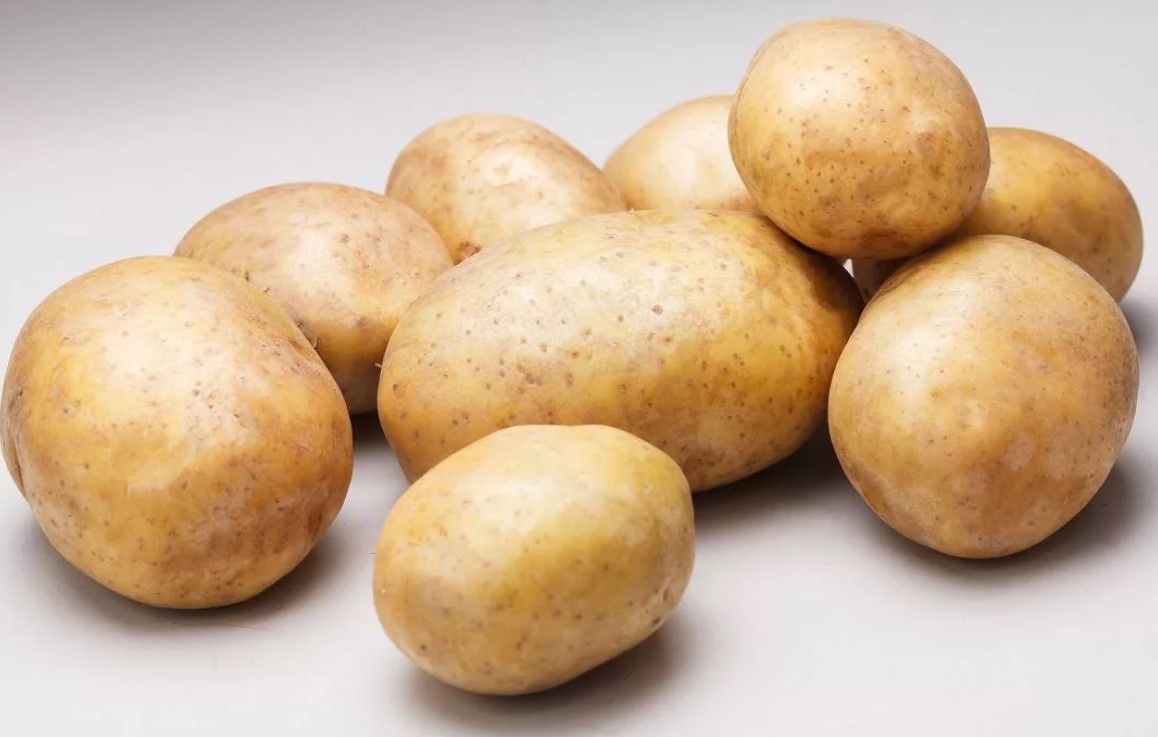
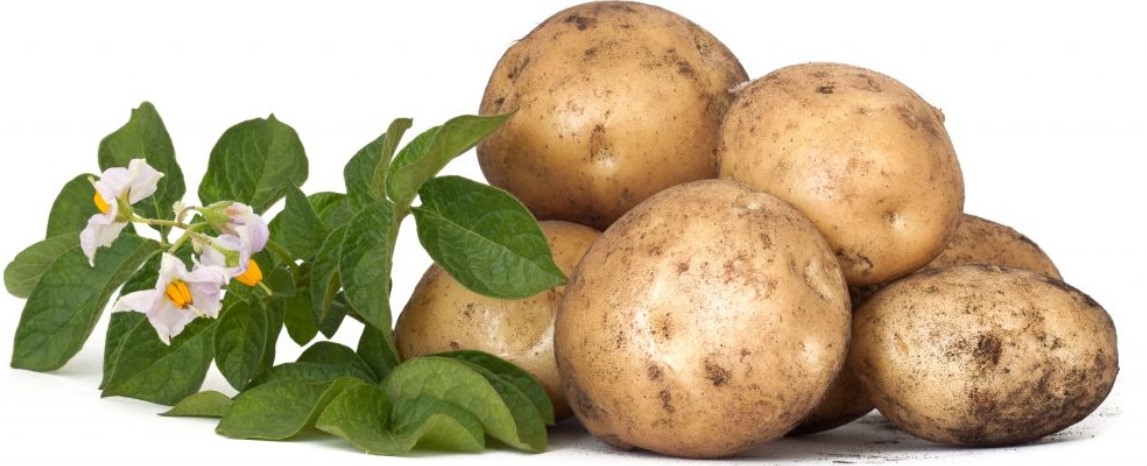
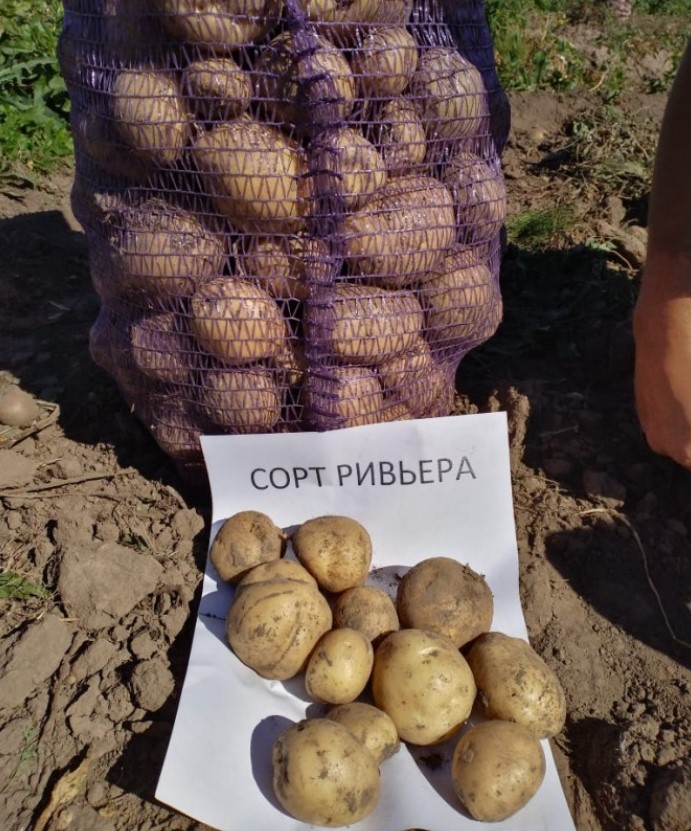
Photo gallery of the Riviera potato variety
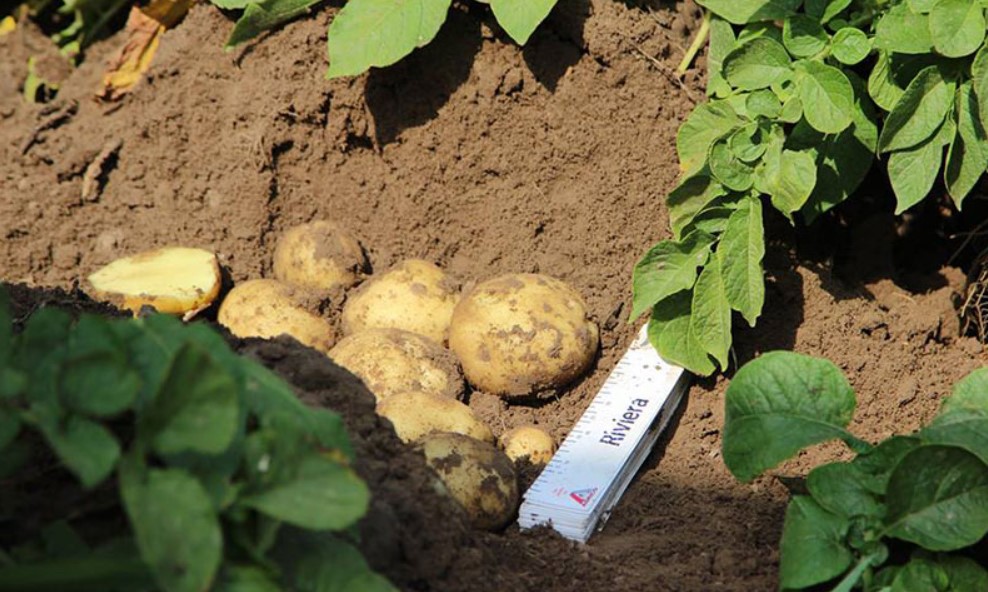
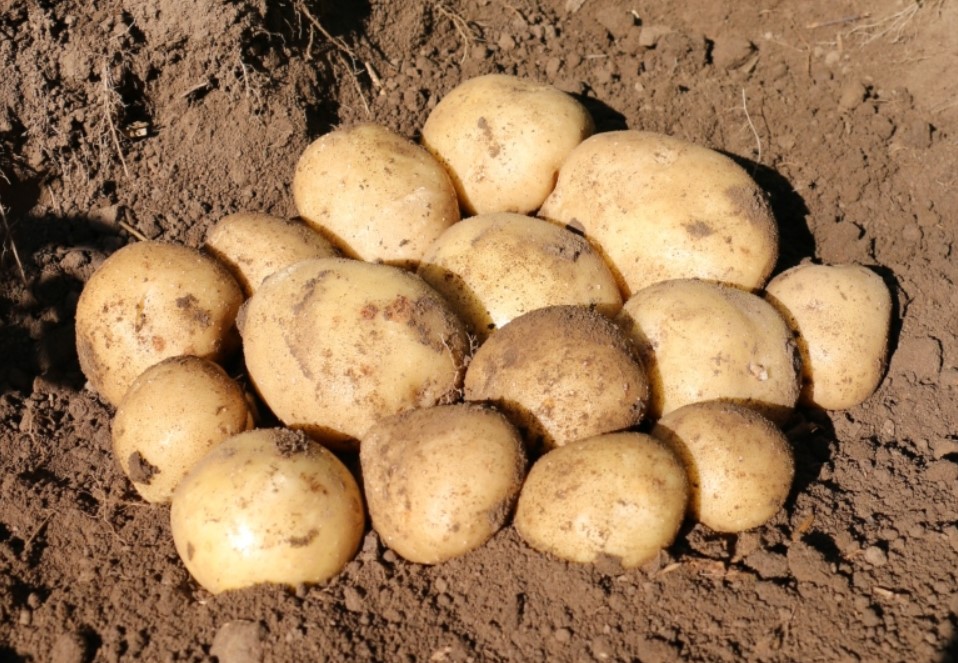
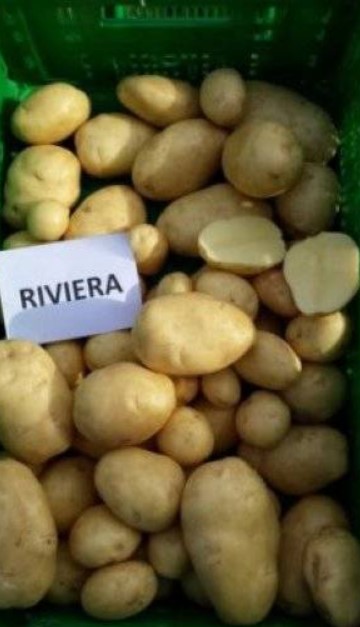
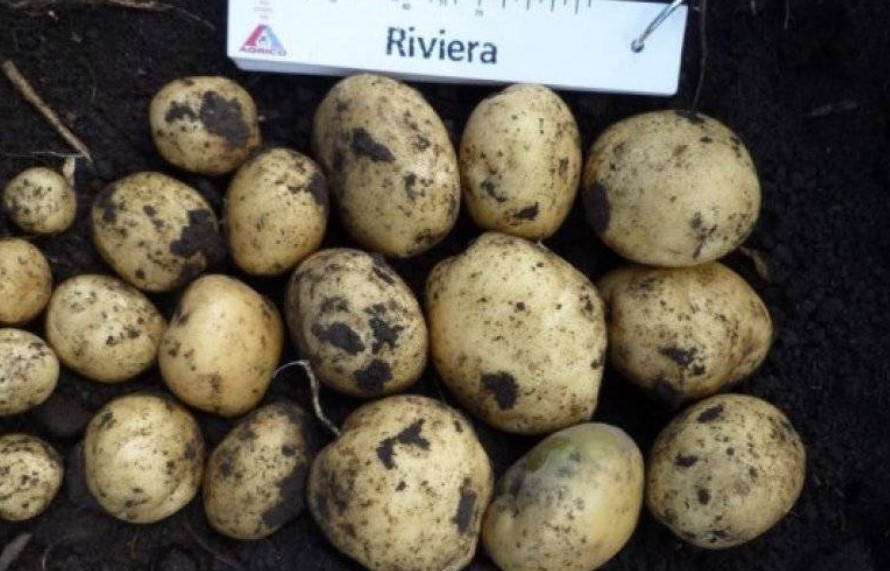
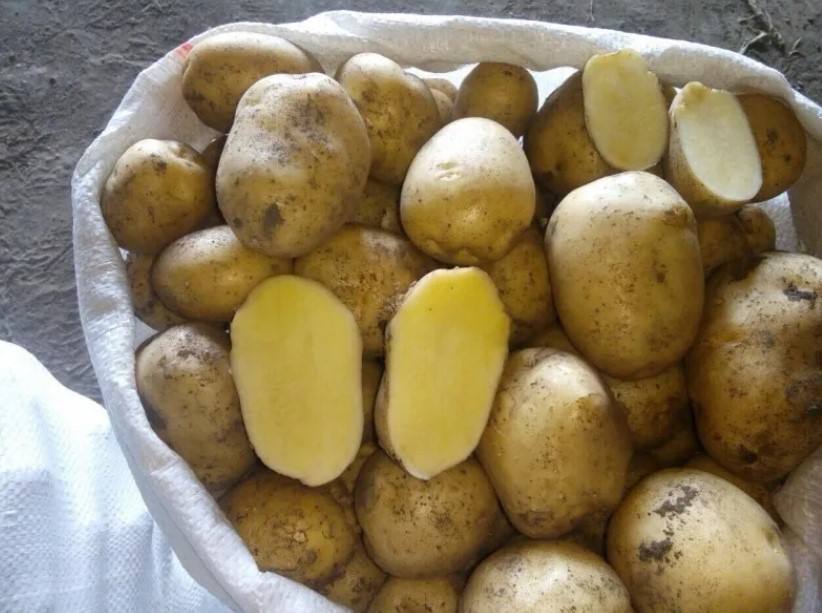
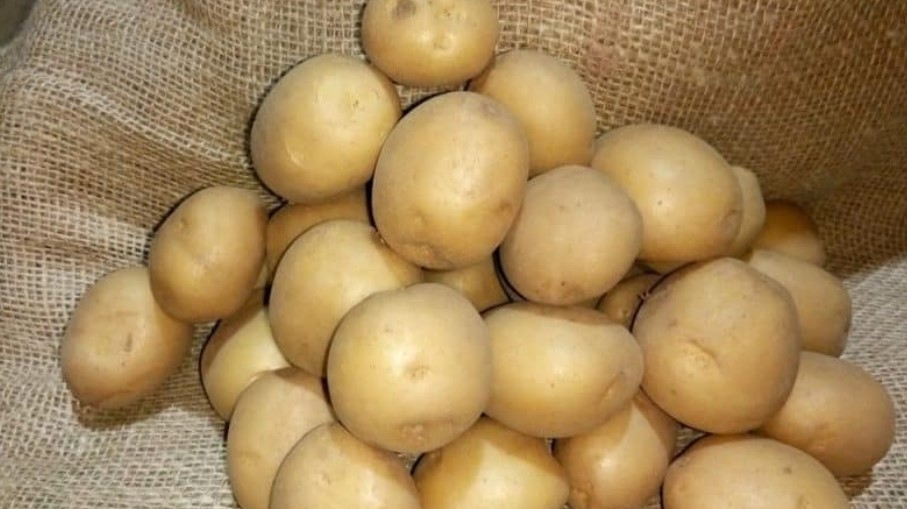
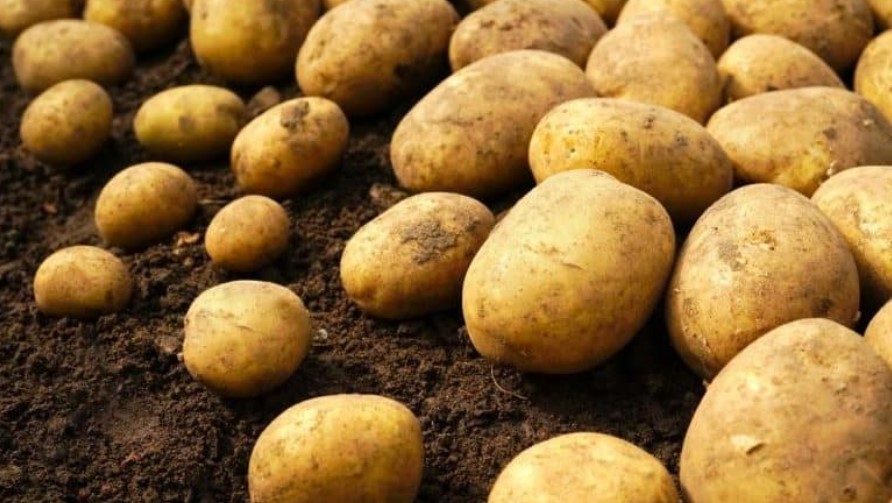
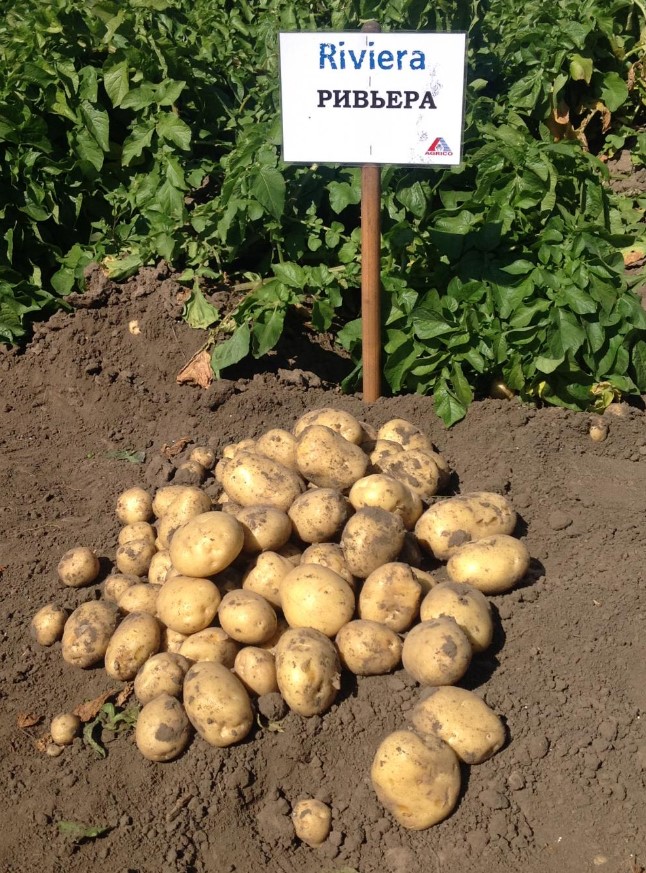
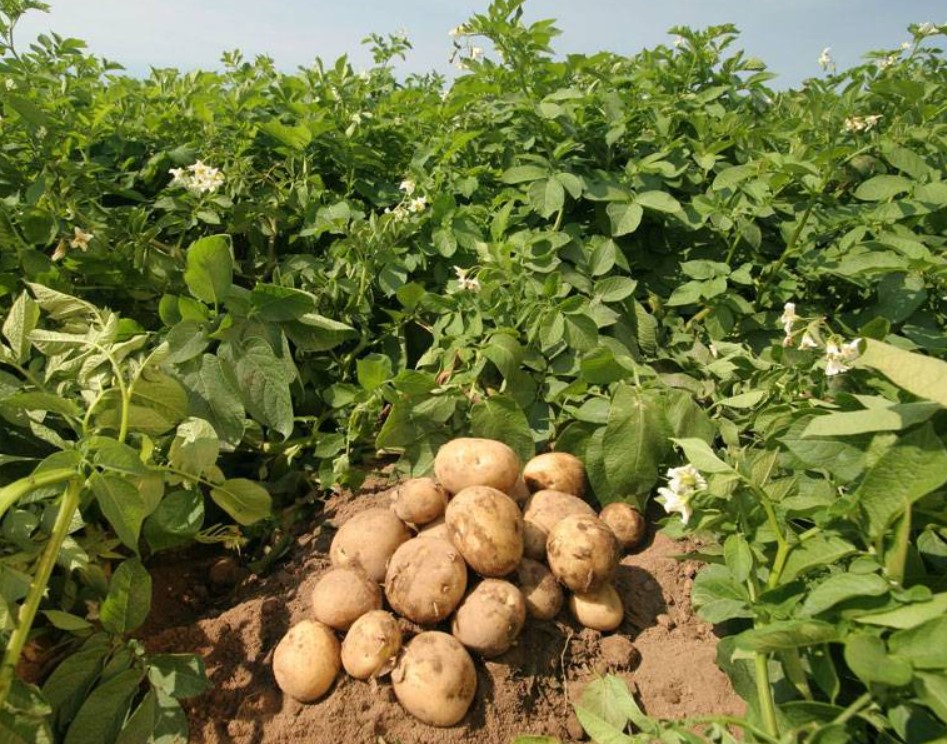
The origins of the Riviera potato variety
The Riviera potato is the work of Dutch breeders who crossed two successful varieties, Minerva and Alkmaria. This variety appeared in Russia relatively recently; in 2013, it was recognized and registered for cultivation in the Central, Lower Volga, North Caucasus, and Central Black Earth regions.
Description of the Riviera potato variety
Riviera is not a capricious potato variety; it ripens quite early, but at the same time its marketability and shelf life are relatively high.
Bushes
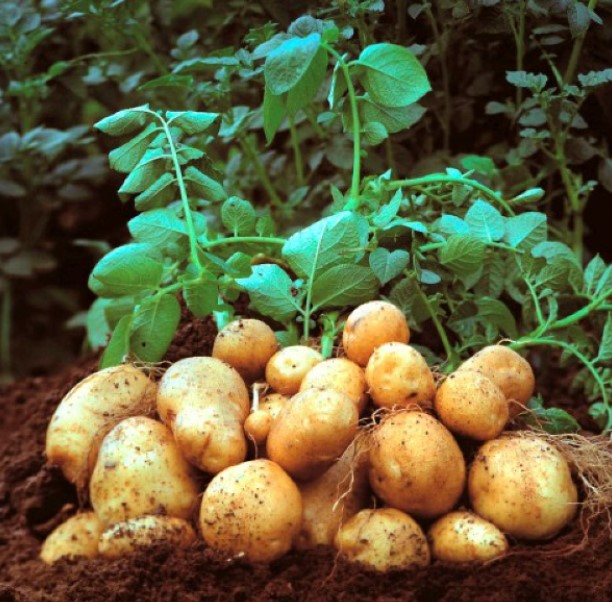
The bushes are medium-sized. The shoots reach 75-90 cm in height, and are upright or spreading with large, light-green leaves. The root system is well developed, so vegetative mass accumulates very quickly. Each bush produces 7 to 12 root vegetables.
Tubers
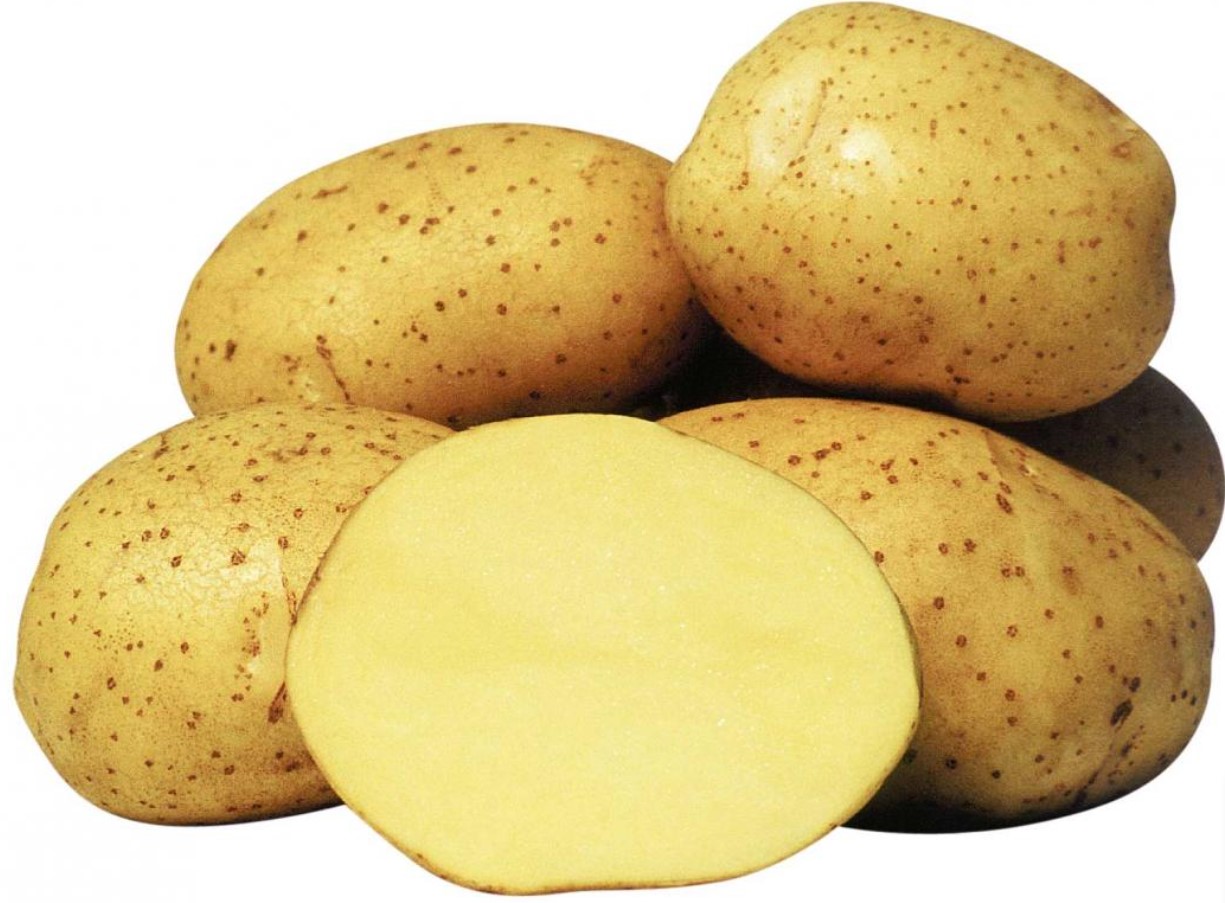
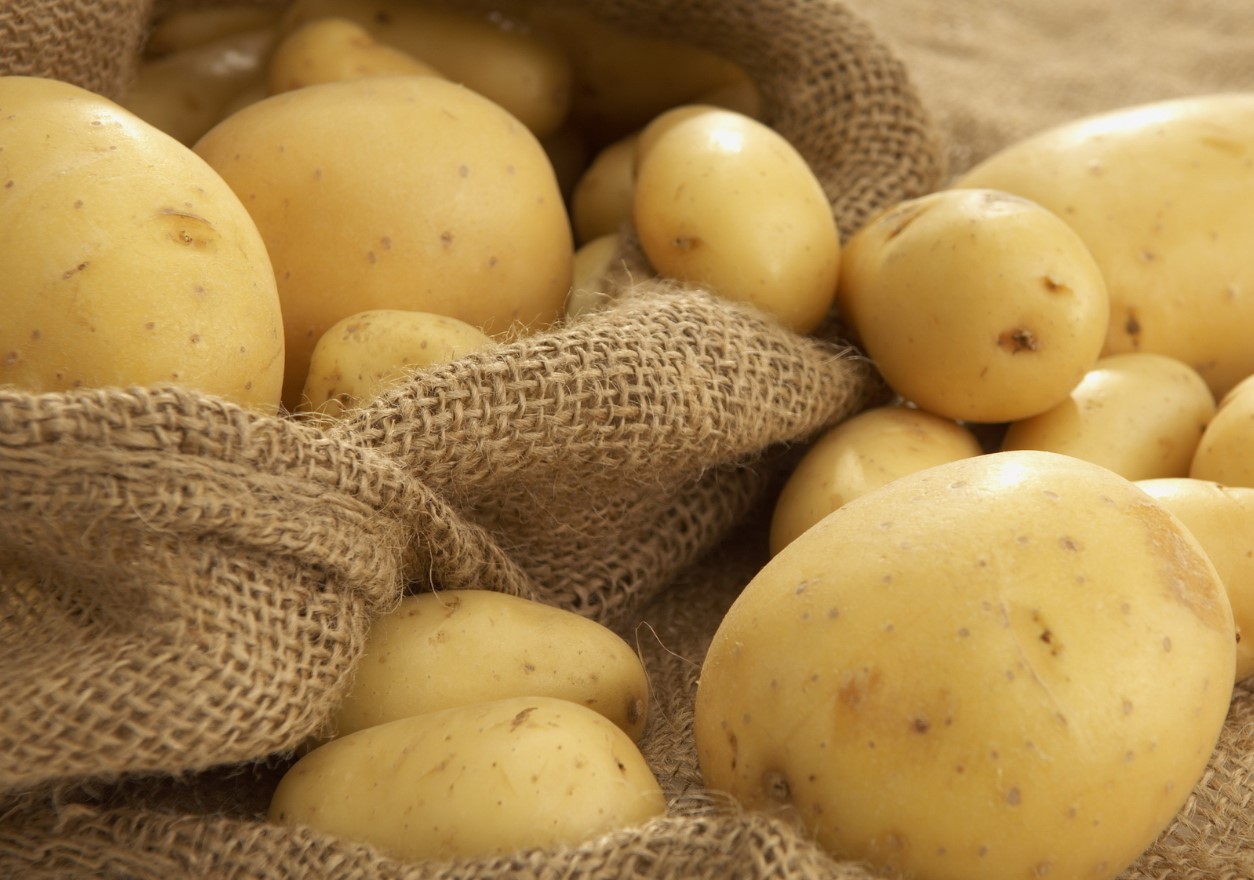
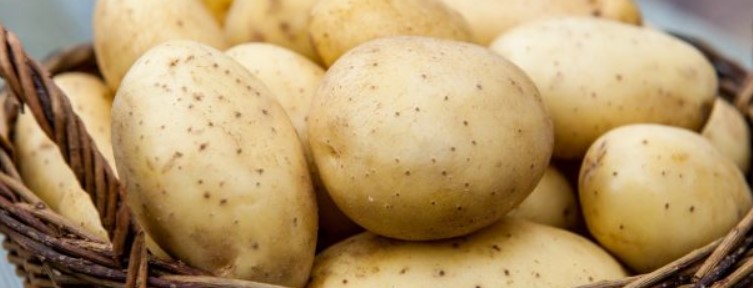
The tubers are oval-round, weighing from 101 to 180 g. The skin is smooth, the eyes are small, widely spaced, and shallow. The color is light beige, and the flesh is creamy.
Nutrients and nutritional value
The potato flesh has a delicate, creamy consistency, and due to its low starch content (less than 16%), Riviera can be used in dietary menus.
Consumers rated the taste at 4.8 points out of 5 possible.
Productivity, ripening time
The Riviera potato yield ranges from 190 to 370 kg per 100 square meters. The final yield depends on the specific region: the cooler and rainier the summer, the lower the yield.
Resistance to diseases and pests
The Riviera variety boasts a fairly robust immunity. Resistance indicators to major potato diseases are listed below.
| Name | Stability indicator |
| Virus (PVY) Y | High |
| Potato cancer | High |
| Golden nematode | High |
| Striped mosaic | High |
| Tuber blight | Average |
| Leaf blight | Low |
For which regions is the Riviera potato variety suitable?
The Riviera potato variety is intended for cultivation in the Central, Lower Volga, North Caucasus and Central Black Earth regions.
Advantages and disadvantages of the Riviera potato variety
| Advantages | Flaws |
|
|
Planting Features of the Riviera Potato Variety
The Riviera variety is easy to grow; simply prepare the planting material properly, choose a suitable location, and provide proper care.
Requirements for the landing site and its preparation
Riviera potatoes prefer well-lit areas with full sunlight. The soil should be light, so if you have loamy soil, you may need to add sand.
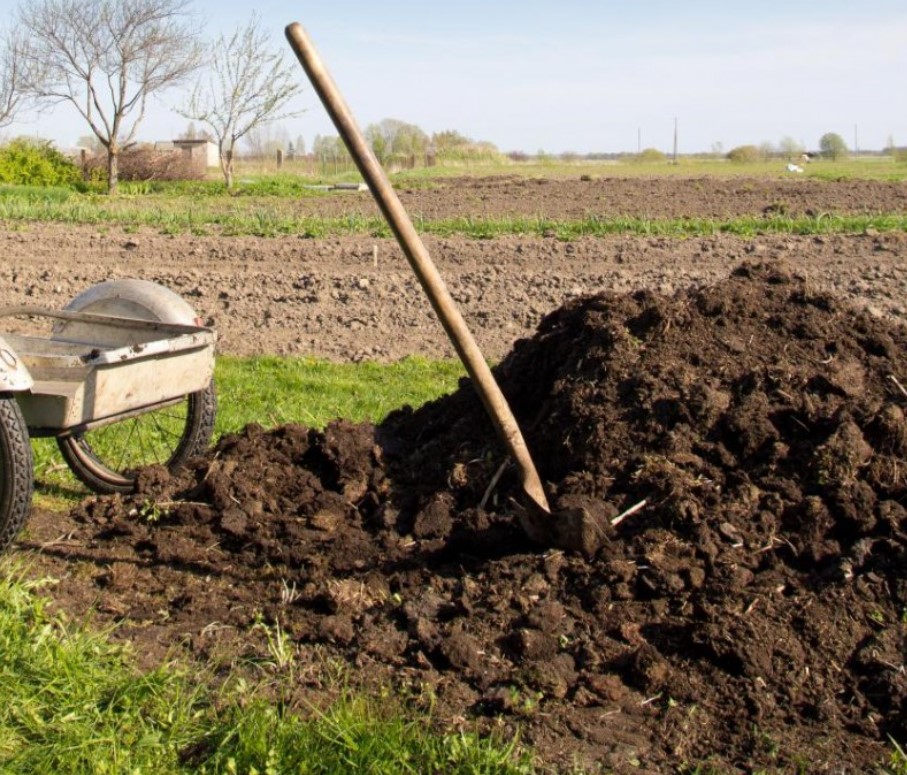
In the fall, the planting site is plowed with organic fertilizer, such as manure, at a rate of 10 kg per square meter. In the spring, all that remains is to dig the bed, add dolomite flour, and plant the potatoes.
Selection and preparation of seed tubers
For planting, select healthy tubers without visible damage. To speed up germination, sprout them first. To do this, place the potatoes in boxes and leave them for two weeks in a bright room with a temperature of 12 to 15 degrees Celsius. You can also place the potatoes in bags, poke holes in them, and hang them in the light, but protect them from direct sunlight. The greenhouse effect will cause sprouts to emerge even faster.
Growing from seeds
When potatoes are used for about 5 years, their yield decreases.
In such cases, you can grow new planting material from seeds. This is done as follows:
- Small pots are filled with a soil mixture of 1 part soil and 4 parts peat.
- Pre-sprouted seeds are placed to a depth of 1 cm, covered with soil and sprayed.
- The containers are covered with film and placed in a warm, light place.
- The plantings are ventilated and watered periodically.
- After 10 days, seedlings will begin to actively emerge, then you can remove the cover and provide uniform lighting.
- The grown seedlings are hardened off by taking them outside for a short period of time, and then gradually increasing the time.
More details about growing potato seedlings from seeds You can find out on our website.
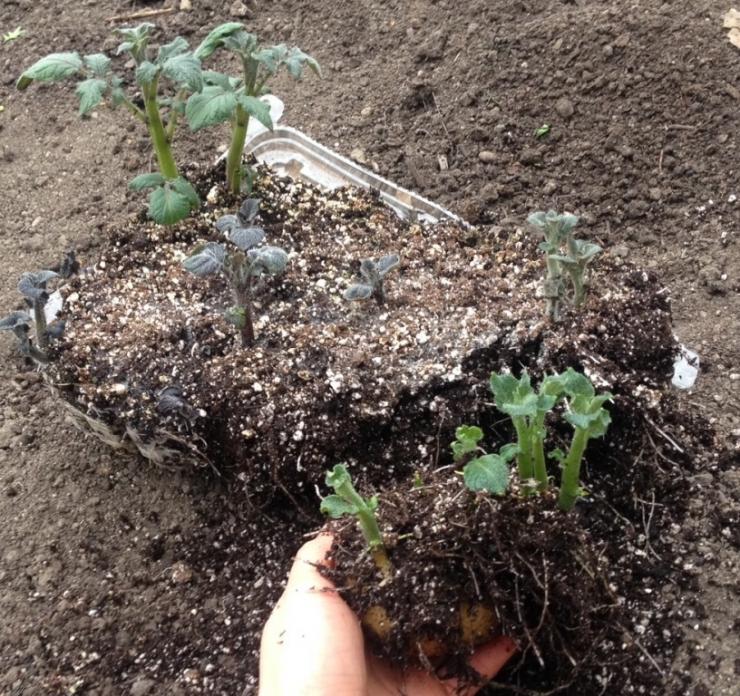
Once the weather forecast indicates the danger of frost has passed, potatoes can be planted in the garden. It is recommended to add 300 grams of compost to each hole before planting. Plants should be planted deep enough to leave three leaves above the surface. Initially, the plants should be covered with agrofibre to protect them from the sun and inclement weather. Watering should be done every other day at first, then reduce the amount.
Planting times and rules
In good weather conditions, you can begin planting Riviera potatoes as early as mid-April. However, it's important to ensure the soil warms up to 9 degrees Celsius (49 degrees Fahrenheit). A popular belief holds that the best time to plant is when the birch tree's leaves are the size of a nickel.
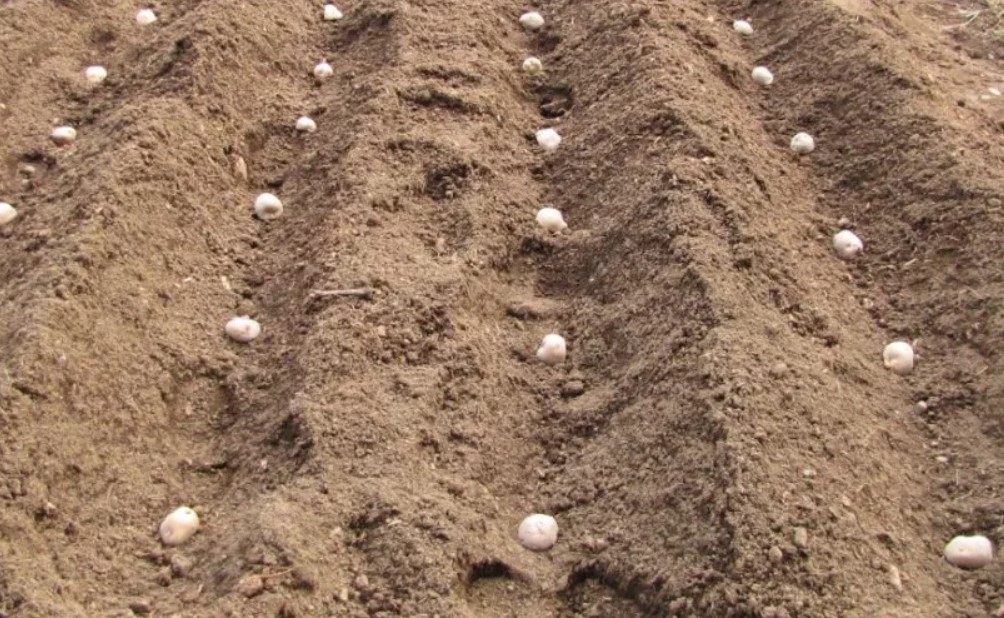
To ensure even and neat rows, mark them using a string and two pegs. Dig holes about 10 cm deep along this line. It's best to stagger them, leaving 35-40 cm between them. The distance between rows should be at least 65 cm.
A handful of ash and humus is thrown into each hole, followed by a tuber. This is then covered with soil. The soil in the hole is watered beforehand.
Caring for the Riviera potato variety
The Riviera variety doesn't require any special care. If you follow the correct watering schedule, remove weeds, hill up, and control pests, the harvest will be excellent.
Watering
Riviera is a drought-resistant potato variety and doesn't require much watering. The soil only needs to be watered during periods of severe drought.
The first watering of potatoes should be done 14 days after germination. The recommended rate per plant is 3 liters. It's best to water with a watering can rather than a hose to avoid disturbing the root system.
The second time, the plants are watered is during the budding stage. If the weather is rainy, additional watering is naturally not necessary.
Top dressing
Potatoes are fertilized during bush formation. You can use a mineral fertilizer consisting of 20 g of superphosphate, 10 g of sodium chloride, and 10 g of urea per square meter.
Riviera requires more nitrogen than other varieties, so at the initial stage it is recommended to use organic fertilizers made from diluted bird droppings.
When flowering comes to an end, you can carry out foliar feeding of potatoes with superphosphate (100 g per 10 l).
Loosening, weeding
To reduce the risk of pest infestation, weeding is necessary. This is done in conjunction with loosening the soil. This should be done carefully to avoid damaging the potato roots.
Hilling
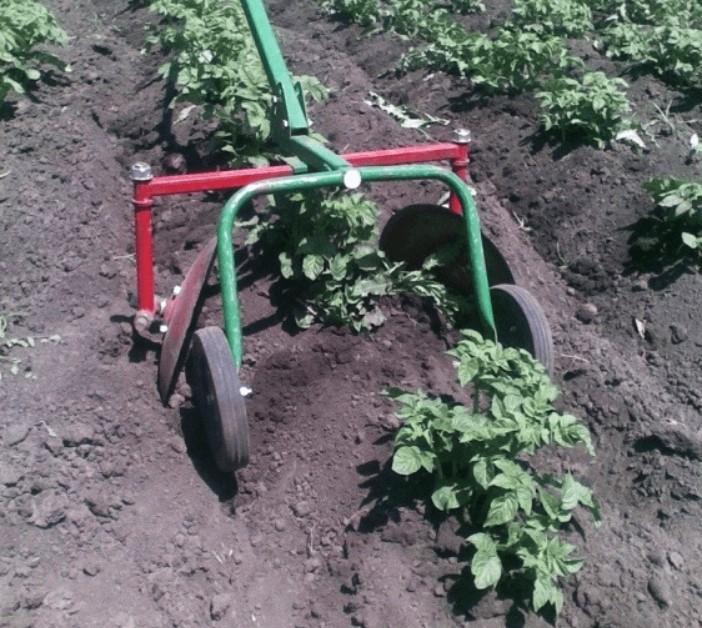
Two hilling operations are carried out during one season:
- The stem is covered with soil for the first time after the shoots reach a height of 15 cm.
- The second hilling is repeated after 2 weeks, before flowering begins.
Protection from diseases and pests
The table below describes the main potato diseases and methods of controlling them.
| Disease, pest | Characteristic | Prevention and treatment |
| Late blight | Dark spots appear on the leaves and stems. The flesh of the tubers turns brown. Gray dents appear on the surface. | To prevent the disease, spray the bushes with a copper sulfate solution at a rate of 10 g per 10 liters of water. At the first signs of the disease, treat with a 0.5% copper oxychloride solution. |
| Macrosporiosis | The base of the stem rots, the leaves dry out and curl. The tubers begin to darken and emit an unpleasant odor. | The disease is incurable; affected bushes are uprooted and destroyed. To prevent infection, spray the plantings with a copper sulfate solution (10 g per 10 liters of water). |
| Colorado beetle | Orange eggs appear on the leaves, and all the pulp from the leaves is eaten away. | A small number of individuals can be collected manually, but if the affected area is large, then only treatment with specialized preparations, such as Aktara, Batsikol, etc., is suitable. |
| Wireworm | Numerous passages eaten by larvae appear in the tubers. | As a preventative measure, the soil is treated before planting potatoes. Wireworm control products such as Decis and Actellic are used. |
| Mole cricket | Numerous tunnels can be seen in the beds. The bushes are dying. | In the fall, deep soil digging is necessary. If mole crickets appear, the area should be treated with Medvetox at a rate of 2 g per square meter. |
| Potato moth | Prefers to gnaw at the base of plants and can also damage tubers. | Regular weeding and thorough soil tillage serve as preventative measures. Agrovertin or Fitoverm are used to control the pest. |
| Potato moth | Leaves gnawed holes on tubers, and eggs appear on the leaves. | Affected bushes are treated with a 1% solution of Bitoxibacillin or Lepidocid. |
Harvesting and storing the Riviera potato variety
Experienced gardeners recommend removing all the tops 14 days before harvesting to ensure all the plants' energy is devoted to ripening the tubers. Potatoes that will be used as seed are left in the sun to improve germination.
The harvest must be sorted, which results in the removal of damaged or rotten tubers.
Find out, when to dig up potatoes, What tools can be used to do this quickly?, and also, as How to properly store tubers until spring.
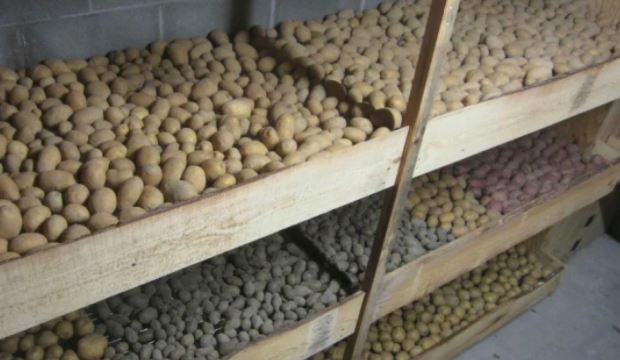
The potatoes that will be used for food are dried under a canopy, placed in bags and stored in a room with a temperature of 2-4 degrees Celsius.
Top.tomathouse.com's tips on growing the Riviera potato variety
To get a good harvest of the Riviera potato variety, you need to follow several important tips:
- Avoid rocky soil for growing. It will cause the tubers to become deformed and take a long time to develop.
- To reduce the risk of late blight, plant garlic and onions nearby.
- Follow crop rotation rules, do not plant potatoes in the same place for more than 3 years in a row.
- Coriander, beans, nasturtium, and tansy planted between rows will help repel the Colorado potato beetle.
- Small tubers weighing up to 30 g should be planted in a hole, 2-3 pieces at a time.
Comparison of the Riviera potato variety with other varieties in the table
| Variety | Ripening period (number of days to maturity) | Starch (%) | Yield (c/ha) | Weight of tubers (g)
Number of tubers per bush Color of tuber, pulp |
Shelf life (%) |
| Riviera | Early ripening* | 11.5-15.9 | 189-366 | 101-177
11-12 light beige, cream |
94 |
| Lorkh | Mid-late**** | 15-20 | 250-350 | 90-120
9-11 light beige, white |
88-92 |
| White Night | Mid-early** | 10.9-16.9 | 250 | 120-215
up to 12 light, creamy |
90 |
| Meteor | Early ripening* | 10-16 | 210-405 | 100-150
10-12 cream, light yellow |
95 |
| Nevsky | Mid-early** | 10-12 | 380-500 | 90-130
12-15 beige, white |
91-96 |
| Strongman | Mid-early** | 10-12 | 127-275 | 78-105
15-20 yellow, cream |
97 |
| Nikulinsky | Mid-late**** | 12.5-21.3 | 170-410 | 70-135
12 beige, cream |
95 |
| Armada | Early ripening* | 17-18 | 230-370 | 96-130
9-14 beige-yellow, light yellow |
80-85 |
| Giant | Mid-season*** | 15.9-18.9 | 290-424 | 104-143
8-13 light beige, cream |
97 |
| Assol | Early ripening* | 12-16 | up to 345 | 80-120
8-12 light yellow, cream |
92 |
| Innovator | Mid-early** | 12-15 | 320-344 | 83-147
6-11 creamy, soft yellow |
94 |
| Zekura | Mid-early** | 13-18 | 350-370 | 60-150
12-20 sandy, light yellow |
98 |
| Vega | Mid-early** | 10-16 | 230-380 | 90-120
8-12 yellow, light yellow |
99 |
*Early ripening – 50-65 days.
**Mid-early – 65-80 days.
***Mid-season – 80-95 days.
****Mid-late – 95-110 days.
Reviews of the Riviera potato variety
Riviera potatoes are excellent for their early ripening, and by mid-summer you can enjoy the taste of homegrown potatoes. They have excellent shelf life, so they can be stored for a long time without losing their quality.
Good afternoon
If we compare the characteristics of the Colomba (HZHC Sadokas website) and Riviera (Agrico Eurasia website) varieties, then in terms of resistance to the main diseases, both varieties are almost identical.
The Riviera variety's advantages include drought resistance and a long dormancy period (according to the originator). However, it mostly depends on storage conditions (I picked up Colomba from Valmix at the end of March and there was no sign of sprouting).
I don't think the forum participants grow potatoes in large areas, but I'm sure watering a furrow or two of early potatoes in their favorite plot won't be difficult.
As for taste, until you grow it in your own garden and try it, all other assessments will be subjective.
It's no wonder many people are looking for the Adretta variety, although it has plenty of drawbacks (mine is severely affected by common scab, and it's also susceptible to late blight). Original seeds are almost impossible to find, but it's considered the standard of taste.
Farmers in Ukraine and southern Russia have moved to the Riviera.
A friend of mine from our area also grew Colombo, but two years ago he planted Riviera and decided to give up Colombo entirely. The only thing is, when he planted Riviera the first year, he was very surprised that it didn't bloom, even though there were already large potatoes under the bushes within 50 days. It's better than Colombo in both taste and disease resistance. I'll plant both varieties and see which is better; I'm used to testing things myself.
I have already written in my reviews that I keep over a dozen varieties to take into account the characteristics of different climatic conditions.
The Riviera variety is a mid-early variety with yellow-skinned tubers and yellow flesh. It ripens moderately.A key feature is the need to strictly control moisture levels during tuber formation. In dry weather, the variety tends to produce no more than 5-7 tubers. While they will be large, they won't yield 2 kg per plant (which, in my opinion, is the minimum yield benchmark for any gardener).
So, we wait for the rudimentary flower stalk to appear, monitor the weather, and, if necessary, scoop into the bed with a trowel to check the moisture level at a depth of 15 centimeters. Then, water! At least 30 liters per square meter. Wait a day or two and then loosen or hill up the soil. This is how we'll achieve a production of 15-17 tubers.
Please note that this variety is highly susceptible to late blight in the Moscow region. Therefore, don't forget to treat it with phytosporin. I use whey, which I have in abundance.